



If you are wondering where to find free courses online, you have more credible options in 2026 than ever before. Universities, technology companies, nonprofits, government-backed education platforms, and professional training providers now offer free learning in artificial intelligence, programming, cybersecurity, business, mathematics, marketing, science, languages, and many other subjects.
The challenge is no longer finding something labeled “free.” The real challenge is figuring out what is actually included. One platform may let you complete the full course and earn a certificate without paying. Another may provide the lessons for free but charge for the certificate. A third may offer only a preview, audit track, free trial, financial-aid route, or library-sponsored access.
This guide compares 17 of the best sites for free online courses in 2026, explains what each platform actually gives you for free, and helps you choose the best option based on your learning or career goal.
Quick Answer: Where to Find Free Courses Online
Some of the best places to find free courses online in 2026 are:
- MIT OpenCourseWare
- edX
- Coursera
- Harvard Free Courses
- Khan Academy
- OpenLearn
- Saylor University
- freeCodeCamp
- IBM SkillsBuild
- Microsoft Learn
- Cisco Networking Academy
- Google Skillshop
- HubSpot Academy
- AWS Skill Builder
- Alison
- SWAYAM
- Open Yale Courses
For university-level learning, start with MIT OpenCourseWare, OpenLearn, Harvard, edX, or Open Yale Courses. For career and technology skills, consider freeCodeCamp, IBM SkillsBuild, Microsoft Learn, Cisco Networking Academy, AWS Skill Builder, HubSpot Academy, and Google Skillshop.
If your priority is a free certificate, look closely at Saylor University, HubSpot Academy, IBM SkillsBuild, eligible freeCodeCamp certifications, OpenLearn, and selected Harvard CS50 courses.
Always check the individual course page before enrolling because free-access rules, certificates, examination fees, and subscription policies can change.
Key Takeaways
If you’re deciding where to find free courses online, the key is to compare access, certificate rules, course quality, and how well each platform matches your goal.
- MIT OpenCourseWare provides access to materials from more than 2,500 MIT courses without tuition or enrollment, but does not award MIT credit or certificates.
- edX offers free audit access for many courses, while verified certificates generally require payment.
- Coursera’s free-access model varies by course and may include previews, trials, selected free content, or financial aid.
- OpenLearn provides approximately 1,000 free courses, with free Statements of Participation and digital badges on selected courses.
- Saylor University provides free self-paced courses and free standard course-completion certificates.
- IBM SkillsBuild offers free learning in AI, cybersecurity, data, and professional skills, with digital credentials available on eligible pathways.
- HubSpot Academy provides free professional training and many free marketing and sales certifications.
- Your public library may provide free access to premium learning services such as Gale Presents: Udemy or LinkedIn Learning.
- A certificate becomes more valuable when you combine it with projects, practical work, or other evidence that you can use the skill.
17 Best Sites for Free Online Courses in 2026
This comparison makes it easier to see where to find free courses online without opening dozens of websites or guessing which platforms are genuinely free.
| # | Platform | Best For | What Is Free? | Certificate |
| 1 | MIT OpenCourseWare | University-level learning | Course materials | No |
| 2 | edX | University MOOCs | Many audit tracks | Usually paid |
| 3 | Coursera | Career and university learning | Varies by course | Usually paid |
| 4 | Harvard Free Courses | University and professional topics | Selected courses | Varies |
| 5 | Khan Academy | School and foundational subjects | Core learning | Not a professional credential |
| 6 | OpenLearn | Flexible university-style learning | Courses | Free participation statement |
| 7 | Saylor University | Academic and professional courses | Courses and completion certificates | Free |
| 8 | freeCodeCamp | Coding and development | Curriculum and eligible certifications | Free |
| 9 | IBM SkillsBuild | AI, cybersecurity and data | Learning and selected credentials | Selected free credentials |
| 10 | Microsoft Learn | Microsoft, Azure and AI | Training | Certification exams separate |
| 11 | Cisco Networking Academy | Cybersecurity, networking and IT | Many self-paced courses | Certification exams may be separate |
| 12 | Google Skillshop | Google Ads and marketing tools | Official training | Eligible certifications |
| 13 | HubSpot Academy | Marketing and sales | Training and many certifications | Free |
| 14 | AWS Skill Builder | Cloud and AI | Many learning resources | AWS exams separate |
| 15 | Alison | Broad vocational learning | Course study | Official certificate usually paid |
| 16 | SWAYAM | Indian academic courses | Course enrollment and study | Proctored certificate exam usually paid |
| 17 | Open Yale Courses | Yale lecture materials | Full published materials | No |
“Free” means something different on each platform. Always confirm the current course page before investing significant time.
Which Free Course Platform Is Best for Your Goal?
| Your Goal | Best Places to Start |
|---|---|
| University-level learning | MIT OCW, OpenLearn, Harvard, edX |
| Coding | freeCodeCamp, Harvard CS50, MIT OCW |
| Artificial intelligence | IBM SkillsBuild, Microsoft Learn, AWS Skill Builder |
| Cybersecurity | Cisco Networking Academy, IBM SkillsBuild, Microsoft Learn |
| Cloud computing | AWS Skill Builder, Microsoft Learn |
| Digital marketing | HubSpot Academy, Google Skillshop |
| Free certificates | Saylor, HubSpot, OpenLearn, IBM SkillsBuild |
| Computer science | Harvard CS50, freeCodeCamp, MIT OCW |
| Mathematics | Khan Academy, MIT OCW |
| School subjects | Khan Academy |
| Business | Saylor, OpenLearn, edX |
| Indian university learning | SWAYAM/NPTEL |
| Humanities | Open Yale Courses, OpenLearn |
| Vocational skills | Alison |
| Compare courses across providers | Class Central |
| Premium courses through a library | Gale Presents: Udemy, LinkedIn Learning |
How We Chose These Free Course Sites
When researching where to find free courses online, we prioritized platforms that provide meaningful learning value rather than simply using “free” as a marketing hook.
A platform did not make this list simply because it uses the word “free.”
Each option was evaluated using practical criteria:
- Meaningful free access — learners should receive real educational value without immediately paying.
- Provider credibility — preference was given to established universities, nonprofits, government initiatives, and major companies.
- Course quality — courses should include useful lessons, projects, assessments, exercises, or clearly defined learning outcomes.
- Pricing transparency — learners should be able to understand what is free and what may require payment.
- Career or academic value — the training should help build useful knowledge or demonstrable skills.
- Current availability — course-access and credential policies were reviewed using current 2026 information.
A platform does not have to provide a free certificate to be valuable. MIT OpenCourseWare is a good example: its academic material is excellent even though it provides no MIT credential.
1. MIT OpenCourseWare — Best for Completely Free University Learning
Engineering, mathematics, computer science, economics, science, and advanced academic subjects
MIT OpenCourseWare, commonly called MIT OCW, is one of the strongest answers to where to find free courses online if you care more about learning than collecting certificates.
MIT publishes materials from more than 2,500 courses across its curriculum.
Resources can include:
- Syllabi
- Lecture notes
- Video lectures
- Reading lists
- Assignments
- Problem sets
- Exams
- Free textbooks
You do not need to apply to MIT, enroll, pay tuition, or follow a fixed schedule.
What Is the Catch?
MIT OpenCourseWare does not provide:
- MIT academic credit
- A degree
- A completion certificate
That makes it ideal for independent learners who want rigorous university material without tuition.
It is particularly strong for subjects where foundational material remains valuable for years, such as calculus, physics, linear algebra, economics, and computer-science theory.
Best choice for: Serious university-level self-study without tuition.
2. edX — Best for Auditing University Courses
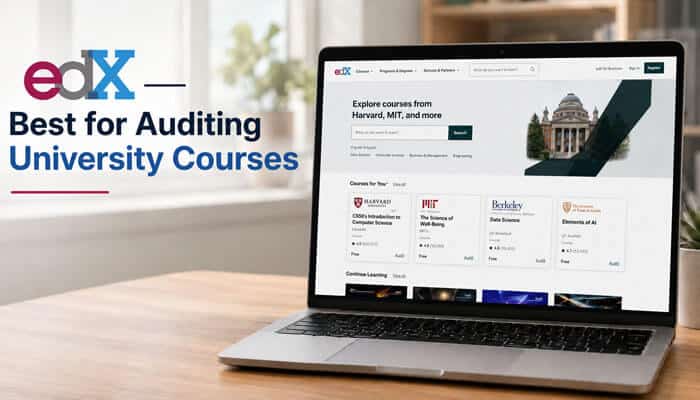
If you want to know where to find free courses online from universities without immediately paying for a certificate, edX is one of the strongest places to check.
Best for: Computer science, business, engineering, public health, data science, AI, and academic subjects
edX hosts online courses and programs from universities, institutions, and professional organizations.
Many individual courses provide a free audit or similar access option.
Depending on the course, free learners may receive:
- Video lessons
- Readings
- Course modules
- Discussion material
- Selected exercises
Paid tracks can add:
- Verified certificates
- Extended access
- Graded assessments
- Professional programs
- Degree pathways
Who Should Use edX?
edX works particularly well if you want structured university-style learning but do not necessarily need a credential.
If the certificate matters, compare the upgrade cost with free-certificate platforms before enrolling.
Best choice for: University-style learning through an audit option.
3. Coursera — Best for Variety, but Check What “Free” Means
For learners comparing where to find free courses online across career and university subjects, Coursera is useful—but its free-access terms require careful reading.
Best for: Business, technology, artificial intelligence, data science, professional development, and career exploration
Coursera partners with universities and companies to provide:
- Individual courses
- Specializations
- Professional Certificates
- Degree programs
It offers enormous variety, but users should pay close attention to what “free” means on each enrollment page.
Depending on the program, you may encounter:
- Free module previews
- Free trials
- Selected free courses
- Financial-aid options
- Paid subscriptions
- Paid certificate programs
Before Clicking “Enroll for Free”
Check whether the offer is actually:
- A full free course
- A preview
- A limited trial
- Financial-aid access
- Subscription enrollment
- Paid certificate access
Do not assume that “Enroll for Free” automatically means the entire course and certificate cost nothing.
When Coursera Is Most Useful
Coursera is still valuable for comparing career programs and courses from different institutions in one ecosystem.
Just verify the enrollment terms before investing significant time.
Best choice for: Learners who want variety across university and career subjects.
4. Harvard Free Courses — Best for University Learning and CS50
Harvard is another important option when researching where to find free courses online from major universities, especially for computer science and selected academic subjects.
Best for: Computer science, programming, data science, mathematics, humanities, health, and social sciences
Harvard’s online learning catalog contains a substantial selection of courses listed under free options.
Subjects include:
- Programming
- Computer science
- Data science
- Mathematics
- Health
- Humanities
- Education
- Social sciences
Free conditions vary by course.
Some Harvard programs are delivered through platforms such as edX, meaning free learning and verified certificates can follow different pricing rules.
Harvard CS50 Is a Standout Option
Harvard’s CS50x is particularly valuable for people looking for serious computer-science education.
Topics include:
- C
- Algorithms
- Data structures
- Python
- SQL
- HTML
- CSS
- JavaScript
- Flask
Learners who successfully complete the required work can qualify for a free CS50 certificate, while the separate verified edX credential can require payment.
Related CS50 courses may also provide free CS50 certificates when their completion requirements are met.
Best choice for: Learners seeking university-quality computer-science instruction.
5. Khan Academy — Best for Foundations and School Subjects
Best for: Mathematics, science, economics, computing, and school-level learning
Khan Academy remains one of the best free resources for strengthening foundational academic knowledge.
Subjects include:
- Arithmetic
- Algebra
- Geometry
- Statistics
- Calculus
- Biology
- Chemistry
- Physics
- Economics
- Computing
The platform combines instructional material with exercises and progress tracking.
Khan Academy also provides localized resources for students in multiple regions and languages.
Where Khan Academy Is Most Valuable
It is especially useful if you need to strengthen fundamentals before moving into a more advanced subject.
For example, improving algebra before studying statistics, programming, or data science may create more value than earning another short certificate.
Khan Academy is not primarily a professional-certification platform.
Best choice for: Students and adults rebuilding core academic skills.
6. OpenLearn — Best for Truly Free Flexible Learning
If your priority is where to find free courses online with flexible pacing and free evidence of participation, OpenLearn deserves a place near the top of your shortlist.
Best for: Psychology, business, education, health, science, technology, and lifelong learning
OpenLearn is operated by The Open University in the United Kingdom.
It provides a large collection of free courses that learners can start and complete at their own pace.
Free Proof of Completion
After creating an account, enrolling, and completing an eligible course, learners can receive a free Statement of Participation.
Selected courses also provide digital badges.
These achievements provide evidence of completion but do not automatically carry formal academic credit toward an Open University qualification.
Why OpenLearn Is Strong
It combines:
- Genuinely free learning
- Structured courses
- Flexible schedules
- Free completion evidence
Best choice for: Learners who want academic-style education with free proof of participation.
7. Saylor University — Best for Free Courses With Free Certificates
Best for: Business, computer science, professional development, humanities, ESL, and academic study
Saylor University deserves special attention if your goal is to complete free online courses with certificates.
The platform offers a large catalog of free self-paced courses.
Standard course-completion certificates are also free.
To receive one, learners generally need to pass the course’s Certificate Final Exam.
Can Saylor Courses Earn College Credit?
Some Saylor courses participate in Saylor Direct Credit and carry American Council on Education recommendations for potential college credit.
The course itself remains free, but the credit route requires a separate proctored examination with a small proctoring fee.
Your receiving college or university ultimately decides whether to accept the recommendation.
Best choice for: People who want free self-paced courses plus free standard completion certificates.
8. freeCodeCamp — Best for Practical Coding
Best for: Web development, JavaScript, Python, databases, front-end development, and programming projects
freeCodeCamp focuses heavily on learning by doing.
Rather than only watching lessons, learners work through coding challenges, projects, and certification requirements.
Learning areas include:
- Responsive web design
- JavaScript
- Databases
- Front-end development
- Python
- Data-related programming skills
Why freeCodeCamp Is Valuable for Job Seekers
A certificate may show that you completed a curriculum.
A working application or GitHub repository shows what you can actually build.
freeCodeCamp encourages learners to produce practical projects while developing technical knowledge.
Some newer certification pathways may be rolled out progressively, so verify that the credential you want is currently available.
Best choice for: Learners who want to build real coding skills and projects.
9. IBM SkillsBuild — Best for Free AI and Technology Skills
For people asking where to find free courses online in AI, cybersecurity, data, and workplace technology, IBM SkillsBuild offers a particularly practical starting point.
Best for: Artificial intelligence, generative AI, cybersecurity, data, and career-readiness skills
IBM SkillsBuild provides free education focused on technology and professional development.
Learning areas include:
- Artificial intelligence
- Generative AI
- Cybersecurity
- Data
- Cloud concepts
- Professional skills
- Career readiness
Free IBM Digital Credentials
Selected learning pathways provide IBM-branded digital credentials that can be shared professionally.
This makes IBM SkillsBuild useful for learners who want both introductory technology education and evidence that they completed selected programs.
Best choice for: Beginners exploring AI, data, cybersecurity, or technology careers.
10. Microsoft Learn — Best for Microsoft, Azure, and AI Training
Best for: Azure, Microsoft 365, Power Platform, development, security, and AI
Microsoft Learn provides Microsoft’s official self-paced training.
Resources include:
- Learning paths
- Individual modules
- Documentation
- Knowledge checks
- Practice assessments
- Role-based training
Training vs. Certification
Microsoft Learn’s training material can be free, while official Microsoft certification exams are separate.
That means you can use Microsoft Learn to study and prepare without paying for every learning resource.
Then decide whether a formal exam is worth the cost for your career.
Best choice for: IT professionals, developers, cloud administrators, and Microsoft users.
11. Cisco Networking Academy — Best for Cybersecurity and Networking
Best for: Networking, cybersecurity, Python, AI, IT fundamentals, and digital literacy
Cisco provides free learning through its Networking Academy and Skills for All ecosystem.
Topics can include:
- Cybersecurity
- Networking
- Programming
- AI and data
- Information technology
- Digital literacy
- Professional skills
Many courses are self-paced and aimed at learners exploring entry-level technical careers.
Does a Free Cisco Course Include Certification?
Not necessarily.
A free course may align with a Cisco certification, while the official external examination still has separate requirements and fees.
Treat the free training as preparation unless the course explicitly states that the credential is included.
Best choice for: Learners pursuing networking, cybersecurity, and IT-support careers.
12. Google Skillshop — Best for Google Ads Training
Best for: Google Ads, advertising, campaign measurement, optimization, and digital marketing
Google Skillshop provides official training around Google’s professional products.
Google Ads learning paths can cover:
- Search advertising
- Display advertising
- Video campaigns
- Campaign measurement
- Optimization
- Advertising strategy
Eligible pathways can also lead to Google certifications.
Who Should Use Skillshop?
It is particularly useful for:
- PPC specialists
- Freelancers
- Agency staff
- Digital marketers
- Marketing students
- Business owners
Because the training comes directly from Google, it is useful for understanding Google’s own tools and advertising workflows.
Best choice for: Google Ads and platform-specific marketing skills.
13. HubSpot Academy — Best for Free Marketing Certifications
Best for: Digital marketing, content, social media, email marketing, sales, and CRM
HubSpot Academy is one of the strongest professional-learning options in this guide.
Topics include:
- Digital marketing
- Content marketing
- Social media
- Email marketing
- Inbound marketing
- Sales
- Customer service
- CRM
- Revenue operations
Popular free certifications include:
- Digital Marketing
- Content Marketing
- Social Media Marketing
- Inbound
- Inbound Sales
- Digital Advertising
Eligible credentials can be added to a résumé or LinkedIn profile.
One Caveat
Some software-specific certifications may require access to particular HubSpot features to complete practical exercises.
Check the requirements before beginning a product-specific certification.
Best choice for: Marketers, sales professionals, content creators, and business owners.
14. AWS Skill Builder — Best for Cloud and AI Learning
Best for: AWS, cloud computing, artificial intelligence, security, data, architecture, and DevOps
AWS Skill Builder is Amazon Web Services’ official training platform.
It offers a large collection of free learning resources covering areas such as:
- AWS fundamentals
- Artificial intelligence
- Machine learning
- Cloud architecture
- Networking
- Security
- Data
AWS also offers paid Skill Builder subscriptions that unlock additional labs, immersive experiences, and advanced certification preparation.
Training vs. AWS Certification
Free AWS learning and formal AWS Certification are separate.
Use Skill Builder to develop knowledge first.
Pay for a certification exam only when the credential provides enough value for your career goals.
Best choice for: Cloud, DevOps, infrastructure, and AWS learners.
15. Alison — Best for Broad Vocational Learning
Best for: Business, technology, health, languages, marketing, and workplace skills
Alison provides a broad catalog of online courses in professional and general subjects.
Learning can generally be completed without purchasing an official certificate.
After completing a course, learners may have the option to purchase a digital or printed certificate or diploma.
A free learner record can still provide evidence of completed courses and results.
Who Should Use Alison?
Alison works well if your primary goal is:
- Learning a new topic
- Exploring a career field
- Building general workplace skills
- Studying without paying tuition
If an official certificate matters, check its price before starting.
Best choice for: Learners who value subject variety more than receiving a free formal certificate.
16. SWAYAM — Best for University Learning in India
Best for: School, university, engineering, management, and postgraduate study
SWAYAM is a Government of India online-learning initiative.
Its national coordinators include organizations such as:
- NPTEL
- AICTE
- UGC
- CEC
- IGNOU
- NCERT
- NIOS
- IIM Bangalore
Courses can include:
- Video lectures
- Downloadable reading material
- Self-assessment tests
- Discussion forums
- Assignments
Course learning is generally available free of cost.
What About Certificates?
Learners who want an official certificate commonly need to register for a paid proctored examination.
Requirements and examination fees can vary by course.
Can SWAYAM Courses Earn Academic Credit?
Eligible courses may participate in academic credit-transfer arrangements.
However, your college or university ultimately decides how the credit is accepted and applied.
Best choice for: Indian students seeking government-backed online education.
17. Open Yale Courses — Best for Classic Yale Lectures
Best for: Humanities, economics, history, literature, social science, and foundational science
Open Yale Courses makes selected Yale College lectures and course materials available without charge.
Resources can include:
- Video lectures
- Audio
- Transcripts
- Syllabi
- Reading information
- Assignments
- Exams
Registration is not required.
However, Open Yale Courses does not award Yale credit, a degree, or a certificate.
Yale is also no longer regularly adding new courses to the Open Yale Courses collection, so the platform is best treated as an archive of high-quality academic material.
Best choice for: Independent learners interested in timeless university subjects.
Bonus: Use Class Central to Search Thousands of Courses at Once
If you are unsure where to find free courses online for a specific subject, Class Central can save time by helping you compare options from multiple providers in one place.
If you already know what you want to study, visiting every platform individually can waste time.
Class Central is a course-search engine and aggregator that indexes a huge number of online courses from different providers.
You can search topics such as:
- Artificial intelligence
- Python
- Cybersecurity
- Finance
- Data science
- Psychology
- Project management
- Digital marketing
You can then compare:
- Course provider
- Difficulty
- Duration
- Reviews
- Format
- Certificate availability
Best Way to Use Class Central
Use it for discovery, then verify the current pricing and certificate terms on the original provider’s website.
An aggregator can help you find a course.
The provider should remain your final source for enrollment terms.
Check Your Public Library Before Paying for Online Courses
Your public library may be one of the most overlooked answers to where to find free courses online.
Some libraries purchase institutional access to premium educational platforms and make it available to cardholders.
Gale Presents: Udemy
Participating libraries may provide access to thousands of Udemy courses through Gale Presents: Udemy.
Subjects can include:
- Programming
- Cybersecurity
- Data
- Design
- Business
- Marketing
- Management
- Productivity
LinkedIn Learning for Library
Some libraries also provide access to LinkedIn Learning.
Where available, patrons may be able to authenticate using their library card credentials.
Certificate rules can differ from ordinary individual LinkedIn Learning accounts, so verify the current policy if receiving a certificate matters to you.
How to Check
Visit your library website and search for:
- Online learning
- Udemy
- LinkedIn Learning
- Gale
- Digital databases
- Career resources
Checking your library before purchasing a subscription can save a significant amount of money.
Where to Find Free Courses Online With Certificates
If earning a free credential is your main goal, use a narrower shortlist.
| Platform | Free Learning | Free Credential? | Important Caveat |
|---|---|---|---|
| Saylor University | Yes | Yes | Standard certificate is free |
| HubSpot Academy | Yes | Many certifications | Some software credentials have requirements |
| OpenLearn | Yes | Participation statement; selected badges | Not academic credit |
| IBM SkillsBuild | Yes | Selected credentials | Depends on learning pathway |
| Harvard CS50 | Yes | Free CS50 certificate | Completion requirements apply |
| freeCodeCamp | Yes | Eligible certifications | Check current curriculum availability |
| Google Skillshop | Yes | Certification pathways | Assessment rules vary |
The most important rule is simple:
Check the certificate terms before starting a long course.
Do not spend 30 or 40 hours studying only to discover that the credential requires an unexpected payment.
Free Course vs. Free Audit vs. Free Certificate
These terms sound similar but have different meanings.
| Term | What It Usually Means |
|---|---|
| Free course | Most or all learning material is available without payment |
| Free audit | You can study the content but may lose graded features or certification |
| Free preview | Only part of the course is accessible |
| Free trial | Paid access is available temporarily |
| Free certificate | The completion credential itself costs nothing |
| Paid certificate | Learning may be free but proof of completion costs extra |
| Financial aid | Eligible learners may receive reduced or covered access |
| Scholarship | A provider or third party funds eligible learners |
| Sponsored access | A library, school, employer, or government pays for access |
The phrase “free online course” alone does not tell you which of these applies.
Can Financial Aid Make a Paid Course Free?
Another answer to where to find free courses online is to look beyond standard free catalogs and check whether a paid course offers financial aid, scholarships, or sponsored access.
Sometimes.
If the course you want normally requires payment, check whether the provider offers:
- Financial aid
- Scholarships
- Student programs
- Employer-paid training
- Library access
- University subscriptions
- Government-funded education
- Promotional learning programs
Coursera, for example, provides financial-aid options for selected eligible programs.
Financial aid does not automatically mean every fee will be covered.
Check:
- Eligibility
- What costs are included
- Whether the certificate is included
- Whether aid covers the entire program
- Any deadlines or application requirements
Can Free Online Courses Count for College Credit?
Sometimes, but free learning and transferable college credit are not the same thing.
MIT OpenCourseWare
MIT OCW provides no MIT academic credit.
Saylor University
Selected Saylor courses have ACE credit recommendations.
Learners pursuing the credit option generally need to complete a separate proctored examination.
Your college decides whether to accept the credit recommendation.
SWAYAM
Eligible SWAYAM courses may participate in academic credit-transfer frameworks in India.
Again, the receiving institution decides how the credit applies.
Before Taking a Course for Credit
Ask your college:
- Does this exact course transfer?
- How many credits can it provide?
- Do I need approval first?
- Is a proctored exam required?
- What score must I earn?
- Are there examination or transcript fees?
Never assume a course earns college credit simply because it is described as university-level.
How to Check Whether an Online Course Is Really Free
Knowing where to find free courses online is only half the job.
You also need to recognize misleading pricing.
1. Look Beyond “Enroll for Free”
It may mean:
- Preview
- Audit
- Trial
- Financial-aid application
- Free lessons with a paid certificate
2. Confirm Access to Every Module
Make sure later lessons are not locked behind payment.
3. Check Certificate Pricing Separately
Look for wording such as:
- Free certificate
- Verified certificate
- Digital badge
- Statement of Participation
- Certificate available for purchase
4. Check Whether a Credit Card Is Required
A course that asks for billing information may actually be starting a trial.
5. Check Automatic Renewal
If payment details are required, find out exactly when billing begins.
6. Check When the Course Was Updated
Freshness matters especially for:
- Artificial intelligence
- Cybersecurity
- Cloud computing
- Software development
- SEO
- Digital marketing
- Advertising tools
An older calculus course may remain excellent.
An old advertising-platform tutorial may no longer match the current interface or policies.
How to Choose the Right Free Online Course
There are thousands of free courses, so choosing well matters.
Step 1: Define the Outcome
Ask:
What should I be able to do when I finish?
Examples:
- Build a basic website
- Understand Python
- Run Google Ads
- Improve algebra
- Prepare for an Azure exam
- Analyze data
- Understand introductory economics
Step 2: Choose the Correct Level
Look for:
- Beginner
- Intermediate
- Advanced
Starting too far above your current skill level often wastes time.
Step 3: Check the Syllabus
A good course should have a logical progression rather than a collection of unrelated lessons.
Step 4: Evaluate the Provider
Give preference to credible:
- Universities
- Established technology companies
- Nonprofit educational organizations
- Government programs
- Experienced instructors
Step 5: Look for Practical Work
For career-focused subjects, prioritize courses with:
- Projects
- Exercises
- Labs
- Assessments
- Case studies
Step 6: Consider Accessibility
Check for:
- Captions
- Transcripts
- Downloadable materials
- Mobile access
- Flexible schedules
- Screen-reader compatibility
Step 7: Consider Language
A famous course is not necessarily the best option if you struggle to follow its teaching style or language.
5-Minute Free Course Quality Checklist
| Question | What to Check |
|---|---|
| Is the entire course free? | Avoid confusing previews with full access |
| Is the certificate free? | Check separately from course pricing |
| Who created the course? | Prefer credible providers |
| When was it updated? | Important for fast-changing topics |
| What level is it? | Match your experience |
| How long will it take? | Make sure you can finish |
| Are assessments included? | Useful for measuring understanding |
| Are projects included? | Valuable for career skills |
| Does it carry credit? | Verify before assuming |
| Is it accessible? | Check captions, transcripts and device support |
| What languages are available? | Choose one you can follow comfortably |
| Is special software required? | Technical courses may need a computer or cloud account |
Remember:
A free course still costs your time.
A useful five-hour course can be more valuable than an irrelevant 40-hour program.
Free Job Simulations: Learn by Doing With Forage
Traditional online courses are not the only way to develop skills.
Forage provides free virtual job simulations created with employers.
Fields can include:
- Software engineering
- Consulting
- Banking
- Cybersecurity
- Finance
- Data
- Law
- Healthcare
How Is a Job Simulation Different?
A finance course may explain valuation.
A simulation may ask you to complete a simplified task similar to work performed by an analyst.
That gives you something more concrete to discuss during an interview.
However, do not describe a Forage simulation as employment or a formal internship.
It is a learning and career-exploration experience.
Are Free Online Courses Worth It in 2026?
Yes—when you choose them for a clear reason.
Free courses can help you:
- Explore a new career
- Learn a technical skill
- Prepare for certification
- Improve school performance
- Rebuild foundational knowledge
- Learn software
- Create portfolio projects
- Prepare for interviews
- Test whether you enjoy a subject
- Avoid paying for unnecessary training
Their main limitation is simple:
Education does not guarantee an outcome.
A free course cannot automatically replace:
- A university degree
- Professional licensing
- Apprenticeships
- Required industry certification
- Work experience
What free learning can do is reduce the cost of acquiring useful knowledge.
Can Free Online Courses Help You Get a Job?
They can strengthen your profile if you turn the learning into evidence.
After a Coding Course
Build:
- A portfolio website
- A responsive webpage
- A JavaScript application
- A Python project
- A GitHub repository
After a Marketing Course
Create:
- Keyword research
- A sample advertising plan
- A content strategy
- A social media calendar
- A campaign measurement framework
After a Data Course
Create:
- An Excel model
- A SQL project
- A Python analysis
- A dashboard
A useful formula is:
Learning + Practice + Project + Evidence = More Career Value
A certificate tells an employer you completed a course.
A project helps demonstrate what you can actually do.
How to Add Free Online Courses to Your Résumé
Do not list every tutorial you have watched.
Prioritize courses that are:
- Relevant to the role
- Created by a credible provider
- Substantial enough to matter
- Connected to a real skill
- Supported by a credential or project
A résumé section could look like:
Professional Development
Digital Marketing Certification — HubSpot Academy, 2026
Introduction to Cybersecurity — Cisco Networking Academy, 2026
CS50x: Introduction to Computer Science — Harvard, 2026
If the provider offers a verifiable credential link, you can also add it to LinkedIn or your portfolio.
Are Free Course Certificates Recognized?
There is no universal answer.
“Recognized” can mean different things to:
- Employers
- Universities
- Professional bodies
- Government regulators
Before completing a course mainly for its certificate, ask:
- Who issued it?
- Can it be verified?
- Is the provider respected in my field?
- Is it a completion certificate or professional certification?
- Does it carry academic credit?
- Does my employer require another credential?
- Is professional licensing involved?
A free completion certificate should not be represented as equivalent to a university degree or professional license unless it genuinely carries that status.
How to Avoid Fake Free Courses and Worthless Certificates
Not every website advertising “free education” is trustworthy.
Be cautious if a provider:
- Guarantees employment
- Promises an accredited degree in a few hours
- Hides its identity
- Uses questionable university logos
- Reveals major fees only after course completion
- Makes vague claims about “international accreditation”
- Provides no syllabus
- Provides no instructor information
- Uses aggressive countdown timers
- Claims a short course automatically provides professional licensing
Certificate Does Not Automatically Mean Accreditation
A completion certificate does not automatically make a program:
- University accredited
- Worth college credit
- Professionally licensed
- Employer-required
- Equivalent to a degree
If the qualification affects employment, licensing, immigration, or academic credit, verify it with the relevant official authority.
University Courses vs. Professional Courses: Which Should You Choose?
Neither category is automatically better.
Choose University-Style Learning for:
- Academic foundations
- Mathematics
- Science
- Economics
- Humanities
- Theory
- Deep subject understanding
Good choices include:
- MIT OpenCourseWare
- edX
- Harvard
- OpenLearn
- Open Yale Courses
- SWAYAM
Choose Professional Learning for:
- Programming
- Cybersecurity
- Cloud platforms
- Advertising
- Digital marketing
- Business software
- Career-specific technology
Good choices include:
- freeCodeCamp
- IBM SkillsBuild
- Microsoft Learn
- Cisco Networking Academy
- Google Skillshop
- HubSpot Academy
- AWS Skill Builder
For many learners, the best strategy is to combine both.
Learn the concept, then apply it.
A Simple 4-Week Free Learning Plan
If you are overwhelmed by too many options, use this structure.
Week 1: Pick One Skill
Choose one:
- Programming
- AI
- Data
- Marketing
- Cybersecurity
- Mathematics
- Business
Do not enroll in seven unrelated courses.
Week 2: Learn the Foundations
Study for approximately 30–60 minutes a day.
Write down concepts you do not understand.
Week 3: Practice
Move from consuming content to applying it.
Write code, solve problems, analyze data, or build a campaign.
Week 4: Create Evidence
Complete one meaningful output:
- Project
- Assessment
- Certificate
- Portfolio sample
- Job simulation
- Case study
Then identify the next skill gap.
This prevents course collecting—continuously enrolling without finishing or applying anything.
Common Mistakes When Looking for Free Courses Online
Choosing a Course Only Because It Is Free
Free does not mean useful.
Assuming the Certificate Is Free
Always verify certificate pricing separately.
Starting Too Many Courses
One completed course can be more valuable than ten abandoned courses.
Ignoring the Update Date
This is especially risky in AI, cybersecurity, cloud computing, and digital marketing.
Paying for a Certificate You Do Not Need
If your only goal is learning, a free audit or open course may be enough.
Confusing Completion Certificates With Professional Certifications
They serve different purposes.
Learning Without Practicing
Watching lessons alone does not build mastery.
Forgetting About Library Access
Your library may already pay for premium training.
Assuming Every University Course Earns Credit
Open university resources frequently provide no formal academic credit.
Choosing Prestige Over Fit
A simple course you complete and apply may be more useful than a famous course you abandon.
Final Thoughts
Knowing where to find free courses online can save you hundreds or even thousands of dollars, but the best strategy is not to enroll in every course that costs nothing. Choose learning based on the outcome you actually want. For academic depth, MIT OpenCourseWare, OpenLearn, Harvard, edX, SWAYAM, and Open Yale Courses are strong choices.
For career skills, freeCodeCamp, IBM SkillsBuild, Microsoft Learn, Cisco Networking Academy, AWS Skill Builder, Google Skillshop, and HubSpot Academy are better starting points. If your priority is getting a credential without paying, investigate Saylor University, HubSpot Academy, OpenLearn, IBM SkillsBuild, Harvard CS50, and eligible freeCodeCamp pathways.
Also use Class Central when you want to compare courses across providers and check your public library before paying for premium education subscriptions. Most importantly, do not measure progress by the number of courses saved in your account.
Where to Find Free Courses Online FAQs
1. Where to Find Free Courses Online in 2026?
If you are wondering where to find free courses online, strong options include MIT OpenCourseWare, OpenLearn, Khan Academy, edX, Harvard, freeCodeCamp, IBM SkillsBuild, Microsoft Learn, HubSpot Academy, and SWAYAM. The best platform depends on whether you want academic learning, career skills, coding, or certificates.
2. Where to Find Free Courses Online With Certificates?
Saylor University, HubSpot Academy, OpenLearn, IBM SkillsBuild, Harvard CS50, and eligible freeCodeCamp programs are good places to check. Always verify the individual course page because certificate rules and eligibility can change.
3. Can I Take University Courses Online for Free?
Yes. MIT OpenCourseWare, Open Yale Courses, Harvard’s selected free courses, OpenLearn, edX audit options, and SWAYAM provide access to university-level learning. Some offer course materials only, while others may include assessments or completion credentials.
4. Are Free Online Courses Really Completely Free?
Some are completely free, while others charge for certificates, graded assignments, exams, or extended access. Check whether the offer is a full free course, audit track, preview, trial, or paid certificate option before enrolling.
5. Can Free Online Courses Help Me Get a Job?
Yes, they can strengthen your skills and résumé, especially when combined with projects, portfolios, certifications, or practical work. A course alone does not guarantee employment, but showing how you applied the skill can improve its career value.
