


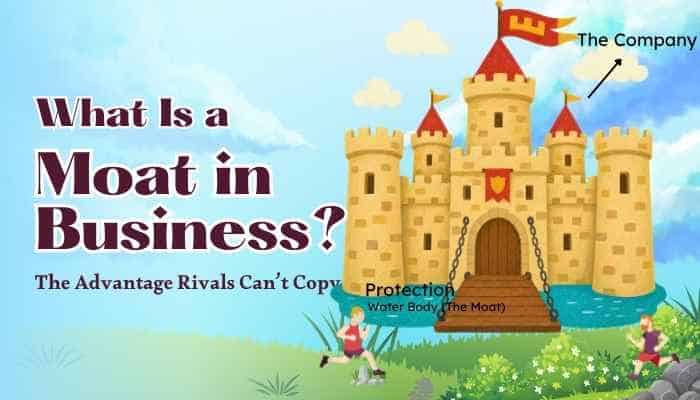

What is a moat in business? It is the lasting advantage that helps some companies retain customers, protect profits and remain difficult to challenge, even when rivals offer similar products or lower prices.
Consider two businesses selling almost the same thing. One begins losing customers as soon as a cheaper competitor appears. The other continues growing because buyers trust its brand, rely on its network, face costly switching barriers or cannot find an equally convenient alternative. That protection is the company’s moat.
To understand what is a moat in business, look beyond short-term popularity or rapid growth. A successful product, large advertising budget or early lead may attract customers, but none guarantees lasting protection. A genuine moat continues working after competitors notice the opportunity and begin copying features, cutting prices or targeting the same customers.
Quick Answer:
A business moat is a durable competitive advantage that helps a company retain customers, protect profits and withstand pressure from rivals. Understanding what is a moat in business means identifying the structural advantage that competitors cannot easily copy, replace or weaken.
Common sources of a business moat include:
- High customer switching costs
- Powerful network effects
- A structurally lower cost base
- Patents, trusted brands or regulatory licenses
- Efficient scale in a limited market
- Proprietary distribution or operating systems
- An ecosystem that becomes more valuable as it grows
Morningstar groups economic moats into five primary sources: switching costs, network effects, cost advantages, intangible assets and efficient scale.
Key Takeaways: What Is a Moat in Business?
- A business moat is a durable advantage that protects customers, profits and market position from competitors.
- Understanding what is a moat in business requires looking for structural strengths, not temporary promotions, rapid growth or popularity.
- The five primary moat sources are switching costs, network effects, cost advantages, intangible assets and efficient scale.
- Brand recognition becomes a moat only when it creates customer loyalty, pricing power or lower acquisition costs.
- Market share, advanced technology and strong management may support a moat, but they are not durable advantages by themselves.
- Companies must continue investing in innovation, customer value and operations because even powerful moats can weaken.
- For investors, a strong business moat does not guarantee a good investment if the company’s shares are excessively valued.
What Is a Moat in Business?
What is a moat in business? It is the built-in reason customers do not leave the moment a rival offers a cheaper price or a similar product. That protection may come from years of customer data, a trusted brand, exclusive licenses, a valuable network or operating costs competitors cannot match.
A company with a genuine moat may be able to:
- Keep customers for longer
- Raise prices without losing substantial demand
- Operate at lower costs than competitors
- Protect valuable patents, licenses or proprietary knowledge
- Make its product more useful as its network grows
- Maintain stronger margins during competitive pressure
- Force rivals to spend considerable time and money to catch up
Understanding what is a moat in business comes down to one practical test: could a capable, well-funded competitor reproduce the advantage quickly? If the answer is yes, the company probably has a temporary edge rather than a lasting moat.
Why Is It Called a Business Moat?
The term comes from the defensive moats once built around castles. In business, it describes the barriers surrounding a company—such as switching costs, customer data, integrations or trusted relationships—that make its success difficult for competitors to copy.
Why Does a Business Moat Matter?
What is a moat in business? It is the protection that helps a company keep customers and profits when rivals copy its products, lower prices or increase advertising. Understanding what is a moat in business matters because every profitable market eventually attracts competition.
A strong moat can help a company:
- Retain customers for longer
- Raise prices without losing substantial demand
- Protect market share and profit margins
- Earn stronger returns on invested capital
- Spend less replacing lost customers
- Reinvest in new products and innovation
- Withstand competitors and economic downturns
Competitive Advantage vs. Business Moat
A competitive advantage helps a company win today. A business moat keeps rivals from easily taking that advantage away.
| Competitive Advantage | Business Moat |
|---|---|
| May be temporary | Expected to last for years |
| Can be easier to copy | Difficult or costly to reproduce |
| Example: a popular campaign | Example: high switching costs |
A lower price may create a temporary advantage. A cost structure competitors cannot match may create a moat.
Business Moat vs. Barrier to Entry
A barrier to entry makes entering a market difficult. A business moat protects a specific company after competitors enter.
| Barrier to Entry | Business Moat |
|---|---|
| Often affects the whole market | Usually belongs to one company |
| Mainly discourages new entrants | Protects against new and existing rivals |
| Example: licensing requirements | Example: network effects |
Understanding what is a moat in business comes down to this distinction: barriers restrict market entry, while moats protect customers and profits.
The Five Main Types of Business Moats
Understanding what is a moat in business becomes easier when you examine the five main sources of long-term competitive protection. Morningstar identifies switching costs, network effects, cost advantages, intangible assets and efficient scale. A company may rely on one moat or combine several to strengthen its position.
1. Switching-Cost Moat
A switching-cost moat exists when leaving a company would cost customers time, money or create unnecessary risk.
Switching may require customers to:
- Move and verify data
- Retrain employees
- Rebuild important integrations
- Change established workflows
- Risk service interruptions
- Give up years of stored information
This moat is common in enterprise software, banking, healthcare technology and other services embedded in daily operations.
Microsoft is a useful example. A business may use its cloud infrastructure, workplace software, security tools and partner services together. A competitor might copy individual features, but replacing the complete system can require substantial migration work, employee training and operational disruption.
When evaluating what is a moat in business, switching costs matter only when customers remain because the product continues to provide value. Confusing cancellation rules or unfair contracts may trap customers temporarily, but they do not create lasting loyalty.
2. Network-Effect Moat
A network effect occurs when a product becomes more useful as more people or businesses join it.
Common examples include:
- Payment networks
- Online marketplaces
- Communication platforms
- Social networks
- Developer ecosystems
- Professional networks
Visa illustrates this model. More cardholders make the network more attractive to merchants, while broader merchant acceptance makes Visa more useful to cardholders and banks.
Network effects may be direct or indirect. A direct effect occurs when each additional user improves the experience for existing users. An indirect effect occurs when growth on one side of a marketplace attracts more participants on the other side.
A large user base alone is not a moat. To understand what is a moat in business, ask whether each new participant makes the product more valuable to the people already using it.
3. Cost-Advantage Moat
A cost-advantage moat allows a company to provide a comparable product at a lower structural cost than competitors.
The advantage may come from:
- Purchasing scale
- Efficient manufacturing
- Better logistics
- High capacity utilization
- Proprietary processes
- Lower-cost distribution
- Access to cheaper inputs
A company can use this advantage to charge market prices and earn higher margins or lower its prices while remaining profitable.
Costco, for example, combines volume purchasing, limited product selection, rapid inventory turnover and efficient distribution. Its moat is not simply that it offers low prices. The advantage comes from an operating model that allows those prices to remain sustainable.
This distinction is important when explaining what is a moat in business. A temporary discount can be copied quickly, while a structurally lower cost base may take competitors years to reproduce.
4. Intangible-Asset Moat
Intangible assets are valuable nonphysical resources that protect customer demand or limit competition.
They may include:
- Patents
- Trademarks
- Regulatory licenses
- Government approvals
- Proprietary formulas
- Exclusive contracts
- Trusted brands
A patent may prevent competitors from legally copying an invention, while regulatory approval may restrict which companies can operate in a market.
A well-known brand can also become a moat, but recognition alone is not enough. The brand must influence customer behavior by producing repeat purchases, stronger retention, premium pricing or trust that competitors cannot easily reproduce.
Brand awareness without customer preference is visibility—not a moat.
5. Efficient-Scale Moat
Efficient scale exists when a market can profitably support only a small number of competitors.
Entering such a market may require major infrastructure investment, while adding another provider could create more capacity than customers need. This makes entry economically unattractive.
Efficient-scale moats are often found in:
- Railroads
- Pipelines
- Utilities
- Airports
- Communication towers
- Specialized local infrastructure
Railroads are a common example. Building a competing network requires enormous capital, and duplicate routes may not attract enough demand to justify the investment.
The final lesson in understanding what is a moat in business is that size alone does not create protection. Efficient scale depends on whether the market can support another competitor without reducing returns for everyone.
Another Way to Analyze Moats: Hamilton Helmer’s 7 Powers
Hamilton Helmer’s 7 Powers framework looks at the strategic advantages that allow a company to earn stronger returns while making imitation difficult. It offers founders and managers a practical way to examine what is a moat in business beyond the five Morningstar categories.
The seven powers are:
- Scale economies: Costs fall as the company grows.
- Network economies: More users make the product more valuable.
- Counter-positioning: An established rival cannot copy the model without damaging its current business.
- Switching costs: Customers face time, expense or risk when changing providers.
- Branding: Trust and preference support loyalty or premium pricing.
- Cornered resource: The company controls a scarce asset, right or capability.
- Process power: Years of experience create systems that are difficult to reproduce.
The framework provides another useful answer to what is a moat in business, but it should complement rather than replace Morningstar’s five primary moat sources.
Other Advantages That Can Strengthen a Business Moat
Some advantages do not fit neatly into one moat category but can strengthen switching costs, network effects or cost advantages:
- Distribution advantage: Exclusive retail access, partnerships, logistics or sales channels help a company reach customers more efficiently than rivals.
- Data advantage: Proprietary, continuously updated data can improve recommendations, fraud detection, automation and product performance.
- Ecosystem advantage: Connected products, services and customer accounts make the overall experience more valuable and switching more difficult.
These advantages become genuine moats only when competitors cannot easily copy them and they create measurable customer or financial value.
What Creates a Business Moat in the AI Era?
AI alone is not a moat. Competitors can often access the same models, APIs and development tools, so a chatbot or AI feature may be copied quickly. In the AI era, understanding what is a moat in business means looking at the assets surrounding the technology.
A defensible AI business may rely on:
- Proprietary data: Unique, permissioned data that improves results and is difficult to obtain elsewhere.
- Workflow integration: The product becomes embedded in customer records, approvals, reporting and daily operations.
- Industry expertise: Specialized knowledge of regulations, terminology and customer risks improves the product.
- Distribution: Existing relationships, partnerships or sales channels make customers easier to reach.
- Trust and compliance: Security, audit trails, reliability and human oversight matter in sensitive industries.
- A data flywheel: More usage improves the product, which attracts more customers and generates better data.
Claims such as “we use AI,” “we have a chatbot” or “we launched first” do not explain what is a moat in business. The real advantage must be difficult to copy and become stronger as customers continue using the product.
Business Moat Examples
Real-world examples make what is a moat in business easier to understand. Most successful companies do not depend on one advantage alone; they combine several protections that make their customers, profits or market position difficult to take away.
Visa: Network Effects
Visa becomes more useful as more consumers, merchants and financial institutions join its network. More cardholders attract merchants, while wider merchant acceptance makes Visa more valuable to customers and banks.
Apple: Ecosystem and Switching Costs
Apple connects devices, apps, services, subscriptions and customer accounts within one ecosystem. A competitor may copy an individual feature, but replacing the full experience can be inconvenient and time-consuming for users.
Costco: Structural Cost Advantage
Costco uses purchasing scale, limited product selection and rapid inventory turnover to maintain low prices. Its advantage is not a temporary discount but an operating model that competitors may struggle to match profitably.
Microsoft: Switching Costs
Many businesses rely on Microsoft software, cloud infrastructure, security tools, stored data and integrations. Moving those systems to another provider may require extensive migration work, employee retraining and operational disruption.
These companies help illustrate what is a moat in business: an advantage built into how customers buy, use or depend on a company’s products.
Railroads: Efficient Scale
Building a competing railroad network requires enormous capital. In many regions, demand may not be large enough to support duplicate routes, making new competition economically unattractive.
Pharmaceutical Companies: Patents and Approvals
Patents can prevent competitors from directly copying a medicine for a limited period. Clinical research, manufacturing requirements and regulatory approvals create additional cost and time barriers.
Specialized Marketplaces: Network Effects
A marketplace becomes more useful as more buyers and sellers participate. Buyers attract sellers through greater demand, while a wider selection of sellers attracts more buyers.
Together, these examples show what is a moat in business: a lasting defense that forces rivals to overcome more than a popular product, lower price or successful marketing campaign.
Moat vs. Brand, Flywheel and Product-Market Fit
Understanding what is a moat in business becomes easier when it is compared with other commonly used strategy terms. Although these concepts are connected, each describes a different part of a company’s growth, value and competitive position.
| Concept | What It Means | Relationship to a Business Moat | Primary Question |
|---|---|---|---|
| Product-market fit | The company has created something customers genuinely want and continue using. | Product-market fit usually comes first. A company must prove customer demand before it can build lasting protection around the product. | Do customers strongly want the product? |
| Competitive advantage | A feature, capability or strategy that helps a company outperform rivals today. | It becomes a moat only when competitors cannot easily copy, replace or weaken it. | Why is the company performing better today? |
| Business moat | A durable advantage that protects customers, profits and market position over time. | The clearest answer to what is a moat in business is an advantage that remains valuable even after capable competitors try to reproduce it. | Why will rivals struggle to take away the company’s success? |
| Brand | The reputation, expectations and trust customers associate with a company. | A brand becomes a moat when it creates loyalty, repeat purchases, premium pricing or trust that competitors cannot easily reproduce. | What do customers recognize, expect or trust? |
| Flywheel | A repeating cycle in which one business activity strengthens another. | A flywheel may create a moat when competitors cannot reproduce the cycle. For example, more buyers attract sellers, while more sellers improve selection and attract additional buyers. | Does one activity strengthen another? |
| Business model | The system a company uses to create value, serve customers and generate revenue. | A business model can support a moat when it creates lower costs, stronger relationships or a structure that competitors cannot copy without harming their existing operations. | How does the company create, deliver and capture value? |
Knowing what is a moat in business means recognizing that demand, branding and growth loops are not automatically defensible. They become part of a moat only when they create an advantage that competitors cannot easily reproduce.
How to Identify a Real Business Moat
A genuine moat shows up in customer behavior, competitive pressure and financial results. To understand what is a moat in business, look for evidence that the advantage is valuable, difficult to copy and likely to last.
Look for these five signals:
- Clear customer value: Buyers choose the company for lower costs, better performance, convenience, trust or reduced risk.
- A real barrier: Patents, switching costs, exclusive access, scale, regulation or proprietary data make imitation difficult.
- Measurable results: Strong retention, healthy margins, pricing power, free cash flow or high returns on invested capital support the moat.
- Long-term durability: The advantage can survive new technology, cheaper substitutes, changing habits and aggressive competitors.
- Growing strength: Higher retention, lower unit costs and deeper integrations suggest the moat is widening; rising churn and discounting suggest it is weakening.
The practical test for what is a moat in business is simple: could a well-funded rival copy the advantage quickly and profitably? If yes, it is probably a temporary edge rather than a lasting moat.
The Financial Test: Does the Moat Create Real Value?
A real moat should appear in the company’s financial results, not only in its brand reputation or market share. When evaluating what is a moat in business, look for evidence that the advantage consistently protects profits and returns.
Key financial signals include:
- ROIC remaining above WACC for several years
- Healthy margins despite competitive pressure
- Reliable free-cash-flow generation
- Strong customer retention and pricing power
- Attractive results during weaker economic periods
- A clear reason competitors cannot eliminate those returns
One profitable year is not enough. The financial results should support the same competitive advantage over an extended period.
How to Build a Moat in Business
Building a moat starts with creating real customer value. When considering what is a moat in business, focus on an advantage that becomes harder to copy as the company grows.
- Solve an important problem: Customers need a clear reason to choose, use and recommend the product.
- Choose one defensible strength: Compete through lower costs, deeper integrations, proprietary data, trusted expertise, better distribution or a stronger network.
- Make usage increase value: Customer activity may improve recommendations, expand the network, lower costs or produce better data.
- Create useful switching costs: Saved history, integrations, personalized workflows and employee training can make changing providers inconvenient without unfairly trapping customers.
- Reinvest in the advantage: Use profits to improve products, security, infrastructure, customer service and operational efficiency.
- Measure whether the moat is strengthening: Track the indicators connected to the claimed advantage.
| Claimed Moat | Useful Metrics |
|---|---|
| Switching costs | Retention, churn and migration rates |
| Network effects | Active users, transactions and participation |
| Cost advantage | Unit costs, margins and inventory turnover |
| Brand | Repeat purchases, pricing power and direct demand |
| Data advantage | Accuracy, product improvement and customer outcomes |
The practical answer to what is a moat in business is an advantage that becomes more valuable, more measurable and more difficult for competitors to reproduce over time.
Building a Moat at Different Business Stages
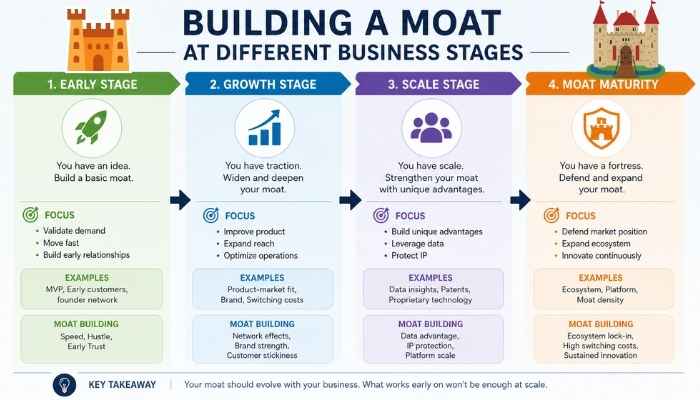
A company should not focus on defensibility before proving that customers value its product. The right moat-building priority changes as the business develops.
| Business Stage | Main Priority | Moat-Building Focus |
|---|---|---|
| Idea stage | Validate the problem | Conduct customer interviews and market tests |
| Early startup | Reach product-market fit | Improve usefulness, retention and customer satisfaction |
| Growth stage | Build repeatable advantages | Add integrations, proprietary data and distribution channels |
| Scale stage | Strengthen the economics | Lower unit costs and expand network effects |
| Mature company | Defend and renew the moat | Reinvest, innovate and respond to disruption |
The usual path is:
Customer problem → Product-market fit → Repeatable growth → Defensibility
A startup that builds barriers before proving demand may protect a product that customers do not actually want.
How Small Businesses Can Build a Moat
Small businesses rarely compete through massive scale or large patent portfolios. Their strongest advantages usually come from trust, specialization and customer relationships that take years to reproduce. This practical view helps explain what is a moat in business for a local company or niche service provider.
A small business can build a moat through:
- Local reputation: Reliable service, strong reviews and community trust make customers less likely to choose an unknown competitor.
- Specialized expertise: Deep knowledge of one industry, customer group or technical problem can separate the business from general competitors.
- Recurring relationships: Maintenance plans, subscriptions and retainers create predictable revenue, familiarity and valuable customer history.
- Exclusive access: Supplier agreements, certifications, permits, locations or referral networks may be difficult for rivals to obtain.
- Proprietary processes: Better training, scheduling, quality control and service systems can produce faster and more consistent results.
- Customer knowledge: Purchase histories, preferences and service records allow the business to provide a more personal and convenient experience.
A useful test is:
What would a new competitor need to reproduce before customers viewed it as an equally safe and convenient choice?
When the answer involves years of trust, relationships, expertise or operational learning, the business may have a meaningful moat. That is what is a moat in business at the small-business level: an advantage a new rival cannot simply buy or copy overnight.
How to Explain Your Moat to Investors
Investors are less interested in what makes a product impressive than in what makes the business difficult to challenge. A strong explanation of what is a moat in business should show why customers stay, how the advantage strengthens over time and what a competitor would need to overcome.
Focus on four points:
- Customer value: Why buyers choose the product
- Compounding advantage: What becomes stronger as usage grows
- Replication barrier: What a rival must build, spend or overcome
- Evidence: Retention, margins, usage, pricing power or switching behavior
For example:
Customers choose our inventory platform because it connects directly with specialist suppliers and reduces manual ordering. Each new integration expands product coverage, while switching requires customers to move years of records and rebuild established workflows. We measure the advantage through retention, integration usage and automated order volume.
When discussing what is a moat in business, avoid vague claims such as “we have a better team,” “we use AI” or “we were first.” These may support growth, but they do not prove that the advantage will survive competition.
Common Moat-Building Mistakes
Many companies mistake temporary success for lasting protection. Understanding what is a moat in business also means recognizing the strategies that look defensible but can quickly weaken.
- Confusing growth with defensibility: Rapid growth attracts competitors but does not prevent them from copying the opportunity.
- Treating technology as the moat: Features can often be copied; stronger protection may come from data, integrations, distribution or customer adoption.
- Using market share as proof: A leading position may result from discounts, timing or temporary demand rather than a durable advantage.
- Relying on management alone: Strong leaders matter, but employees can leave. A moat should remain embedded in the business.
- Depending on one platform: Heavy reliance on a search engine, marketplace, app store or social network creates risk rather than protection.
- Creating lock-in without value: Difficult cancellation processes may delay customer losses but can damage trust and attract regulatory attention.
- Failing to reinvest: Even a strong moat can weaken when a company stops improving its products, operations and customer experience.
A lasting moat keeps customers through superior value—not temporary growth, artificial restrictions or features competitors can quickly reproduce.
Can a Business Moat Disappear?
Yes. No business moat lasts automatically. New technology, regulation, patent expiration, brand damage, cheaper alternatives or changing customer habits can weaken an advantage that once looked secure.
Warning signs include:
- Rising customer churn
- Falling margins or pricing power
- Easier switching
- New substitutes
- Greater dependence on one supplier or platform
- Slower innovation
Former market leaders often lose their position because the basis of competition changes. A company must keep reinvesting in customer value, efficiency and innovation to protect its moat.
Is the Business Moat Widening or Narrowing?
A moat can grow stronger, remain stable or slowly lose its value. This matters because a company may still appear successful even while customers are becoming easier to lose. Knowing what is a moat in business also means tracking whether the advantage is improving or weakening over time.
| Moat Direction | Common Signs |
|---|---|
| Widening | Retention improves, unit costs fall, the network grows and switching becomes harder |
| Stable | Margins, pricing power and customer behavior remain consistent |
| Narrowing | Churn rises, discounts increase and competitors become easier to choose |
| Disappearing | Customers see little difference between the company and its alternatives |
Warning signs include:
- Falling margins or pricing power
- Easier customer switching
- New and cheaper substitutes
- Declining engagement
- Expiring patents or exclusive agreements
- Heavy dependence on one supplier or platform
The practical test for what is a moat in business is whether the company’s advantage becomes harder or easier for competitors to overcome. A moat must be measured, protected and renewed; it does not remain strong automatically.
Does a Strong Moat Make a Company a Good Investment?
Not necessarily. A moat describes the strength of the business, but investment returns also depend on the price paid for its shares.
Even an excellent company can produce disappointing returns when its valuation already assumes years of rapid growth. Investors should also consider:
- Valuation
- Debt and financial strength
- Management and capital allocation
- Industry risks
- Future growth expectations
- Portfolio diversification
A business moat is an important starting point, not a complete investment decision.
Conclusion
A company’s real strength is revealed when competitors begin copying its products, cutting prices and targeting the same customers. That pressure shows what is a moat in business more clearly than growth, popularity or market share alone.
A durable moat may come from switching costs, network effects, lower operating costs, intellectual property or customer trust built over many years. The advantage should make competition harder and show up in stronger retention, pricing power, margins or returns on capital.
The best way to judge what is a moat in business is to ask how much time, money and risk a capable rival would face trying to take the company’s customers. The harder that challenge is, the stronger the moat.
FAQs About What Is A Moat In Business
What Is a Moat in Business Compared With a Monopoly?
A business moat is an advantage that makes a company difficult to challenge. A monopoly describes a market controlled by one seller. A company can have a strong moat while still competing with several rivals.
Can Customer Service Become a Business Moat?
Yes, but only when excellent service is supported by training, fast response systems, customer history and trust that competitors cannot quickly reproduce. Friendly employees alone do not create a lasting moat.
Is a Subscription Model Automatically a Business Moat?
No. A subscription is a payment model, not a competitive defense. It may support a moat when customers receive continuing value through personalization, stored data, integrations or services they would lose by cancelling.
Can Company Culture Create a Business Moat?
Company culture can strengthen a moat when it consistently produces faster innovation, better service, fewer mistakes or stronger execution. Culture becomes defensible only when those benefits reach customers and are difficult for rivals to imitate.
How Long Does It Take to Build a Business Moat?
There is no fixed timeline. Patents or licenses may provide early protection, while trusted brands, network effects, proprietary data and operating processes may take years to become genuinely defensible.
Can an Open-Source Company Have a Moat?
Yes. Even when competitors can access the source code, a company may build a moat through trusted distribution, cloud hosting, enterprise support, integrations, proprietary data or a large developer community.
Can a Commodity Business Develop a Moat?
Yes. A commodity company may build protection through lower production costs, better logistics, scarce assets, reliable delivery, valuable locations or long-term customer contracts, even when its core product is not unique.
Can a Strong Business Moat Create Regulatory Risk?
Yes. A company with substantial market power may face scrutiny over pricing, acquisitions, customer lock-in, data access or interoperability. A strong moat does not place a business beyond competition or regulation.
