


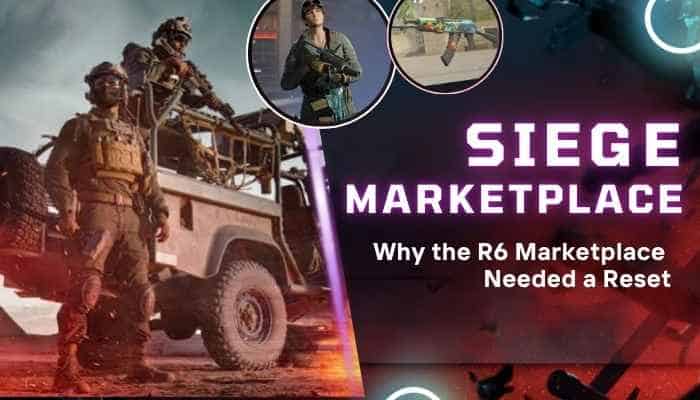

The Siege Marketplace gave Rainbow Six Siege players something they had wanted for years: an official way to trade eligible cosmetic items instead of leaving collectors to rely on unofficial markets. Rare skins found new owners, unused cosmetics gained value, and R6 Credits became part of a thriving player-driven economy.
That success did not last. Behind the scenes, Ubisoft uncovered account theft, automated bot activity, improper credit transfers, suspicious transactions, and growing economic problems that were affecting both player trust and the game’s virtual economy.
Instead of bringing the platform back with a few technical fixes, Ubisoft decided a larger overhaul was necessary. The Siege Marketplace is now being rebuilt with stronger security, better fraud detection, and improved economic controls before player-to-player trading can return.
Quick Answer
The Siege Marketplace was temporarily closed because Ubisoft identified serious security and economic issues affecting the platform. These included account theft, bot activity, improper R6 Credit transfers, suspicious transactions, unstable item prices, and distorted item circulation. Instead of applying temporary fixes, Ubisoft chose to redesign the Marketplace with stronger account security, improved fraud detection, better monitoring, and a more balanced in-game economy. As of July 28, 2026, the R6 Marketplace remains closed, and Ubisoft has not announced an official reopening date.
Key Takeaways
- The Siege Marketplace was temporarily closed after Ubisoft identified serious security threats and economic imbalances affecting the platform.
- Account theft, botting, improper R6 Credit transfers, and suspicious transactions damaged player trust and disrupted trading.
- Price instability and distorted item circulation created broader challenges for the Rainbow Six Siege virtual economy.
- Ubisoft is rebuilding the system with stronger account security, improved fraud detection, and better monitoring tools.
- The Siege Marketplace originally allowed eligible players to buy and sell approved cosmetic items using R6 Credits.
- Ubisoft deducted a 10% transaction fee from every completed sale.
- As of July 28, 2026, the Marketplace remains closed, and Ubisoft has not announced an official reopening date.
- Ubisoft has not confirmed that the Marketplace has been permanently discontinued.
What Is the R6 Marketplace?
The Siege Marketplace, officially known as the R6 Marketplace, is Ubisoft’s official trading platform for Tom Clancy’s Rainbow Six Siege. It allows eligible players to buy and sell approved cosmetic items using R6 Credits, giving older skins, uniforms, and weapon cosmetics renewed value through a secure player-to-player trading system.
Players listed eligible items for sale, while buyers submitted purchase orders for the cosmetics they wanted. Once prices matched, Ubisoft automatically completed the transaction without requiring players to contact each other or share personal information.
The Marketplace was commonly used to:
- Sell unwanted cosmetic items
- Buy older weapon skins and collectibles
- Obtain cosmetics from previous seasons
- Reuse R6 Credits earned from completed sales
- Compare item prices before buying
- Give eligible inventory items additional value
Unlike third-party trading websites, the Siege Marketplace did not support real-money payouts. Credits earned from completed sales remained within Ubisoft’s ecosystem and could only be spent on supported Rainbow Six Siege content.
Official Marketplace vs Third-Party Trading Sites
Unlike third-party trading websites, the Siege Marketplace operated entirely within Ubisoft’s ecosystem. Eligible cosmetic items were traded using R6 Credits, and players never needed to exchange passwords, account details, or payment information. Ubisoft has repeatedly warned that unofficial marketplaces, account trading, and boosting services can expose players to fraud, phishing, account theft, and possible account sanctions.
How the Siege Marketplace Originally Worked
The Siege Marketplace matched buyers and sellers through an automated order system instead of direct negotiations. Buyers entered the highest number of R6 Credits they were willing to pay, while sellers listed eligible cosmetic items at their asking price. When both prices matched, Ubisoft completed the trade automatically.
If a buyer set a maximum price of 1,200 R6 Credits and an eligible item was available for 1,050 Credits, the purchase was completed at the lower matching price rather than the buyer’s maximum offer.
Eligible items appeared in each player’s inventory, and sale orders remained active until they were completed, cancelled, updated, or expired. Players could also review active and completed trades through their transaction history.
Ubisoft deducted a 10% transaction fee from every completed sale. For example:
| Completed Sale | Ubisoft Fee (10%) | Seller Receives |
|---|---|---|
| 1,000 Credits | 100 Credits | 900 Credits |
The Siege Marketplace used this fee for every successful transaction. While Ubisoft confirmed the fee itself, the company has not publicly stated that its sole purpose was to manage the in-game economy.
What Could and Could Not Be Traded on the Siege Marketplace?
The Siege Marketplace was never intended to support every item in a player’s inventory. Instead, Ubisoft selected which cosmetics could be traded, and only eligible items appeared in the Sell section. If an owned cosmetic was missing from that list, it could not be listed until Ubisoft made it tradable.
Eligible items included selected:
- Weapon skins
- Attachment skins
- Headgear
- Uniforms
- Charms
- Operator cards
- Player-card backgrounds
- Older seasonal and event cosmetics
- Supported unopened packs
Ubisoft expanded Marketplace eligibility in 2025 by allowing certain unopened Celebration Packs to be traded, showing that supported items could change over time.
The Siege Marketplace did not support account sales, login credentials, boosting services, unsupported cosmetics, physical merchandise, or R6 Credits for real-world money. Current-season cosmetics also remained unavailable until Ubisoft approved them for trading. Because the platform is being rebuilt, future eligibility rules may differ from the previous system.
A Brief History of the Siege Marketplace
The Siege Marketplace began as a limited beta before becoming Ubisoft’s official player-to-player trading platform for Rainbow Six Siege cosmetics. Over time, the platform expanded its trading features, but growing security risks and economic concerns eventually forced Ubisoft to pause the service while a larger redesign was planned.
| Date | Development |
|---|---|
| November 12, 2023 | Ubisoft opened registration for the upcoming Marketplace beta. |
| Early 2024 | Selected eligible players gained access to the beta. |
| June 25, 2024 | The Marketplace launched more broadly for eligible players. |
| 2025 | Ubisoft expanded tradable items and introduced updates to address Marketplace exploits. |
| January 30, 2026 | Ubisoft confirmed the Marketplace would remain temporarily closed while security and economic improvements were developed. |
| June 30, 2026 | Ubisoft said the platform required a broader rebuild before reopening. |
| July 28, 2026 | No official reopening date had been announced. |
When the platform launched more widely in June 2024, players generally needed to reach Clearance Level 25, enable two-factor authentication, and maintain an account in good standing to access trading.
By 2026, Ubisoft concluded that resolving isolated issues would not be enough. Instead, the Siege Marketplace entered a longer rebuilding phase focused on stronger account security, improved fraud detection, and a healthier in-game economy before player-to-player trading could return.
Why the R6 Marketplace Needed a Reset
The Siege Marketplace was created to provide a secure and official way for Rainbow Six Siege players to trade eligible cosmetic items. Over time, however, Ubisoft found that the platform faced growing security threats and economic problems that could not be resolved with routine updates. Instead of applying temporary fixes, the company decided that a broader rebuild was necessary.
Ubisoft identified problems in two major areas:
Security Challenges
- Stolen and compromised player accounts
- Automated marketplace bots
- Improper R6 Credit transfers
- Transactions linked to malicious activity
- Increased risk of fraud and abuse
Economic Challenges
- Unstable cosmetic prices
- Distorted circulation of tradable items
- Unreliable supply and demand
- Imbalances across the Rainbow Six Siege virtual economy
- Reduced confidence in the player-driven trading system
Ubisoft stated that a significant share of Marketplace transactions was connected to malicious activity, although it did not disclose the number of affected trades or their financial value.
Rather than releasing another technical patch, Ubisoft concluded that the Siege Marketplace required a more comprehensive redesign with stronger account security, improved fraud detection, better monitoring systems, and a healthier trading model before player-to-player trading could safely return.
Account Theft Turned Cosmetics Into Security Targets
The Siege Marketplace changed the value of compromised accounts. Before player-to-player trading, stealing an account mainly meant gaining access to someone else’s progress. Once eligible cosmetics could be traded, those same accounts became a source of valuable digital assets that attackers could quickly move through the Marketplace.
A compromised account could be exploited to:
- Sell eligible cosmetic items
- Transfer R6 Credits
- Move valuable inventory to connected accounts
- Hide suspicious trading activity
This created a wider security problem. Rare cosmetics increased the incentive to target player accounts, while stolen items and credits could circulate through unauthorized transactions before the rightful owner reported the theft.
To reduce these risks, Ubisoft has expanded security measures, including app-based two-factor authentication for important features such as Ranked play and the Siege Marketplace.
How Botting Distorted Marketplace Activity
The Siege Marketplace depended on genuine buying and selling activity to keep prices fair. Ubisoft later identified automated bot activity as one of the harmful behaviors affecting the platform, indicating that some trading no longer reflected normal player demand.
Bot-driven activity could:
- Monitor listings around the clock
- React to new sale orders within seconds
- Target underpriced or high-demand items
- Operate across multiple accounts
- Create misleading trading patterns
When automated accounts compete with human players, rare cosmetics can become harder to obtain and visible market activity may no longer represent genuine supply and demand. Ubisoft has not publicly detailed every botting technique it detected, but improving bot detection and transaction monitoring is expected to be an important part of the Siege Marketplace rebuild.
Why Price Instability Became a Serious Problem
Price changes are expected in any player-driven marketplace, but Ubisoft concluded that the Siege Marketplace was no longer reflecting normal buying and selling behavior. Instead, the company identified pricing instability as one of the economic problems that contributed to the platform’s reset.
Price instability can be driven by several factors, including:
- Automated bot activity
- Stolen or compromised accounts
- Improper R6 Credit transfers
- Coordinated market manipulation
- Artificial supply and demand
When prices no longer reflect genuine player demand, buyers may overpay, sellers may undervalue rare cosmetics, and confidence in the trading system begins to decline. Ubisoft also indicated that unstable Marketplace prices could influence how players value cosmetics, event packs, Battle Pass rewards, and other premium content across the game.
Restoring accurate price discovery is expected to be an important goal of the Siege Marketplace rebuild.
Distorted Item Circulation Reduced Market Confidence
Ubisoft identified distorted item circulation as one of the economic problems that prevented the Siege Marketplace from reopening. In a healthy player-driven economy, cosmetics move naturally between independent buyers and sellers, allowing prices to reflect genuine demand.
Instead, Ubisoft found that abnormal trading activity was affecting how items circulated across the Marketplace.
This could involve:
- Automated bot activity
- Concentrated trading across connected accounts
- Stolen inventory entering the market
- Artificial supply and demand
- Misleading price signals
When circulation becomes distorted, rare cosmetics can appear either more scarce or more widely available than they really are. That makes prices less reliable and reduces player confidence in the Siege Marketplace, making a broader economic reset necessary.
The Cyberattack Added Pressure to the Marketplace Rebuild

Ubisoft’s January 30, 2026 player-protection update confirmed that Rainbow Six Siege had recently experienced a cyberattack. The company said affected player inventories had been restored and stated that its investigation found no evidence that player personal data or Ubisoft source code had been compromised.
Although the cyberattack increased the urgency of improving account security, Ubisoft did not describe it as the sole reason for the Marketplace’s extended closure. Later updates made it clear that broader issues—including account theft, bot activity, improper R6 Credit transfers, price instability, and distorted item circulation—also required long-term changes before player-to-player trading could safely return.
Why Ubisoft Could Not Simply Reopen the Marketplace
The Marketplace’s problems went far beyond a temporary outage. Ubisoft determined that reopening the Siege Marketplace without major structural changes would likely restore many of the same security and economic issues that had already undermined player trust.
Reopening the previous system could have restored:
- Automated bot activity
- Stolen-account transactions
- Improper R6 Credit transfers
- Unstable cosmetic prices
- Distorted item circulation
- Weak transaction monitoring
- Gaps in fraud detection
For that reason, Ubisoft decided to rebuild the Siege Marketplace instead of bringing back the existing system with a series of patches.
What Ubisoft Is Rebuilding
Ubisoft has not revealed the complete design of the next Siege Marketplace, but it has confirmed that the rebuild extends beyond fixing technical issues. The company is redesigning key systems to improve security, detect abuse more effectively, and create a healthier player-driven economy.
Its priorities include:
Stronger Account Security
- Better protection against account theft
- Expanded use of app-based two-factor authentication
- Improved account verification for Marketplace access
Enhanced Fraud Detection
- Better identification of suspicious transactions
- Detection of bot activity
- Stronger controls over improper R6 Credit transfers
Improved Transaction Monitoring
- Faster identification of unusual trading activity
- Better tools to investigate suspicious transactions
- Earlier detection of coordinated abuse
A Healthier Virtual Economy
- More stable cosmetic pricing
- Better balance between supply and demand
- Fairer player-to-player trading
Ubisoft says the goal is to build a safer and more sustainable trading platform before the Siege Marketplace returns.
Why the Marketplace Matters to Ubisoft
The Siege Marketplace was more than a player-to-player trading platform. It supported Ubisoft’s digital ecosystem by giving older cosmetic items continued value, increasing the usefulness of R6 Credits, and keeping players engaged beyond regular matches. Each completed transaction also generated a marketplace fee, helping sustain the platform while encouraging a healthier in-game economy. These benefits help explain why Ubisoft chose to rebuild the Siege Marketplace instead of abandoning it after the security and economic issues it identified.
Is the Siege Marketplace Permanently Closed?
No. Ubisoft has not announced that the Siege Marketplace has been permanently discontinued.
Instead, the company has repeatedly stated that it is rebuilding the platform to improve security, reduce fraudulent activity, and create a more stable player-driven economy before trading resumes. While Ubisoft has not provided a relaunch date, its official updates indicate that player-to-player trading is expected to return once the necessary improvements are complete.
For now, the Siege Marketplace remains unavailable, and players should rely only on official Ubisoft announcements for updates rather than rumors or unverified social media posts.
R6 Marketplace Return: Confirmed Facts vs. Rumors
Although Ubisoft has confirmed that it is rebuilding the Siege Marketplace, the company has not announced an official reopening date. As a result, speculation about the platform’s return continues across forums and social media.
| Claim | Status |
|---|---|
| The R6 Marketplace is currently closed | Confirmed |
| Ubisoft is rebuilding the Marketplace | Confirmed |
| Security and fraud detection are being improved | Confirmed |
| An official return date has been announced | Not confirmed |
| The Marketplace has been permanently cancelled | Not confirmed |
| All previous trading rules will remain unchanged | Not confirmed |
Until Ubisoft releases another official update, claims about reopening dates, new trading rules, price caps, or other Marketplace features should be treated as rumors rather than confirmed information.
When Will the Siege Marketplace Return?
As of July 28, 2026, Ubisoft has not announced a return date for the Siege Marketplace.
In its January 2026 player-protection update, Ubisoft said that rebuilding the platform’s security and economic systems would take several months. A later update in June described the work as a longer-term effort focused on rebuilding the Marketplace’s foundations rather than applying temporary fixes.
This means the Siege Marketplace is expected to return only after Ubisoft is confident that the new security measures, fraud detection systems, transaction monitoring, and economic safeguards are ready for a stable relaunch.
Until Ubisoft publishes an official announcement, any claimed reopening date should be treated as speculation.
Business Lessons From the Siege Marketplace Reset
The Siege Marketplace reset offers valuable lessons for any business managing a digital platform, virtual economy, or customer marketplace. Ubisoft’s experience shows that long-term success depends on more than launching a popular feature—it requires strong security, effective monitoring, and sustainable platform governance.
1. Security Must Scale With Growth
As a marketplace grows in value, it becomes a more attractive target for fraud and account theft. Security should evolve alongside user adoption rather than after major incidents occur.
2. Platform Health Matters More Than Transaction Volume
High trading activity is not always a sign of success. Businesses must distinguish legitimate customer activity from bots, fraud, and other forms of market manipulation.
3. Digital Economies Require Continuous Oversight
Virtual currencies and player-driven marketplaces depend on trust. Monitoring, fraud detection, and balanced economic controls are essential to maintaining confidence in the platform.
4. Rebuilding Trust Takes Time
Fixing immediate problems is often easier than restoring user confidence. By rebuilding instead of rushing to reopen the Siege Marketplace, Ubisoft prioritized long-term stability over a faster return.
Conclusion
The Siege Marketplace showed how a player-driven economy can add lasting value to a game by allowing users to trade eligible cosmetics through an official platform. At the same time, its suspension demonstrated that a successful marketplace depends on far more than buying and selling items. Strong account security, effective fraud detection, reliable pricing, and a balanced virtual economy are all essential to maintaining player trust.
Rather than applying temporary fixes, Ubisoft chose to rebuild the Siege Marketplace to address deeper security and economic challenges before trading returns. Although the company has not announced a relaunch date, its updates make clear that the goal is to create a safer, more stable platform that can support long-term player-to-player trading. Until then, official Ubisoft announcements remain the most reliable source for Marketplace updates.
FAQs About Siege Marketplace
1. Can New Players Use the Siege Marketplace?
No. While the Siege Marketplace remains unavailable, new players cannot buy or sell eligible cosmetic items until Ubisoft officially reopens the platform.
2. Does the Siege Marketplace Support Real-Money Trading?
No. The Siege Marketplace only supports transactions using R6 Credits. Ubisoft does not allow official cash withdrawals or real-money payouts.
3. Will Every Cosmetic Return to the Siege Marketplace?
Not necessarily. Ubisoft has not confirmed that every previously tradable cosmetic item will be available when the Marketplace returns.
4. Can Players Lose Their R6 Credits While the Siege Marketplace Is Closed?
No. R6 Credits continue to work for supported Rainbow Six Siege purchases even though the Siege Marketplace is currently unavailable.
5. Is the Siege Marketplace Available on Console and PC?
The Siege Marketplace is linked to eligible Ubisoft accounts rather than a single gaming platform. Availability depends on Ubisoft’s official requirements.
6. Will the Siege Marketplace Have New Trading Rules?
Ubisoft has not confirmed the final trading rules. Any changes will be announced through official Marketplace updates before the service returns.
7. Can Players Trade Duplicate Cosmetics in the Siege Marketplace?
When available, the Siege Marketplace allows trading only for cosmetic items that Ubisoft has designated as eligible for player-to-player transactions.
8. Why Does Ubisoft Control Which Items Appear in the Siege Marketplace?
Ubisoft limits tradable items to help manage the game’s virtual economy, maintain item availability, and support a more balanced trading system.
