


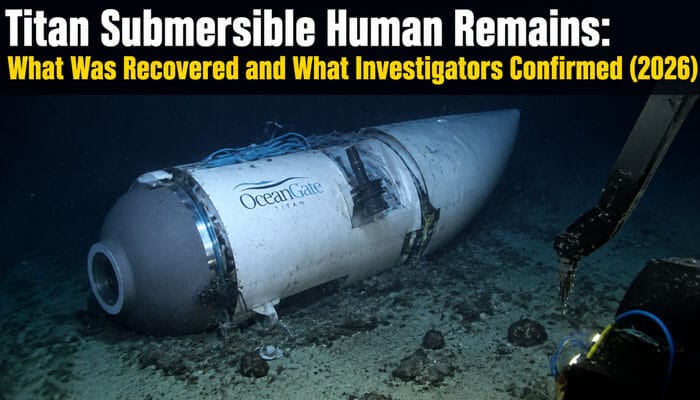

The recovery of OceanGate’s Titan wreckage raised difficult questions about whether investigators found human remains and whether the five people aboard were formally identified. Early announcements used cautious terminology, but later forensic evidence provided a clearer answer. Official records confirm that presumed Titan submersible human remains were recovered during two salvage operations. The U.S. Coast Guard later disclosed that the Department of Defense DNA Identification Laboratory positively identified DNA profiles corresponding to the five victims.
Authorities have not released detailed forensic reports or publicly disclosed the quantity, condition, or individual location of the recovered material. Claims describing those details without official documentation therefore go beyond the available evidence.
This guide explains what was recovered, what DNA testing confirmed, what remains private and what completed U.S. and Canadian investigations concluded about the Titan implosion.
Quick Answer: Titan submersible human remains
Yes. Titan submersible human remains were recovered from the wreckage during two separate salvage operations in 2023. The U.S. Coast Guard announced on June 28, 2023, that presumed human remains had been carefully recovered from within Titan’s wreckage. Additional presumed remains were recovered during a second operation in September 2023 and publicly announced on October 10.
During the Coast Guard’s September 2024 public hearing, an official presentation stated that the Armed Forces Medical Examiner System—specifically the Department of Defense DNA Identification Laboratory—positively identified DNA profiles for the five victims.
This does not mean that five complete bodies were recovered. Public evidence confirms the recovery of human material and DNA identification, but it does not describe the amount, condition, or completeness of the remains.
Key Takeaways
- Presumed human remains were recovered during two Titan salvage operations.
- DNA profiles were identified for all five people aboard the submersible.
- Officials have not said that five complete bodies were recovered.
- Detailed laboratory and medical-examiner reports remain private.
- The first recovery was publicly announced in June 2023.
- Additional presumed remains were announced in October 2023.
- Titan’s carbon-fiber cylinder fragmented into numerous pieces.
- Investigators could not conclusively identify the exact point where failure began.
- The carbon-fiber cylinder was considered the likeliest initial failure area.
- Investigators identified preventable engineering, testing, monitoring, and oversight failures.
What Happened to the Titan Submersible?
Titan was an experimental human-occupied submersible developed and operated by OceanGate. Its pressure vessel consisted of a cylindrical carbon-fiber composite section connected to titanium rings and titanium end domes.
On June 18, 2023, Titan began descending toward the wreck of RMS Titanic in the North Atlantic.
The five people aboard were:
- Stockton Rush, OceanGate chief executive and Titan pilot
- Paul-Henri Nargeolet, Titanic specialist
- Hamish Harding, businessman and explorer
- Shahzada Dawood, businessman
- Suleman Dawood, Shahzada Dawood’s 19-year-old son
At approximately 10:47 a.m. local time, while Titan was still descending, its pressure hull failed and the submersible imploded at a depth of roughly 3,360 metres. All five people aboard died.
Communications and tracking stopped at approximately the same time. A multinational search continued until June 22, when a remotely operated vehicle located Titan’s wreckage near Titanic.
The debris pattern established that the submersible had suffered a catastrophic pressure-hull failure rather than becoming disabled or stranded intact.
Were Titan Submersible Human Remains Recovered?
Yes. The recovery of Titan submersible human remains is confirmed by multiple official Coast Guard records.
On June 28, 2023, the Coast Guard reported that U.S. medical professionals would formally examine presumed human remains carefully recovered from within Titan’s wreckage.
The recovered debris and evidence were transported to St. John’s, Newfoundland and Labrador, aboard the recovery vessel Horizon Arctic. The material was then transferred into the custody of the Coast Guard-led Marine Board of Investigation.
A second recovery operation took place in September 2023. The Coast Guard later confirmed that additional presumed human remains were recovered from within Titan’s debris and transported for medical examination.
The Coast Guard’s September 2024 hearing presentation stated that remains had been recovered during both operations and respectfully transported to shore.
The word “presumed” was used during the initial recovery period because formal forensic examination and identification had not yet been publicly confirmed.
What Was Recovered During the Titan Salvage Operations?
The salvage missions recovered pressure-vessel components, electronic equipment, structural wreckage and human material.
First Titan Recovery Operation
The first major recovery operation followed the discovery of Titan’s debris field on June 22, 2023.
When Horizon Arctic arrived in St. John’s on June 28, the recovered material was transferred to investigators for transportation, cataloguing, forensic examination and technical analysis.
The recovered evidence included:
- Carbon-fiber pressure-vessel fragments
- Titanium pressure-vessel components
- Sections of Titan’s external structure
- Mechanical equipment
- Electronic equipment
- Presumed human remains
The Coast Guard’s initial announcement did not provide a complete item-by-item public inventory.
| Evidence category | Investigative purpose |
| Carbon-fiber fragments | Examine delamination, material defects, and structural failure |
| Titanium components | Reconstruct the pressure vessel and failure sequence |
| External wreckage | Study debris distribution and component movement |
| Electronic equipment | Attempt to recover operating and monitoring data |
| Presumed human remains | Conduct medical examination and forensic identification |
Second Titan Recovery Operation
A follow-up operation was conducted in late September 2023.
The NTSB reported that the additional recovered wreckage included Titan’s aft dome and an external camera. The Coast Guard also confirmed that additional presumed human remains were recovered.
| Recovery stage | Confirmed development |
| June 2023 | Initial wreckage, evidence and presumed remains recovered |
| September 2023 | Additional debris, aft dome, camera and presumed remains recovered |
| October 2023 | Evidence transported for technical and medical examination |
| November 2023 | U.S., Canadian and French investigators jointly reviewed evidence |
| September 2024 | DNA identification results were publicly disclosed |
Although the Coast Guard described the second effort as recovering the “remaining evidence,” not every component of Titan was recovered.
Canada’s Transportation Safety Board later explained that missing wreckage prevented investigators from conclusively identifying the precise point where structural failure began.
Were All Five Titan Victims Identified?
The clearest public forensic statement was presented during the Coast Guard Marine Board hearing in September 2024.
The presentation confirmed that:
- Presumed remains were recovered during two operations.
- The remains were respectfully transported to shore.
- The Department of Defense DNA Identification Laboratory positively identified DNA profiles for the five victims.
- The Rhode Island Medical Examiner coordinated decedent affairs with the families.
This means forensic specialists obtained biological evidence corresponding to the five people aboard Titan.
However, the public statement did not disclose:
- The size or quantity of the samples
- Whether samples were recovered separately
- Where material associated with each person was found
- The physical condition of the remains
- The laboratory process used for each identification
- Whether all recovered material was returned to the families
What DNA Testing Confirmed About Titan Submersible Human Remains
DNA identification is the strongest official forensic finding concerning the Titan submersible human remains, but it must be described precisely.
A forensic laboratory can develop a DNA profile from a limited quantity of biological material. Identifying five DNA profiles does not prove that investigators recovered five complete bodies.
| Official finding | Accurate interpretation |
| DNA profiles were identified for five victims | Biological evidence corresponding to everyone aboard was examined |
| Remains were recovered during two operations | Human material was recovered from the Titan site more than once |
| Medical professionals examined the evidence | A formal forensic process took place |
| Families worked with the medical examiner | Decedent affairs followed official procedures |
| Five complete bodies were recovered | Not established by the public record |
| Each victim was recovered separately | Not publicly confirmed |
| The condition of the remains is publicly known | False; those details have not been released |
The most accurate summary is:
Investigators recovered human remains and positively identified DNA profiles corresponding to the five Titan victims.
What Officials Have Not Disclosed About Titan Submersible Human Remains
Public agencies have released enough information to confirm the recovery and identification of Titan submersible human remains. They have not released a complete forensic account.
Official records do not disclose:
- The total quantity of human material recovered
- The physical condition of the remains
- Whether material associated with each victim was found separately
- Whether different samples were recovered together
- The exact wreckage component associated with each recovery
- Which samples came from the first salvage operation
- Which samples came from the second salvage operation
- The individual DNA-analysis methods
- The reference samples used for comparison
- Individual autopsy or medical-examiner findings
- Death certificates
- Photographs identified as showing human remains
- Whether every recoverable sample was returned to the families
These details may remain private for ethical, investigative, legal and family-related reasons.
The absence of publicly released information should not be filled with unsupported or graphic speculation. Articles claiming to describe the exact condition of individual victims are not supported by the public records discussed here.
What Titan Wreckage Was Recovered?
ROV footage and recovered evidence showed that different parts of Titan reacted differently during the pressure-hull collapse.
Canada’s Transportation Safety Board reported that:
- The titanium domes remained largely intact.
- The viewport was forced outward.
- The carbon-fiber cylinder separated into numerous fragments.
- The viewport itself was not recovered.
- The retaining ring surrounding the viewport was deformed.
- Cabin and electronic material was compressed with other wreckage.
NTSB investigators identified extensive delamination in recovered cylinder material. They also documented adhesive voids, rubbing damage, and a buckled section in a fragment believed to have originated near the bottom of the pressure vessel.
| Titan component | Reported condition |
| Forward titanium dome | Found largely intact |
| Aft titanium dome | Found and recovered |
| Carbon-fiber cylinder | Fragmented and extensively delaminated |
| Acrylic viewport | Not recovered |
| Viewport retaining ring | Deformed consistently with outward movement |
| Cabin and electronic material | Found compressed with other wreckage |
| External camera | Recovered during the second operation |
| Human remains | Recovered during both operations |
Because not every component was recovered, investigators could not conclusively determine the exact location where structural failure began.
The available engineering and debris evidence pointed to the carbon-fiber cylinder as the likeliest initial failure area.
Did Titan’s Viewport Cause the Implosion?
Titan’s acrylic viewport was a significant design concern, but investigators did not identify it as the likeliest origin of the fatal failure.
The installed viewport was rated for pressure equivalent to a depth of approximately 649 metres, while OceanGate intended to use Titan at depths approaching 4,000 metres.
The manufacturer advised OceanGate that additional testing was required and recommended a conventionally designed, independently certified alternative. OceanGate did not complete the recommended additional testing before using the viewport.
However, the recovered retaining ring was deformed in a way indicating that the viewport moved outward during the collapse.
The Canadian TSB concluded that this evidence suggested the viewport had not failed first.
The balanced conclusion is:
- The viewport was inadequately rated and tested for Titan’s intended operating depth.
- It represented a serious unresolved safety concern.
- The available wreckage did not establish that it initiated the implosion.
- The carbon-fiber cylinder remained the likelier initial failure area.
Titan Recovery and Investigation Timeline
| Date | Event |
| June 18, 2023 | Titan began its final descent and imploded |
| June 22, 2023 | An ROV located Titan’s debris field |
| June 28, 2023 | Initial wreckage and presumed human remains arrived in St. John’s |
| Late September 2023 | Second recovery operation collected additional evidence |
| October 10, 2023 | Coast Guard announced the recovery of additional presumed remains |
| November 2023 | International investigators jointly reviewed the recovered evidence |
| September 16–27, 2024 | Coast Guard conducted its public Marine Board hearing |
| September 2024 | DNA profiles for the five victims were publicly confirmed |
| August 5, 2025 | Coast Guard Marine Board released its Report of Investigation |
| October 2, 2025 | NTSB issued its final accident report |
| June 17, 2026 | Canadian TSB released its final investigation report |
The Coast Guard’s August 2025 document is formally known as the Marine Board of Investigation’s Report of Investigation.
Its release stated that the report remained under review by the Coast Guard Commandant, who was expected to issue a Final Action Memorandum.
The NTSB completed its investigation in October 2025, and the Canadian TSB released its final report in June 2026.
What Happened During Titan’s Final Minutes?
Titan began its descent toward Titanic on the morning of June 18, 2023. Communication continued while the submersible travelled deeper.
The final operational message reported that Titan had dropped two weights.
Canada’s TSB found that the pressure hull failed approximately 5.4 seconds after the weight message appeared on the surface-support team’s computer.
Differences among official timestamps partly reflect the delay between a message being transmitted underwater and appearing aboard the Polar Prince.
The reconstructed sequence was:
- Titan continued descending.
- Two weights were released earlier than normal.
- The message and final tracking information reached the surface team.
- The pressure hull failed within seconds.
- Communications and tracking stopped.
Did Dropping Two Weights Indicate an Emergency?
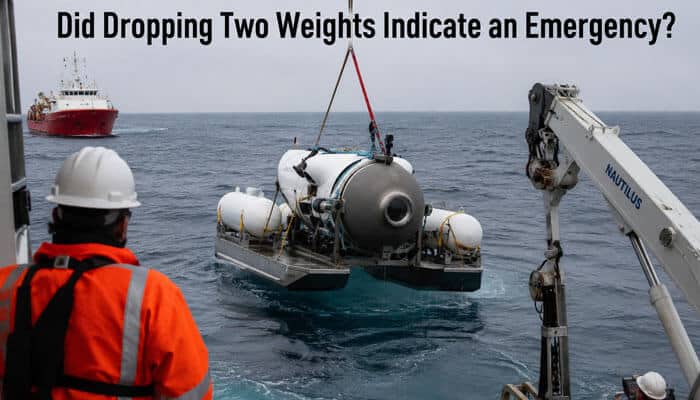
Releasable weights were part of Titan’s normal buoyancy-control system. Releasing them could reduce the descent rate or help the submersible prepare for neutral buoyancy.
The Canadian TSB found that the two weights were released earlier than was usual during Titanic dives. This suggested that the crew may have been attempting to slow the descent.
However, investigators could not determine why the weights were released at that moment.
The weight release does not prove that the crew recognized an imminent pressure-hull failure. No publicly released final message reported:
- Flooding
- Structural cracking
- A hull-monitoring warning
- Electrical failure
- Loss of control
- A declared emergency
- An emergency ascent
Did the Passengers Know the Hull Was Failing?
Public evidence does not establish that the occupants knew a catastrophic implosion was imminent. The final communications were operational rather than distress messages. The pressure hull failed only seconds after the final recorded exchange.
This does not support claims that the passengers spent hours waiting for the submersible to collapse. Investigators have not released individual medical findings or evidence establishing exactly what the occupants heard, saw or understood. Descriptions of their precise final experiences remain speculative.
What About the Underwater Sounds Detected During the Search?
During the multinational search, aircraft detected underwater sounds in the wider search area. Responders redirected ROV operations and shared recordings with the U.S. Navy because every potentially useful lead had to be investigated while Titan’s fate remained unknown.
Officials did not confirm that the sounds came from Titan or its occupants. Later investigative reconstruction placed the implosion close to the moment communications and tracking ended on June 18.
The fact that the wreckage was not located until June 22 does not mean the passengers remained alive during the search.
What Recovered Electronics Could Not Reveal
Investigators recovered some electronic and camera equipment, but the implosion damaged important devices and data. The NTSB examined an external camera whose casing remained largely intact even though its lens had shattered.
Investigators retrieved 12 still images and nine videos from an undamaged memory card, but none came from the fatal dive. Electronic components believed to include a mission computer were found in a compressed mass. Investigators were unable to recover operational or diagnostic information from those components.
Consequently, investigators could not establish:
- What appeared on the pilot’s displays immediately before failure
- Whether the occupants saw a monitoring warning
- What the final strain measurements showed
- Whether an uncommunicated action was attempted
- What sounds may have been detected inside the cabin
- Whether an onboard system registered the beginning of the collapse
This missing information is one reason official reports cannot reconstruct every detail of the final seconds.
What Caused the Titan Implosion?
Three principal investigative bodies examined the disaster:
- U.S. Coast Guard Marine Board of Investigation
- U.S. National Transportation Safety Board (NTSB)
- Transportation Safety Board of Canada
Their responsibilities differed, but their central findings were broadly consistent.
| Investigative authority | Central conclusion |
| U.S. Coast Guard Marine Board | The casualty was preventable and involved serious design, certification, maintenance, operational, workplace, and oversight failures |
| NTSB | OceanGate’s inadequate engineering failed to establish the vessel’s actual strength and durability |
| NTSB | Delamination and additional damage led to local buckling and implosion |
| Canadian TSB | Carbon-fiber hull damage accumulated progressively during repeated dives |
| Canadian TSB | The as-built cylinder was not properly tested against theoretical design assumptions |
| Canadian TSB | Company structure and social and psychological factors weakened risk management |
| Canadian TSB | Canadian and international oversight gaps left Titan without adequate independent scrutiny |
What the NTSB Concluded
The NTSB determined that the probable cause was OceanGate’s inadequate engineering process.
The company did not establish the pressure vessel’s actual strength and durability and continued operating a carbon-fiber composite hull that had sustained delamination and additional damage.
That damage eventually led to local buckling and implosion.
The NTSB found that:
- One or more delaminations likely formed after dive 80.
- Additional damage occurred after dive 82.
- The pressure vessel’s condition continued to deteriorate.
- The damaged structure could not survive another descent to Titanic depth.
- OceanGate did not perform adequate cycle-life testing.
- The company’s interpretation of monitoring data was flawed.
- Titan should have been removed from service after evidence of damage appeared.
What the Canadian TSB Concluded
Canada’s final report found that Titan’s carbon-fiber hull failed progressively, with damage accumulating over repeated dives. The as-built properties were not tested to confirm that they matched the theoretical specifications used during design, and construction did not follow established engineering practices.
The TSB also found that OceanGate did not know how long the hull would remain safe under repeated deep-sea pressure cycles. Risk management was weakened by company structure and social and psychological factors. Inconsistent international rules and gaps in Canadian oversight also allowed Titan to operate without effective independent review.
What the Coast Guard Marine Board Concluded
The Coast Guard Marine Board described the casualty as preventable.
Its report identified inadequate design, certification, maintenance and inspection as primary contributing factors.
It also cited:
- OceanGate’s workplace culture
- Ineffective handling of whistleblower concerns
- Failure to respond appropriately to known hull anomalies
- Insufficient independent engineering oversight
- Gaps in domestic and international regulations
The report included 17 safety recommendations addressing submersible oversight, operator documentation, emergency planning, federal coordination, deep-ocean response capability and international standards.
Why a Deep-Sea Implosion Is Different From a Typical Shipwreck
Titan was designed to maintain a near-normal atmospheric environment inside its cabin while resisting enormous external ocean pressure. A conventional ship may flood and sink over minutes or hours. A deep-diving pressure vessel operates differently. Once its structure loses the ability to resist the external load, collapse may propagate extremely rapidly.
That distinction explains why:
- Communication stopped suddenly.
- The carbon-fiber cylinder fragmented.
- The titanium domes remained comparatively intact.
- No intact passenger cylinder was recovered.
- Investigators relied heavily on debris analysis, material testing and DNA evidence.
Descriptions of a long, survivable flooding event do not match the official engineering findings.
Common Misconceptions About Titan Submersible Human Remains
- “No human remains were found”
False. The Coast Guard confirmed that presumed Titan submersible human remains were recovered during two salvage operations.
- “Five complete bodies were recovered”
Not confirmed. Officials have not described the recovered material as five complete or intact bodies.
- “Only one or two victims were identified”
False. The Coast Guard stated that DNA profiles were identified for the five victims.
- “The passenger compartment was recovered intact”
False. Titan’s carbon-fiber cylinder separated into numerous pieces. Although the titanium domes remained largely intact, the central pressure cylinder did not.
- “The passengers survived for several days”
Unsupported. Investigators placed the implosion close to the time communication and tracking stopped on June 18.
- “The underwater sounds proved the passengers were alive”
False. The sounds were investigated during the search, but no official investigation established that they came from Titan.
- “The viewport was proven to have failed first”
False. The Canadian TSB found that the retaining-ring deformation suggested the viewport moved outward and did not initiate the failure.
- “Officials released photographs of the remains”
No official public record reviewed for this article contains images identified as showing human remains.
Released images show Titan, its structural wreckage, recovery equipment and investigation exhibits.
Why Officials Used the Term “Presumed Human Remains”
Authorities used the phrase “presumed human remains” when announcing the recoveries because forensic analysis had not yet been publicly completed.
Specialists first needed to determine:
- Whether the recovered material was human
- Whether usable DNA could be obtained
- Whether the DNA corresponded to the people aboard
- Whether environmental exposure affected testing
- Whether reference samples produced reliable identifications
The Coast Guard’s September 2024 presentation later confirmed the identification of DNA profiles corresponding to the five victims.
Continued use of the original recovery terminology in some documents does not mean investigators remained uncertain after forensic testing was completed.
Titan Investigation Status as of July 2026
| Investigation or process | Public status |
| Coast Guard public hearing | Completed in September 2024 |
| Forensic DNA identification | Confirmed for the five victims |
| Coast Guard Marine Board report | Released August 5, 2025 |
| Coast Guard Commandant review | A Final Action Memorandum was expected after review |
| NTSB investigation | Completed; final report issued October 2, 2025 |
| Canadian TSB investigation | Completed; final report issued June 17, 2026 |
| Detailed public forensic reports | Not released |
| Exact initial failure location | Not conclusively determined |
| Likeliest failure area | Carbon-fiber cylinder |
The Canadian report is the latest major completed investigation document.
It issued six recommendations concerning regulatory oversight, technical standards, safety management, support-vessel responsibilities and international coordination.
Safety Lessons and Recommendations
The Titan disaster exposed weaknesses in the oversight of privately operated human-occupied submersibles.
U.S. Recommendations Focused On:
- Studying current pressure-vessel-for-human-occupancy operations
- Developing clearer federal requirements
- Strengthening registration and documentation
- Improving independent engineering review
- Requiring appropriate emergency-response planning
- Expanding deep-ocean search and recovery capability
- Promoting mandatory international standards
Canadian Recommendations Focused On:
- Regulatory oversight
- Technical standards for submersibles
- Safety-management arrangements
- Responsibilities of operators and support vessels
- Information sharing among government organizations
- International coordination
Canada’s TSB concluded that non-binding international guidance and incomplete information sharing contributed to inconsistent oversight.
Respectful Reporting on Titan Submersible Human Remains
Articles about the Titan submersible human remains should answer legitimate public questions without using graphic speculation to attract clicks.
A reliable article separates evidence into clear categories:
| Evidence category | Example |
| Officially confirmed | Human remains were recovered during two operations |
| Forensically confirmed | DNA profiles for the five victims were identified |
| Technically confirmed | The carbon-fiber cylinder fragmented and delaminated |
| Not publicly disclosed | Quantity and condition of the remains |
| Investigative finding | The cylinder was the likeliest failure area |
| Unsupported speculation | Graphic descriptions absent from official records |
This approach preserves the dignity of the victims while helping readers understand exactly what investigators established.
Conclusion: Titan submersible human remains
Official evidence provides a clear but appropriately limited answer to questions about the Titan submersible human remains. Human remains were recovered during two separate salvage operations. The Department of Defense DNA Identification Laboratory subsequently identified DNA profiles corresponding to the five people aboard Titan.
Authorities have not stated that five complete bodies were recovered. They have not publicly disclosed the amount, condition or precise individual location of the remains. Claims supplying those details without official evidence go beyond the public record.
The engineering evidence is more extensive. Titan’s carbon-fiber pressure vessel contained manufacturing anomalies, lacked adequate testing and accumulated structural damage. The NTSB concluded that delamination and additional damage led to local buckling. Canada’s TSB found that damage accumulated progressively until the hull failed.
The responsible conclusion is factual and restrained: Titan submersible human remains connected through DNA profiles to the five victims were recovered, while detailed forensic information remains private. The disaster resulted from preventable failures in engineering, testing, monitoring, organizational risk management and independent oversight.
Titan Submersible Human Remains FAQs
1. Were Titan submersible human remains recovered?
Yes. The U.S. Coast Guard confirmed that presumed Titan submersible human remains were recovered during two separate salvage operations in 2023.
2. Were all five Titan victims identified?
Yes. The Department of Defense DNA Identification Laboratory positively identified DNA profiles corresponding to all five people aboard Titan.
3. Were five complete bodies recovered from the Titan wreckage?
Officials have not said that five complete bodies were recovered. Public evidence confirms the recovery of human material and DNA identification, but it does not disclose the amount, condition or completeness of the remains.
4. Where were the Titan submersible human remains found?
The Coast Guard said presumed remains were recovered from within Titan’s wreckage and debris at the ocean-floor site. The exact recovery location associated with each victim has not been publicly disclosed.
5. How were the Titan submersible human remains identified?
The recovered material underwent official medical and forensic examination. DNA specialists positively identified profiles corresponding to all five Titan victims.
