



Searches for thejavasea.me leaks aio-tlp370 lead to a confusing mix of claims involving leaked databases, exposed credentials, private information, downloadable archives, software bundles, and a mysterious identifier known as AIO-TLP370. The real difficulty is not finding pages discussing the subject. It is determining which claims are supported by evidence and which have simply been repeated across multiple websites.
Based on the material reviewed for this article, thejavasea.me leaks aio-tlp370 is clearly an established online search topic. What remains much less certain is whether AIO-TLP370 represents one newly confirmed data breach, exactly what the alleged package contains, who created it, where any information originated, or how many people may have been affected.
There is also an important terminology issue. Some online discussions connect the “TLP” portion of AIO-TLP370 with cybersecurity’s Traffic Light Protocol. FIRST’s current standard recognizes:
- TLP: RED
- TLP: AMBER
- TLP: GREEN
- TLP: CLEAR
“TLP370” is therefore not an official Traffic Light Protocol classification. This article takes an evidence-first approach to the topic. Rather than treating every claim as established fact, it separates verified information from speculation, explains the security implications, and gives practical guidance for readers concerned about possible exposure.
Quick Answer: What Is TheJavaSea.me Leaks AIO-TLP370?
Thejavasea.me leaks aio-tlp370 is an online phrase associated with an alleged leak, archive, dataset, tool bundle, or digital package identified as AIO-TLP370. Multiple websites discuss the term, but their descriptions do not consistently agree on exactly what AIO-TLP370 contains.
The safest way to describe thejavasea.me leaks aio-tlp370 is as an alleged leak-related package or identifier whose exact origin, scope, and contents remain insufficiently verified.
The strongest conclusions currently available are:
- AIO-TLP370 has a genuine online footprint.
- It is frequently associated with allegedly leaked or redistributed digital material.
- AIO is commonly interpreted as “All-In-One.”
- That interpretation does not prove what this specific package contains.
- The exact meaning of TLP370 remains unclear.
- TLP370 is not an official FIRST Traffic Light Protocol label.
- Exact victim counts and record totals remain unverified.
- Search-result repetition should not be confused with independent confirmation.
- Unknown leak-related downloads can introduce malware, phishing, privacy, and account-security risks.
Key Takeaways
Anyone researching thejavasea.me leaks aio-tlp370 should keep these points in mind:
- The search topic is real, but many of the strongest claims remain unconfirmed.
- Public pages disagree on whether AIO-TLP370 is primarily a dataset, credential collection, software bundle, digital archive, or combination of resources.
- A data dump does not automatically prove that a new cyberattack occurred.
- Previously exposed information can be repackaged under a different name.
- Old passwords may still create security problems when users continue reusing them.
- TLP370 is not an official Traffic Light Protocol designation.
- HTTPS does not prove that a downloadable file is safe.
- You do not need to download an alleged database to investigate known credential exposure.
- Account protection should take priority over curiosity.
For readers seeking a concise explanation, AIO-TLP370 is best understood as a disputed leak-related identifier rather than a fully documented breach event.
What Does “TheJavaSea.me Leaks AIO-TLP370” Mean?
Breaking thejavasea.me leaks aio-tlp370 into individual components helps explain why the topic is difficult to verify.
| Component | Likely Meaning | Verification Status |
|---|---|---|
| TheJavaSea.me | Domain referenced in online discussions | Domain existence is verifiable |
| Leaks | Suggests files or information were exposed or redistributed | Descriptive wording; not proof of a breach |
| AIO | Commonly interpreted as “All-In-One” | Plausible secondary-source interpretation |
| TLP370 | Appears to function as a package, version, release, or indexing identifier | Exact meaning remains unverified |
| TLP | Also refers to FIRST’s Traffic Light Protocol | Real framework, but TLP370 is not an official TLP label |
The key point is simple:
Interpreting a package name is not the same as verifying its origin or contents.
A filename can tell us what somebody chose to call something. It cannot independently establish:
- Who created it
- Where its contents originated
- Whether its data is genuine
- Whether the material is new
- Whether several datasets were combined
- Whether the package was modified
- Whether downloadable copies are safe
That distinction is central to thejavasea.me leaks aio-tlp370, because much of the online discussion starts with the package name and then moves quickly into assumptions about what the name supposedly proves.
What Can Actually Be Verified About AIO-TLP370?
The most useful way to investigate the subject is to separate observable facts from repeated claims.
1. The Search Term Has a Real Online Footprint
Multiple websites currently publish content about thejavasea.me leaks aio-tlp370.
That confirms that the phrase has attracted enough online interest to become an established search query.
However, search visibility does not independently establish:
- Who created AIO-TLP370
- Which organization was allegedly compromised
- Whether a new intrusion occurred
- Whether the information is current
- Whether advertised files are authentic
- Whether different copies contain identical information
- How many people were affected
Search visibility proves discussion—not necessarily the underlying breach claim.
2. Sources Disagree About What AIO-TLP370 Contains
Current descriptions vary substantially.
AIO-TLP370 has variously been described as:
- A leaked-data collection
- A credential package
- A digital archive
- An “all-in-one” bundle
- A collection of software or tools
- A group of digital files
- A wider cybersecurity incident
These descriptions are not interchangeable.
The disagreement does not prove that AIO-TLP370 is fabricated. It does mean that the most dramatic version should not be presented as confirmed fact without stronger evidence.
3. A Package Name Does Not Establish Provenance
A label such as AIO-TLP370 cannot prove:
- Who assembled the package
- Who originally collected any data
- Whether the information is authentic
- Whether records were modified
- Whether everything came from one incident
- Whether older datasets were combined
- Whether files contain malware
- Whether the description attached to a file is accurate
That matters for thejavasea.me leaks aio-tlp370 because filenames can be copied, renamed, reused, and repackaged without preserving their original source or context.
4. TLP370 Is Not an Official Traffic Light Protocol Label
One of the clearest verifiable facts surrounding AIO-TLP370 is that “TLP370” is not an official FIRST Traffic Light Protocol category.
FIRST’s standardized framework currently recognizes:
- TLP: RED
- TLP: AMBER
- TLP: GREEN
- TLP: CLEAR
Therefore, an article should not describe AIO-TLP370 as “Traffic Light Protocol Level 370” or another official TLP classification.
Verified Facts vs Popular AIO-TLP370 Claims
The following table summarizes the evidence position around thejavasea.me leaks aio-tlp370.
| Claim | Assessment | Why |
|---|---|---|
| The term exists online | Verified | Multiple pages discuss AIO-TLP370 |
| AIO-TLP370 is described as leak-related | Verified as an online description | Secondary coverage repeatedly frames it this way |
| AIO definitely means “All-In-One” for this package | Plausible but unconfirmed | Common interpretation, not authoritative confirmation |
| TLP370 is an official cybersecurity TLP level | Incorrect | FIRST recognizes four official labels |
| AIO-TLP370 definitely contains passwords | Unverified | Public descriptions conflict |
| Millions of people were affected | Unverified | No authoritative victim total identified |
| One brand-new breach produced AIO-TLP370 | Unverified | Origin has not been established |
| Every AIO-TLP370 file is identical | Unverified | A filename does not establish file integrity |
| HTTPS proves a download is safe | Incorrect assumption | Encryption does not authenticate file contents |
| Old credentials can still matter | Supported | Reused credentials can remain exploitable |
The important editorial takeaway is that phrases such as “alleged,” “reported,” “described as,” and “unverified” are more appropriate than unsupported certainty.
Evidence Confidence Scale
A useful way to evaluate thejavasea.me leaks aio-tlp370 claims is to classify them by evidence strength.
| Confidence Level | Meaning | Example |
|---|---|---|
| Confirmed | Supported directly by authoritative evidence | TLP370 is not an official FIRST TLP label |
| Strongly Supported | Supported by recognized cybersecurity guidance | Reused compromised passwords create security risks |
| Plausible but Unconfirmed | Reasonable interpretation without primary confirmation | AIO may mean “All-In-One” |
| Unsupported | Reliable evidence has not been identified | Exact victim totals or definitive package contents |
Confidence would increase if future claims were supported by:
- A formal breach notice from an affected organization
- A regulatory disclosure
- A government cybersecurity authority
- A documented incident-response investigation
- Multiple independent researchers
- Technical evidence establishing the origin and age of the data
- A reputable newsroom using direct primary sources
Until evidence reaches that level, precise claims should remain labeled unconfirmed.
Is AIO-TLP370 a Data Leak, Data Breach, Dump, or Aggregated Dataset?
A major source of confusion around thejavasea.me leaks aio-tlp370 is that terms such as leak, breach, dump, and dataset are often used as though they mean the same thing.
They do not.
| Term | General Meaning | Relevance to AIO-TLP370 |
|---|---|---|
| Data Breach | Unauthorized access to systems or protected data | Requires evidence of a particular compromise |
| Data Leak | Information becomes improperly exposed or distributed | Does not always require a new intrusion |
| Data Dump | Collection of information distributed as a dataset | Does not prove when or how it was obtained |
| Aggregated Dataset | Information combined from multiple sources | Could contain data from several incidents |
| Recycled Breach Data | Previously exposed information redistributed later | Should not automatically be described as a new breach |
| Fake or Mislabeled Leak | Fabricated or inaccurately described material | May be used to attract attention, downloads, or payments |
This distinction helps explain why AIO-TLP370 cannot responsibly be reduced to a simple “confirmed breach” label without additional evidence.
An alleged dataset could theoretically be:
- Entirely new
- Entirely old
- A mixture of old and new records
- Combined from several previous breaches
- Built partly from publicly available information
- Partially fabricated
- Republished under a different filename
Is AIO-TLP370 a Confirmed New Data Breach?
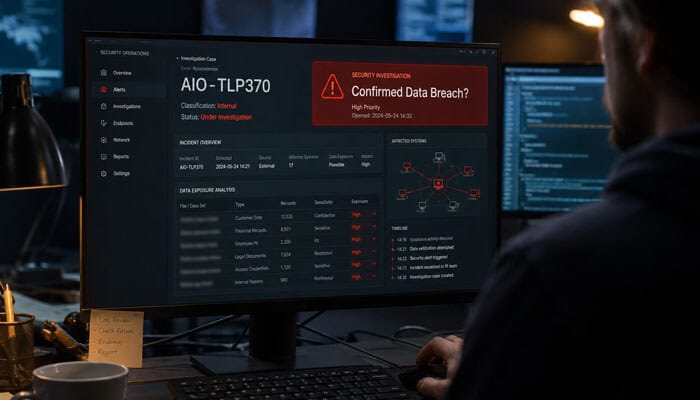
Based on the evidence currently available, thejavasea.me leaks aio-tlp370 is better described as an alleged leak-related package or identifier whose exact origin and contents remain insufficiently verified.
A well-documented breach normally produces evidence answering questions such as:
- Which organization was compromised?
- What system was affected?
- When did the incident happen?
- What information was accessed?
- How was the compromise detected?
- How many people were affected?
- Has the organization acknowledged it?
- Has an independent researcher corroborated it?
- Has a regulator or government authority documented it?
Current public discussion does not consistently establish those points.
That does not prove unauthorized material does not exist.
It means the available evidence does not justify presenting one specific breach narrative as established fact.
Does AIO Mean “All-In-One”?
Many secondary articles discussing thejavasea.me leaks aio-tlp370 interpret AIO as “All-In-One.”
That interpretation is plausible because “all-in-one” is commonly used to describe a bundle combining several tools, files, datasets, or resources.
However, AIO-TLP370 coverage does not agree on exactly what is supposedly combined.
Depending on the source, descriptions may include:
- Data
- Credentials
- Software
- Tools
- Scripts
- Files
- Digital resources
The most accurate wording is therefore:
AIO is commonly interpreted as “All-In-One” in AIO-TLP370 coverage, but that interpretation does not independently establish what the package contains.
What Does TLP370 Mean?
The exact meaning of TLP370 within thejavasea.me leaks aio-tlp370 remains unclear.
Possible interpretations include:
- Package identifier
- Release number
- Version number
- Internal index
- Sequential label
- Community-created tag
None has been conclusively established by an authoritative primary source. What can be established is that TLP370 does not correspond to FIRST’s standardized Traffic Light Protocol naming system.
Until credible documentation explains the identifier, reporting on AIO-TLP370 should treat “TLP370” simply as part of the package name rather than an official security classification.
Why Old or Recycled Breach Data Still Matters
Even if thejavasea.me leaks aio-tlp370 eventually proves to involve previously exposed information rather than newly stolen records, old information can still have security value. A password leaked years ago may remain useful to an attacker if the same credential is still active somewhere else.
Potential risks include:
- Credential stuffing
- Account takeover
- Password guessing
- Targeted phishing
- Identity correlation
- Social engineering
Simple Example
Suppose separate sources reveal:
Old breach: email address + username
Another source: phone number
Public profile: employer + location
Current scam: personalized phishing message
An attacker does not need one complete, newly stolen database. Several older pieces of information can be combined into a convincing modern attack. The practical lesson for readers following thejavasea.me leaks aio-tlp370 is that two statements can be true simultaneously:
Old breach information may still create a security risk. Old information republished today should not automatically be called a brand-new breach.
Why So Many AIO-TLP370 Articles Sound Certain
A major problem with unusual leak-related keywords is circular sourcing.
The process can look like this:
- One website publishes a claim.
- Several websites repeat it.
- Search engines index every version.
- New writers discover many similar pages.
- They assume the claim has been independently verified.
- More articles repeat the same information.
The number of pages discussing thejavasea.me leaks aio-tlp370 increases. The amount of original evidence may remain exactly the same. That creates an information amplification loop.
The right question is:
Where did the original claim come from?
Ten articles derived from one unsupported statement do not provide ten independent confirmations.
How to Evaluate TheJavaSea.me Leaks AIO-TLP370 Claims
Anyone researching thejavasea.me leaks aio-tlp370 can evaluate public claims without downloading private or unauthorized material.
1. Look for an Identifiable Primary Source
Stronger evidence may come from:
- An affected organization
- Government cybersecurity authority
- Regulator
- Incident-response provider
- Recognized security researcher
- Court or regulatory filing
- Reputable newsroom using direct sources
Anonymous summaries and unsupported articles provide weaker evidence.
2. Check Whether Sources Are Truly Independent
Two pages making the same AIO-TLP370 claim may have copied the same original source. Independent verification means separate investigators reached compatible conclusions using their own evidence.
3. Look for a Clearly Identified Victim
A serious breach report should normally answer:
- Who was affected?
- Which service or system was compromised?
- When did it happen?
- What information was exposed?
If those basic facts cannot be established, claims about a “massive breach” deserve additional scrutiny.
4. Demand Evidence for Large Numbers
If an article about thejavasea.me leaks aio-tlp370 claims millions of passwords, thousands of documents, or a precise number of victims, ask:
- Where did the number come from?
- Were duplicates removed?
- Were records validated?
- Were the records current?
- Did all records come from the same source?
Without those answers, precise numbers can create a false impression of certainty.
What Domain Signals Can—and Cannot—Tell You
Technical signals can add context to AIO-TLP370, but they cannot authenticate a specific leak.
| Signal | What It Can Tell You | What It Does Not Prove |
|---|---|---|
| HTTPS | Browser-server traffic can be encrypted | Files are safe |
| TLS Certificate | Encrypted transport can be established | Website operator is trustworthy |
| Search Indexing | Search engine discovered a page | Claims are verified |
| Domain Age | Domain has existed for a period | Current content is legitimate |
| Server Response | Infrastructure is active | A specific leak is authentic |
| Popularity | People visit a website | Information is accurate |
A padlock icon should never be treated as proof that a download connected with thejavasea.me leaks aio-tlp370 is legitimate.
Is TheJavaSea.me Safe?
A search for AIO-TLP370 naturally leads some users to ask whether TheJavaSea.me itself is safe. There is not enough evidence to give an entire changing domain a permanent universal classification of safe or unsafe. A better approach is to evaluate the behavior of the specific page, file, or request you encounter.
Potential warning signs include:
- Unexpected executable downloads
- Requests to disable antivirus software
- Instructions to ignore browser warnings
- Password-protected archives from unknown sources
- Fake CAPTCHA instructions
- Requests to paste commands into PowerShell or a terminal
- Unexplained administrator privileges
- Unknown browser extensions
- Unrelated login pages
- Cryptocurrency payment requests
- Artificial urgency
When following thejavasea.me leaks aio-tlp370, never weaken your security controls simply because a webpage instructs you to do so.
Why Unknown AIO-TLP370 Downloads Can Be Risky
Someone researching AIO-TLP370 may eventually encounter sites claiming to offer downloadable copies. That introduces a separate cybersecurity risk.
Unknown files may theoretically contain:
- Credential-stealing malware
- Ransomware
- Remote-access malware
- Malicious scripts
- Browser-session theft tools
- Fake documents
- Phishing pages
- Deceptive installers
- Unwanted applications
Archive formats such as ZIP, RAR, and 7Z can contain multiple files behind a single download. That means an alleged thejavasea.me leaks aio-tlp370 archive may create risks unrelated to whether the claimed leak itself is authentic.
Potential consequences include:
- Email compromise
- Stolen browser sessions
- Financial fraud
- Cloud-account access
- Theft of personal documents
- Unauthorized remote access
- Further exposure of private information
There is no need for an ordinary reader to download an alleged leak archive merely to understand the subject.
What If You Already Downloaded an AIO-TLP370 File?
If you downloaded something advertised through thejavasea.me leaks aio-tlp370, the appropriate response depends on whether you simply downloaded the file or actually opened or executed it.
If You Downloaded It but Did Not Open It
Consider the following:
- Leave the file unopened.
- Delete the unknown download.
- Keep browser and operating-system protections enabled.
- Install pending security updates.
- Run a reputable security scan if concerned.
- Do not disable antivirus protection.
- Do not bypass browser warnings merely to access the file.
If You Opened or Executed an Unknown File
Take additional defensive steps:
- Stop interacting with the suspicious file.
- Run an updated security scan.
- Install pending browser and operating-system updates.
- Review important accounts for unusual activity.
- Sign out of unfamiliar sessions.
- Change potentially exposed passwords from a trusted device.
- Enable multi-factor authentication.
- Review account-recovery information.
- Check email forwarding rules.
- Contact your employer’s IT or security team if a work device was involved.
Reopening an unknown file simply to inspect it can add unnecessary risk.
What to Do If You Think Your Information Was Exposed
If your concern about thejavasea.me leaks aio-tlp370 is personal, focus on securing your accounts rather than trying to locate an alleged database.
1. Secure Your Primary Email First
Your primary email often controls password resets for many other services.
Review:
- Current password
- Recovery email
- Recovery phone number
- Active sessions
- Connected applications
- Forwarding rules
- Inbox filters
2. Replace Compromised and Reused Passwords
Prioritize:
- Primary email
- Password manager
- Bank and payment accounts
- Google, Microsoft, or Apple account
- Cloud storage
- Work accounts
- Social-media accounts
- Shopping services with saved payment details
Use a unique password for every important account.
3. Enable Multi-Factor Authentication
MFA adds another barrier beyond a password.
Options may include:
- Passkeys
- FIDO security keys
- Authenticator applications
- Push authentication
- One-time codes
For people worried about thejavasea.me leaks aio-tlp370, strengthening authentication is more useful than trying to obtain or inspect alleged leaked files.
4. Review Active Sessions
Look for:
- Unknown devices
- Unrecognized browsers
- Unexpected locations
- New connected applications
- Changed recovery information
- Suspicious integrations
Revoke anything you do not recognize.
5. Check Email Rules and Forwarding
Attackers sometimes create forwarding rules so copies of incoming messages continue to reach them.
Review:
- Automatic forwarding
- Inbox rules
- Filters
- Connected applications
- Recovery information
Delete anything you did not configure.
6. Watch for Follow-Up Phishing
The attention surrounding AIO-TLP370 can itself become phishing bait.
Be cautious of messages claiming:
- “Your password was found in AIO-TLP370.”
- “Click here to see your leaked information.”
- “Your account will be suspended.”
- “Pay to remove your information.”
- “Download the database to check your account.”
Open the official service independently instead of following unexpected links.
Personal Security Response Checklist
For readers concerned about thejavasea.me leaks aio-tlp370, this checklist prioritizes the most useful defensive actions.
| Action | Priority | Why It Matters |
|---|---|---|
| Secure Primary Email | Immediate | Email can reset many other accounts |
| Change Confirmed Compromised Passwords | Immediate | Stops continued use of exposed credentials |
| Replace Reused Passwords | Immediate | Reduces credential-stuffing risk |
| Enable MFA or Passkeys | High | Adds protection beyond passwords |
| Revoke Unknown Sessions | High | Removes potentially unauthorized access |
| Check Recovery Settings | High | Helps prevent account takeover |
| Review Email Forwarding | High | Detects persistent access |
| Monitor Financial Activity | High | Helps identify fraud |
| Install Security Updates | Medium | Reduces exposure to known vulnerabilities |
| Avoid Unknown Leak Downloads | Ongoing | Reduces secondary malware risk |
What to Do Based on the Type of Information Exposed
If credible evidence ever links specific personal information to AIO-TLP370, the correct response should depend on the data involved.
| Potentially Exposed Information | Recommended Response |
|---|---|
| Email Address | Watch for targeted phishing and suspicious password-reset messages |
| Password | Change it immediately everywhere it was reused |
| Email + Password | Secure email first, replace reused passwords, and enable MFA |
| Phone Number | Watch for impersonation and account-recovery attempts |
| MFA Recovery Codes | Regenerate or revoke them |
| Active Session/Token | Revoke sessions and reauthenticate trusted devices |
| Bank/Card Information | Contact the financial provider and monitor transactions |
| Identity Documents | Follow official identity-theft guidance for your country |
| Work Credentials | Notify your employer’s IT/security team promptly |
The security response to thejavasea.me leaks aio-tlp370 should be proportional to what was actually exposed rather than based on rumors alone.
Can You Check for Exposure Without Downloading AIO-TLP370?
Yes.
Readers researching AIO-TLP370 do not need an alleged archive to determine whether an email address has appeared in a known breach.
Established breach-notification services such as Have I Been Pwned provide a safer way to check known exposure.
Benefits include:
- No need to possess questionable datasets
- No unknown archive downloads
- Lower malware exposure
- No manual searching through other people’s private information
- Faster account-security decisions
A clean result does not prove your information has never been exposed. A breach-monitoring service can report only incidents and datasets it knows about.
For thejavasea.me leaks aio-tlp370, that limitation is especially important because the exact package contents have not been conclusively established.
What Businesses Should Do if AIO-TLP370 Mentions Their Brand
If a company is mentioned in connection with AIO-TLP370, it should neither ignore a credible allegation nor announce a breach before establishing evidence.
Preserve Evidence
Record:
- When the allegation appeared
- Relevant public URLs
- Screenshots
- Accounts spreading the claim
- Claimed breach dates
- Claimed data categories
- Named internal systems
Avoid unnecessarily redistributing personal data.
Investigate Internal Security Signals
Security teams can review:
- Abnormal authentication
- Unexpected privilege changes
- New administrator accounts
- Unusual data transfers
- Endpoint alerts
- Cloud-storage anomalies
- Suspicious API activity
- Remote-access events
Determine Whether the Data Could Be Genuine
For thejavasea.me leaks aio-tlp370, useful questions include:
- Does the structure resemble internal systems?
- Do account formats match company conventions?
- Are timestamps plausible?
- Is the information current?
- Could it originate from a vendor?
- Was some information already public?
- Are records malformed or fabricated?
- Could the material come from an older incident?
Rotate Credentials When Evidence Warrants It
If genuine authentication secrets appear exposed, revoke or rotate affected credentials and review active sessions.
Communicate Carefully
A responsible interim statement for a company named in thejavasea.me leaks aio-tlp370 might be:
“We are aware of the claim and are investigating its authenticity and whether any systems, employees, customers, or data were affected.”
That communicates action without overstating what is known.
AIO-TLP370 Rumor vs Evidence
| Rumor or Assumption | Evidence-Based Position |
|---|---|
| “Many sites mention it, so all claims must be true.” | Repetition does not equal independent verification |
| “TLP370 is an official cybersecurity classification.” | FIRST recognizes TLP: RED, TLP: AMBER, TLP: GREEN, and TLP: CLEAR |
| “AIO proves several breaches were combined.” | “All-In-One” is only a common interpretation |
| “A realistic filename proves the contents.” | File names do not authenticate data |
| “HTTPS means a download is safe.” | Encrypted transport does not establish file safety |
| “Old leaks do not matter.” | Reused credentials can remain useful to attackers |
| “I need the leaked database to check my email.” | Reputable breach-monitoring services provide a safer alternative |
| “One valid record proves the entire dataset is genuine.” | Mixed datasets can contain real, old, unrelated, or fabricated information |
Why “Exclusive Leak” Pages Deserve Extra Caution
Leak-related searches such as thejavasea.me leaks aio-tlp370 combine two powerful motivations:
fear and curiosity.
That makes them useful bait for malicious pages.
A page may promise exclusive leaked content while attempting to persuade visitors to:
- Download unknown archives
- Install browser extensions
- Enter passwords
- Disable antivirus protection
- Run terminal commands
- Join unknown private groups
- Pay cryptocurrency
- Ignore browser warnings
Artificial urgency is another warning sign.
Examples include:
- “Download before it disappears.”
- “Antivirus gives a false positive.”
- “Disable protection first.”
- “Run this command to unlock the archive.”
- “Only a few minutes remain.”
If a page tied to AIO-TLP370 uses those tactics, treat that as a reason to stop rather than continue.
Why This Topic Matters Even if AIO-TLP370 Is Never Fully Confirmed
The broader lesson from thejavasea.me leaks aio-tlp370 extends beyond one unusual search phrase. Modern search results can make uncertain claims appear more established than they really are.
A rumor can move through a simple cycle:
- One page publishes a claim.
- Blogs rewrite it.
- AI summaries paraphrase those blogs.
- Social posts repeat those summaries.
- Search engines index every version.
- New writers mistake the volume of coverage for proof.
The result is an information amplification loop.
The correct response is not to dismiss every cybersecurity allegation.
Instead, ask:
- What is the original source?
- What evidence supports the claim?
- Has anybody independently corroborated it?
- Is a victim organization identified?
- Is the data new?
- Is the information authentic?
- Are statistics documented?
- Is technical terminology being used correctly?
- Are verified facts separated from assumptions?
How This Article Researched TheJavaSea.me Leaks AIO-TLP370
This article approaches AIO-TLP370 using an evidence hierarchy rather than treating every search result as equally reliable.
The review considered:
- Exact-match searches for the focus keyword
- Multiple secondary pages with differing descriptions
- Public information about TheJavaSea.me
- FIRST Traffic Light Protocol documentation
- NIST password and account-security guidance
- CISA multi-factor authentication guidance
- FTC hacked-account recovery guidance
- Google Chrome download-security guidance
The article deliberately did not:
- Download alleged AIO-TLP370 archives
- Search stolen credentials
- Republish private information
- Provide unauthorized download locations
- Circumvent website restrictions
- Treat anonymous claims as confirmed facts
- Declare an organization breached without adequate evidence
That methodology matters because thejavasea.me leaks aio-tlp370 is a subject where the volume of repeated commentary appears greater than the amount of clearly attributable primary evidence.
Conclusion: What Can We Actually Verify?
The discussion around thejavasea.me leaks aio-tlp370 shows why cybersecurity claims should be evaluated carefully before they are treated as established facts. The term has a clear online footprint, but the available evidence does not conclusively establish one newly confirmed breach, a verified victim count, the exact contents of AIO-TLP370, or the identity of whoever created the package.
What can be stated with more confidence is that public descriptions of AIO-TLP370 conflict, “AIO” is commonly interpreted as “All-In-One,” and TLP370 is not an official FIRST Traffic Light Protocol classification.
For readers concerned about thejavasea.me leaks aio-tlp370, the safest response is not to search for or download questionable archives. Instead, focus on practical account protection: change reused passwords, secure your primary email, enable MFA or passkeys, review active sessions, check recovery settings, monitor for phishing attempts, and use reputable breach-notification services.
The most important takeaway is simple: the number of websites repeating a claim does not prove that the claim is accurate. With thejavasea.me leaks aio-tlp370, reliable verification matters more than speculation, sensational headlines, or unsupported numbers.
TheJavaSea.me Leaks AIO-TLP370 FAQs
1. What is TheJavaSea.me leaks AIO-TLP370?
thejavasea.me leaks aio-tlp370 is an online search phrase associated with an alleged leak, archive, dataset, bundle, or digital package called AIO-TLP370. Multiple websites discuss it, but descriptions of its contents differ.
2. Are the TheJavaSea.me leaks AIO-TLP370 a confirmed data breach?
Current evidence does not establish thejavasea.me leaks aio-tlp370 as one independently confirmed new breach with a clearly identified victim, incident date, affected system, and verified record count.
3. Is TLP370 an official Traffic Light Protocol level?
No. When discussing thejavasea.me leaks aio-tlp370, remember that FIRST’s official framework uses TLP:RED, TLP:AMBER, TLP: GREEN, and TLP: CLEAR. TLP370 is not an official designation.
4. What information was leaked in AIO-TLP370?
Secondary pages discussing thejavasea.me leaks aio-tlp370 make different claims involving credentials, personal data, software, files, tools, and other digital resources. The exact contents should not be treated as confirmed without stronger evidence.
5. Should I download AIO-TLP370 to check my information?
No. If you are researching thejavasea.me leaks aio-tlp370, downloading an unknown alleged leak archive introduces unnecessary malware and privacy risk. Reputable breach-monitoring services are safer.
6. What should I do if my password may have leaked?
If you are worried because of thejavasea.me leaks aio-tlp370, change the affected password, replace it anywhere it was reused, enable MFA, review active sessions, secure your primary email, and verify recovery settings.
7. Does HTTPS mean an AIO-TLP370 download is trustworthy?
No. A page connected to thejavasea.me leaks aio-tlp370 may use HTTPS while still offering unsafe or unverified files. HTTPS protects network transport; it does not prove that a download is authentic or malware-free.
