



If you have ever held a forex position past the end of the trading day, a small charge or credit will have appeared on your account overnight. That is swap, and for some traders it is not merely a cost. It is a reason they cannot use a standard account at all.
A swap-free account removes that overnight interest. It is often called an Islamic account, because the traders who need it most are those following Islamic finance principles, under which earning or paying interest is prohibited. This guide explains what swap actually is, how brokers replace it when they remove it, what the terms usually contain, and who genuinely benefits from switching.
What Is a Swap in Forex Trading?
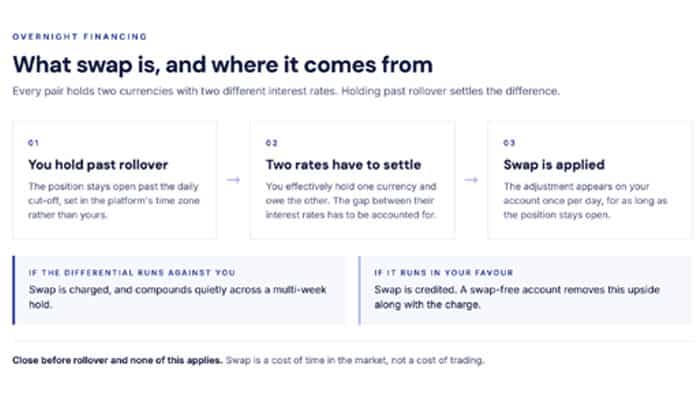
Every currency pair involves two currencies with two different interest rates. When you hold a position overnight, you are effectively holding one currency and owing the other, so the interest rate difference between them has to be settled. That settlement is the swap, also called rollover.
Depending on the direction of your trade and which currency carries the higher rate, swap can be charged to you or credited to you. Brokers apply it at a set time each day, calculated in the platform’s own time zone rather than yours, which is why the charge sometimes appears at an hour that seems arbitrary from where you are sitting.
For a day trader who closes everything before the session ends, swap never appears. For anyone holding positions for days or weeks, it becomes a running cost that quietly compounds. And for traders who cannot accept interest in any form, it is a barrier rather than a cost.
What Is a Swap-Free Account?
A swap-free account is an account where overnight interest charges are removed on eligible instruments. The standard account type at most brokers is swap-enabled by default, with swap-free status granted on request rather than offered automatically.
Two details in that sentence matter more than they look. First, swap-free usually applies to a defined list of instruments, not to everything you can trade. Second, it is granted at the broker’s discretion, which means eligibility rules, documentation requirements and available markets differ from one broker to the next.
It is also worth knowing that the status often applies at the client level rather than the account level. Under GTCFX’s terms, for example, if a swap-free account is made available to you, all of your accounts become swap-free by default unless separately agreed. If you were planning to run one swap-free account alongside a conventional one, check that assumption before you rely on it.
How Swap-Free Accounts Work in Practice
Removing swap does not remove the underlying cost of financing an overnight position. The broker still carries that cost, so it reappears in a different form. Understanding which form is the practical difference between a swap-free account that saves you money and one that does not.
The Grace Period and the Administrative Fee
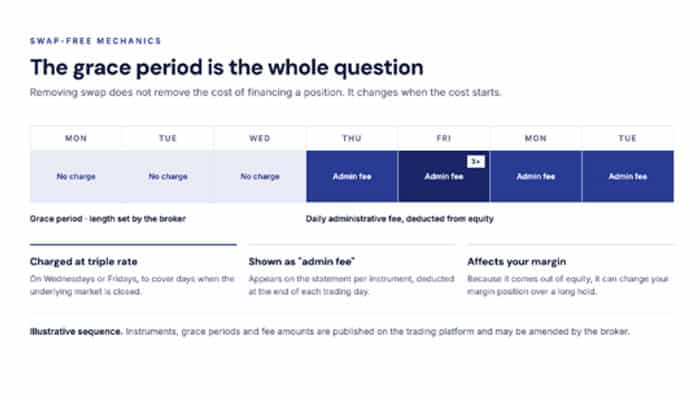
The most common model works in two stages. Positions held overnight incur nothing for an initial window, known as the grace period. Once a position stays open beyond that window, a daily administrative fee applies instead.
The mechanics are worth reading closely. Under GTCFX’s swap-free terms, the administrative fee is calculated daily, deducted from account equity at the end of each trading day, and shown on your statement as an “admin fee” on a per-instrument basis. On Wednesdays or Fridays it is charged at three times the standard rate, to account for days when the underlying market is closed. Because the fee comes out of equity, it can also affect your margin, which makes it your responsibility to keep an eye on the account rather than assume nothing is accruing.
The list of eligible instruments, the length of the grace period and the fee amounts are published through the platform, and brokers generally reserve the right to amend that list at their discretion. Check it before you open a position you intend to hold, not after.
Terms That Can Change
Swap-free accounts come with conditions attached that standard accounts do not have, and they are usually set out in a separate document rather than the main client agreement.
Two clauses recur across the industry and both appear in GTCFX’s terms. The account cannot be used primarily to profit from swap charges, and abuse, arbitrage or manipulation gives the broker grounds to act at its discretion. Separately, the broker may widen the minimum spread or increase commission on a swap-free account, and may charge additional fees where it considers this appropriate. None of that is unusual, but it does mean the pricing on a swap-free account is not automatically identical to the standard one.
Swap-Free vs a Standard Account
The comparison depends almost entirely on how long you hold positions.
| Standard account | Swap-free account | |
| Overnight cost | Swap, charged or credited daily | None during grace period, admin fee after |
| Cost direction | Can be positive or negative | Charge only, never a credit |
| Instrument coverage | All tradable instruments | A defined eligible list |
| Pricing | Standard spreads and commission | Spread or commission may differ |
| How to get it | Default | On request, at broker discretion |
For an intraday trader, the two accounts are effectively identical, because neither swap nor admin fee is ever triggered. For a swing trader holding a few days at a time, a swap-free account can be cheaper if the grace period covers the typical holding period, and more expensive if it does not. For a position trader holding weeks, the admin fee will usually exceed what swap would have cost on a favourable carry.
One thing a swap-free account definitively removes is the possibility of positive swap. If your strategy relies on being paid to hold a position, that upside disappears along with the charge.
Swap-Free Accounts and Islamic Finance
The reason these accounts exist is riba, the prohibition on interest in Islamic finance. Swap is calculated from interest rate differentials, so it falls squarely within what the prohibition addresses. Removing it is what the account is designed to do.
Whether that alone makes a trading account acceptable is a separate question, and not one a broker or a guide like this can answer. Scholars hold differing views on leveraged CFD trading, on speculation, and on contracts settled in cash rather than by delivery. The removal of swap addresses one specific concern. It does not resolve the others, and no broker is in a position to certify that it has.
The practical advice is to look past the label. An account marketed as an Islamic account is telling you that swap has been removed, which is a statement about fees rather than a religious ruling. If the answer matters to you, read the account terms in full, note what replaces the swap, and take the specifics to a qualified scholar you trust rather than relying on marketing language.
Opening a Swap-Free Account with GTCFX
Swap-free status at GTCFX is granted on request rather than applied automatically, and the standard account type is swap-enabled by default. Availability also depends on which account you hold: the option is offered on the Standard account and is not available on ECN.
Before requesting it, read the swap-free terms rather than the summary. Three points in particular decide whether the account will actually suit you:
- The grace period is the whole question: Beyond it, the daily administrative fee begins, charged at triple rate on Wednesdays or Fridays. If your typical holding period is longer than the grace period, price that in.
- Pricing may not match the standard account: The terms permit a wider minimum spread or higher commission on a swap-free account, so compare the total cost rather than assuming you are only removing a line item.
- The eligible instrument list can change: Instruments, grace periods and fees are published on the platform and may be amended at the broker’s discretion. It is worth rechecking periodically rather than once at signup.
The account options page sets out which account types the request applies to. If you trade intraday and close everything before the daily rollover, none of this affects you and the standard account is simpler.
The Bottom Line
A swap-free account solves one specific problem: it removes overnight interest for traders who cannot accept it, or who would rather not pay it. What it does not do is make holding positions free.
Read the replacement mechanism before you switch. The grace period, the admin fee schedule and the eligible instrument list determine whether the account saves you anything, and all three are published. If you want to compare terms directly, GTCFX sets its swap-free conditions out in a standalone document.
Frequently Asked Questions
Is a swap-free account better than a standard one?
Only for certain holding periods and certain traders. It removes swap but replaces it with an administrative fee after a grace period, and it also removes any possibility of earning positive swap. Intraday traders gain nothing from switching.
Do swap-free accounts have hidden fees?
The fees are not hidden, but they are documented separately from the main client agreement. The administrative fee, the grace period and the eligible instrument list sit in the swap-free terms and on the trading platform, which is why reading that document matters more than reading the product page.
What is swap in forex?
Swap is the interest adjustment applied when a position is held past the daily rollover, derived from the interest rate difference between the two currencies in a pair. It can be charged or credited depending on your position direction, and it is applied in the platform’s time zone.
Disclaimer: Trading CFDs involves significant risk of loss and is not suitable for every investor. Leverage increases both potential gains and potential losses. Account terms described here are current at the time of writing and may be amended by the broker. Only trade with capital you can afford to lose, and seek independent advice if you are unsure.
