




Most business strategies are built around a familiar goal: attract customers, keep them inside your own ecosystem and give rivals as little access to them as possible. Digital poker turns that logic partly upside down. Two operators can compete fiercely for the same audience while also benefiting when their customers meet at the same tables.
The reason is structural. Poker is not simply a catalogue item that becomes more valuable because its graphics, promotions or interface improve. Its usefulness also depends on who else is available to play at that moment. A larger pool can support more tables, more stake levels, more tournament entries and more activity outside peak hours. In other words, customer numbers become part of the product itself.
Why Shared Player Pools Change the Product
For someone choosing where to play poker online, the front-end experience may appear to be the main product. In practice, much of the value sits behind the interface. The important question is whether enough other players are active to create a useful range of games at the moment a customer arrives.
That is what the industry means by liquidity. A deep player pool makes it easier to
- Fill six-seat or nine-seat cash tables
- Maintain several stake levels
- Keep different game formats active at the same time
- Support larger tournament fields
- Offer more varied tournament schedules
- Create stronger prize pools without requiring every individual brand to recruit all of those players itself
This creates an unusual technical structure. Several customer-facing operators can connect to a common gaming network. Each operator still manages its own customer relationship, interface, payments, promotions and service, but players from different brands can be seated together. The shared system handles functions such as matchmaking, table management and tournament entry.
A rival’s customer can improve your own product
That arrangement changes the meaning of competition. In a conventional subscription service, allowing a rival’s customer to consume part of your product could weaken exclusivity. Poker works differently because the rival’s customer can improve the experience for your own customer by occupying an otherwise empty seat or adding another entry to a tournament.
The effect becomes particularly important across different stake levels and hours of the day. One operator may have plenty of low-stakes traffic but fewer players interested in a particular format. Another may have customers active at different times. Combining those groups can turn several thin pockets of demand into one deeper marketplace.
That is why the decision to play online poker is closely linked to network size rather than brand features alone. Operators still have many ways to stand apart, but the game inventory is created collectively by active participants. Shared liquidity therefore lets businesses compete around the customer while cooperating on the underlying supply of opponents.
The Numbers Show Why Liquidity Deserves Executive Attention
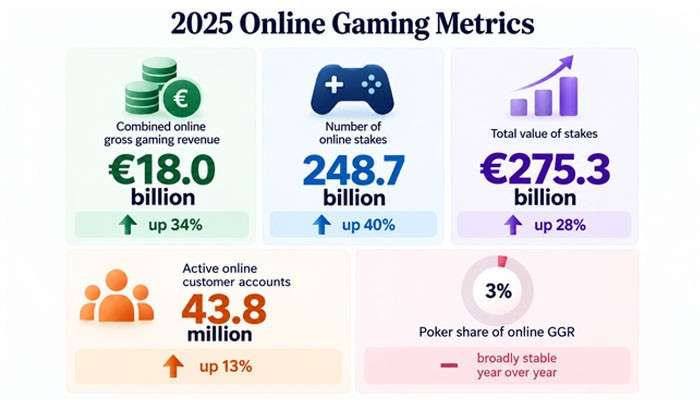
The latest European industry figures underline the scale surrounding this relatively compact poker segment. The European Gaming and Betting Association’s 2026 annual report covers aggregated 2025 activity from its members and notes that some of the increase reflects a larger membership base as well as growth among existing participants.
Original visual material created by us.
The 3% figure is important from a business perspective. Poker does not need to be the largest product category for liquidity to matter. In fact, a smaller segment has a strong reason to make each active customer more useful to the network rather than splitting demand across many isolated pools.
Research published in International Gambling Studies found that online poker players place value on game availability and that expanding a smaller player network can improve the usefulness of the platform, highlighting why liquidity is such an important part of the poker experience.
That is the unusual efficiency behind customer sharing. The same acquired customer can remain commercially attached to one operator while simultaneously improving game availability for users acquired elsewhere.
The Next Competitive Edge Is the Quality of the Pool
More players help, but research suggests that scale does not improve the experience indefinitely at the same rate. That is an important second lesson for any platform business considering shared networks.
Once sufficient scale exists, the composition of the pool starts to matter more. Players may value the availability of particular stakes, tournament styles, formats or playing times. A network with more total accounts is not automatically better if activity is concentrated in parts of the product that a particular customer rarely uses.
That shifts the operator’s job. Customer acquisition remains important, but so do scheduling, matchmaking, tournament design and the balance of activity across formats. Shared liquidity supplies the raw audience; product management decides how effectively that audience becomes usable inventory.
Device behaviour adds another layer. A European market outlook found that mobile devices generated 58% of online gambling revenue in 2024 and projected that share to reach 67% by 2029. As more activity moves to phones, fast access to active tables and suitable games becomes even more valuable.
The broader business lesson is that cooperation at the infrastructure level does not have to weaken differentiation. It can move competition toward the parts of the customer experience where each operator has more freedom to create value.
Sharing customers sounds irrational when customers are treated purely as property. In poker, active customers are also part of the inventory, so pooling them can make every participating business’s product more useful.
