


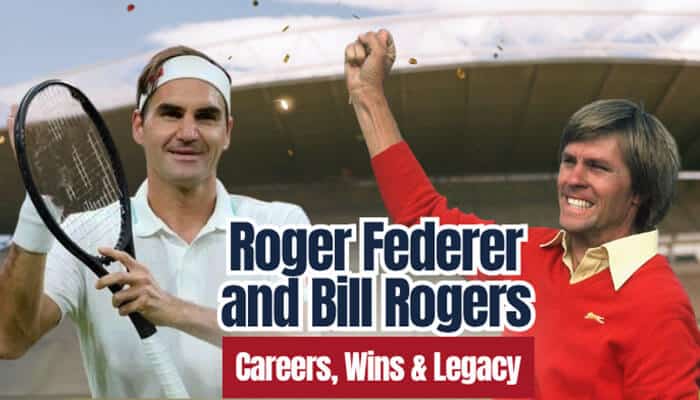

Roger Federer and Bill Rogers became champions in two very different individual sports. Federer built one of the greatest careers in tennis through sustained dominance, technical versatility and remarkable longevity. Rogers secured his place in golf history by winning the 1981 Open Championship and producing an exceptional season across the United States, England, Japan and Australia.
The achievements of Roger Federer and Bill Rogers cannot be evaluated simply by placing their trophy totals side by side. Tennis and golf use different tournament formats, scoring systems, competitive environments and measures of consistency. Federer had to defeat a series of direct opponents to win each tournament, while Rogers competed against large fields over four rounds of stroke play.
Their career patterns were also very different. Federer won Grand Slam titles across a 15-year period and remained an elite player against several generations of opponents. Rogers reached his greatest heights during a concentrated period, particularly in 1981, when he won seven times worldwide, captured a major championship and tied for second at the U.S. Open.
This guide examines the careers, biggest wins, championships, records, playing qualities, setbacks and lasting legacies of Roger Federer and Bill Rogers. It also clarifies an important point: there is no widely documented family, professional or competitive relationship between the two athletes. This is an editorial comparison of two respected champions rather than an account of a partnership between them.
Quick Answer: Roger Federer and Bill Rogers
Roger Federer is a retired Swiss tennis player who won 20 Grand Slam singles titles, 103 ATP Tour-level singles titles and 1,251 singles matches. He spent 310 weeks as world No. 1, including a record 237 consecutive weeks, and won a men’s record eight Wimbledon singles championships.
Bill Rogers is an American professional golfer best known for winning the 1981 Open Championship at Royal St George’s. Rogers recorded seven worldwide victories during 1981, tied with George Burns for second at that year’s U.S. Open, and was named PGA Player of the Year. The PGA Tour’s current historical database lists six recognized Tour victories, while the Texas Golf Hall of Fame credits him with 14 professional victories worldwide.
The main difference between Roger Federer and Bill Rogers is the shape of their success. Federer sustained an elite level across more than two decades. Rogers produced a shorter but extraordinary competitive peak that permanently established him as a major golf champion.
Key Takeaways
- Roger Federer won 20 Grand Slam singles titles and 103 ATP Tour-level singles championships.
- Federer held the world No. 1 ranking for 310 weeks, including a record 237 consecutive weeks.
- His eight Wimbledon men’s singles championships remain the tournament record as of July 2026.
- Bill Rogers won the 1981 Open Championship by four strokes at Royal St George’s.
- Rogers won seven tournaments worldwide in 1981 and tied for second at the U.S. Open.
- Roger Federer and Bill Rogers represent two different models of sporting greatness.
- Federer’s career reflects sustained excellence, adaptation, longevity and worldwide influence.
- Rogers’ career demonstrates the value of peak performance, international versatility, composure and personal balance.
- Both athletes continued contributing to their sports after leaving regular professional competition.
- There is no authoritative evidence of a direct family or professional connection between Federer and Rogers.
Who Are Roger Federer and Bill Rogers?
Roger Federer was born in Basel, Switzerland, on August 8, 1981. After becoming one of the world’s leading junior players, he developed into the dominant men’s tennis player of the mid-2000s and one of the central figures in the celebrated era shared with Rafael Nadal and Novak Djokovic.
Federer became known for his accurate serve, attacking forehand, one-handed backhand, efficient movement and ability to adjust his tactics across grass, hard courts and clay. He completed his professional career with 103 tour-level singles titles, 1,251 victories, 20 Grand Slam championships and 310 weeks at world No. 1.
Bill Rogers was born in Waco, Texas, on September 10, 1951. Growing up in a U.S. Air Force family, he lived in Germany, North Africa, Alabama and Texas. He began playing golf as a child, earned a scholarship to the University of Houston, became an All-American and represented the United States in the 1973 Walker Cup.
Rogers’ professional career reached its highest point in 1981. He won The Open at Royal St George’s, tied for second at the U.S. Open, recorded seven worldwide victories and played on the winning United States Ryder Cup team.
The careers of Roger Federer and Bill Rogers unfolded in different sporting eras. Federer became much more internationally famous because of his number of championships, career longevity, global sponsorships and the worldwide reach of modern tennis. Rogers nevertheless holds a permanent place in golf history as a major champion and one of the most successful players of the 1981 season.
Why Are Roger Federer and Bill Rogers Compared?
The phrase Roger Federer and Bill Rogers may confuse readers because the athletes competed in different sports, represented different countries, and reached their professional peaks in different eras.
Federer is the Swiss tennis champion associated with Wimbledon, the ATP Tour and the historic rivalries involving Nadal and Djokovic. Rogers is the American golfer associated primarily with the 1981 Open Championship and professional golf during the late 1970s and early 1980s.
There is no authoritative public record showing that Roger Federer and Bill Rogers are related or shared a significant professional relationship. Their official sporting profiles describe entirely separate careers in tennis and golf.
The comparison remains useful because their careers illustrate two different forms of sporting greatness.
Federer achieved:
- Sustained international dominance
- Success across different court surfaces
- Championships spanning several generations of opponents
- Repeated tactical reinvention
- Worldwide popularity extending beyond tennis
- A career that continued until injuries made further competition unsustainable
Rogers achieved:
- Victory in one of golf’s four major championships
- Seven worldwide wins during a single season
- Success in the United States, England, Japan and Australia
- Ryder Cup representation
- PGA Player of the Year recognition
- A respected post-playing career in club leadership, coaching and junior golf
Federer represents greatness accumulated over many seasons. Rogers demonstrates how one extraordinary competitive period can establish an athlete’s permanent historical legacy.
Roger Federer and Bill Rogers at a Glance
| Category | Roger Federer | Bill Rogers |
| Primary sport | Tennis | Golf |
| Nationality | Swiss | American |
| Born | August 8, 1981 | September 10, 1951 |
| Professional breakthrough | First ATP title in 2001 | First PGA Tour victory in 1978 |
| Greatest achievement | 20 Grand Slam singles titles | 1981 Open Championship |
| Top-level titles | 103 ATP singles titles | Six currently recognized PGA Tour wins |
| Worldwide professional titles | 103 ATP singles titles | 14 professional victories |
| Highest ranking or honor | World No. 1 for 310 weeks | 1981 PGA Player of the Year |
| Signature venue | Wimbledon | Royal St George’s |
| Team achievement | 2014 Davis Cup champion | 1981 Ryder Cup winner |
| Olympic achievement | Doubles gold and singles silver | Golf was not an Olympic event during his prime |
| Career pattern | Sustained elite success | Concentrated peak followed by early departure from full-time Tour golf |
| Main legacy | Excellence, adaptability, longevity and worldwide influence | Major success, international achievement, resilience and balance |
The statistics of Roger Federer and Bill Rogers should not be treated as directly equivalent. A tennis player earns a title by defeating consecutive opponents in head-to-head matches. A golfer wins by recording the lowest cumulative score against a large tournament field.
The comparison is therefore most valuable when it considers competitive pressure, adaptability, career longevity, international success and influence rather than relying only on trophy totals.
Roger Federer and Bill Rogers Career Timeline
| Year | Roger Federer milestone | Bill Rogers milestone |
| 1951 | — | Born in Waco, Texas |
| 1972 | — | Won the Southern Amateur |
| 1973 | — | Earned All-American recognition and played in the Walker Cup |
| 1974 | — | Earned his Tour card |
| 1978 | — | Won the Bob Hope Desert Classic |
| 1979 | — | Won the World Match Play Championship |
| 1981 | Born in Basel, Switzerland | Won The Open and seven tournaments worldwide |
| 1982 | — | Finished third at the U.S. Open |
| 1983 | — | Won the USF&G Classic |
| Late 1980s | — | Left full-time tournament golf |
| 1998 | Won the Wimbledon boys’ singles title | — |
| 2001 | Won his first ATP title and defeated Pete Sampras at Wimbledon | — |
| 2003 | Won his first Grand Slam title at Wimbledon | — |
| 2004 | Reached world No. 1 | — |
| 2009 | Completed the career Grand Slam at Roland Garros | — |
| 2014 | Helped Switzerland win its first Davis Cup | — |
| 2017 | Won the Australian Open and an eighth Wimbledon title | — |
| 2018 | Won his twentieth Grand Slam title | — |
| 2022 | Played his final professional match | — |
| 2026 | Elected to the International Tennis Hall of Fame | — |
The timeline highlights the central contrast between Roger Federer and Bill Rogers. Federer won Grand Slam titles from 2003 through 2018. Many of Rogers’ most important accomplishments were concentrated in and around 1981.
Roger Federer’s Tennis Career
Roger Federer’s Early Life and Development
Federer became one of the world’s best junior tennis players during the late 1990s. In 1998, he won the Wimbledon boys’ singles title and finished the season as the leading junior player.
His potential was clear, but the controlled champion remembered by later audiences had not yet fully developed. Federer could become emotional and impatient during his early matches. His progress therefore required more than improving individual strokes. He needed greater concentration, stronger conditioning, tactical discipline and emotional control.
Federer won his first ATP Tour-level singles title in Milan in 2001. During the same year, he produced an early signature victory by defeating seven-time Wimbledon champion Pete Sampras in five sets.
Sampras entered their fourth-round match with a 31-match Wimbledon winning streak. Federer was a 19-year-old prospect who had not yet won a major championship. The match became their only official Tour meeting and is often viewed as a symbolic transition between generations.
Federer did not win Wimbledon that year. Tim Henman defeated him in the quarterfinals, and Federer needed another two years to capture his first Grand Slam championship.
The delay matters because defeating an established champion did not instantly make Federer dominant. His breakthrough required continued technical development, stronger physical preparation and a more disciplined response to pressure.
Federer’s Rise to World No. 1
Federer won his first Grand Slam singles championship at Wimbledon in 2003, defeating Mark Philippoussis in straight sets in the final. He became the first Swiss man to win a major singles title.
The victory changed Federer’s position within tennis. He was no longer simply a gifted player with an attractive style. He had demonstrated that he could complete seven rounds of best-of-five-set competition and perform effectively under championship pressure.
Federer finished the 2003 season by winning the year-end ATP Finals. He then captured the 2004 Australian Open and reached world No. 1 for the first time on February 2, 2004.
He remained No. 1 for 237 consecutive weeks, from February 2004 until August 2008. That remains the longest uninterrupted reign since the ATP rankings began in 1973.
Federer eventually spent 310 total weeks at No. 1 and completed five seasons as the year-end leader: 2004, 2005, 2006, 2007 and 2009.
Federer’s Dominant Years
Federer won three of the four Grand Slam tournaments in 2004, 2006 and 2007. During his strongest period, he regularly reached the closing rounds of major events regardless of playing surface or location.
His dominance rested on several connected qualities:
- An accurate and difficult-to-read serve
- A forehand capable of controlling or ending points
- Efficient movement across different surfaces
- Comfort at both the baseline and net
- The ability to change pace, spin and ball height
- Improved patience during long matches
- Confidence in important moments
- Strong physical preparation
- Tactical flexibility against different playing styles
Federer’s tennis frequently appeared effortless. That appearance could disguise the preparation required to sustain such a high level. His success depended on repetition, anticipation, fitness and the ability to execute technically demanding shots under pressure.
Roger Federer’s Grand Slam Victories
Federer won 20 Grand Slam singles championships: six Australian Opens, one Roland Garros title, eight Wimbledon championships and five US Opens.
| Grand Slam tournament | Titles | Championship years |
| Australian Open | 6 | 2004, 2006, 2007, 2010, 2017, 2018 |
| Roland Garros | 1 | 2009 |
| Wimbledon | 8 | 2003, 2004, 2005, 2006, 2007, 2009, 2012, 2017 |
| US Open | 5 | 2004, 2005, 2006, 2007, 2008 |
| Total | 20 | 2003–2018 |
Australian Open Success
Federer’s six Australian Open championships illustrate the longevity of his success. His first came in 2004, when he reached No. 1. His sixth arrived in 2018, fourteen years later.
The Australian Open’s hard courts rewarded his serving, early ball striking and ability to attack short returns. His championships also occurred during different stages of his career and against different generations of opponents.
The 2017 tournament became one of Federer’s most memorable victories. He returned after missing six months because of a knee injury and defeated Nadal in a five-set final to win his first major title since Wimbledon in 2012.
Federer successfully defended the title in 2018 by defeating Marin Čilić in five sets. The victory made him the first man to reach 20 Grand Slam singles titles.
Completing the Career Grand Slam at Roland Garros
Clay presented Federer with his greatest surface-specific challenge, largely because Nadal became the dominant clay-court player of the era.
Federer reached three consecutive Roland Garros finals from 2006 through 2008 but lost each to Nadal. He received another opportunity in 2009 after Nadal was eliminated earlier in the tournament.
Federer defeated Robin Söderling in the final to complete the career Grand Slam by winning all four major tournaments at least once. At the time, he became the sixth man to accomplish the feat.
The championship filled the most obvious gap in Federer’s career record. It also showed that repeated disappointment did not prevent him from succeeding when another opportunity appeared.
Federer’s Record Eight Wimbledon Titles
Wimbledon is the tournament most closely associated with Federer.
He won five consecutive championships from 2003 through 2007 and added further titles in 2009, 2012 and 2017. His eight men’s singles championships remain the Wimbledon record as of July 2026.
Grass rewarded several of Federer’s defining strengths:
- Accurate serving
- Fast first-strike tennis
- Low backhand slices
- Comfortable forward movement
- Quick reactions near the net
- Efficient footwork
- The ability to shorten points
Federer’s 2017 championship was particularly notable. At 35, he completed the tournament without losing a set and became the first man to win eight Wimbledon singles titles.
Wimbledon also produced some of his most painful defeats. Nadal ended Federer’s five-title streak in the 2008 final. Djokovic defeated him in the finals of 2014, 2015 and 2019.
The 2019 final remains especially significant because Federer held two championship points before losing in a final-set tiebreak. The match demonstrated how narrow the margin between victory and disappointment can be, even for an eight-time champion.
Five Consecutive US Open Championships
Federer won the US Open every year from 2004 through 2008.
The hard courts allowed him to use his serve and forehand aggressively. His movement helped him defend when necessary, while his variety prevented powerful baseline opponents from settling into a predictable rhythm.
The 2008 championship was particularly important because Nadal had taken the No. 1 ranking and Federer had experienced a difficult season by his standards. Winning in New York showed that Federer could respond after losing his position at the top.
His five consecutive US Open titles remain one of the defining achievements of his competitive peak.
Federer’s Records and Career Statistics
Federer completed his professional career with one of the most extensive records in men’s tennis.
| Achievement | Federer’s record |
| ATP Tour-level singles titles | 103 |
| Career singles victories | 1,251 |
| Grand Slam singles titles | 20 |
| Grand Slam match victories | 369 |
| Weeks at world No. 1 | 310 |
| Consecutive weeks at No. 1 | 237 |
| Year-end No. 1 finishes | 5 |
| ATP Finals titles | 6 |
| ATP Masters 1000 titles | 28 |
| Consecutive major semifinals | 23 |
| Consecutive major quarterfinals | 36 |
| Consecutive grass-court victories | 65 |
| Wimbledon singles titles | 8 |
Federer never retired during any of the 1,526 singles and 224 doubles matches he began. That does not mean he avoided injuries. It means he completed every match he started, although injuries later caused him to withdraw from tournaments or miss extended periods.
Several records Federer once held have since been surpassed, particularly by Djokovic. Federer nevertheless retains the men’s record of eight Wimbledon singles championships and the ATP record of 237 consecutive weeks at No. 1.
Records measure competitive results, but they do not capture every part of an athlete’s influence. Federer also attracted international audiences, inspired younger players and became strongly associated with graceful movement, sportsmanship and tactical creativity.
Federer’s Playing Style and Tactical Evolution
Federer’s tennis was frequently described as elegant. Elegance alone, however, does not explain why his game was so effective.
The Serve
Federer did not rely exclusively on extreme speed. His service motion made direction difficult to recognize early.
He could direct the ball wide, toward the body or down the center using a similar delivery. Accurate placement frequently produced weak returns, allowing him to take control with his next shot.
The serve also helped Federer conserve energy. Quick service games reduced the physical demands of long matches, especially during the later stages of his career.
The Forehand
Federer’s forehand was his primary attacking weapon.
He could generate heavy topspin, flatten the ball for additional speed, create sharp inside-out angles or direct the shot behind an opponent. His footwork allowed him to move around the backhand and create forehand opportunities from several court positions.
The shot was effective not only because of its speed. Federer could disguise its direction until relatively late in the swing, making it difficult for opponents to anticipate.
The One-Handed Backhand
Federer’s one-handed backhand gave him variety but also created tactical challenges.
High-bouncing topspin could push him behind the baseline or force contact above his preferred striking zone. Nadal repeatedly exploited this issue by directing his left-handed forehand toward Federer’s backhand.
Federer adapted by:
- Taking the ball earlier
- Driving through the backhand more aggressively
- Using a low slice to disrupt rhythm
- Changing his position near the baseline
- Approaching the net
- Shortening exchanges when possible
These adjustments became particularly valuable during Federer’s successful comeback in 2017. His more aggressive backhand allowed him to take time away from opponents and alter the patterns of his matches against Nadal.
Movement and Court Position
Federer’s footwork contributed to the impression that he had more time than other players.
He moved quickly into position, maintained balance and recovered efficiently after each shot. Rather than relying only on speed, he anticipated likely ball direction and organized his movement early.
Later in his career, Federer positioned himself closer to the baseline. The tactic allowed him to strike the ball earlier, reduce his opponents’ reaction time and limit the number of physically demanding rallies.
Variety and Adaptability
Federer could:
- Attack immediately after the serve
- Defend from the baseline
- Change pace with a slice
- Use drop shots
- Approach behind a deep groundstroke
- Serve-and-volley
- Redirect an opponent’s power
- Move forward aggressively during return games
That variety helped extend his career as tactics, equipment and opponents changed. Federer did not attempt to play exactly the same way at 35 that he had at 23. He preserved the foundations of his game while adapting its execution.
Federer’s Greatest Rivalries
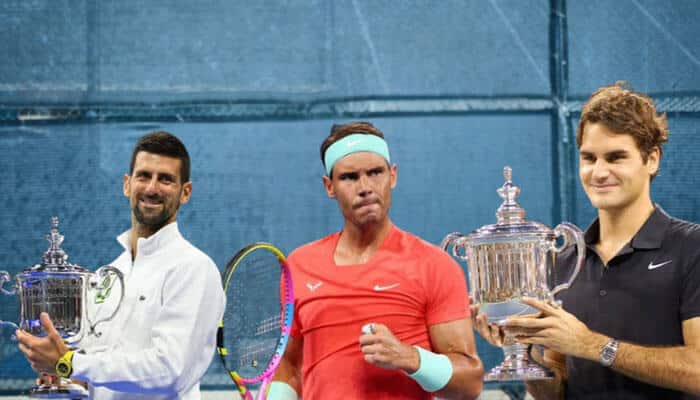
Federer’s legacy cannot be separated from his rivalries with Rafael Nadal and Novak Djokovic. Their overlapping careers helped define one of the strongest eras in men’s tennis.
Roger Federer vs. Rafael Nadal
Nadal created a difficult tactical matchup because his left-handed forehand produced heavy topspin toward Federer’s one-handed backhand. Nadal’s speed, defensive strength and clay-court dominance also limited Federer’s opportunities at Roland Garros.
Their rivalry produced several historically important matches:
- The 2007 Wimbledon final
- The 2008 Wimbledon final
- The 2009 Australian Open final
- The 2017 Australian Open final
- The 2019 Wimbledon semifinal
Nadal defeated Federer in the 2008 Wimbledon final, ending Federer’s five-year championship streak. Federer later earned one of his most meaningful victories over Nadal in the 2017 Australian Open final.
Their relationship eventually developed from intense competition into a widely recognized friendship. Nadal partnered Federer in the final professional match of Federer’s career at the 2022 Laver Cup.
Roger Federer vs. Novak Djokovic
Djokovic presented a different set of problems.
His return of serve, balance, backhand and defensive court coverage made it difficult for Federer to control points quickly. Djokovic could absorb pace, redirect the ball and extend rallies until Federer was required to take greater risks.
Their rivalry included Grand Slam finals at Wimbledon and the US Open. Djokovic’s victory in the 2019 Wimbledon final became one of the most dramatic losses of Federer’s career.
Nadal and Djokovic prevented Federer from winning even more championships. At the same time, competing against other historic players strengthened Federer’s legacy by forcing him to adapt and by producing matches that attracted worldwide attention.
Federer’s Injuries, Comeback and Retirement
Federer’s later career was increasingly shaped by knee injuries.
He underwent left-knee surgery in 2016 and right-knee procedures in February 2020, May 2020 and August 2021. He missed six months during 2016 and played only five tournaments between February 2020 and August 2022.
The 2017 Comeback
Federer’s return in 2017 became one of the most successful late-career comebacks in tennis.
After six months away, he won the Australian Open, defeated Nadal in the final and added an eighth Wimbledon championship without losing a set.
His adjustments included:
- More aggressive backhand play
- Earlier contact with the ball
- A carefully selected tournament schedule
- Greater willingness to shorten points
- More attention to recovery
- Increased use of forward court positioning
Federer added another Australian Open championship in 2018 and returned to world No. 1 at age 36.
The comeback changed the larger story of his career. Federer was no longer remembered only as the dominant player of the mid-2000s. He had demonstrated that an older champion could reinvent his tactics and succeed after injury.
Final Seasons and Retirement
Federer’s final singles match took place at Wimbledon in 2021, where Hubert Hurkacz defeated him in the quarterfinals.
His knee did not recover sufficiently for a full singles comeback. In September 2022, Federer announced that the Laver Cup would be his final ATP event.
His final professional appearance was a doubles match with Nadal against Jack Sock and Frances Tiafoe. Federer and Nadal lost in a match tiebreak, but the result was secondary to the emotional farewell that followed.
Federer’s retirement reflected an important reality of elite sport. His competitive desire remained, but his body could no longer sustain the preparation and workload required for regular professional tennis.
Federer’s Olympic and Davis Cup Career
Federer represented Switzerland in both the Olympic Games and Davis Cup.
At the 2008 Beijing Olympics, he partnered Stan Wawrinka to win the men’s doubles gold medal. At the 2012 London Olympics, Federer earned the men’s singles silver medal.
Davis Cup remained one of the most significant team trophies missing from his career until 2014.
Federer and Wawrinka helped Switzerland reach the final against France in Lille. Switzerland entered the final day with a 2–1 lead, and Federer defeated Richard Gasquet in straight sets to secure the country’s first Davis Cup championship.
Federer’s major national-team achievements included:
- Olympic doubles gold in 2008
- Olympic singles silver in 2012
- Davis Cup championship in 2014
- Fifteen years of Davis Cup participation
- Swiss Davis Cup records for singles and total match victories
These results demonstrate that Federer’s career was not based exclusively on individual rankings and Grand Slam tournaments.
Roger Federer’s Legacy Beyond Tennis
Sportsmanship and Fan Support
Federer received the ATP’s Stefan Edberg Sportsmanship Award 13 times. He was also selected as the ATP Fans’ Favourite for 19 consecutive years from 2003 through 2021.
His public reputation was shaped by:
- Respectful treatment of opponents
- Controlled match behavior
- Thoughtful interviews
- Appreciation for tennis history
- Long-term relationships with coaches and team members
- International popularity
- A visually distinctive style of play
Awards cannot provide a complete measurement of character. Federer’s repeated recognition by players and fans nevertheless illustrates the consistency of his public reputation.
Roger Federer Foundation
Federer established the Roger Federer Foundation in 2003.
The foundation has reached more than one million children and invested more than $50 million in community-based education initiatives in Southern Africa and Switzerland.
This work expanded Federer’s influence beyond professional tennis and created a long-term structure for supporting early education.
Leadership Within Tennis
Federer served as president of the ATP Player Council from 2008 through 2014 and later returned to the council from 2019 through 2022.
That service gave him a role in discussions involving player interests, tournament structures and the direction of professional men’s tennis.
Roger Federer’s Legacy in 2026
Federer’s competitive record has been complete since 2022, but his formal historical recognition continues.
He was elected to the International Tennis Hall of Fame’s Class of 2026. The induction celebration for Federer and contributor Mary Carillo is scheduled for August 27–29, 2026, in Newport, Rhode Island. Because the ceremony had not occurred as of July 27, 2026, Federer should be described as elected to the Hall of Fame rather than already formally inducted.
Federer’s record of eight Wimbledon men’s singles championships also remained intact following the 2026 tournament. Djokovic surpassed Federer’s men’s Wimbledon match-win total during the event, but Federer continued to hold the championship record.
Federer’s legacy in 2026 includes:
- 20 Grand Slam singles titles
- 103 ATP Tour-level singles championships
- 1,251 singles victories
- 310 weeks at world No. 1
- A record 237 consecutive weeks at No. 1
- A record eight Wimbledon men’s singles titles
- Olympic and Davis Cup success
- Election to the International Tennis Hall of Fame
- Continuing philanthropic involvement
- Lasting influence on tennis technique, popularity and athlete branding
Bill Rogers’ Golf Career
Bill Rogers’ Early Life and Amateur Career
Bill Rogers grew up in a military family and lived in several locations during childhood. He began playing golf in Alabama at nine and entered competitive golf by the age of 13.
After his family settled in Texas, Rogers continued developing his game and earned a golf scholarship to the University of Houston. He won the 1972 Southern Amateur and the 1973 All-American Intercollegiate Invitational, received All-American recognition and earned his Tour card in 1974.
Rogers also represented the United States in the 1973 Walker Cup.
His amateur record is important because it shows that the 1981 Open Championship was not an isolated result by an unknown player. Rogers had already competed successfully in junior, collegiate and international amateur golf before becoming an established professional.
Bill Rogers’ Professional Breakthrough
Rogers became a regular Tour professional during the 1970s.
His first PGA Tour victory came at the 1978 Bob Hope Desert Classic. The PGA Tour’s current career record identifies it as the first of his six recognized Tour victories.
Rogers was not primarily known for exceptional driving distance. His strengths were more closely associated with:
- Accuracy
- Consistent ball striking
- Intelligent course management
- Emotional control
- Patience
- International adaptability
- The ability to recover after mistakes
In 1979, Rogers won the World Match Play Championship at Wentworth in England. The victory demonstrated that he could compete successfully outside the United States and against leading international golfers.
His willingness to travel became a defining part of his professional identity. Rogers won events in several countries at a time when not every successful American golfer regularly followed an international schedule.
Bill Rogers’ Extraordinary 1981 Season
The 1981 season transformed Rogers from an established professional into a major champion and one of the leading golfers in the world.
He won seven tournaments worldwide. Four of those victories appear on the PGA Tour’s current career page:
- Sea Pines Heritage
- The Open Championship
- World Series of Golf
- Texas Open
Rogers also won the Suntory Open in Japan, the New South Wales Open and the Australian Open.
Bill Rogers’ Main 1981 Results
| Event | Result | Importance |
| Sea Pines Heritage | Winner | Important PGA Tour title |
| U.S. Open | Tied for second | Finished three strokes behind David Graham |
| The Open Championship | Winner | Rogers’ only major title |
| World Series of Golf | Winner | Prestigious elite-field victory |
| Texas Open | Winner | Defeated Ben Crenshaw in a playoff |
| Suntory Open | Winner | International victory in Japan |
| New South Wales Open | Winner | International victory in Australia |
| Australian Open | Winner | Significant international title |
| Ryder Cup | Winning U.S. team member | Represented the United States |
| PGA Player of the Year | Recipient | Recognition of his exceptional season |
At the 1981 U.S. Open, Rogers and George Burns both finished on 276, three strokes behind champion David Graham. Rogers should therefore be described as tied for second or joint runner-up rather than the sole runner-up.
One month later, Rogers won The Open. He followed that championship with further victories and a place on the winning U.S. Ryder Cup team.
The Texas Golf Hall of Fame identifies Rogers as the 1981 PGA Player of the Year and credits him with 14 professional victories worldwide.
Why the 1981 Season Was Exceptional
Rogers won across four countries:
- The United States
- England
- Japan
- Australia
That international range required him to adjust to different climates, grasses, course designs, travel schedules and competitive fields.
The season also contained both disappointment and recovery. Rogers came close to winning the U.S. Open before responding with an Open Championship victory the following month.
That response is central to understanding his peak. Rogers did not allow a missed opportunity at Merion to prevent him from succeeding at Royal St George’s.
How Bill Rogers Won the 1981 Open Championship
The 1981 Open Championship at Royal St George’s remains Rogers’ defining achievement. He almost did not enter. His friend and fellow Texan Ben Crenshaw encouraged him to travel to England and compete.
Rogers then nearly missed his first-round tee time after misreading the starting list. Journalist John Whitbread noticed that Rogers was still on the practice putting green and alerted him. Rogers hurried to the first tee and arrived in time to avoid disqualification.
First Round: Surviving Difficult Conditions
Rogers opened with a round of 72.
The conditions were difficult enough that Jack Nicklaus recorded an 83, described by The Open as the worst score of his professional career. Rogers’ opening round kept him within reach of the leaders without creating a damaging deficit.
Second Round: Taking the Lead
Rogers shot a 66 in the second round.
The score moved him to the top of the leaderboard, one stroke ahead of Crenshaw. Rogers had transformed a steady opening into a serious championship opportunity.
Leading a major creates a different form of pressure. A player must continue attacking appropriate opportunities without becoming excessively defensive.
Third Round: Creating Separation
Crenshaw struggled to a 76 in the third round. Rogers followed his second-round 66 with a 67 and built a five-stroke lead over Mark James and Bernhard Langer.
The advantage gave Rogers control, but it did not guarantee victory. Links golf can create unpredictable bounces, changing winds and costly bunker problems.
Final Round: Recovering After a Double Bogey
Rogers began the final round five strokes ahead. A double bogey at the seventh hole reduced his advantage over Langer to one. The championship had suddenly become uncertain.
Rogers responded by making birdies at the ninth, tenth and twelfth holes. Those three birdies in four holes restored his advantage and placed him back in control. He completed a final-round 71 and finished with a four-round score of 276, four under par.
Rogers won by four strokes over Langer and by seven over Raymond Floyd and Mark James. He was the only player in the tournament to finish below par.
Final Leaderboard
| Position | Player | Score |
| 1 | Bill Rogers | 276, four under par |
| 2 | Bernhard Langer | 280, even par |
| T3 | Raymond Floyd | 283, three over par |
| T3 | Mark James | 283, three over par |
Why the Victory Mattered
Rogers’ Open Championship victory:
- Made him a major champion
- Validated his international playing schedule
- Followed his tie for second at the U.S. Open
- Required him to recover from a costly final-round mistake
- Became the centerpiece of a seven-win season
- Contributed to his PGA Player of the Year recognition
- Secured his permanent place in golf history
The championship also demonstrated an important feature of pressure performance. Rogers did not win because he avoided every mistake. He won because he responded decisively after making one.
Bill Rogers’ Major Championship Record
Rogers’ 1981 Open title was his only major championship, but his record included several other strong finishes.
Tied for Second at the 1981 U.S. Open
Rogers and George Burns finished three strokes behind David Graham at Merion.
Graham closed with a final-round 67 to win the championship. Rogers’ result showed that his Open victory was part of a sustained period of major-level performance rather than a single fortunate week.
Third at the 1982 U.S. Open
Rogers finished third at the 1982 U.S. Open behind Tom Watson and Jack Nicklaus.
That gave him three notable major finishes within approximately one year:
- Tied for second at the 1981 U.S. Open
- Winner of the 1981 Open Championship
- Third at the 1982 U.S. Open
Rogers also finished eighth in the 1983 Open at Royal Birkdale. That was the final occasion on which he made the cut in The Open.
His major record was not as extensive as those of golfers who remained near the top for many seasons. One championship and two additional top-three U.S. Open finishes nevertheless demonstrate the exceptional quality of his competitive peak.
Bill Rogers’ Career Wins and Statistics
The PGA Tour’s current profile lists six recognized victories.
| Year | Tournament |
| 1978 | Bob Hope Desert Classic |
| 1981 | Sea Pines Heritage |
| 1981 | The Open Championship |
| 1981 | World Series of Golf |
| 1981 | Texas Open |
| 1983 | USF&G Classic |
The modern PGA Tour database includes The Open among Rogers’ six Tour victories. The Texas Golf Hall of Fame describes his record as five PGA Tour wins plus the Open Championship.
The difference reflects classification rather than an additional victory. The Open is included in the PGA Tour’s current total, while some historical summaries identify it separately.
Bill Rogers’ Broader PGA Tour Record
| PGA Tour category | Record |
| Career starts | 320 |
| Cuts made | 232 |
| Recognized victories | 6 |
| Runner-up finishes | 9 |
| Third-place finishes | 4 |
| Top-five finishes | 35 |
| Top-10 finishes | 60 |
| Top-25 finishes | 111 |
| Official career earnings | $1,384,710 |
| Lowest recorded Tour round | 62 |
| Worldwide professional wins | 14 |
The PGA Tour records 320 starts, 232 made cuts, six wins, nine runner-up finishes and 60 top-10 results.
The official earnings figure belongs to the prize-money structure of Rogers’ era. Modern tournament purses and sponsorship opportunities are much larger, making direct comparisons with current players potentially misleading.
The 1981 Texas Open
Rogers defeated Crenshaw in a playoff at the 1981 Texas Open.
The victory was personally meaningful because both players were Texans and friends. It also completed the PGA Tour portion of Rogers’ outstanding season.
Final PGA Tour Victory
Rogers won the USF&G Classic in 1983, the last victory listed on his PGA Tour record.
Although he continued competing, the workload created by his international success had begun to affect his enthusiasm for professional tournament life.
Bill Rogers in the Ryder Cup
Rogers represented the United States in the 1981 Ryder Cup at Walton Heath in England.
The selection added another significant achievement to his finest season. Rogers was not only an individual major champion but also part of a successful national team.
He later returned to the Ryder Cup in a leadership role, serving as an assistant captain for the victorious United States team at Brookline in 1999.
His Ryder Cup legacy included:
- Player on the winning 1981 U.S. team
- Assistant captain of the winning 1999 U.S. team
- Contributions during active competition and post-playing leadership
Why Bill Rogers Left Full-Time Tournament Golf
Rogers’ early move away from regular Tour competition is one of the most important parts of his career story.
The Open states that he retired from tournament golf in 1988 after becoming burned out from competing around the world. Other records show that he later made occasional competitive appearances, so it is more accurate to say that he left full-time or regular tournament golf.
His success created greater demand for:
- International appearances
- Sponsor commitments
- Tournament invitations
- Media obligations
- Travel
- Time away from family
- Continued championship-level performance
The schedule that followed his success eventually reduced his enjoyment of tournament life.
This part of Rogers’ career challenges the assumption that a champion must continue pursuing trophies for as long as possible.
A professional sports career also involves mental well-being, physical recovery, family responsibilities, personal values and preparation for life after competition. Leaving full-time tournament golf may have reduced Rogers’ opportunity to add more titles, but it allowed him to create a different and more sustainable relationship with the sport.
Bill Rogers’ Career After the Tour
Rogers remained closely involved with golf after stepping away from regular professional competition.
He became director of golf at San Antonio Country Club from 1990 through 2000. He also became involved in course development, junior golf, club leadership and college coaching.
The Texas Golf Hall of Fame credits Rogers with helping bring American Junior Golf Association competition to San Antonio. He also coached within the University of Texas at San Antonio golf program and made occasional PGA Tour Champions appearances.
His post-playing recognition and contributions include:
- Texas Golf Hall of Fame membership
- University of Houston Cougars Hall of Fame induction in 1987
- Assistant captain of the 1999 U.S. Ryder Cup team
- San Antonio Sports Hall of Fame induction in 2004
- Club leadership
- Junior golf support
- College coaching
- Golf-course development work
Rogers’ later career demonstrates that influence is not limited to tournament statistics. Teaching, mentoring, and strengthening junior golf can shape a sport in less visible but meaningful ways.
Roger Federer and Bill Rogers Compared
A direct statistical contest between Roger Federer and Bill Rogers would be misleading because tennis and golf measure performance differently.
Tennis normally places two players directly against each other. A competitor must defeat one opponent at a time across several rounds to win a tournament.
Golf places players in a large field, with each competitor recording a score against the course. A golfer cannot directly prevent another participant from making a birdie or producing a low round.
Consequently:
- Tennis rankings measure results accumulated through head-to-head competition.
- Golf leaderboards compare scores across large tournament fields.
- Men’s Grand Slam tennis matches use a best-of-five-set format.
- Golf majors normally require four rounds of stroke play.
- Court surfaces influence tennis tactics.
- Course design, weather and tee times influence golf results.
Federer’s 103 titles reflect repeated head-to-head tournament success. Rogers’ 14 worldwide victories reflect wins against large fields, including one of golf’s four major championships.
Longevity Versus Peak Performance
The clearest difference between Roger Federer and Bill Rogers is the shape of their success.
Federer won Grand Slam titles from 2003 through 2018. He remained competitive across multiple generations and repeatedly adjusted his style as he aged.
Rogers reached his greatest heights during a shorter period. His Open Championship, seven worldwide victories, U.S. Open tie for second, Ryder Cup appearance and PGA Player of the Year award all came in 1981.
Long-term dominance requires:
- Sustained motivation
- Injury management
- Tactical evolution
- Repeated recovery
- Careful scheduling
- Adaptation to younger opponents
A concentrated competitive peak requires:
- Immediate confidence
- The ability to convert opportunities
- Performance under intense pressure
- Rapid adjustment across venues
- Maintaining momentum during a career-defining period
The career patterns of Roger Federer and Bill Rogers are different, but both represent meaningful athletic achievement.
Playing Qualities
Federer’s tennis depended on variety, early ball striking, serve placement, movement and quick transitions between defense and attack.
Rogers’ golf emphasized accuracy, course management, patience and composure.
Both sports required precision, although the technical tasks were different.
Federer had to control a moving ball while reacting immediately to an opponent. Rogers struck a stationary ball but had to account for distance, wind, lie, terrain, hazards and tournament circumstances.
Both athletes succeeded because they combined technical skill with intelligent decision-making.
Responding to Pressure
Federer experienced pressure through direct competition. Momentum could change within a few points, and every successful shot immediately affected his opponent.
Rogers’ defining pressure response occurred during the final round of the 1981 Open. After a double bogey reduced his lead to one, he made three birdies in four holes and regained control.
The careers of Roger Federer and Bill Rogers show that resilience does not require avoiding every mistake. It often means preventing one mistake from determining the final result.
Career Endings
Federer continued until repeated knee problems prevented a complete singles comeback.
Rogers left regular competition earlier because extensive travel, professional obligations and burnout affected his quality of life.
Their decisions reflect two realities of elite sport:
- Physical limitations may determine when a career must end.
- Emotional and personal costs may make continued competition undesirable.
Neither outcome should automatically be interpreted as a lack of dedication.
Awards and Recognition
| Recognition | Roger Federer | Bill Rogers |
| Major achievement | 20 Grand Slam singles titles | 1981 Open champion |
| Top annual honor | Five-time year-end world No. 1 | 1981 PGA Player of the Year |
| Sportsmanship | 13 ATP Sportsmanship Awards | Reputation for humility and professionalism |
| Fan recognition | ATP Fans’ Favourite for 19 consecutive years | Strong respect within professional golf |
| National-team success | Davis Cup and Olympic doubles champion | Ryder Cup-winning player |
| Leadership | ATP Player Council president | Ryder Cup assistant captain |
| Hall of Fame | International Tennis Hall of Fame Class of 2026 | Texas Golf Hall of Fame |
| Post-career contribution | Foundation and continued tennis involvement | Coaching, club leadership and junior golf |
Roger Federer and Bill Rogers Legacy Comparison
| Legacy area | Roger Federer | Bill Rogers |
| Historical position | One of tennis’s greatest champions | Major golf champion and 1981 Player of the Year |
| Peak accomplishment | 20 major titles and 310 weeks at No. 1 | Open Championship and seven wins in 1981 |
| Longevity | More than two decades as a professional | Shorter elite peak |
| International success | Titles across the global tennis calendar | Wins in the U.S., England, Japan and Australia |
| Team achievements | Davis Cup and Olympic gold | Ryder Cup player and assistant captain |
| Signature style | Fluid, attacking and versatile | Accurate, strategic and composed |
| Main setback | Repeated knee injuries | Burnout and demanding travel |
| Post-career influence | Philanthropy and global tennis involvement | Coaching, club leadership and junior golf |
| Central lesson | Adaptation can extend excellence | Success should be balanced with health and purpose |
Lessons From Roger Federer and Bill Rogers
1. Talent Must Be Developed
Federer’s junior success did not immediately make him a Grand Slam champion. He needed emotional discipline, physical preparation and tactical consistency.
Rogers also progressed through junior golf, college competition, amateur team selection and professional tournaments.
The careers of Roger Federer and Bill Rogers show that natural ability must be supported by discipline, preparation and competitive experience.
2. One Breakthrough Does Not Complete a Career
Federer defeated Sampras at Wimbledon in 2001 but waited two more years for his first major championship.
Rogers earned his first PGA Tour victory in 1978, three years before his career-defining Open victory.
A breakthrough demonstrates potential. It does not eliminate the need for continued development.
3. Athletes Can Build Legacies on Different Timelines
Federer accumulated major accomplishments across many seasons.
Rogers secured permanent historical importance through one major victory and an exceptional year.
Roger Federer and Bill Rogers demonstrate that there is no universal schedule for sporting success. Some athletes dominate for decades, while others reach an extraordinary level during a shorter competitive period.
4. The Response to Failure Is Crucial
Federer lost major finals, struggled repeatedly against Nadal on clay and spent several seasons without winning another Grand Slam title.
Rogers tied for second at the U.S. Open before winning The Open one month later. During the final round at Royal St George’s, he recovered after a double bogey threatened his lead.
Both careers show that failure does not have to determine the next result.
5. Adaptation Protects Performance
Federer adjusted his equipment, backhand, schedule, and court positioning as he aged.
Rogers adapted to tournament conditions and courses across several countries.
Elite athletes must understand which strengths should remain stable and which methods need to change.
6. Health and Balance Are Part of Career Management
Federer’s knee injuries eventually ended his professional career.
Rogers’ burnout led him away from full-time tournament golf.
The experiences of Roger Federer and Bill Rogers show why athletes and sporting organizations should take recovery, scheduling, mental well-being, family needs and life after competition seriously.
7. Legacy Continues After Competition
Federer’s foundation and continued involvement in tennis extend his influence beyond his final match.
Rogers’ coaching, junior golf work, club leadership and Ryder Cup role continued after his regular Tour career.
Trophies record victories. Legacy also includes what an athlete builds, supports and teaches.
Conclusion: Roger Federer and Bill Rogers
Roger Federer and Bill Rogers represent two distinct forms of sporting greatness.
Federer became a global tennis icon through sustained excellence, technical variety, famous rivalries and successful adaptation. His 20 Grand Slam titles, 103 ATP singles championships, 1,251 victories and 310 weeks at world No. 1 place him among the most accomplished players in tennis history.
His legacy also extends beyond statistics. Federer’s playing style attracted international audiences, his sportsmanship earned repeated recognition and his foundation has supported educational initiatives reaching more than one million children.
Rogers built a different but meaningful legacy. His outstanding 1981 season included seven worldwide victories, the Open Championship, a tie for second at the U.S. Open, Ryder Cup representation and PGA Player of the Year recognition.
His Open victory demonstrated exceptional resilience. After a double bogey reduced his final-round lead to one stroke, Rogers responded with three birdies in four holes and won by four.
Rogers’ decision to leave full-time tournament golf adds another dimension to his story. It illustrates that professional success can create personal costs and that athletes may need to prioritize health, family and purpose over the pursuit of additional trophies.
The comparison between Roger Federer and Bill Rogers should not attempt to determine whether tennis or golf requires more talent. It should also not suggest a relationship between the athletes without evidence.
Instead, the careers of Roger Federer and Bill Rogers demonstrate that sporting legacies can be built in different ways. One athlete may dominate for many years and reshape the global image of a sport. Another may reach an extraordinary peak, win one of the world’s greatest championships and continue contributing through coaching and leadership.
Roger Federer and Bill Rogers FAQs
1. Who are Roger Federer and Bill Rogers?
Roger Federer and Bill Rogers are legendary athletes from different sports. Roger Federer is a Swiss tennis champion with 20 Grand Slam singles titles, while Bill Rogers is an American golfer best known for winning the 1981 Open Championship.
2. Are Roger Federer and Bill Rogers related?
No, there is no verified family or professional relationship between Roger Federer and Bill Rogers. They are compared because both achieved remarkable success and created lasting legacies in their respective sports.
3. What are the biggest achievements of Roger Federer and Bill Rogers?
Roger Federer’s biggest achievements include 20 Grand Slam titles, eight Wimbledon championships, and 310 weeks as world No. 1. Bill Rogers’ greatest achievement was winning the 1981 Open Championship along with an outstanding seven-win season.
4. How are Roger Federer and Bill Rogers’ careers different?
Roger Federer built a decades-long tennis career through consistency, adaptability, and record-breaking success. Bill Rogers reached his peak during an exceptional 1981 golf season, winning major championships and earning PGA Player of the Year recognition.
5. What legacy did Roger Federer and Bill Rogers leave behind?
Roger Federer and Bill Rogers left lasting sporting legacies through championship victories, professionalism, and contributions beyond competition. Federer influenced global tennis, while Rogers continued supporting golf through leadership, coaching, and development.
