


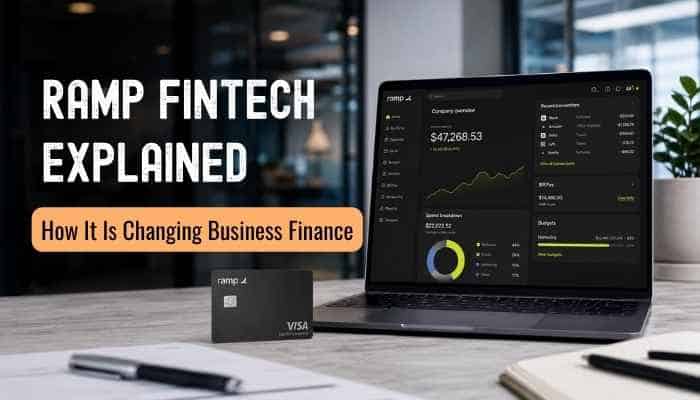

Ramp Fintech has grown from a corporate-card startup into a much broader business finance platform. Founded in 2019, Ramp now combines corporate cards, expense management, Bill Pay, procurement, travel, business banking, accounting automation, investments, stablecoin payments, and AI-powered financial workflows.
The expansion has been rapid. In June 2026, Ramp raised $750 million at a $44 billion valuation, while the company said annualized revenue had surpassed $1 billion. Ramp also reports that more than 70,000 businesses use its platform.
What makes Ramp Fintech particularly interesting in 2026 is not simply its size. Ramp is trying to connect financial tasks that businesses have traditionally handled through separate cards, banking portals, expense tools, AP software, spreadsheets, and accounting systems.
This guide examines how Ramp Fintech works, its pricing and fees, eligibility requirements, corporate cards, AI tools, banking, stablecoins, procurement, competitors, and whether the platform makes sense for businesses in 2026.
Quick Answer: What Is Ramp Fintech?
Ramp Fintech is a business finance platform that brings corporate cards, expense management, Bill Pay, procurement, travel, business banking, cash management, investments, vendor management, accounting automation, and AI-powered financial workflows into one system.
Ramp itself is not a bank. Ramp Checking is provided by First Internet Bank of Indiana, Member FDIC, while its core corporate card is a business charge card powered by the Visa network.
Rather than simply providing businesses with another way to pay, Ramp is designed to connect spending with approvals, policies, vendors, budgets, payments, and accounting. The idea is to give finance teams more control over company money from the moment spending is requested through payment and reconciliation.
Key Takeaways
- Ramp Fintech has grown from a corporate-card startup into a broader finance-operations platform covering expenses, Bill Pay, procurement, travel, banking, investments, accounting automation, and AI.
- Ramp says it serves 70,000+ businesses and raised $750 million at a $44 billion valuation in June 2026.
- The company remains privately held as of August 2026.
- Ramp Fintech introduced stablecoin accounts and expanded stablecoin payments in July 2026.
- Ramp offers 200+ integrations, including support for 40+ accounting and ERP systems.
- Its core card and expense platform has no standard software subscription fee, while Ramp Plus provides more advanced capabilities.
- Standard U.S. applicants generally need at least $25,000 in a linked business bank account, while Ramp typically does not require a personal guarantee.
Ramp Fintech by the Numbers in 2026
The growth of Ramp Fintech can be seen in several company-reported operating metrics, from its expanding customer base to the volume of payments moving through its platform.
| Metric | Ramp-Reported Figure |
|---|---|
| Businesses Served | 70,000+ |
| Annualized Card + AP Payment Volume | $100B+ |
| Customer Savings | $12B+ |
| Customer Hours Saved | 27M+ |
| June 2026 Private Valuation | $44B |
The first four figures are reported by Ramp and should not be treated as independently audited public-company metrics. The Ramp Fintech valuation of $44 billion comes from its June 2026 private financing round, which was also reported by TechCrunch.
Who Founded Ramp?
Ramp Fintech was founded in 2019 by Eric Glyman, Karim Atiyeh, and Gene Lee. Glyman and Atiyeh had previously worked together on Paribus, a consumer-finance startup acquired by Capital One.
Their experience with Paribus centered on helping consumers save money after purchases. Ramp brought a similar cost-conscious approach to business finance, focusing on spending controls, automation, and reducing unnecessary expenses rather than simply encouraging companies to spend more.
Ramp’s leadership structure changed on June 25, 2026, when Karim Atiyeh formally became Co-CEO alongside Eric Glyman. The move reflected Ramp’s growth from a corporate-card startup into the broader financial platform that Ramp Fintech represents today.
How Ramp Fintech Has Evolved
Ramp Fintech began primarily as a corporate-card and spend-management company, but by 2026 its scope extends across much more of the business finance stack.
Ramp now combines several major areas:
- Cards and expenses: Physical and virtual cards, reimbursements, spending controls, and expense management
- Accounts payable: Bill Pay, invoices, vendor payments, and purchase orders
- Procurement: Purchase requests, vendor management, contracts, approvals, and renewals
- Travel: Business travel connected with company spending and expense policies
- Cash management: Business checking and managed investment accounts
- Stablecoins: Stablecoin accounts and eligible vendor payments
- Finance operations: Budgeting, accounting automation, ERP integrations, and developer APIs
- Artificial intelligence: AI assistants and agents designed to automate financial workflows
This expansion changes where Ramp Fintech competes. Rather than replacing only a corporate card, Ramp increasingly competes across multiple parts of a company’s finance technology stack.
How Does Ramp Fintech Work?
Ramp Fintech connects company spending with the rules and workflows around it. Businesses can issue cards, set spending limits, restrict merchants or categories, require approvals, collect receipts, and connect transactions with accounting.
For example, a marketing team with a $5,000 advertising budget could receive a virtual card limited to approved vendors and that specific amount. After a purchase, Ramp can collect the receipt, check the transaction against company policy, flag exceptions, and send the relevant information to the accounting system.
A typical workflow looks like:
Request → Approve → Spend → Review → Reconcile
The basic idea behind Ramp Fintech is to control spending earlier and reduce the manual work that normally follows a business purchase.
1. Ramp Fintech Corporate Cards
Corporate cards remain at the center of Ramp Fintech. Ramp offers a corporate charge card powered by Visa, with physical and virtual cards available for employees, teams, departments, and specific vendors.
Finance teams can apply controls such as:
- Custom and recurring spending limits
- Merchant and category restrictions
- Approval requirements
- Real-time transaction monitoring
- Automated receipt collection
- Digital-wallet support
Ramp says administrators can create unlimited cards and funds within the platform. Availability, currencies, and issuing arrangements can vary by market.
Is Ramp a Credit Card?
The standard U.S. Ramp card is a charge card rather than a traditional revolving credit card. Businesses pay according to the applicable statement terms instead of carrying a balance indefinitely and paying interest.
That makes the card within Ramp Fintech more suitable for controlling and managing company spending than for financing purchases over long periods.
2. Ramp Fintech Rewards and Cashback
Ramp Fintech offers cashback on eligible corporate-card spending, although rewards and eligibility can vary by account and current terms.
Eligible accumulated cashback can be redeemed toward:
- Ramp card statement balances
- Ramp Checking
- Ramp Plus and certain platform fees
- Airline and hotel loyalty programs
- Gift cards
- Charitable donations
Ramp currently states that eligible accumulated cashback does not expire.
For many businesses, however, the main attraction is not maximizing travel points. Ramp combines rewards with expense controls and automation, while companies primarily interested in premium travel benefits or transferable points may prefer a traditional rewards card.
3. Ramp Fintech Expense Management
Ramp Fintech approaches expense management by putting more control around a purchase before and immediately after it happens.
Businesses can create expense policies and spending limits while Ramp helps with:
- Receipt collection and matching
- Expense categorization
- Policy checks
- Approval routing
- Employee reimbursements
- Repayment requests
- Accounting synchronization
Receipts can also be submitted through mobile and digital workflows.
The practical advantage is that finance teams can spend less time chasing receipts and manually reviewing ordinary transactions while focusing attention on expenses that actually need review.
4. Ramp Fintech Bill Pay and Accounts Payable
Ramp Fintech extends beyond corporate-card spending into accounts payable through Ramp Bill Pay. Businesses can receive invoices, capture bill information, route approvals, schedule payments, manage vendors, and sync payment data with accounting systems.
Available payment methods include ACH, checks, domestic and international wires, and eligible stablecoin payments.
Ramp Bill Pay Fees in 2026
| Payment Method | Current Listed Fee |
|---|---|
| Standard ACH | $0.59 |
| Same-Day ACH | $10 |
| Domestic Wire | $15 |
| International SWIFT USD Wire | $20 |
| Standard Check | $1.99 |
| Overnight Check | $20 |
| Check Attachment | $1 per page |
| Stablecoin Payment | $0 payment fee |
Standard ACH and standard check fees became effective June 1, 2026, with a temporary grace period applying to certain existing users. Ramp also says several eligible transaction fees are waived when payments are funded through Ramp Checking.
5. Ramp Fintech Procurement
Procurement brings Ramp Fintech into the process before money is actually spent. Businesses can create purchasing workflows that determine who is requesting something, which budget will pay for it, whether the vendor is approved, and which teams need to sign off.
Ramp procurement can help coordinate:
- Purchase requests
- Approval workflows
- Purchase orders
- Vendor reviews
- Budget checks
- Legal and security reviews
- Contracts and renewals
The purpose is to catch unnecessary or unapproved purchases before they become card transactions or invoices.
Vendor Management
Vendor management within Ramp Fintech connects supplier information with procurement and payment workflows.
Businesses can maintain vendor records, collect payment and tax information, verify vendors, organize documents, and perform TIN verification. Vendor information can then connect with Bill Pay, procurement, contracts, and 1099 workflows.
Contracts and Renewals
Ramp Fintech also provides tools for tracking vendor contracts and renewals. Businesses can store contracts, record values and dates, assign owners, monitor auto-renewal terms, and create renewal reminders.
Ramp can also connect contracts with purchasing data and use AI to pre-fill certain renewal requests.
For businesses with formal purchasing controls, Ramp supports workflows such as:
Purchase Order → Invoice
and:
Purchase Order → Receipt → Invoice
The latter provides three-way matching between what was ordered, what was received, and what was invoiced.
6. Ramp Fintech Vendor Tax Management and 1099 Filing
Ramp Fintech also covers part of the vendor tax-administration process. Businesses can manage eligible vendors and electronically file Form 1099-NEC and Form 1099-MISC.
Ramp also supports tax-information collection, W-9-related workflows, electronic delivery, physical mail delivery, and selected state filings.
Ramp 1099 Pricing
| Service | Current Price |
|---|---|
| Federal Filing | $0.65 per form |
| State Filing | $0.90 per form |
| Mail Delivery | $1.85 per form |
| Rush Mail Delivery | $1 additional per form when applicable |
Ramp does not replace payroll software and does not provide W-2 or W-4 employee forms.
7. Ramp Fintech Travel
Ramp Fintech connects business travel with corporate cards, expense policies, and spending records rather than treating travel booking and expense reporting as completely separate processes.
This allows employee travel spending to remain within the same broader financial-control environment used for other company expenses.
Ramp competes here with travel-and-expense platforms such as Navan and SAP Concur. The main difference is that travel is one part of Ramp’s broader finance platform rather than its sole focus.
8. Ramp Fintech Business Banking
An important distinction when evaluating Ramp Fintech is that Ramp itself is not a bank.
Ramp Checking is a deposit account provided by First Internet Bank of Indiana, Member FDIC. Businesses can use it to hold operating cash, pay Ramp card statements, fund Bill Pay, handle reimbursements, and move money.
Ramp has also changed some product names over time. Ramp Checking was previously called Ramp Business Account, while Ramp Banking was previously known as Ramp Treasury.
These distinctions are useful when comparing current Ramp products with older reviews or documentation.
9. Ramp Fintech Stablecoins
Stablecoins became a significant new part of Ramp Fintech in July 2026, when Ramp introduced its Stablecoin Account and expanded stablecoin payment capabilities.
The beta Stablecoin Account is available to selected eligible U.S. businesses, excluding businesses in New York, and currently supports:
- USDC
- USDT
Eligible businesses can hold supported stablecoins, convert between stablecoins and USD, pay vendors and bills, fund Ramp card statements, make reimbursements, and handle certain international payments.
Paying Vendors Without Holding Stablecoins
One notable Ramp Fintech feature is the ability to fund an eligible Bill Pay transaction with Ramp Checking or an external bank account while the vendor receives USDC or USDT.
That means a company does not necessarily have to maintain a long-term stablecoin balance simply to use stablecoins as a payment method.
Supported Blockchain Networks
Ramp currently lists deposit support across networks including:
- Base
- Ethereum
- Polygon
- Arbitrum
- Optimism
- Solana
- Tempo
Stablecoin Fees and Risks
Ramp currently lists no payment fee for stablecoin Bill Pay transactions.
Stablecoins, however, are not equivalent to FDIC-insured bank deposits. Businesses considering this part of Ramp Fintech should evaluate issuer, custody, network, smart-contract, depegging, regulatory, accounting, tax, and transaction-irreversibility risks.
10. Ramp Fintech Managed Investment Account
Ramp Fintech also provides a way for businesses to invest excess cash through its Managed Investment Account.
In 2026, Ramp retired its older Self-Directed Investment Account and moved customers toward the managed product. Existing Self-Directed customers were required to migrate by July 31, 2026.
The Managed Investment Account is professionally managed through Moment Advisors, LLC.
| Strategy | General Investment Approach |
|---|---|
| Reserve | Primarily Treasuries and government money-market funds |
| Reserve Plus | Treasuries, government money-market funds, short-duration corporate securities and prime money-market funds |
| Premier | Greater emphasis on short-duration corporate securities and prime money-market funds |
The Managed Investment Account should not be confused with Ramp Checking. Investments can involve market, credit, liquidity, and principal-loss risk.
Ramp Fintech Cash Products Compared
| Product | Primary Purpose |
|---|---|
| Ramp Checking | Operating cash and payments |
| Reserve Account | Support additional card spending capacity |
| Managed Investment Account | Invest excess business cash |
| Stablecoin Account | Hold and transact in supported stablecoins |
This distinction is important because the cash and investment products within Ramp Fintech do not all have the same purpose, protections, or risk profile.
11. Ramp Fintech Accounting Automation
Accounting automation is an important part of Ramp Fintech because card transactions, reimbursements, bills, and purchasing data eventually need to reach a company’s books.
Ramp says it supports 40+ accounting and ERP systems, including:
- QuickBooks Online and Desktop
- NetSuite
- Sage Intacct
- Xero
- Microsoft Dynamics
- Workday Financial Management
- Oracle Fusion Cloud
- Acumatica
- Zoho Books
- Odoo
Depending on the integration, Ramp can synchronize transactions, vendors, accounting categories, reimbursements, purchase orders, bills, payments, cashback, and accounting dimensions.
Some enterprise ERP integrations require Ramp Plus or Enterprise, so businesses should confirm plan availability before choosing the platform.
12. Ramp Fintech Integrations and Developer API

Ramp Fintech currently advertises more than 200 integrations across accounting, HR, payroll, productivity, procurement, travel, banking, and other business systems.
Examples include:
- Slack
- Microsoft Teams
- Asana
- Jira
- DocuSign
- Okta
- Workday
- ADP
- Gusto
- BambooHR
- Amazon Business
- Uber
- QuickBooks
- NetSuite
These integrations allow Ramp to exchange information with software a business already uses rather than requiring every financial process to remain inside a separate dashboard.
Ramp Developer API
The Ramp Fintech ecosystem also includes a Developer API. Approved administrators and developers can use scoped access to Ramp resources such as cards, users, and transactions to build custom financial workflows and internal integrations.
For companies with their own finance or operations software, API access can make Ramp part of a larger internal technology stack.
13. Ramp Fintech Budgeting and Real-Time Spend Visibility
Ramp Fintech can bring card spending, reimbursements, bills, and purchase orders closer to the budgeting process.
This matters because traditional budgets often remain in spreadsheets while actual spending is scattered across cards, AP software, travel systems, and bank accounts.
Connecting those records can give managers a clearer view of actual and committed spending before month-end, rather than waiting for every transaction to reach the final financial statements.
The result is a shift from simply reporting what has already been spent toward monitoring company spending while decisions are still being made.
14. Ramp Fintech AI and Finance Automation
Artificial intelligence has become a major part of the Ramp Fintech strategy in 2026.
Ramp is applying AI across tasks such as:
- Expense coding
- Receipt matching
- Policy enforcement
- Invoice processing
- Duplicate detection
- Accounting
- Procurement
- Vendor analysis
- Budget analysis
- Contract renewals
The goal is not simply to answer finance questions through a chatbot. Ramp is increasingly using AI to perform routine financial work and send unusual or higher-risk situations to employees for review.
From Automation to Finance Agents
The AI strategy behind Ramp Fintech is moving beyond fixed rules.
Traditional automation might send every expense above $5,000 to the CFO. An AI-powered system can potentially consider additional context, such as the vendor, budget, contract, receipt, previous transactions, company policy, and whether human approval is actually necessary.
This is the difference between software that simply records financial work and software that can perform parts of that work.
15. Ramp Fintech Applied AI Solutions
Ramp Fintech expanded its AI strategy further with Applied AI Solutions in June 2026.
Ramp says AI-token spending across its customer base increased 13× between January 2025 and June 2026. Because that statistic comes from Ramp’s own customer data, it should not be interpreted as a measure of AI spending across the entire economy.
Applied AI reflects a broader strategy of connecting:
Financial Data → Company Policies → Business Context → Workflow → Action
The idea is to give AI enough financial and operational context to automate more sophisticated tasks than traditional rule-based finance software.
16. Ramp Fintech AI Token Spend Management
The rise of generative AI has created a new expense category for businesses, and Ramp Fintech is beginning to build financial controls around it.
Companies may now pay for AI through subscriptions, API usage, token consumption, model inference, developer tools, and autonomous agents. Unlike a fixed annual software license, those costs can change quickly with usage.
Ramp’s tools can help finance teams analyze AI spending by:
- Provider
- Model
- Project
- Team
- Usage
For finance leaders, the question is increasingly not just how much the company spends on AI, but which models and AI workflows produce enough value to justify their cost.
17. Using Ramp Fintech Through AI Assistants
Ramp Fintech is also developing ways for external AI assistants to interact with financial workflows.
One example is Ramp MCP, which allows compatible AI copilots to work with Ramp while respecting the permissions attached to a user’s role. Potential uses include checking balances, requesting reimbursements, answering policy questions, and analyzing spending.
Instead of navigating several screens, some future workflows could look more like:
Employee → AI Assistant → Ramp → Financial Action
The opportunity is greater convenience and automation. The challenge is maintaining permissions, security, explainability, audit trails, and appropriate human oversight.
18. Ramp Fintech Economics Lab and Data
Another interesting part of Ramp Fintech is Ramp Economics Lab, which publishes research based on aggregated and anonymized customer transaction data.
Its research covers areas such as:
- AI adoption
- Business spending
- Software spending
- Industry trends
- Economic activity
Ramp’s Spend Share Index uses aggregated and anonymized transaction data from more than 50,000 U.S. businesses using Ramp card and Bill Pay products.
As Ramp’s customer base grows, this data can potentially provide useful benchmarks for procurement, vendor negotiations, software spending, AI adoption, forecasting, and broader business-finance analysis.
How Does Ramp Fintech Make Money?
Ramp Fintech makes money primarily through card interchange and paid Ramp Plus subscriptions. When customers use Ramp corporate cards, Ramp receives a portion of the interchange fees generated by those transactions.
The company also earns revenue from Ramp Plus and certain services, including some international transactions and accelerated payments. Because Ramp’s standard corporate card is a charge card, its business model does not depend on collecting interest from customers carrying revolving balances.
This gives Ramp an unusual position: it earns money when businesses use its payment ecosystem while marketing Ramp Fintech around tighter spending controls and lower financial waste.
Ramp Fintech Pricing in 2026
Ramp Fintech combines free core software with paid plans and transaction-based fees. The actual cost depends on which products, payment methods, and advanced features a business uses.
Ramp Free/Core Platform
Ramp’s core card and expense-management platform has no standard software subscription fee and includes features such as:
- Unlimited users and cards
- Expense management
- Vendor Bill Pay
- Real-time reporting
- Accounting automation
Ramp also states that its card product has no interest charges, late fees, or card-replacement fees. This free core offering is one of the main pricing advantages of Ramp Fintech.
Ramp Plus
Ramp Plus is the paid tier for businesses that need more advanced capabilities, including:
- Advanced approvals
- Procure-to-pay workflows
- Multi-entity support
- Multi-currency functionality
- Additional ERP integrations
- Advanced financial workflows
Ramp’s billing documentation uses examples of $15 per user per month on monthly billing and $12 per user per month on annual billing, although actual pricing and contract terms can vary.
For companies that need more sophisticated financial controls, Ramp Plus extends Ramp Fintech beyond the capabilities included in its free core platform.
Ramp Enterprise
Ramp Enterprise is aimed at larger organizations with more complex requirements, including multiple entities, enterprise ERP systems, international operations, procurement, advanced security, integrations, and implementation support.
Unlike the standard plans, Enterprise does not have one universally applicable public price. Businesses considering Ramp Fintech at this level should request pricing based on their specific users, systems, entities, and implementation requirements.
Ramp Fees to Know
Ramp Fintech does not charge a standard software subscription for its core card and expense platform, but businesses can still pay for certain transfers, checks, international transactions, tax filings, and premium plans.
| Potential Cost | What to Know |
|---|---|
| Core Card & Expense Software | Free |
| Ramp Plus | Paid subscription |
| Enterprise | Contract pricing |
| Standard ACH Bill Pay | $0.59 |
| Same-Day ACH | $10 |
| Domestic Wire | $15 |
| SWIFT USD Wire | $20 |
| Standard Check | $1.99 |
| Overnight Check | $20 |
| Stablecoin Bill Pay | Currently no payment fee |
| Federal 1099 Filing | $0.65 per form |
| State 1099 Filing | $0.90 per form |
| International Card Conversion | Visa conversion plus potential Ramp markup |
| Investment Account | Investment-specific terms and risks apply |
International card transactions that require currency conversion may include Visa’s conversion rate plus a Ramp markup of up to 3%. Some eligible Bill Pay fees can also be waived when payments are funded through Ramp Checking.
The real cost of Ramp Fintech therefore depends on how a business uses the platform. A useful comparison should include software fees, payment charges, FX costs, implementation effort, staff time, rewards, and any existing software Ramp could replace.
Who Can Qualify for Ramp?
Ramp Fintech is aimed at established U.S. businesses rather than casual side hustles or individual applicants. Under Ramp’s current eligibility rules, a standard U.S. applicant generally needs to:
- Be registered in the United States
- Operate as an eligible corporation, LLC, or LP
- Have an EIN
- Keep at least $25,000 in cash in a linked U.S. business bank account
- Conduct most business operations and spending in the U.S.
- Maintain an eligible physical business address
Individuals and sole proprietors are not currently accepted through the standard Ramp Fintech U.S. application process.
Does Ramp Require a Personal Guarantee?
For its standard U.S. corporate card, Ramp Fintech generally does not require a personal guarantee. Instead, Ramp evaluates the financial strength of the business, including factors such as cash balance, cash flow, and revenue.
That can be useful for qualifying founders who want company spending limits based more on the business than on their personal credit exposure.
How Does Ramp Determine Your Spending Limit?
Approval does not give every company the same limit. Ramp Fintech can consider bank balances, liquid assets, debt, revenue, industry, credit-bureau information, spending history, SaaS costs, advertising spend, travel needs, and connected financial data.
The company-wide business limit sets the maximum eligible outstanding exposure, while individual employees, cards, teams, vendors, or funds can receive smaller limits within it. Ramp also notes that the overall limit can change as the company’s financial position changes.
Is Ramp Safe?
Ramp Fintech uses security and compliance controls including multi-factor authentication, single sign-on, encryption at rest and in transit, transaction monitoring, virtual-card controls, and merchant restrictions.
Ramp also references annual SOC and PCI assessments and ISO 27001 certification in its security materials.
Businesses evaluating Ramp Fintech should still review their own requirements around administrator permissions, payment approvals, ERP access, data retention, business continuity, third-party dependencies, and access to financial data through AI features.
Ramp’s International Expansion in 2026
Ramp Fintech expanded its international reach in 2026, including plans to serve businesses headquartered in the UK and European Union.
Ramp also completed its acquisition of Billhop, giving the company additional payments infrastructure and regulatory authorization in the UK and EU.
Its 2026 international capabilities also include:
- Bill payments from UK and EU bank accounts
- INR-funded reimbursements in India
- Local corporate cards in Mexican pesos
- Local corporate cards in Brazilian reais
For multinational businesses, the international expansion of Ramp Fintech could reduce the need to manage separate cards, reimbursement systems, banks, and payment workflows across multiple markets.
Ramp Fintech Funding and $44 Billion Valuation
On June 4, 2026, Ramp Fintech raised $750 million at a $44 billion private valuation, reinforcing its position as one of the most highly valued private U.S. fintech companies.
TechCrunch reported that the round was led by ICONIQ, GIC, and Ontario Teachers’ Pension Plan, with participation from investors including Goldman Sachs Alternatives, D.E. Shaw, Morgan Stanley Investment Management, Generation Investment Management, Insight Partners, and BroadLight Capital.
Ramp also said annualized revenue had exceeded $1 billion and that the company had reached positive free cash flow.
The $44 billion figure should be understood as a private financing valuation, not a continuously traded public-market capitalization. A future funding round or eventual IPO could value the company differently.
Is Ramp Publicly Traded?
No. Ramp Fintech remains a privately held company as of August 2026, so there is no Ramp stock ticker available on a public exchange.
CEO Eric Glyman has discussed eventually taking the company public, but Ramp has not announced a specific IPO date. Until a formal public offering occurs, Ramp Fintech remains unavailable to ordinary investors through the public stock market.
Ramp Fintech vs. Traditional Business Finance
The main difference between Ramp Fintech and a traditional finance stack is how many financial workflows are connected within one platform.
| Traditional Finance Workflow | Ramp-Style Workflow |
|---|---|
| Separate corporate cards | Cards linked to spending controls |
| Manual receipt collection | Automated receipt matching |
| AP managed through email | Centralized Bill Pay |
| Procurement handled separately | Procurement connected to spending |
| Contracts stored separately | Contracts linked to vendors and renewals |
| Budgets tracked in spreadsheets | Spend and budget visibility |
| Banking handled separately | Banking connected with finance operations |
| Manual accounting workflows | ERP and accounting synchronization |
| Separate crypto payment tools | Stablecoin payments through Bill Pay |
| Routine manual reviews | AI-assisted review and automation |
Ramp Fintech did not invent corporate cards, AP software, procurement, banking, or expense management. Its strategy is to connect these functions so that a purchase can move from approval and payment to reconciliation with less manual work.
What Ramp Fintech Does Not Replace
Despite its broad product range, Ramp Fintech does not replace every part of a company’s financial stack.
- Accounting software: Ramp integrates with platforms such as QuickBooks, NetSuite, Xero, and Sage Intacct, but it does not replace a company’s complete general ledger or ERP.
- Payroll: Ramp supports reimbursements and vendor tax workflows but is not a full payroll system.
- Tax advice: 1099 automation can simplify filing, but businesses may still need professional tax guidance.
- Business loans: Ramp’s standard U.S. product is not a traditional long-term business lending solution.
- Banking: Ramp itself is not a bank; Ramp Checking is provided through First Internet Bank of Indiana.
- Insured operating cash: Managed investments and stablecoins have different risks and protections from conventional bank deposits.
These limits are important when evaluating Ramp Fintech as a finance platform rather than an all-in-one replacement for every accounting, banking, payroll, tax, and financing service.
Why Ramp Fintech Is Changing Business Finance
The significance of Ramp Fintech is not simply the number of products Ramp offers. The bigger change is how spending, payments, accounting, procurement, banking, and AI are being connected within the same financial workflow.
1. Spending Controls Start Before the Purchase
Traditional expense management often catches problems after money has already been spent. Ramp can apply card limits, merchant restrictions, budgets, and approval rules before or during a purchase, giving finance teams more control earlier in the process.
2. Routine Finance Work Is Being Automated
Receipt matching, expense coding, invoice processing, policy checks, approvals, and reconciliation can increasingly happen automatically. Ramp Fintech is pushing this further with AI designed to handle routine work and escalate exceptions that actually require human judgment.
3. Procurement Is Connecting With Payments
Ramp links purchase requests, vendors, contracts, purchase orders, invoices, and payments. That gives finance teams an opportunity to control what gets purchased, rather than simply analyzing the expense afterward.
4. Business Finance Is Becoming More Connected
Cards, Bill Pay, banking, budgets, accounting integrations, and vendor management traditionally sit in separate systems. Ramp’s model brings more of these activities together, giving businesses a clearer view of spending without waiting for month-end reconciliation.
5. New Payment and AI Costs Are Entering Finance
Stablecoins and usage-based AI costs are creating financial workflows that traditional expense systems were not built to manage. Ramp’s stablecoin payments and AI-token spend tools show how Ramp Fintech is expanding beyond conventional corporate-card and expense management.
The larger shift is from recording business spending after it happens to controlling, connecting, and automating more of the financial process as it happens.
Ramp vs. Brex vs. Navan
Ramp Fintech competes most directly with platforms that combine cards, expenses, payments, and finance workflows, but each rival has a different emphasis.
| Feature | Ramp | Brex | Navan |
|---|---|---|---|
| Corporate Cards | Yes | Yes | Yes |
| Expense Management | Yes | Yes | Yes |
| Travel | Yes | Yes | Core strength |
| Accounts Payable | Yes | Yes | Less central |
| Procurement | Yes | Available in broader spend workflows | Not primary focus |
| Banking/Cash Tools | Yes | Yes | Not primary focus |
| Accounting Automation | Strong focus | Yes | T&E-focused integrations |
| Stablecoin Capabilities | Yes | Available capabilities vary | Not core positioning |
| Best Known For | Finance operations | Spend management | Travel and expense |
A major 2026 change is that Capital One completed its $5.15 billion acquisition of Brex, meaning Brex is no longer an independent fintech company. Navan remains more heavily centered on business travel and expense management.
The main difference is positioning: Ramp Fintech is trying to cover a wider share of the finance stack, while Brex and Navan remain stronger in particular spending and travel use cases.
Ramp Alternatives by Use Case
There is no single best alternative to Ramp Fintech because the right platform depends on which financial workflow matters most.
| Platform | Often Considered For |
|---|---|
| Brex | Corporate cards and spend management |
| Navan | Travel and expense |
| BILL | Accounts payable and SMB finance |
| SAP Concur | Enterprise travel and expense |
| Expensify | Expense management |
| Coupa | Enterprise procurement |
| Tipalti | Global AP and supplier payments |
| Mercury | Startup banking |
| Slash | Banking, cards and financial workflows |
Businesses comparing alternatives should focus on the problem they actually need to solve—whether that is cards, travel, AP automation, procurement, banking, ERP integration, international payments, or multi-entity control—rather than simply choosing the platform with the longest feature list.
Ramp Fintech: Advantages and Drawbacks
| Advantages | Drawbacks |
|---|---|
| Free core software | $25,000 U.S. cash requirement |
| No personal guarantee for qualifying businesses | Sole proprietors not eligible |
| Strong spending controls | No long-term revolving credit |
| AP and procurement automation | Advanced features may cost extra |
| 200+ integrations | Greater platform dependence |
| AI-powered finance workflows | AI requires human oversight |
| Stablecoin payment options | Stablecoin risks apply |
Overall, Ramp Fintech is best suited to businesses that value automation, spending control, and connected finance workflows.
How Long Does Ramp Take to Implement?
Ramp Fintech implementation depends mainly on a company’s size and finance setup. Connecting a simple accounting system can be relatively straightforward, while multi-entity businesses with complex ERP, HRIS, procurement, and approval workflows may require a longer rollout.
Ramp’s onboarding generally covers application, system connections, policy setup, and card rollout, with migration and onboarding support available.
Who Is Ramp Best For?
Ramp Fintech is a strong fit for growing companies that want to bring cards, expenses, AP, procurement, and accounting workflows closer together.
| Best For | Less Suitable For |
|---|---|
| Startups and growing SMBs | Sole proprietors |
| Mid-market and multi-entity companies | Very small businesses below eligibility rules |
| Finance teams automating AP and expenses | Businesses needing revolving credit |
| Companies consolidating finance tools | Businesses wanting only a basic card |
| Businesses with significant SaaS spend | Premium travel-rewards seekers |
What Could Ramp Fintech Become Next?
Ramp Fintech appears to be moving beyond spend management toward a broader operating layer for business finance. Its AI strategy could increasingly automate expense reviews, invoice processing, reconciliation, procurement, budgeting, and other routine finance work.
The bigger shift would be from software that simply records financial activity to software that can act on company policies, handle routine tasks, and send exceptions to finance teams for human judgment.
Is Ramp Fintech Worth Considering in 2026?
Ramp Fintech is worth considering for qualifying businesses that want more than a corporate card—especially companies looking to connect expenses, AP, procurement, travel, vendors, and accounting workflows in fewer systems.
The value becomes stronger as financial complexity grows. Businesses should weigh the potential savings from automation, tighter spending controls, and software consolidation against subscription fees, transaction costs, implementation effort, and platform dependence. For very small businesses with simple financial needs, Ramp Fintech may offer more functionality than necessary.
Conclusion: Why Ramp Fintech Matters in 2026
Ramp Fintech has evolved far beyond its corporate-card origins. By connecting cards, expenses, Bill Pay, procurement, travel, banking, accounting, stablecoins, and AI, Ramp is trying to bring more of the business finance workflow into one platform.
Its $44 billion private valuation and more than 70,000 reported customers show the scale of that ambition, but Ramp still faces strong competition across travel, AP, procurement, banking, and enterprise finance software.
What makes Ramp Fintech particularly important in 2026 is its focus on connecting financial data with real-time controls and automation. Instead of simply recording spending after it happens, Ramp increasingly aims to help businesses approve, control, pay, reconcile, and analyze that spending as part of one workflow.
That shift from financial software that records work to software that helps perform it is why Ramp is worth watching.
Frequently Asked Questions About Ramp Fintech
1. Is Ramp Fintech actually free?
Yes. Ramp Fintech offers its core corporate card and expense-management software without a standard subscription fee. Ramp Plus, Enterprise features, and certain transactions can cost extra.
2. Does Ramp Fintech affect your personal credit?
Ramp Fintech generally does not require a personal guarantee for its standard U.S. corporate card. Ramp primarily evaluates the business, although applicants should verify current credit-review terms before applying.
3. Is Ramp Fintech good for startups?
Yes, Ramp Fintech can be a strong option for qualifying startups that need corporate cards, expense controls, Bill Pay, procurement, and accounting automation in one platform.
4. Can Ramp Fintech control employee spending?
Yes. Ramp Fintech lets businesses set spending limits, merchant restrictions, category controls, approval requirements, and other rules around employee card purchases.
5. Does Ramp Fintech offer virtual cards?
Yes. Ramp Fintech supports virtual cards that can be assigned to employees, teams, vendors, or specific expenses with customized spending controls.
6. Can Ramp Fintech help manage SaaS subscriptions?
Yes. Ramp Fintech can help businesses monitor vendor spending, contracts, renewals, procurement requests, and recurring software costs, making it useful for controlling SaaS spending.
7. Is Ramp Fintech suitable for small businesses?
Ramp Fintech can suit established small businesses that meet its eligibility requirements and need stronger expense automation. Very small businesses or sole proprietors may not qualify or need its broader feature set.
8. Can Ramp Fintech speed up month-end close?
Yes. Ramp Fintech can reduce manual reconciliation by connecting transactions, receipts, expense coding, bills, and accounting data. However, it does not replace a company’s accounting system or general ledger.
