


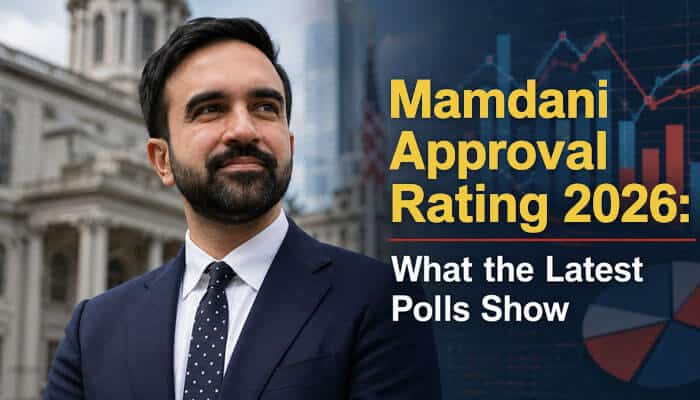

The Mamdani Approval Rating remains positive during Zohran Mamdani’s opening months as mayor of New York City, but no single percentage fully captures his public standing. The two leading citywide job-performance polls conducted around his first 100 days placed the Mamdani Approval Rating between 43% and 48%, with disapproval ranging from 27% to 30% and net approval between +16 and +18 percentage points.
These results indicate that the Mamdani Approval Rating is currently stronger than his disapproval numbers, showing that more New Yorkers approve of his performance than disapprove. However, neither major citywide survey found majority approval. Between 23% and 30% of respondents remained neutral or unsure, suggesting that a significant portion of voters had not yet formed a firm opinion about the new administration.
Additional surveys provide insight into Mamdani’s broader political image, although they measure favorability rather than the official Mamdani Approval Rating. A May 2026 Data for Progress survey found that 48% of likely voters across New York State viewed him favorably, while 41% viewed him unfavorably. Within New York City, his support was notably stronger, with 61% favorable and 35% unfavorable ratings.
Overall, the latest Mamdani Approval Rating data suggests a positive but not overwhelming start to his mayoralty. He continues to perform best among Democrats, younger voters, Manhattan residents, and Brooklyn residents.
The future direction of the Mamdani Approval Rating will likely depend on whether his housing, affordability, childcare, budget, and public-safety initiatives deliver measurable results for New Yorkers.
Fast Facts About the Mamdani Approval Rating
Current citywide approval range: 43%–48%
Current citywide disapproval range: 27%–30%
Current net approval range: +16 to +18
Strongest support:
- Democrats
- Younger adults
- Manhattan
- Brooklyn
Strongest policy area: – Childcare
Most challenging policy area: – City budget
Largest opportunity: – Neutral and undecided voters
Quick Answer: What Is the Mamdani Approval Rating in 2026?
The two major citywide job-performance polls identified for this update found:
- Marist Poll: 48% approve, 30% disapprove, and 23% are unsure.
- Emerson College Polling/PIX11: 43% approve, 27% disapprove, and 30% are neutral.
- Marist net approval: +18 percentage points.
- Emerson net approval: +16 percentage points.
Therefore, the most defensible answer is:
Major citywide polls place the Mamdani approval rating between 43% and 48%, with disapproval between 27% and 30%.
His approval is positive because supporters outnumber opponents in both surveys. It is not dominant because fewer than half of respondents approved in either poll, and a substantial share had not formed a definite opinion.
Newer favorability surveys found:
- Siena University statewide: 43% favorable and 40% unfavorable in late April.
- Siena New York City subgroup: 56% favorable and 34% unfavorable.
- Data for Progress statewide: 48% favorable and 41% unfavorable in late May.
- Data for Progress New York City subgroup: 61% favorable and 35% unfavorable.
These favorability percentages should not replace the citywide job-approval figures because they measure a different type of public opinion.
Key Findings at a Glance
The available evidence points to five major conclusions:
- The Mamdani Approval Rating is currently positive, with approval exceeding disapproval in major citywide polls.
- Support remains strongest among Democrats, younger adults, Manhattan residents, and Brooklyn residents.
- Housing affordability and childcare generate the most favorable policy ratings.
- Budget management and economic concerns present the greatest risks to future approval.
- A large group of neutral and undecided residents could significantly influence future polling results.
While early polling suggests a generally favorable public response, the long-term trajectory of the Mamdani Approval Rating will depend on measurable policy outcomes rather than campaign promises or first impressions.
Mamdani Approval Rating Polling Update
The newest relevant public-opinion release connected to the Mamdani approval rating was published in June 2026 by Data for Progress and was based on interviews conducted from May 20 through May 26.
That survey measured whether voters had a favorable or unfavorable opinion of Mamdani. It did not ask a representative citywide sample whether respondents approved of his performance as mayor.
The latest major surveys directly measuring citywide job approval remain:
- Marist’s March 26–31 poll of New York City adults
- Emerson College Polling’s April 5–6 poll of registered New York City voters
Later, Emerson surveys conducted in May measured Mamdani’s approval among likely Democratic primary voters in three congressional districts. Those findings are useful for understanding his standing within parts of the Democratic electorate, but they are not representative of citywide approval ratings.
Key Takeaways
- Major citywide polls place Mamdani’s early job approval between 43% and 48%.
- His disapproval ranges from 27% to 30%.
- His net approval is positive by 16 to 18 points.
- Between 23% and 30% of respondents remain unsure or neutral.
- Mamdani’s personal favorability is higher than his job approval.
- Childcare is his strongest policy area in the Emerson poll.
- Housing affordability also receives a positive rating.
- Public safety is positive but more divided.
- The city budget is his weakest major policy area.
- Democrats and younger adults form important parts of his support base.
- Manhattan and Brooklyn provide his strongest borough-level results.
- Staten Island remains his weakest borough.
- Statewide opinion is more divided than opinion inside New York City.
- There is not yet enough comparable citywide polling to establish a reliable upward or downward trend.
- Approval, favorability, and popularity are different measurements and should not be combined.
Why the Mamdani Approval Rating Matters
Approval ratings are more than political statistics. They provide insight into how residents evaluate leadership, policy implementation, government services, and overall confidence in local government.
For elected officials, approval ratings can influence:
- Political capital
- Legislative negotiations
- Budget discussions
- Public trust
- Media coverage
- Future election prospects
Because New York City is the largest city in the United States, the Mamdani Approval Rating is often viewed as an indicator of how voters respond to progressive urban policy priorities such as housing affordability, childcare expansion, public transportation investment, and tax reform.
Latest Mamdani Approval Rating Polls
The following table places the Mamdani approval rating beside statewide favorability and national popularity while keeping those measurements clearly separated.
| Pollster | Field dates | Survey population | Positive | Negative | Neutral or unsure | Measurement |
| Marist Poll | March 26–31, 2026 | 1,454 NYC adults | 48% approve | 30% disapprove | 23% unsure | Job approval |
| Emerson College/PIX11 | April 5–6, 2026 | 850 NYC registered voters | 43% approve | 27% disapprove | 30% neutral | Job approval |
| Siena University | April 27–30, 2026 | 806 NYS registered voters | 43% favorable | 40% unfavorable | 17% no opinion | Statewide favorability |
| Siena NYC subgroup | April 27–30, 2026 | NYC respondents in statewide sample | 56% favorable | 34% unfavorable | Remaining respondents | Favorability |
| Data for Progress | May 20–26, 2026 | 719 NYS likely voters | 48% favorable | 41% unfavorable | 12% had not heard enough | Statewide favorability |
| Data for Progress NYC subgroup | May 20–26, 2026 | 240 weighted NYC respondents | 61% favorable | 35% unfavorable | 4% had not heard enough | Favorability |
| YouGov public-figure tracker | Displayed in 2026 | Broader U.S. audience | 40% popularity | 25% disliked | 13% neutral | National popularity |
Different results do not necessarily mean one poll is right and another is wrong. Each survey may use a different population, geographic area, question, interview method, and weighting system.
A poll of New York City adults asking about job approval cannot be directly compared with a statewide poll asking about personal favorability.
How to Read the Mamdani Approval Rating: Approval, Favorability, and Popularity
One of the most common problems in reporting the Mamdani approval rating is treating every public-opinion percentage as though it measures the same thing.
Job Approval
Job approval asks whether respondents approve or disapprove of how an elected official is performing.
A typical question is:
Do you approve or disapprove of the job Zohran Mamdani is doing as mayor?
This is the most relevant measurement when evaluating Mamdani’s performance at City Hall.
Favorability
Favorability asks whether respondents have a favorable or unfavorable overall opinion of a person.
A resident could like Mamdani personally but remain unsure about his performance. Another respondent could dislike his political style while approving of a particular policy.
Favorability often reflects personality, ideology, media coverage, and political identity as well as performance.
Popularity
Popularity trackers generally measure the percentage of a broader audience that holds a positive opinion of a public figure.
Those respondents may live outside New York City and may know Mamdani mainly through national news coverage.
Therefore, the following statements are not equivalent:
- Mamdani has 48% job approval among New York City adults.
- Mamdani is viewed favorably by 61% of a Data for Progress New York City subgroup.
- Mamdani has 40% popularity in YouGov’s broader public-figure tracker.
Each figure may be accurate within its own survey, but combining the percentages without explaining their differences would mislead readers.
What Marist Says About the Mamdani Approval Rating
The Marist Poll provides the most detailed citywide examination of the Mamdani approval rating and Mamdani’s early performance.
Marist surveyed 1,454 New York City adults from March 26 through March 31, 2026. The reported margin of error for all adults was plus or minus 3.3 percentage points.
The survey also included 1,247 registered voters, whose results had a reported margin of error of plus or minus 3.5 points.
Overall Job Approval
| Response | Percentage |
| Approve | 48% |
| Disapprove | 30% |
| Unsure | 23% |
| Net approval | +18 points |
Totals may not equal exactly 100% because of rounding.
Marist also measured the strength of respondents’ opinions:
| Response intensity | Percentage |
| Strongly approve | 25% |
| Approve | 23% |
| Disapprove | 9% |
| Strongly disapprove | 21% |
| Unsure | 23% |
The results reveal two competing forces. First, Mamdani has a clear positive advantage because approval exceeds disapproval by 18 percentage points. Second, the poll includes both a meaningful, strongly disapproving group and a large, uncertain group.
The uncertain respondents may become especially important later in 2026. Their views could depend on city services, housing costs, public safety, budget decisions, and whether the administration fulfills its major campaign promises.
Mamdani Approval Rating vs Favorability in the Marist Poll
Marist separately asked respondents whether they had a favorable or unfavorable impression of the mayor.
| Opinion | NYC adults |
| Favorable | 55% |
| Unfavorable | 33% |
| Unsure or had not heard enough | 12% |
Among registered voters, Mamdani’s favorability stood at 55%, compared with 35% unfavorable and 10% unsure. The difference between 55% favorability and 48% job approval is significant. It suggests that some residents have a positive personal opinion of Mamdani but are not yet prepared to approve of his administration’s performance.
This personal goodwill could help him expand his approval rating if his policies succeed. It could also decline if voters conclude that his administration is not delivering results.
Mamdani Approval Rating and the Citywide Favorability Trend
Marist’s repeated surveys provide a useful comparison because the same pollster asked a similar question over time.
| Survey date | Favorable | Unfavorable | Unsure |
| September 2025 | 51% | 38% | 11% |
| October 2025 | 55% | 35% | 10% |
| April 2026 | 55% | 35% | 10% |
Among registered New York City voters, Mamdani’s April 2026 result was identical to his October 2025 result. This indicates that his personal standing remained stable from the final stage of the mayoral campaign through his first 100 days in office.
It also shows why statewide surveys should not be used to claim that New York City residents were rapidly turning against him. Statewide polls include large numbers of voters who live outside the mayor’s jurisdiction.
Mamdani Approval Rating by Political Affiliation
Political affiliation creates one of the clearest divisions in the Marist results.
| Political group | Approve | Disapprove | Unsure |
| Democrats | 63% | 20% | 17% |
| Republicans | 25% | 63% | 12% |
| Non-enrolled residents | 27% | 41% | 31% |
Democrats
Nearly two-thirds of Democrats approved of Mamdani’s performance, while one-fifth disapproved. New York City’s heavily Democratic electorate gives the mayor a significant political foundation. Maintaining that base will be essential if he faces criticism over taxes, spending, public safety, or relations with state government.
Republicans
Republican opinion was almost the reverse of Democratic opinion. Twenty-five percent approved and 63% disapproved. Mamdani’s ideological profile and nationally visible political positions likely make Republicans one of his most difficult constituencies.
Non-Enrolled Residents
Non-enrolled residents gave Mamdani a negative net rating:
- 27% approved
- 41% disapproved
- 31% were unsure
This group represents both a risk and an opportunity. It is less supportive than Democrats, but almost one-third had not reached a definite conclusion.
Improved services and visible policy outcomes may persuade some non-enrolled residents. Budget disputes, economic problems, or public-safety concerns could move others toward disapproval.
Mamdani Approval Rating by Borough
The mayor’s support is distributed unevenly across New York City.
| Borough | Approve | Disapprove | Unsure |
| Manhattan | 55% | 29% | 15% |
| Brooklyn | 54% | 26% | 20% |
| Bronx | 45% | 19% | 36% |
| Queens | 42% | 34% | 24% |
| Staten Island | 27% | 57% | 16% |
Manhattan and Brooklyn
Manhattan and Brooklyn produced Mamdani’s strongest results. Majorities approved in both boroughs.
His net approval was:
- +26 points in Manhattan
- +28 points in Brooklyn
These boroughs include many neighborhoods that formed an important part of Mamdani’s progressive electoral coalition.
The Bronx
The Bronx gave Mamdani 45% approval and only 19% disapproval, producing a positive 26-point margin.
However, 36% were unsure—the largest uncertain percentage among the five boroughs.
The result suggests that opposition was relatively limited, but many Bronx residents were still waiting before judging the administration.
Queens
Queens produced a more competitive result:
- 42% approved
- 34% disapproved
- 24% were unsure
Housing, transportation, public safety, sanitation, flooding, and the quality of city services may affect how Queens residents evaluate the mayor during the remainder of 2026.
Staten Island
Staten Island was Mamdani’s weakest borough. Only 27% approved, while 57% disapproved. This gave him a net rating of negative 30 points.
Borough-level findings should be interpreted carefully because subgroup samples are smaller than the citywide sample and therefore have greater statistical uncertainty.
Mamdani Approval Rating by Age
Age is another important dividing line.
| Age group | Approve | Disapprove | Unsure |
| 18–29 | 60% | 18% | 22% |
| 30–44 | 48% | 29% | 24% |
| 45–59 | 37% | 38% | 25% |
| 60 or older | 48% | 32% | 20% |
Mamdani performed best among adults aged 18 to 29. Six in ten approved, compared with fewer than one in five who disapproved. Residents aged 45 to 59 were almost evenly divided. Approval stood at 37%, while disapproval was 38%.
The results suggest that younger adults remain central to Mamdani’s coalition. Expanding the Mamdani approval rating will require persuading middle-aged and older residents that his agenda also addresses their concerns.
Mamdani Approval Rating by Race and Ethnicity
Marist found meaningful differences among racial and ethnic groups.
| Race or ethnicity | Approve | Disapprove | Unsure |
| White adults | 49% | 39% | 12% |
| Black adults | 55% | 13% | 31% |
| Latino adults | 49% | 26% | 25% |
| Non-white adults overall | 49% | 23% | 28% |
Black adults gave Mamdani the highest approval and lowest disapproval among the separately reported racial groups. However, nearly one-third remained unsure. White adults had the smallest uncertain group but the highest disapproval among the groups listed in the table. Their opinions were more firmly divided.
Latino adults gave Mamdani a positive rating, but one-quarter remained uncertain. These findings are not permanent judgments. Housing, employment, education, transportation, public safety, and access to government services may affect each community differently as the term progresses.
Mamdani Approval Rating by Gender, Income, and Education
| Group | Approve | Disapprove | Unsure |
| Men | 50% | 33% | 18% |
| Women | 47% | 26% | 27% |
| Household income below $50,000 | 46% | 25% | 29% |
| Household income of $50,000 or more | 50% | 32% | 18% |
| College graduates | 52% | 31% | 17% |
| Non-college graduates | 45% | 29% | 26% |
Men were more likely than women to approve, but they were also more likely to disapprove. Women had a larger uncertain group. Lower-income residents reported less disapproval than higher-income residents, but they were also more likely to remain unsure.
College graduates gave Mamdani a majority approval. Non-college graduates were less likely to approve and more likely to withhold judgment. These results illustrate why approval alone does not tell the full story. A group with lower approval may be more opposed, more uncertain, or a combination of both.
Mamdani Approval Rating by Religious Group
| Religious group | Approve | Disapprove | Unsure |
| Protestant | 46% | 28% | 26% |
| Catholic | 41% | 39% | 21% |
| Jewish | 38% | 49% | 12% |
| Other religion or no religion | 59% | 17% | 23% |
Mamdani performed best among residents who reported another religion or no religious affiliation. Catholic adults were closely divided. Jewish respondents were the only reported religious group in which disapproval clearly exceeded approval.
Religious subgroups have smaller sample sizes than the complete survey. They should not be treated as exact measurements of every member of a diverse community.
Mamdani Approval Rating Among Jewish NYC Voters
A separate survey commissioned by The Jewish Majority and conducted by Mercury Public Affairs questioned 665 Jewish New York City residents who had voted in the November 2025 mayoral election.
The interviews were conducted from February 17 through February 28, 2026.
| Rating of Mamdani’s performance | Percentage |
| Excellent or good | 32% |
| Fair | 18% |
| Poor | 40% |
| Undecided or another response | Approximately 10% |
This survey should not be directly compared with Marist’s citywide approval question.
“Excellent or good” is not identical to “approve,” while “fair” may include neutral, mildly positive, or mildly negative opinions. The survey also included Jewish voters who participated in the election rather than every Jewish adult in New York City.
The poll’s sponsorship should also be disclosed because the Jewish Majority is an advocacy organization.
The findings nevertheless reinforce the conclusion that Jewish voters are among Mamdani’s more challenging constituencies. Issues involving antisemitism, Israel, political demonstrations, and community safety may influence how some Jewish residents evaluate his administration.
Jewish New Yorkers are not politically uniform. Opinions can differ substantially by age, ideology, religious observance and views concerning Israel.
What Personal Traits Reveal About the Mamdani Approval Rating
Marist’s questions about Mamdani’s personal qualities were generally more positive than his overall job-approval result.
| Statement about Mamdani | Agree |
| He is working hard as the mayor | 73% |
| He understands the problems facing NYC | 64% |
| He is a good leader for NYC | 60% |
| He is fulfilling campaign promises | 60% |
| He is changing NYC for the better | 52% |
| He is doing more to unite than divide the city | 61% |
| Residents trust him to make decisions for NYC | 58% |
These results help explain why Mamdani’s personal favorability is higher than his job approval. Many residents appear willing to give him credit for effort, leadership, and understanding the city’s problems, even when they are not ready to approve of his overall performance.
That goodwill may not last automatically. As the administration moves beyond its opening months, voters are likely to place greater emphasis on measurable results.
What Emerson Says About the Mamdani Approval Rating
Emerson College Polling and PIX11 provided another major measurement of the Mamdani approval rating by surveying 850 registered New York City voters on April 5 and April 6, 2026.
The poll reported a credibility interval of approximately plus or minus 3.4 percentage points.
| Response | Percentage |
| Approve | 43% |
| Disapprove | 27% |
| Neutral | 30% |
| Net approval | +16 points |
Although Emerson’s approval percentage was five points lower than Marist’s, the overall conclusions were similar:
- Mamdani had more supporters than opponents.
- His approval remained below 50%.
- A substantial share of respondents had not taken a positive or negative position.
- His net approval was positive by double digits.
Mamdani Approval Rating Among Voters and Nonvoters
Emerson found a notable difference between registered voters who participated in the November 2025 election and those who did not vote.
| Group | Approve | Disapprove | Net rating |
| Voted in the November election | 55% | 29% | +26 |
| Did not vote | 35% | 26% | +9 |
Mamdani performed better among politically engaged residents who participated in the election.
However, the lower approval among nonvoters did not result from overwhelming opposition. They still gave him a positive net rating but were more likely to remain neutral.
Mamdani Approval Rating by Major Policy Area
Emerson asked registered voters to evaluate Mamdani’s performance on four major issues.
| Policy area | Approve | Disapprove | Net rating |
| Childcare | 54% | 21% | +33 |
| Housing affordability | 49% | 25% | +24 |
| Public safety and policing | 45% | 32% | +13 |
| City budget | 40% | 37% | +3 |
Childcare Is Mamdani’s Strongest Issue
Childcare produced Mamdani’s strongest policy rating. A majority approved, while approximately one in five disapproved.
Childcare is directly connected to the administration’s broader affordability agenda. Access to affordable care affects household expenses, employment decisions, and whether families can remain in New York City.
Future approval will depend on whether announced programs produce enough places, reach eligible families, and provide adequate support for childcare workers and providers.
Housing Affordability Receives Positive Reviews
Housing affordability received 49% approval and 25% disapproval. Mamdani made renters and the cost of housing central parts of his campaign. His administration later announced a housing strategy called “Block by Block,” addressing production, preservation, tenant protections, public housing, supportive housing, and homeownership.
Housing programs generally take longer to produce visible results than emergency responses or administrative changes.
Future public opinion may depend on:
- Rent levels
- Affordable housing production
- Development timelines
- NYCHA repairs
- Tenant protections
- Homelessness
- Housing-placement delays
- Enforcement against unsafe landlords
Public Safety Is Positive but More Divided
Mamdani received 45% approval and 32% disapproval for his handling of public safety and policing.
That is a positive result, but it is less favorable than his childcare and housing ratings.
Public-safety opinion may be affected by:
- Violent-crime trends
- Subway safety
- Visible street disorder
- Police response times
- Mental-health emergencies
- Relations between City Hall and the NYPD
- High-profile incidents
- Differences in neighborhood conditions
Residents often evaluate safety through personal experience as well as official statistics. A major incident or sustained change in conditions can affect approval quickly.
The City Budget Is His Most Divisive Issue
The city budget produced the narrowest margin:
- 40% approved
- 37% disapproved
Budget policy requires difficult tradeoffs. Residents may support expanded services but disagree over taxation, spending, borrowing, reserves, and long-term obligations. In May 2026, Mamdani’s administration released a proposed $124.7 billion Fiscal Year 2027 executive budget. City Hall presented it as a balanced plan that protected services and supported affordability, housing, childcare, and safety.
New York City Comptroller Mark Levine offered a more cautious assessment, arguing that the proposal did not fully resolve structural financial challenges. Both perspectives matter. Administration announcements describe City Hall’s objectives, while independent fiscal analysis examines whether revenue assumptions, reserves, and future spending are sustainable.
How City Direction Affects the Mamdani Approval Rating
Marist and Emerson produced sharply different findings about New York City’s overall direction.
| Poll | Right direction | Wrong direction |
| Marist | 56% | 43% |
| Emerson | 41% | 59% |
The surveys were conducted within a relatively short period, but their results differed by 15 percentage points.
Possible explanations include:
- Marist surveyed New York City adults.
- Emerson surveyed registered voters.
- The polls used different interview methods.
- Question order may have influenced respondents.
- The surveys used different weighting procedures.
- Registered voters may be more politically engaged or critical.
- Normal sampling variation may have contributed.
The disagreement means it would be misleading to declare that New Yorkers had reached a clear consensus about the city’s direction.
A more defensible conclusion is that Mamdani’s personal rating was positive while broader confidence in New York City remained unsettled.
How Economic Concern Could Affect the Mamdani Approval Rating
Emerson found widespread dissatisfaction with the condition of the New York City economy.
| Rating of the NYC economy | Percentage |
| Excellent | 3% |
| Good | 16% |
| Fair | 38% |
| Poor | 40% |
A combined 78% described the economy as fair or poor. Only 19% rated it excellent or good.
This result is especially important because affordability is central to Mamdani’s political identity.
Residents may evaluate him through their experiences with:
- Rent
- Grocery prices
- Utility bills
- Childcare expenses
- Transportation costs
- Wages
- Job security
- Taxes
- Access to housing
The mayor does not control every economic force. National inflation, interest rates, state policies and global conditions also affect New York City.
Nevertheless, voters often hold the most visible officeholder responsible for their financial experiences.
How Tax Policy Could Influence the Mamdani Approval Rating
Although budget management is one of Mamdani’s weaker policy areas, Emerson found substantial support for parts of his revenue agenda.
- 65% supported a millionaire’s tax.
- 20% opposed it.
- 15% were unsure.
- 55% said the state should raise taxes on wealthy residents to address the budget gap.
- 41% preferred better city spending management.
- 4% supported a five-percent property-tax increase.
Support for a millionaire’s tax remained positive among respondents with household incomes above $150,000, although the margin was smaller than among lower-income households. Siena also found statewide support for allowing New York City to raise income taxes on residents earning at least $1 million.
The findings suggest public support for the general principle of asking wealthy residents to contribute more. They do not guarantee support for every rate, spending proposal, or budget agreement. Implementation also requires cooperation from Albany. The mayor cannot independently change every part of the city’s income-tax structure.
How Winter Storms Affected the Mamdani Approval Rating
Mamdani received relatively strong reviews for the administration’s winter-storm response.
Marist found:
- 65% approved of his handling of the storms.
- 34% disapproved.
- Approval exceeded 60% in Manhattan, Brooklyn, the Bronx and Queens.
- Only 30% approved in Staten Island.
Emerson asked respondents to assign a letter grade.
| Grade | Percentage |
| A | 29% |
| B | 33% |
| C | 18% |
| D | 9% |
| F | 11% |
A combined 62% gave the administration an A or B.
Emergency management can influence an early mayoral image because residents see immediate evidence of whether streets, schools, transportation, and public services are functioning.
The storm response appears to have helped Mamdani demonstrate operational competence, although Staten Island remained considerably more critical.
How Government Relationships Affect the Mamdani Approval Rating
Marist asked residents whether Mamdani had found the right balance in his relationships with Governor Kathy Hochul and President Donald Trump.
Relationship With Governor Kathy Hochul
| Response | Percentage |
| Working together the right amount | 60% |
| Working too closely with Hochul | 15% |
| Not working closely enough | 20% |
| Unsure | 4% |
Most respondents believed Mamdani had found an appropriate level of cooperation with the governor.
That relationship is important because several parts of his tax, housing, childcare, and transportation agenda require state legislation or funding.
Relationship With President Donald Trump
| Response | Percentage |
| Working together the right amount | 59% |
| Working too closely with Trump | 12% |
| Not working closely enough | 26% |
| Unsure | 3% |
Despite major political differences, most residents believed Mamdani was maintaining an appropriate balance with the president. The finding suggests that many voters expect practical cooperation between different levels of government even when political leaders disagree ideologically.
Mamdani Approval Rating and Favorability Across New York State
Siena University repeatedly asked registered New York State voters whether they viewed Mamdani favorably or unfavorably.
| Siena survey | Favorable | Unfavorable | No opinion | Net |
| January 2026 | 48% | 32% | 20% | +16 |
| February 2026 | 47% | 35% | 18% | +12 |
| March 2026 | 44% | 37% | 19% | +7 |
| April 2026 | 43% | 40% | 17% | +3 |
The same pollster trend shows Mamdani’s statewide favorability margin narrowing between January and April.
Several cautions are necessary:
- The surveys measured favorability, not job approval.
- They included voters outside New York City.
- Many respondents were not directly affected by Mamdani’s administration.
- Small changes can reflect sampling variation.
- Statewide opinion may be influenced by national political coverage.
Siena’s late-April survey still showed a much stronger rating within New York City: 56% favorable and 34% unfavorable.
The correct conclusion is not that New York City had turned against Mamdani. Instead, his statewide image became more politically divided while the city-level Mamdani approval rating remained positive.
June 2026 Favorability Data Related to the Mamdani Approval Rating
Data for Progress surveyed 719 likely New York voters from May 20 through May 26, 2026.
The organization reported a margin of error of plus or minus four percentage points.
| Region | Favorable | Unfavorable | Had not heard enough | Net |
| New York State overall | 48% | 41% | 12% | +7 |
| New York City subgroup | 61% | 35% | 4% | +26 |
| Upstate New York | 39% | 39% | 22% | 0 |
| New York City suburbs | 43% | 50% | 7% | -7 |
The results reveal a substantial geographic divide.
Mamdani was viewed positively inside New York City, even upstate, and negatively in the suburbs. The city result came from a weighted subgroup of approximately 240 respondents. Subgroup findings have more uncertainty than the statewide topline and should be interpreted cautiously.
The Data for Progress result does not prove that Mamdani’s statewide standing improved after Siena’s April poll. The organizations used different survey populations, methods, and weighting procedures. A reliable trend is best established through repeated polling by the same organization using similar questions.
District Polling and the Mamdani Approval Rating
Emerson College Polling conducted surveys from May 16 through May 17 among likely Democratic primary voters in New York’s 7th, 10th, and 12th congressional districts.
Mamdani’s approval among those Democratic primary voters was:
| Congressional district | Approve |
| NY-07 | 78% |
| NY-10 | 79% |
| NY-12 | 66% |
These figures demonstrate strong support within selected Democratic primary electorates.
They should not be described as a new citywide Mamdani approval rating because:
- The surveys included only likely Democratic primary voters.
- They covered three congressional districts rather than all five boroughs.
- The district samples were designed for congressional-primary analysis.
- The results exclude Republicans, non-enrolled residents and many general-election voters.
Is the Mamdani Approval Rating Rising or Falling?
The available evidence does not establish a clear citywide rise or decline.
Marist and Emerson conducted their citywide surveys within approximately one week and reported similar net results:
- Marist: +18
- Emerson: +16
The difference between their headline approval percentages—48% and 43%—should not automatically be described as a decline. They surveyed different populations and used different answer choices.
Siena’s repeated statewide polling showed Mamdani’s favorability narrowing through April. Data for Progress later reported a positive seven-point statewide favorability margin.
The most accurate summary is:
- Mamdani had positive citywide job approval around his first 100 days.
- His personal image was stronger inside New York City than statewide.
- Statewide opinion became more politically divided.
- There is insufficient comparable citywide polling to declare a clear approval trend.
Why YouGov Is Not a Citywide Mamdani Approval Rating
YouGov’s public-figure tracker displayed Mamdani with:
- 78% fame
- 40% popularity
- 25% disliked
- 13% neutral
YouGov defines popularity as the percentage of people who hold a positive opinion of a public figure. This is not an official mayoral job-approval rating and should not replace the Marist or Emerson citywide results.
The broader audience may include people who live outside New York City and are evaluating Mamdani through national political coverage.
Mamdani Approval Rating Compared With Recent NYC Mayors
Marist compared Mamdani’s early approval with Eric Adams’ standing at around the same point in his administration.
| Mayor near first 100 days | Approve | Disapprove | Unsure |
| Eric Adams in 2022 | 61% | 24% | 15% |
| Zohran Mamdani in 2026 | 48% | 30% | 23% |
Adams began with higher approval and a smaller uncertain group. Other reporting has compared Mamdani’s result with Bill de Blasio’s early standing, which was close to 49%.
Historical comparisons have limitations because:
- Each mayor entered office under different conditions.
- The economic environment changed.
- Public-safety concerns were different.
- Polling methods and question wording may vary.
- Political polarization has increased.
- An early honeymoon does not predict the full term.
A strong opening rating does not guarantee long-term political success, and a more modest opening result does not determine how voters will judge the administration later.
What the Election Coalition Says About the Mamdani Approval Rating
Marist compared approval among residents based on who they supported in the 2025 mayoral election.
| 2025 mayoral support | Approve Mamdani | Disapprove | Unsure |
| Voted for Mamdani | 86% | 2% | 12% |
| Voted for another candidate | 18% | 60% | 23% |
The results show that Mamdani retained most of his electoral supporters but made limited progress among residents who voted for another candidate.
His largest opportunities for growth may include:
- Residents who did not vote
- Non-enrolled residents
- People who remain unsure
- Moderate voters
- Residents outside Manhattan and Brooklyn
- People who view him favorably but have not approved of his performance
Converting personal goodwill into job approval will require visible results rather than campaign messaging alone.
Why There Is No Reliable Mamdani Approval Rating Average Yet
Creating a simple polling average would be misleading.
| Difference | Examples |
| Geography | NYC, New York State, or national |
| Population | Adults, registered voters, or likely voters |
| Measurement | Job approval, favorability, or popularity |
| Response choices | Neutral, unsure, or had not heard enough |
| Survey mode | Telephone, text, email, or online panel |
| Field dates | March, April, or May |
| Pollster | Marist, Emerson, Siena, or Data for Progress |
Averaging Marist’s 48% citywide job approval with Data for Progress’ 48% statewide favorability would combine different questions asked of different populations.
A meaningful Mamdani approval rating average would require multiple surveys that:
- Question comparable New York City populations
- Ask nearly identical job-performance questions
- Use similar response options
- Cover a similar time period
- Publish transparent methodologies
Until more comparable polls become available, reporting a range is more responsible:
The two major citywide polls place Mamdani’s early job approval between 43% and 48%.
Why Mamdani Approval Rating Polls Produce Different Results
Adults Versus Registered Voters
Marist surveyed New York City adults. Emerson surveyed registered city voters. Adults include people who are not registered and residents who may not be eligible to vote. Registered voters are generally more politically engaged.
Neutral Versus Unsure
Marist reported an “unsure” category, while Emerson reported a “neutral” category. A neutral respondent may have mixed views. An unsure respondent may believe there is insufficient information to form an opinion. The two categories are related but not identical.
Different Survey Methods
Marist used a multimodal approach involving live telephone interviews, text, and online responses. The survey was offered in English and Spanish. Emerson contacted voters through email, text-to-web, and online panels matched with voter-file information. The survey was offered in English. Different methods may reach different groups or affect how comfortable people feel answering a question.
Weighting
Pollsters weight survey results to reflect the characteristics of the population they intend to measure. Weighting may account for:
- Age
- Gender
- Race
- Education
- Political registration
- Geography
- Past voting behavior
Different weighting choices can produce slightly different results.
Sampling Error
No public-opinion poll interviews every New Yorker. Each result is an estimate based on a sample. Small differences may result from normal sampling variation rather than a genuine shift in opinion.
The uncertainty ranges surrounding the Marist and Emerson approval percentages overlap. Describing their five-point difference as a sharp decline would therefore be unjustified.
Polling Methodology Checklist
When evaluating any Mamdani Approval Rating poll, consider:
- Sample size
- Survey population
- Field dates
- Geographic coverage
- Margin of error
- Question wording
- Weighting methodology
- Interview mode
- Sponsorship
- Historical comparisons
Small methodological differences can produce meaningful variations in reported approval levels.
Important Limitations of Mamdani Approval Rating Polls
Every poll in the article should be read with the following limitations in mind:
- Polls measure opinion only during their stated field dates.
- Events occurring after the field period cannot affect an earlier survey.
- Borough and demographic subgroups have greater uncertainty.
- Statewide polls do not directly measure citywide opinion.
- Registered voters may differ from all adults.
- Likely voters may differ from registered voters.
- Favorability is not equivalent to approval.
- Neutral and unsure are not interchangeable.
- Question wording and order can affect responses.
- English-only surveys may underrepresent some language communities.
- Online panels and probability-based samples use different recruitment systems.
- Small changes do not always represent meaningful movement.
- Advocacy-sponsored polling should be evaluated with attention to methodology and wording.
Polling remains useful when treated as an estimate and interpreted alongside field dates, sample design, question wording, and repeated trends.
Is the Mamdani Approval Rating Good?
There is no universal percentage that defines a good mayoral approval rating.
Mamdani’s position contains both strengths and warning signs.
Reasons His Rating Is Positive
- Approval exceeds disapproval in both major citywide polls.
- His net approval is positive by double digits.
- His personal favorability is higher than his job approval.
- Most residents describe him as working hard.
- A majority says he understands New York City’s problems.
- Childcare receives majority approval.
- Housing affordability receives a strong positive net rating.
- His winter-storm response receives favorable reviews.
- His Democratic base remains supportive.
- Younger adults give him particularly strong ratings.
- Newer polling shows positive favorability inside New York City.
Reasons His Rating Is Not Overwhelming
- Job approval remains below 50%.
- Between 23% and 30% are neutral or unsure.
- Non-enrolled residents are more negative than positive.
- Staten Island strongly disapproves.
- Adults aged 45 to 59 are almost evenly divided.
- Budget management receives nearly equal approval and disapproval.
- Most Emerson respondents describe the city economy as fair or poor.
- Statewide opinion is more divided than opinion inside the city.
- Mamdani has won over relatively few residents who supported another candidate.
- Marist and Emerson disagree sharply about the city’s overall direction.
The fairest conclusion is that Mamdani has made an encouraging start without securing a broad or permanent mandate.
What Is Driving the Positive Mamdani Approval Rating?
A Strong Democratic Base
Sixty-three percent of Democrats approved in Marist. Because New York City has a large Democratic electorate, this gives Mamdani a substantial foundation.
Strong Support Among Younger Adults
Sixty percent of adults aged 18 to 29 approved. Younger residents may be especially responsive to his focus on housing, rent, transportation, childcare, and living costs.
A Reputation for Working Hard
Nearly three-quarters of Marist respondents agreed that Mamdani was working hard as mayor. Visible activity and public engagement can strengthen an early impression of energy. Over time, residents will increasingly evaluate whether that activity produces results.
Alignment With Affordability Concerns
Childcare, housing, and higher taxes on wealthy residents receive meaningful public support. These issues closely match the platform that helped bring Mamdani to City Hall.
Positive Personal Favorability
Some residents who are not ready to approve of Mamdani’s performance still hold a favorable opinion of him personally. This creates an opportunity to convert goodwill into stronger job approval.
Positive Emergency Management
The winter-storm response allowed the administration to demonstrate practical competence during a visible citywide challenge.
What Could Lower the Mamdani Approval Rating?
1. Failure to Deliver on Affordability
Mamdani has created high expectations involving rent, childcare, transportation, housing, and household expenses. If residents do not experience improvement, they may decide that his promises were unrealistic or poorly implemented.
2. Budget Problems
Budget management is already one of his weakest policy areas. Tax disputes, service reductions, inadequate reserves, revenue shortfalls, or large future deficits could reduce confidence.
3. Public-Safety Concerns
Public safety receives a positive rating, but it remains politically sensitive. Concerns about crime, subway conditions, disorder, or emergency response could move moderate and non-enrolled residents toward disapproval.
4. Dependence on Albany
Many parts of Mamdani’s agenda require cooperation from the governor and state legislature. Residents may blame the mayor for a failed policy even when City Hall lacks the legal power to implement it independently.
5. Geographic Polarization
Strong support in Manhattan and Brooklyn may not be enough if Mamdani struggles in Staten Island, Queens, or other less supportive communities.
6. Failure to Convert Plans Into Results
Executive orders, policy plans, and press conferences can generate early momentum. Long-term approval depends on implementation, access, and measurable outcomes.
7. National Political Attention
National visibility can energize supporters while making local opinion more partisan. Residents may also become critical if they believe national political activity distracts the mayor from city responsibilities.
What Could Improve the Mamdani Approval Rating During 2026?
Deliver Visible City Services
Residents are more likely to approve when they personally experience improvements.
Examples include:
- More available childcare places
- Faster NYCHA repairs
- Cleaner streets
- Safer subway stations
- More responsive city agencies
- Faster housing placements
- Better storm preparation
- Stronger landlord enforcement
- Improved sanitation
- More reliable transportation
Win Over Non-Enrolled Residents
Almost one-third of non-enrolled residents were unsure in Marist. Competent service delivery and clear explanations of policy costs could help Mamdani reach people who are not firmly committed to either major political party.
Strengthen Budget Credibility
The administration can build confidence by explaining:
- Program costs
- Funding sources
- Revenue assumptions
- Reserve levels
- Long-term obligations
- Savings targets
- Performance measurements
Address Borough-Specific Needs
Different boroughs have different priorities involving housing, transportation, flooding, schools, sanitation, traffic, and public safety. A citywide administration must demonstrate that its agenda reaches beyond its strongest electoral neighborhoods.
Maintain Productive Relationships With Albany
Securing state cooperation on housing, taxes, transportation, and childcare would allow Mamdani to show that his proposals can move from campaign commitments to government policy.
What to Watch in the Next Mamdani Approval Rating Poll
When a new Mamdani approval rating poll is released, readers should examine more than the headline percentage.
- Field dates: What events occurred while respondents were interviewed?
- Survey population: Were participants adults, registered voters, or likely voters?
- Geography: Was the survey citywide, statewide, or national?
- Question wording: Did it measure approval, favorability, or popularity?
- Response options: Did respondents have neutral, unsure, or no-opinion choices?
- Sample size: How many people participated?
- Margin of error: Could a small change reflect sampling variation?
- Survey method: Were respondents contacted by phone, text, email, or online panel?
- Languages: Was the survey available in more than one language?
- Borough results: Did geographic support change?
- Party results: Did Democrats, Republicans, or non-enrolled residents move?
- Issue ratings: Did opinions change on childcare, housing, safety, or the budget?
- Same-pollster trend: Is the comparison based on similar surveys from the same organization?
- Sponsor: Was the poll commissioned by a university, media outlet, campaign, or advocacy organization?
Is There an Official Mamdani Approval Rating?
No government agency produces an official mayoral approval percentage. The mayor’s office may publish information about policies, budgets, and programs, but public-opinion ratings come from polling organizations, universities, media partners, and research companies.
A credible poll normally discloses:
- Exact question wording
- Sample size
- Field dates
- Survey population
- Geographic coverage
- Interview method
- Weighting information
- Margin of error or credibility interval
- Sponsor
- Full results or cross-tabulations
An article that reports an approval percentage without identifying the pollster, dates, and population should be treated cautiously.
Overall Interpretation of the Mamdani Approval Rating in 2026
The evidence does not support either of the most extreme interpretations. It would be inaccurate to say Mamdani is overwhelmingly popular. Neither major citywide job-performance survey found majority approval, and a substantial share of residents remained neutral or unsure.
It would also be inaccurate to say most New Yorkers disapprove of him. Disapproval was 27% in Emerson and 30% in Marist, giving Mamdani a positive double-digit net rating in both surveys.
His strongest early advantages include:
- A loyal Democratic base
- Strong support among younger adults
- Positive personal characteristics
- Favorable childcare and housing ratings
- A well-reviewed storm response
- Stronger favorability within New York City than statewide
His most important risks include:
- Economic dissatisfaction
- Budget uncertainty
- Public-safety concerns
- Weak support among non-enrolled residents
- Geographic polarization
- Difficulty winning over previous opponents
- High expectations for affordability policies
The Mamdani approval rating will become more meaningful as residents gain more time to evaluate sustained policy outcomes rather than early announcements and first impressions.
What Would a Strong Mamdani Approval Rating Look Like?
There is no universally accepted benchmark for mayoral approval, but political analysts often evaluate approval ratings using broader context.
General interpretation:
| Approval Range | Interpretation |
|---|---|
| Below 40% | Weak |
| 40%–49% | Competitive but positive |
| 50%–59% | Strong |
| 60%+ | Very strong |
Based on current citywide polling, Mamdani’s position falls within the competitive but positive range. His approval remains above his disapproval, but he has not yet achieved majority support among all surveyed residents.
Future polling will determine whether he can expand support beyond his strongest demographic and geographic groups.
Conclusion: Mamdani Approval Rating
The Mamdani approval rating in 2026 shows that Zohran Mamdani began his mayoralty with more approval than disapproval. Marist measured his job approval at 48%, while Emerson College Polling placed it at 43%. Both surveys gave him positive double-digit net ratings, but both also found that a substantial group of New Yorkers had not reached a firm judgment.
Mamdani’s strongest early advantages include his Democratic base, support among younger adults, personal favorability, and positive ratings on childcare, housing, and winter-storm management. His greatest challenges involve budget confidence, economic dissatisfaction, public safety, weak support among non-enrolled residents, and uneven approval across the five boroughs.
The next phase of the Mamdani approval rating will depend less on campaign promises and early activity and more on whether residents experience visible improvements in affordability, housing, childcare, safety, and everyday government services. Future representative citywide polls will show whether Mamdani expands his coalition, maintains his current position, or becomes more politically polarized.
1. What is the current Mamdani Approval Rating?
The latest major citywide polls place the Mamdani Approval Rating between 43% and 48%, with disapproval ranging from 27% to 30% during his first months as New York City mayor.
2. Why is the Mamdani Approval Rating considered positive?
The Mamdani Approval Rating is considered positive because approval exceeds disapproval in major citywide surveys, giving him a double-digit net approval margin.
3. Which groups contribute most to the Mamdani Approval Rating?
The strongest support behind the Mamdani Approval Rating comes from Democrats, younger voters, and residents of Manhattan and Brooklyn.
4. What issues have the biggest impact on the Mamdani Approval Rating?
Housing affordability, childcare policies, public safety, economic conditions, and budget management are among the key factors influencing the Mamdani Approval Rating.
5. Can the Mamdani Approval Rating change significantly in 2026?
Yes. The Mamdani Approval Rating may rise or fall depending on policy results, economic conditions, public safety trends, and future citywide polling.
