


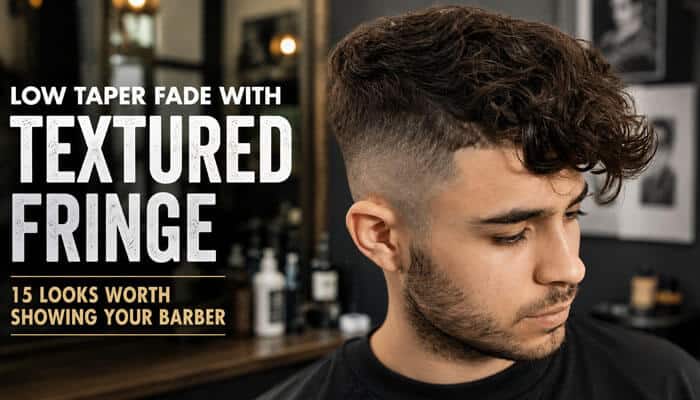

A low taper fade with textured fringe combines clean, controlled edges with natural movement through the front. Instead of taking the fade high around the sides, the taper stays concentrated near the sideburns and neckline while the longer hair on top falls forward into a separated, textured fringe.
That balance is what makes the low taper fade with textured fringe so versatile. The fringe can be short and choppy, long and messy, fluffy, curly, wavy, or swept slightly to one side. At the same time, the low taper tidies the perimeter without removing all the fullness through the sides.
A taper is also generally subtler than a more aggressive low, mid, or high fade. It preserves more of the haircut’s natural silhouette while gradually shortening the hair near the sideburns and neckline. But getting a low taper fade with textured fringe right takes more than walking into a barbershop and saying, “Give me a textured fringe.”
How long should the top be? Should the taper go down to skin? Which guard numbers matter? What if your hair is straight, thick, curly, or affected by a stubborn cowlick?
This guide covers 15 low taper fade with textured fringe looks worth showing your barber, plus face shapes, hair types, exact barber instructions, guard lengths, styling products, maintenance, common mistakes.
Quick Answer: What Is a Low Taper Fade with Textured Fringe?
A low taper fade with textured fringe keeps the shortest transition low around the sideburns and neckline while leaving more length on top.
The front is then layered or texturized so it falls toward the forehead with visible separation instead of forming one heavy, blunt line.
Typical features include:
- A low taper around the sideburns and neckline
- More fullness through the upper sides
- Medium or longer hair on top
- A forward-moving fringe
- Soft layering or controlled texturizing
- Piecey separation through the front
- A matte or natural-looking finish
- Optional skin exposure at the lowest point
The simplest way to request a low taper fade with textured fringe is:
“Keep the taper low around the sideburns and neckline, preserve some fullness through the sides, and leave enough length on top for a textured fringe that falls naturally forward.”
Then show your barber a reference photo.
Low Taper Fade with Textured Fringe at a Glance
| Detail | Good Starting Point |
| Top length | About 2–3 inches for a classic fringe |
| Taper placement | Low around sideburns and neckline |
| Fringe direction | Forward |
| Styling time | Roughly 2–10 minutes |
| Maintenance | About 1–3 weeks for a very crisp taper |
| Finish | Matte, natural or lightly textured |
| Best products | Texture powder, matte paste, light cream |
| Works with | Straight, wavy and curly hair |
| Difficulty | Low to moderate |
| Best advice | Bring a clear reference photo |
A low taper fade with textured fringe can be adjusted significantly within these starting points, so the ideal version will depend on your density, hair texture and desired amount of volume.
Key Takeaways
- A low taper fade with textured fringe does not have to go down to bare skin.
- The taper should stay close to the lower perimeter instead of climbing high toward the temples.
- Roughly 2–3 inches of top length is a useful starting point for many classic versions.
- Fluffy, messy, and side-swept versions often need additional length.
- Straight, wavy, curly, fine, and thick hair require different cutting approaches.
- A #1 or #2 guard does not describe an entire fade because several lengths are usually blended together.
- Thick hair often benefits from controlled weight removal.
- Fine hair generally benefits from preserving density.
- A cowlick can change fringe direction without ruling out the haircut.
- The best reference photos show both the front and side.
- A sharp low taper fade with textured fringe usually needs more frequent perimeter cleanup than a longer, softer hairstyle.
What Makes a Low Taper Fade with Textured Fringe Different?
The easiest way to understand a low taper fade with textured fringe is to separate the name into three parts: low, taper fade, and textured fringe.
What Does “Low” Mean?
“Low” refers to where the shortest transition begins.
Instead of taking the fade far up the temples, most of the shortening remains close to:
- The sideburns
- Around the ears
- The lower neckline
This low placement helps preserve fullness through the sides, which is one of the characteristics that gives a low taper fade with textured fringe its softer appearance.
Exact placement can still vary according to:
- Your barber
- Head shape
- Existing haircut
- Desired contrast
- How much side fullness you want
What Is a Taper Fade?
A taper gradually shortens the hair as it approaches the perimeter of the haircut.
Compared with a dramatic high skin fade, it usually preserves more fullness through the sides and keeps more of the original silhouette intact.
That makes a taper useful if you want:
- Cleaner sideburns
- A tidier neckline
- Subtle contrast
- More side fullness
- Softer grow-out
- A haircut that does not look aggressively faded
In a low taper fade with textured fringe, the taper supports the hairstyle rather than dominating it.
What Is a Textured Fringe?
The fringe is the section of hair that sits or falls toward the forehead.
“Textured” means the hair is intentionally given movement and separation instead of being cut into one dense horizontal line.
A barber may create:
- Soft layers
- Piecey ends
- Different visible lengths
- Separation
- Internal movement
- Controlled weight removal
The finished fringe may look:
- Choppy
- Messy
- Fluffy
- Wavy
- Curly
- Soft
- Side-swept
That variety is one reason the low taper fade with textured fringe can work across so many different hair textures.
Low Taper vs Low Fade vs Skin Fade
These haircut terms are often used loosely online, but the finished results can look noticeably different.
| Haircut | Main Short Area | Contrast | Overall Look |
| Low taper | Sideburns and neckline | Low | Subtle and natural |
| Low fade | Low sides and back | Medium | Cleaner visible transition |
| Low skin taper | Lowest taper reaches skin | Medium-high | Sharper perimeter |
| Mid fade | Around temple level | Medium-high | More obvious contrast |
| High fade | Upper sides | High | Bold and dramatic |
One of the most common mistakes when requesting a low taper fade with textured fringe is assuming that “low taper” automatically means exposed skin.
It does not.
If you want visible hair remaining at the shortest point, tell your barber. If you want the lowest area taken down to skin, say that too.
Why Does a Low Taper Fade with Textured Fringe Work So Well?
A low taper fade with textured fringe combines two contrasting visual effects.
The taper creates structure.
The fringe creates movement.
That combination can give you:
- Cleaner edges
- A tidy neckline
- Forehead coverage
- Natural-looking texture
- Adjustable volume
- More side fullness than many high fades
- Multiple styling options
- A relatively forgiving grow-out
The top can also be changed significantly without replacing the entire haircut.
You can make the fringe:
- Shorter
- Longer
- Messier
- Fluffier
- Curlier
- More structured
- More professional
That flexibility is one of the biggest strengths of a low taper fade with textured fringe.
15 Low Taper Fade with Textured Fringe Styles Worth Showing Your Barber
1. Classic Low Taper Fade with Textured Fringe
The classic low taper fade with textured fringe is the safest place to start if you have never worn the haircut before. It uses medium length through the top, moderate separation through the front and a subtle taper around the perimeter. The fringe falls naturally forward without becoming excessively heavy or extremely fluffy.
Ask Your Barber For:
- A low taper
- Fullness through the upper sides
- Medium top length
- A naturally forward fringe
- Soft separation instead of a blunt line
Best for: First-time wearers and anyone who wants an adaptable everyday haircut.
2. Messy Low Taper Fade with Textured Fringe
A messy low taper fade with textured fringe creates stronger separation and more obvious movement through the top. The strands do not need to sit in exactly the same direction. Some pieces can fall differently to create a more relaxed appearance. The key is controlled messiness.
A good messy fringe should still have a deliberate haircut underneath it.
Best For:
- Medium-density hair
- Thick hair
- Straight-to-wavy textures
- Casual styling
- Matte finishes
Use only enough product to enhance separation without freezing every strand into place.
3. Short Choppy Low Taper Fade with Textured Fringe
If you do not like hair falling close to your eyes, a shorter low taper fade with textured fringe may suit you better. This variation sits somewhere between a textured fringe and a modern textured crop. The front is cut into broken, irregular-looking pieces rather than one heavy horizontal edge.
Advantages:
- Faster styling
- Less hair on the forehead
- Stronger visible texture
- Easier daily control
- Less risk of the fringe falling into your eyes
Best for: Someone who wants the style without maintaining a long fringe.
4. Long Low Taper Fade with Textured Fringe
Keeping additional length through the front creates a softer, more dramatic version of the low taper fade with textured fringe. Depending on your forehead and hair type, the fringe may sit near the eyebrows.
Longer hair also gives you more styling options.
You can wear it:
- Forward
- Messy
- Fluffy
- Side-swept
- Slightly lifted
The downside is greater daily styling and more noticeable changes as the fringe grows.
Best for: Anyone who enjoys longer hairstyles but still wants clean edges.
5. Wavy Low Taper Fade with Textured Fringe
A wavy low taper fade with textured fringe uses the hair’s natural bends to create movement. Instead of aggressively manufacturing texture, the barber can preserve the wave pattern while selectively removing excessive bulk. Finger styling often works better than repeatedly combing the hair flat.
Styling Priorities:
- Preserve natural waves
- Keep enough top length
- Avoid excessive thinning
- Use lightweight styling products
- Allow sections to separate naturally
Best for: Naturally wavy hair.
6. Curly Low Taper Fade with Textured Fringe
Curly hair creates one of the most distinctive versions of a low taper fade with textured fringe. The curls already provide texture, so the barber usually needs to focus more on controlling shape and bulk than creating artificial choppiness. The biggest issue is shrinkage.
Curly hair can appear much shorter once dry than it does when wet or stretched. Tell your barber where you want the fringe to sit after it dries.
Best for: Loose curls through tighter curl patterns with enough front length.
7. Straight-Hair Low Taper Fade with Textured Fringe
Straight hair can create sharp, visible separation through a low taper fade with textured fringe. It can also reveal cutting mistakes more clearly because individual layers and edges are easier to see.
The barber may use controlled layering or texturizing to prevent the front from looking like one solid block. Avoid automatically asking for aggressive thinning. If your hair is fine or medium-density, removing too much hair can make the fringe look weak instead of textured.
Best for: Straight hair with enough density through the front.
8. Thick-Hair Low Taper Fade with Textured Fringe
Thick hair provides excellent volume for a low taper fade with textured fringe, but uncontrolled density can make the fringe look bulky or shelf-like.
The solution is strategic weight removal. Your barber may remove some internal bulk while keeping the outside visually full.
A useful instruction is:
“I want movement and separation, but I still want the fringe to look full.”
That communicates the result better than simply saying:
“Thin it out.”
Best for: Dense or coarse hair.
9. Fine-Hair Low Taper Fade with Textured Fringe
Fine hair usually needs the opposite strategy.
For a fine-hair low taper fade with textured fringe, preserving density is often more important than creating extreme choppiness. Deep texturizing or excessive thinning may leave too little hair through the front.
Consider:
- Softer layering
- Moderate fringe length
- Minimal weight removal
- Lightweight products
- Controlled root lift
Heavy waxes and oils can make fine strands stick together and appear flatter.
Best for: Fine straight or slightly wavy hair.
10. Low Skin Taper Fade with Textured Fringe
Want stronger contrast?
A low skin version takes the lowest part of the low taper fade with textured fringe down to skin while leaving the majority of the sides fuller. The result creates a sharper perimeter without necessarily becoming a full skin fade around the entire head.
The disadvantage is maintenance.
Visible skin makes regrowth easier to notice.
Best for: Anyone who prefers a fresh, highly defined finish.
11. Low Drop Taper Fade with Textured Fringe
A drop variation changes the rear silhouette of the low taper fade with textured fringe. The taper follows the natural curve of the head and falls slightly lower toward the back.
From the front, it may resemble a regular low taper. From the side and rear, the shape becomes more distinctive.
Best for: Someone who wants a more customized silhouette.
12. French Crop–Inspired Low Taper Fade with Textured Fringe
The French crop and low taper fade with textured fringe overlap, but they are not identical.
A French crop tends to be:
- Shorter
- More compact
- More structured
- More deliberately forward
Combining those characteristics with a low taper creates a clean, easy-to-control hybrid. Keep the front slightly broken instead of perfectly horizontal if you want a softer appearance.
Best for: People who prefer shorter styling routines.
13. Side-Swept Low Taper Fade with Textured Fringe
A low taper fade with textured fringe does not need to point straight toward the center of your forehead. Keeping more length through the front allows the fringe to move diagonally toward one side.
This can work particularly well when:
- Your hair naturally grows sideways
- You have a front cowlick
- A straight-forward fringe feels too heavy
- You want more styling flexibility
Best for: Medium-length straight or wavy hair.
14. Fluffy Low Taper Fade with Textured Fringe
The fluffy low taper fade with textured fringe emphasizes root volume. Instead of lying completely flat against the forehead, the front rises before moving forward.
Achieving that silhouette generally requires:
- Enough top length
- Root lift
- Blow-drying
- Lightweight styling products
Avoid using too much heavy wax or clay.
Extra weight can collapse the volume you created.
Best for: Medium-to-thick hair that holds volume well.
15. Professional Low Taper Fade with Textured Fringe
Not every low taper fade with textured fringe needs to look deliberately messy.
For a cleaner workplace-friendly version:
- Keep the taper subtle
- Avoid an aggressive skin transition
- Maintain controlled fringe length
- Use soft separation
- Keep volume moderate
- Choose a natural or low-shine finish
The haircut remains modern without looking overly dramatic.
Best for: Offices, formal settings and understated everyday styling.
Which Low Taper Fade with Textured Fringe Should You Choose?
| Your Goal | Best Variation |
| Safest first haircut | Classic textured fringe |
| Maximum movement | Messy fringe |
| Easier maintenance | Short choppy fringe |
| More forehead coverage | Long fringe |
| Show natural waves | Wavy fringe |
| Highlight natural curls | Curly fringe |
| Strong visible separation | Straight textured fringe |
| Reduce excess bulk | Thick layered fringe |
| Preserve density | Fine-hair soft fringe |
| Stronger contrast | Low skin taper |
| More rear shape | Drop taper |
| Short structured finish | French crop hybrid |
| More styling options | Side-swept fringe |
| Maximum root volume | Fluffy fringe |
| Cleaner everyday styling | Professional version |
The right low taper fade with textured fringe depends less on what is trending and more on your hair type, natural growth pattern, and how much styling you are willing to do.
Best Low Taper Fade with Textured Fringe for Different Face Shapes
Face-shape advice should be treated as a starting point rather than a strict rule.
Your:
- Hairline
- Head shape
- Hair density
- Forehead height
- Facial hair
- Personal style
can matter just as much.
Still, changing fringe width and top volume can alter visual proportions.
| Face Shape | Consider | Avoid Overdoing |
| Oval | Most variations | Unnecessary extreme volume |
| Round | Texture with moderate top lift | Very wide, flat fringe |
| Square | Soft, messy or wavy texture | Extremely rigid styling |
| Long/oblong | Forward fringe with controlled height | Excessive vertical volume |
| Heart | Soft or side-swept fringe | Huge top with bare-looking sides |
| Diamond | Preserve some side fullness | Aggressive high fading |
Because a low taper fade with textured fringe keeps the taper low, it can preserve more side fullness than a high fade.
Best Low Taper Fade with Textured Fringe for Your Hair Type
Straight Hair
A straight-hair low taper fade with textured fringe makes individual cut lines easy to see.
Focus on:
- Controlled layering
- Piecey separation
- Moderate root lift
- Lightweight matte products
- Preserving enough density
Avoid excessively deep thinning if your hair already lacks volume.
Wavy Hair
A wavy low taper fade with textured fringe benefits from natural movement.
Prioritize:
- Enough length for waves to form
- Controlled bulk removal
- Finger styling
- Lightweight cream or texture spray
- Avoiding excessive brushing after drying
Curly Hair
A curly low taper fade with textured fringe already has built-in texture.
Discuss:
- Shrinkage
- Dry fringe position
- Curl direction
- Density
- Bulk
- Styling products
The barber may need to use different cutting techniques than they would on straight hair.
Thick Hair

With thick hair, a low taper fade with textured fringe can look full and dimensional.
Ask your barber to remove bulk strategically rather than thinning every section.
Fine Hair
For fine hair, a low taper fade with textured fringe usually looks best when enough density is preserved.
Focus on:
- Minimal thinning
- Moderate layering
- Lightweight styling
- Root lift
- A fringe that does not rely on extreme density
Remember:
Texture and thinness are not the same thing.
Can You Get a Low Taper Fade with Textured Fringe with a Cowlick?
Yes, in many cases.
A front cowlick can change how a low taper fade with textured fringe naturally falls, but it does not automatically prevent you from wearing the haircut.
The important thing is working with your natural growth direction.
If you have a strong cowlick:
- Tell your barber before cutting begins.
- Preserve slightly more front length.
- Avoid forcing every strand straight forward.
- Try a messy or side-swept fringe.
- Dampen the roots before restyling.
- Blow-dry before the hair naturally sets into the cowlick.
Once the roots dry in their natural direction, redirecting them can become more difficult.
How Long Should Your Hair Be for a Low Taper Fade with Textured Fringe?
There is no single required length.
The ideal length for a low taper fade with textured fringe depends on the version you want and how your hair behaves.
Use these ranges as practical starting points.
| Desired Style | Approximate Top Length |
| Short textured crop | 1.5–2 in / 4–5 cm |
| Classic textured fringe | 2–3 in / 5–7.5 cm |
| Messy fringe | 2.5–3.5 in / 6–9 cm |
| Fluffy fringe | 3–4 in / 7.5–10 cm |
| Side-swept fringe | Around 3+ in / 7.5+ cm |
| Longer eyebrow fringe | Depends on forehead and curl pattern |
Curly hair may require more stretched length because it contracts once dry.
Instead of worrying only about inches, ask:
Does my front hair reach approximately where I want the finished fringe to sit?
That question is often more useful than the measurement alone.
How to Grow Your Hair for a Low Taper Fade with Textured Fringe
If you are starting from a buzz cut or very short crop, the top may need more time before a complete low taper fade with textured fringe is possible.
During the grow-out period:
- Tell your barber you are growing the front.
- Avoid cutting the fringe back at every appointment.
- Clean only the taper areas when necessary.
- Avoid unnecessary thinning.
- Allow enough usable top length to develop.
- Shape the final layers once enough length is available.
A common mistake is repeatedly trimming the exact section you are trying to grow.
Exactly What to Ask Your Barber for a Low Taper Fade with Textured Fringe
Instead of saying only:
“Give me a low taper textured fringe.”
try:
“I want a low taper around the sideburns and neckline. Keep the transition low and preserve fullness through the upper sides. Leave enough length on top for the fringe to fall forward, and add separation through the front without over-thinning it or creating a heavy straight line.”
This gives your barber a much clearer picture of the low taper fade with textured fringe you actually want.
Then clarify four details.
- Taper Height
Say:
“Keep the taper low.”
If necessary, point to the area where you want the transition to remain.
- Shortest Length
Decide whether you want:
- Skin
- Nearly skin
- #1
- #2
- A softer taper with visible hair remaining
- Fringe Length
Show where you want the fringe to finish when dry:
- Upper forehead
- Mid-forehead
- Above eyebrows
- Around eyebrow level
- Longer and side-swept
- Texture Level
Describe the finished low taper fade with textured fringe as:
- Soft
- Piecey
- Choppy
- Messy
- Fluffy
- Layered
A visual reference is extremely helpful because two people can interpret “textured fringe” very differently.
What Guard Number Is Best for a Low Taper Fade with Textured Fringe?
There is no single best guard number for a low taper fade with textured fringe.
A taper is normally created by blending several lengths rather than using one clipper guard across the entire side.
Common guide-comb measurements include:
| Guard | Approximate Length |
| #1 | 1/8 in / 3 mm |
| #2 | 1/4 in / 6 mm |
| #3 | 3/8 in / 10 mm |
| #4 | 1/2 in / 13 mm |
| #5 | 5/8 in / 16 mm |
| #6 | 3/4 in / 19 mm |
| #7 | 7/8 in / 22 mm |
| #8 | 1 in / 25 mm |
That means:
“Give me a #1 haircut.”
is not the same as:
“Begin the lowest part of my taper around a #1 and blend upward while keeping the transition low.”
Your barber may also use:
- Half guards
- Adjustable clipper blades
- Trimmers
- Foil shavers
- Scissor-over-comb
- Clipper-over-comb
For a low taper fade with textured fringe, the finished appearance matters more than memorizing one clipper number.
Bring the Right Reference Photos
A good reference photo can make getting the right low taper fade with textured fringe much easier.
Ideally, save:
- A front view
- A side view
- A back view
Choose someone whose hair resembles yours in:
- Thickness
- Density
- Curl pattern
- Texture
- Approximate length
If you have fine straight hair, a photograph of extremely thick wavy hair may create unrealistic expectations.
When showing the picture, explain exactly what you like:
- “Keep the taper this low.”
- “Leave this much fullness.”
- “I want this fringe length.”
- “I like this texture but want less volume.”
- “Don’t take the fade this high.”
The photograph shows the target low taper fade with textured fringe.
Your explanation tells the barber which details matter most.
How Barbers Create Texture in a Low Taper Fade with Textured Fringe
The exact haircutting method varies according to hair type and barber preference.
Possible techniques include:
- Point cutting
- Layering
- Scissor-over-comb
- Dry cutting
- Texturizing shears
- Controlled internal weight removal
What Is Point Cutting?
Point cutting involves placing the scissors vertically or diagonally into the ends instead of cutting straight across.
It can help:
- Soften heavy lines
- Increase visible movement
- Reduce selected bulk
- Create separation
But more point cutting does not automatically create a better low taper fade with textured fringe.
Fine Hair
Maintain enough density for the fringe to look full.
Thick Hair
Strategic weight removal can increase movement and control.
Curly Hair
The technique may need to change because curls behave differently once weight is removed.
The goal should always be the finished shape.
Low Taper Fade with Textured Fringe vs French Crop
A low taper fade with textured fringe and a French crop can overlap visually, but they are not identical.
| Feature | Low Taper Fade with Textured Fringe | French Crop |
| Fringe | Loose and variable | Usually structured |
| Top | Short to medium/long | Usually shorter |
| Texture | Soft to messy | More compact |
| Front | Broken and natural | Often more defined |
| Styling | Flexible | Usually simpler |
Choose the low taper fade with textured fringe when movement matters most.
Choose a French crop when you want a shorter, more controlled shape.
Low Taper Fade with Textured Fringe vs Textured Crop
A textured crop generally describes the overall short hairstyle.
A textured fringe describes the front section specifically.
A low taper fade with textured fringe can be longer and more flexible than a typical textured crop.
Textured crops are often:
- Short
- Compact
- Forward-directed
- Layered
A textured fringe can appear within:
- Taper fades
- Blowout tapers
- Longer layered cuts
- French crops
- Curly hairstyles
- Wavy hairstyles
That is why the terms sometimes overlap.
Low Taper Fade with Textured Fringe vs Edgar Haircut
The biggest difference is usually the front edge.
An Edgar haircut tends to emphasize a stronger, straighter fringe line.
A low taper fade with textured fringe usually breaks that line using:
- Separation
- Layering
- Softer ends
- Uneven movement
If you do not want a blunt front, say:
“Keep the fringe separated and natural instead of cutting a straight line across my forehead.”
Low Taper Fade with Textured Fringe vs Blowout Taper
These hairstyles are often confused because both can combine longer hair on top with tapered edges.
The biggest difference is volume and direction.
| Feature | Low Taper Fade with Textured Fringe | Blowout Taper |
| Main direction | Forward | Up, outward or back |
| Fringe | Main feature | Optional |
| Crown volume | Moderate | Usually higher |
| Back | Controlled | Often fuller |
| Styling effort | Low-medium | Medium |
| Silhouette | Forward and relaxed | Larger and more lifted |
A blowout taper with textured fringe combines both ideas: more volume through the crown with a forward-moving front.
How to Style a Low Taper Fade with Textured Fringe
A good low taper fade with textured fringe should create most of the structure before styling product is applied.
Step 1: Start with Damp Hair
Towel-dry your hair instead of styling it soaking wet.
Step 2: Establish Direction
Push the top loosely forward using your fingers.
Step 3: Create Root Lift
If you want more volume, briefly direct the roots upward before moving the front forward.
Step 4: Break Up the Fringe
Use your fingertips to separate small sections.
Avoid combing everything into one flat sheet.
Step 5: Add Product
Start with a small amount.
You can always add more.
Too much product can collapse the texture of a low taper fade with textured fringe.
Style Your Low Taper Fade with Textured Fringe in 2, 5 or 10 Minutes
2-Minute Routine
For a relaxed finish:
- Dampen the fringe.
- Push it forward.
- Apply a small amount of lightweight matte product.
- Pinch a few pieces for separation.
5-Minute Routine
For stronger texture:
- Start with damp hair.
- Apply a lightweight pre-styler.
- Blow-dry forward.
- Lift the roots slightly.
- Finish with texture powder or paste.
10-Minute Routine
For a fluffy low taper fade with textured fringe:
- Fully dampen the front.
- Use heat protection before heated styling where appropriate.
- Lift the roots while blow-drying.
- Direct the front forward.
- Let the shape cool.
- Separate sections with your fingers.
- Finish with a small amount of matte product.
Best Styling Products for a Low Taper Fade with Textured Fringe
You do not need an entire shelf of products to style a low taper fade with textured fringe.
Choose according to the result you need.
| Product | Best For | Typical Finish |
| Texture spray | Loose or wavy texture | Natural |
| Texture powder | Root lift and dry volume | Matte |
| Matte clay | Control and definition | Matte |
| Light paste | Piecey separation | Low shine |
| Styling cream | Softer movement | Natural |
| Curl cream | Curl definition | Natural/defined |
| Hairspray | Extra hold | Varies |
Start with one lightweight product before combining several formulas.
Texture Powder vs Matte Clay
Both products can work with a low taper fade with textured fringe, but they solve different problems.
Choose Texture Powder for:
- Root lift
- Dry texture
- Low shine
- Lightweight volume
- Quick restyling
Choose Matte Clay for:
- Stronger control
- More definition
- Piecey sections
- Longer-lasting hold
If your fringe keeps falling flat, adding more clay may actually make the problem worse by increasing weight.
Do You Need to Blow-Dry a Low Taper Fade with Textured Fringe?
Not always.
But a blow dryer gives you more control over:
- Root volume
- Direction
- Cowlicks
- Fluffy texture
For a high-volume low taper fade with textured fringe:
- Begin with damp hair.
- Lift the roots.
- Dry upward briefly.
- Redirect the hair forward.
- Let the shape cool.
- Separate the fringe.
- Add a lightweight finishing product.
If your hair naturally falls into position and you prefer a flatter style, air-drying may be enough.
Why Does a Textured Fringe Get Greasy?
The fringe in a low taper fade with textured fringe sits close to your forehead.
That means it can pick up:
- Skin oil
- Sweat
- Skincare residue
- Styling product
- Oil from repeated touching
Once that happens, individual pieces can clump together and the texture begins to disappear.
Try:
- Keeping heavy product away from the roots
- Using less styling product
- Avoiding constant touching
- Keeping oily skincare away from the hairline where practical
- Using dry shampoo appropriately
- Refreshing only the fringe when necessary
How Often Should You Get a Low Taper Fade with Textured Fringe Redone?
There is no universal schedule.
How often you refresh a low taper fade with textured fringe depends on how crisp you want the taper to look.
| Preference | Approximate Schedule |
| Extremely fresh taper | 1–2 weeks |
| Consistently clean | 2–3 weeks |
| Comfortable with softer grow-out | 3–4 weeks |
| Mainly maintaining top shape | As needed |
The top does not necessarily need to be shortened every time the taper is cleaned up.
How Does a Low Taper Fade with Textured Fringe Grow Out?
As a low taper fade with textured fringe grows:
- The taper becomes softer.
- Sideburn definition decreases.
- The neckline loses sharpness.
- The sides become fuller.
- The fringe becomes heavier.
- Styling may take longer.
- Overall contrast decreases.
A subtle low taper usually grows out more naturally than a very aggressive high skin fade because more length remains through the sides.
Common Low Taper Fade with Textured Fringe Mistakes
- Taking the Fade Too High
Taking the fade too high can completely change a low taper fade with textured fringe.
If you want side fullness, tell the barber to keep the transition low.
- Cutting the Fringe Too Short
Hair can appear shorter after:
- Blow-drying
- Texturizing
- Curl shrinkage
- Styling for volume
Leaving slightly more length initially is easier to correct than removing too much.
- Over-Thinning Fine Hair
Texture does not mean making the fringe thin. Removing too much density can create a stringy low taper fade with textured fringe.
- Leaving Thick Hair Too Heavy
The opposite problem occurs with very dense hair.
Too much internal weight can create a bulky, helmet-like shape.
- Using Too Much Product
A low taper fade with textured fringe should retain movement.
Heavy product can bind separate strands into one solid section.
- Choosing the Wrong Reference Photo
Look for someone whose hair density and texture reasonably resemble your own.
- Ignoring a Cowlick
Natural growth direction affects where the fringe wants to sit.
Tell your barber about it before cutting.
- Asking Only for a Guard Number
A #1 does not explain the complete low taper fade with textured fringe.
It does not specify:
- Taper height
- Blend
- Side fullness
- Top length
- Fringe length
- Texture
Describe the finished haircut instead.
What If Your Low Taper Fade with Textured Fringe Goes Wrong?
Do not immediately remove more hair.
First identify what actually went wrong.
| Problem | Possible Cause | What to Do |
| Fade looks too high | Too much side hair removed | Grow sides and request a lower taper next time |
| Fringe looks like a bowl | Front is too blunt or heavy | Add controlled separation |
| Fringe looks thin | Excessive texturizing | Allow density to grow back |
| Top looks flat | Lack of root lift | Adjust drying and product |
| Top looks too bulky | Too much internal weight | Request strategic bulk removal |
| Fringe constantly splits | Cowlick, oil or growth pattern | Reset damp and change direction |
| Taper looks too harsh | Too much skin exposure | Choose a softer taper next appointment |
| Fringe is too short | Excess length removed | Grow it rather than cutting again |
One of the worst responses to an already-short fringe is continually cutting more off in an attempt to fix it.
Can a Low Taper Fade with Textured Fringe Help Cover a Large Forehead?
A low taper fade with textured fringe can visually cover part of the forehead.
How much depends on:
- Fringe length
- Density
- Hairline
- Texture
- Styling direction
A longer messy or wavy fringe usually provides more coverage than a very short crop.
The best fringe is one that works naturally with your density, forehead and growth pattern.
Can You Wear a Low Taper Fade with Textured Fringe with a Receding Hairline?
Sometimes.
A forward low taper fade with textured fringe may visually soften some frontal or temple recession when enough density remains. However, a haircut does not treat hair loss.
If frontal density is limited, forcing sparse hair into a long fringe may make the lack of density more noticeable. In some cases, a shorter textured crop can create a more balanced appearance.
Pros and Cons of a Low Taper Fade with Textured Fringe
| Pros | Cons |
| Works with several hair textures | Taper needs regular cleanup |
| Can provide forehead coverage | Fringe may need daily styling |
| Preserves more side fullness than many high fades | Cowlicks can complicate styling |
| Offers many variations | Over-texturizing can reduce density |
| Can look casual or polished | Longer fringes can fall into the eyes |
| Usually grows out relatively softly | Some versions require blow-drying |
| Highly customizable | Reference photos cannot guarantee identical results |
Is a Low Taper Fade with Textured Fringe High Maintenance?
Overall, a low taper fade with textured fringe is best described as moderate maintenance. The fringe may take only a few minutes to style once you understand how your hair behaves. The taper requires more attention if you want it permanently sharp.
Lower-Maintenance Version
Choose:
- A subtle taper
- Shorter fringe
- Natural texture
- Minimal skin exposure
Higher-Maintenance Version
Choose:
- Skin taper
- Long fringe
- Fluffy volume
- Precise edges
- Daily blow-drying
You can therefore customize a low taper fade with textured fringe around how much time you actually want to spend styling and maintaining it.
Who Should Consider Another Haircut?
A low taper fade with textured fringe may not suit everyone.
You may prefer something else if:
- You hate hair touching your forehead.
- You want a buzz-length wash-and-go haircut.
- You do not want to style your hair.
- You prefer slicked-back hairstyles every day.
- You dislike regular taper maintenance.
- Your hair is currently too short for your desired fringe.
Otherwise, there are enough variations that the haircut can usually be customized significantly.
Low Taper Fade with Textured Fringe Barber Checklist
Before sitting in the chair, decide:
- Taper: Soft or skin?
- Height: How low?
- Sides: Full or tighter?
- Top: Short, medium or longer?
- Fringe: Upper forehead or eyebrow length?
- Texture: Soft, choppy or messy?
- Volume: Flat, natural or fluffy?
- Finish: Natural or sharply detailed?
- Maintenance: How often will you return?
- Reference photos: Front, side and ideally back?
Answering those questions will communicate far more than simply saying “low taper fade with textured fringe.”
Conclusion: Low Taper Fade with Textured Fringe
A low taper fade with textured fringe works because it gives you clean edges without sacrificing movement, volume or personality on top. The taper keeps the sideburns and neckline controlled while preserving more of the natural side shape than many aggressive fades. The textured fringe can then be adapted to your hair instead of forcing every person into one identical style.
You can wear a low taper fade with textured fringe short and choppy, long and messy, naturally wavy, curly, side-swept, fluffy or professionally controlled. Thick hair can benefit from strategic weight removal, while fine hair generally needs density preserved. Curly hair requires attention to shrinkage, and a cowlick may mean changing the length or direction of the fringe.
Most importantly, do not walk into the barbershop with only the words “low taper fade with textured fringe.”
Bring a clear reference photo and explain:
- How low you want the taper
- Whether you want skin exposed
- How much fullness you want through the sides
- Where the dry fringe should finish
- How much texture you want
- Whether you prefer natural, messy or fluffy volume
Those details give your barber far more useful information than the haircut name alone.
Among the 15 styles above, the best low taper fade with textured fringe is not necessarily whichever version is currently getting the most attention online. It is the version that works with your hair density, growth pattern, face proportions, styling routine, and preferred maintenance level.
Get those variables right, and a low taper fade with textured fringe becomes more than a trend—it becomes a flexible haircut you can continue refining every time you visit your barber.
Low Taper Fade with Textured Fringe FAQs
1. Is a low taper fade with textured fringe good for straight hair?
Yes. A low taper fade with textured fringe can work especially well on straight hair because the texture and separation are easy to see. Controlled layering is important, but fine straight hair should not usually be aggressively thinned.
2. How many inches of hair do you need for a low taper fade with textured fringe?
Around 2–3 inches of usable top length is a practical starting point for many classic versions. Shorter styles can work with less, while fluffy, messy and side-swept versions often need closer to 3–4 inches.
3. Can you get a low taper fade with textured fringe without a skin fade?
Yes. A low taper fade with textured fringe can leave visible hair at the shortest point. Tell your barber explicitly if you do not want bare skin.
4. What guard number should I ask for with a low taper fade with textured fringe?
There is no universal number because a taper blends several lengths. A #1 is roughly 1/8 inch or 3 mm, while a #2 is about 1/4 inch or 6 mm. The overall blend matters more than one guard.
5. Can you get a low taper fade with textured fringe with a cowlick?
Usually. A cowlick may require extra length, a different fringe direction or more deliberate blow-drying. Tell your barber about your natural growth pattern before the fringe is cut.
6. Is a low taper fade with textured fringe the same as a French crop?
No. They overlap, but a French crop is usually shorter and more structured. A low taper fade with textured fringe can be longer, messier, fluffier or more flexible.
7. What is the difference between a blowout taper and low taper fade with textured fringe?
A low taper fade with textured fringe emphasizes hair falling forward toward the forehead. A blowout taper emphasizes lifted volume through the top, crown or back. The two can also be combined.
8. How often should you trim a low taper fade with textured fringe?
People who want a very crisp low taper fade with textured fringe may return roughly every 1–3 weeks. Those comfortable with softer grow-out may wait longer.
9. How do you make a low taper fade with textured fringe fluffy?
Keep enough length on top, create root lift with a blow dryer and use a lightweight matte product. Too much heavy clay or wax can flatten the fringe.
10. Can curly hair have a low taper fade with textured fringe?
Yes. Curly hair works very well with a low taper fade with textured fringe because the curls already provide texture. The barber should focus on controlling shape, bulk and dry fringe length while accounting for shrinkage.
11. Can fine hair work with a low taper fade with textured fringe?
Yes. Fine hair generally benefits from softer layering, minimal thinning and lightweight styling products that do not weigh the fringe down.
12. Does a low taper fade with textured fringe need styling every day?
Not always. Hair that naturally falls forward may need very little styling. Fluffy versions and fringes affected by cowlicks may need a quick damp reset and blow-dry.
