


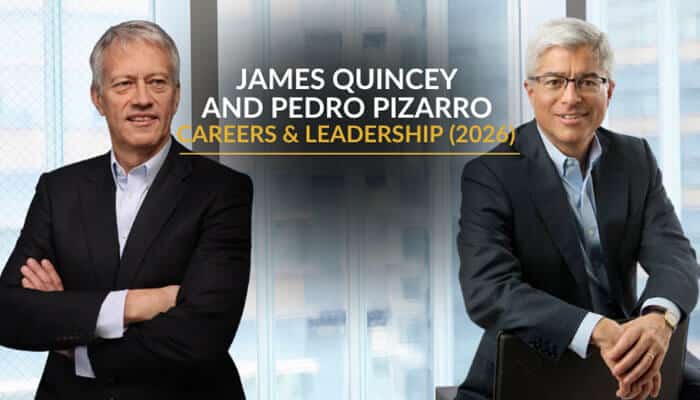

James Quincey and Pedro Pizarro are experienced corporate executives who followed remarkably similar paths to the top of two very different companies. Both began with strategy-consulting experience, joined their principal employers during the 1990s and spent years developing operational knowledge before becoming chief executives.
Quincey served as CEO of The Coca-Cola Company from May 2017 until March 31, 2026, when he became executive chairman. His tenure was defined by Coca-Cola’s expansion beyond traditional soft drinks, organizational restructuring, digital investment and efforts to adapt its portfolio to changing consumer preferences.
Pizarro has served as president and CEO of Edison International since 2016. His responsibilities include the safety and reliability of electric infrastructure, wildfire-risk reduction, customer affordability, grid modernization and the transition toward cleaner energy.
No credible public record identifies a formal partnership, joint venture, family relationship or reporting connection between James Quincey and Pedro Pizarro. Their strongest connection is comparative: both are long-tenured leaders who have guided major public companies through substantial industry change.
Quick Answer: James Quincey and Pedro Pizarro
James Quincey is the executive chairman and former CEO of The Coca-Cola Company. Pedro J. Pizarro is the president and CEO of Edison International, the parent company of Southern California Edison and Trio.
Their careers share several characteristics:
- Both worked in strategy consulting.
- Both joined their current corporate systems during the 1990s.
- Both advanced through numerous internal positions.
- Both became CEOs after gaining extensive operational experience.
- Both serve on the boards of other large public companies.
- Both have led businesses facing technological, environmental and social change.
Their primary difference is industry responsibility. Quincey’s experience centers on global consumer brands, marketing and beverage innovation. Pizarro leads an essential-service business where public safety, reliability, regulation and long-term infrastructure investment are central.
Key Takeaways
- James Quincey joined Coca-Cola in 1996 and became CEO in May 2017.
- He became Coca-Cola’s executive chairman on March 31, 2026.
- Pedro Pizarro joined Edison International in 1999 and became CEO in October 2016.
- Quincey studied electronic engineering; Pizarro earned undergraduate and doctoral degrees in chemistry.
- Quincey previously worked at The Kalchas Group, while Pizarro worked at McKinsey & Company.
- Quincey serves on Pfizer’s board, while Pizarro serves on 3M’s board.
- There is no verified formal business partnership between the two executives.
- Their records include measurable achievements, strategic setbacks and different forms of executive accountability.
Why Are James Quincey and Pedro Pizarro Mentioned Together?
People searching for James Quincey and Pedro Pizarro may assume that they work together, serve on the same board or lead a joint project. Public corporate records do not support those assumptions.
Quincey built his career at The Coca-Cola Company, a global consumer-beverage business. Pizarro developed his career within Edison International and Southern California Edison, companies focused on electricity infrastructure and energy services.
The two executives are most appropriately compared because they share several professional characteristics:
- Long tenures within their principal companies
- Strategy-consulting experience
- Advancement through internal operating roles
- Leadership of established public companies
- Responsibility for major corporate transformations
- Experience serving on outside boards
Their names may also appear within broader corporate-leadership networks. However, appearing in the same executive directory does not establish a direct professional relationship.
The purpose of this article is therefore to compare their careers, results and leadership responsibilities, not to suggest an unverified partnership.
James Quincey and Pedro Pizarro at a Glance
| Category | James Quincey | Pedro J. Pizarro |
| Current position | Executive chairman, The Coca-Cola Company | President and CEO, Edison International |
| Primary industry | Consumer beverages | Electric utilities and energy services |
| Joined principal company | 1996 | 1999 |
| Became CEO | May 2017 | October 2016 |
| Current CEO status | Stepped down March 31, 2026 | Remains CEO |
| Consulting background | Partner, The Kalchas Group | Senior engagement manager, McKinsey & Company |
| Education | Electronic engineering, University of Liverpool | Chemistry, Harvard; Ph.D. in chemistry, Caltech |
| Outside public-company board | Pfizer | 3M |
| Main operating scope | Global | Primarily California, with broader advisory services |
| Core leadership emphasis | Consumer relevance, brands, portfolio growth and agility | Safety, reliability, resilience, affordability and electrification |
Current positions, education and major career details are confirmed by official Coca-Cola and Edison International executive biographies.
James Quincey’s Career and Leadership
James Quincey is a British business executive who serves as executive chairman of The Coca-Cola Company.
He joined Coca-Cola in Atlanta in 1996 as director of learning strategy for the Latin America Group. He subsequently held several operational positions in Latin America, becoming president of the South Latin division in 2003 and president of the Mexico division in 2005.
Quincey later moved into senior European leadership. He served as president of the Northwest Europe and Nordics business unit and then as president of Coca-Cola’s Europe Group.
He became president and chief operating officer in 2015, CEO in May 2017 and chairman of the board in 2019. Henrique Braun succeeded him as CEO on March 31, 2026, while Quincey continued as executive chairman.
James Quincey’s Career Timeline
| Period | Position or Career Stage |
| Before 1996 | Partner at The Kalchas Group |
| 1996 | Joined Coca-Cola’s Latin America Group |
| 2003–2005 | President, South Latin division |
| 2005–2008 | President, Mexico division |
| 2008–2012 | President, Northwest Europe and Nordics |
| 2013–2015 | President, Europe Group |
| 2015–2017 | President and chief operating officer |
| 2017–2019 | Chief executive officer |
| 2019–March 2026 | Chairman and chief executive officer |
| March 31, 2026–present | Executive chairman |
Education and Consulting Background
Quincey earned a bachelor’s degree in electronic engineering from the University of Liverpool.
Before joining Coca-Cola, he was a partner at The Kalchas Group, which Coca-Cola describes as a strategy-consulting firm formed as a spinoff from Bain & Company and McKinsey.
His combination of technical education, consulting experience and international operations gave him exposure to:
- Analytical problem-solving
- Corporate strategy
- Consumer behavior
- International markets
- Organizational restructuring
- Brand and portfolio management
- Corporate governance
His assignments in Latin America and Europe also required him to manage differences in regulation, distribution, retail structures, income levels, and customer preferences.
Building a Total Beverage Company

One of the defining ideas of Quincey’s leadership was that Coca-Cola should become a broader “total beverage company” rather than depend too heavily on traditional carbonated soft drinks.
Coca-Cola’s portfolio includes products across categories such as:
- Sparkling soft drinks
- Water
- Sports drinks
- Coffee
- Tea
- Juice
- Dairy beverages
- Plant-based beverages
The strategy was not to move away from Coca-Cola’s flagship products. It was designed to protect the company’s strongest brands while expanding into additional categories, price points and consumption occasions.
Coca-Cola stated during its CEO succession announcement that more than 10 additional billion-dollar brands had been added during Quincey’s tenure as CEO.
Responding to Consumer Change
Consumer preferences vary by country, age, income, health priorities, retail channel and occasion. A beverage company operating worldwide cannot rely on one product formulation or packaging format.
Under Quincey, Coca-Cola increased its emphasis on:
- Low- and no-sugar beverages
- Hydration products
- Coffee and tea
- Smaller package sizes
- Premium products
- Digital commerce
- More localized consumer insights
Coca-Cola Zero Sugar volume increased 14% worldwide in 2025. Water, sports drinks, coffee and tea collectively grew 2%, while juice, value-added dairy and plant-based beverages declined 3%. These results show the potential of portfolio diversification, but they also demonstrate that growth is not uniform across every beverage category.
Organizational Agility and Digital Transformation
Coca-Cola operates through a network involving the company, regional operating units, bottling partners, retailers, restaurants, and distributors.
Effective leadership requires coordination among:
- Brand teams
- Local market leaders
- Bottling companies
- Retail partners
- Digital platforms
- Marketing teams
- Technology and data specialists
Quincey supported an operating model intended to combine Coca-Cola’s global scale with faster local decisions. His tenure also included greater investment in digital capabilities, data and more modern marketing methods.
The importance of that work continued during the 2026 leadership transition, when Coca-Cola created an enterprise-level digital leadership role intended to unify technology, data and operational excellence.
Leading Through the Pandemic
The COVID-19 pandemic created a major challenge for Coca-Cola because a meaningful portion of beverage consumption normally occurs in restaurants, cinemas, stadiums, hotels and other away-from-home locations.
The company had to respond to abrupt changes in hospitality demand, customer movement, product priorities, distribution and marketing. Coca-Cola specifically cited Quincey’s leadership through the pandemic when announcing his transition from CEO to executive chairman.
Measurable Results
Coca-Cola reported the following results for 2025, Quincey’s final full year as CEO:
| Performance Metric | 2025 Result |
| Net revenue | $47.9 billion |
| Reported revenue growth | 2% |
| Organic revenue growth | 5% |
| Reported earnings per share | $3.04, up 23% |
| Comparable earnings per share | $3.00, up 4% |
| Comparable operating margin | 31.2% |
| Coca-Cola Zero Sugar volume | Up 14% |
| Overall unit-case volume | Even |
| Market performance | Gained value share in total nonalcoholic ready-to-drink beverages |
The results showed revenue growth, margin expansion on a comparable basis and continued momentum for Coca-Cola Zero Sugar.
However, total unit-case volume was unchanged. This indicates that pricing and product mix contributed significantly to revenue growth rather than growth resulting entirely from higher beverage volume.
Company-level results should not be attributed entirely to one executive. They also reflect the work of employees, bottling partners, regional management, the board and broader market conditions.
Challenges and Setbacks
Quincey’s record also includes investments and strategic decisions that did not perform as originally expected.
Coca-Cola recorded a $960 million non-cash impairment charge related to the BODYARMOR trademark in the fourth quarter of 2025. The company attributed the reduced valuation primarily to revised operating projections, a slower expected category growth rate, increasing competition, and more focused innovation and international expansion plans.
The impairment illustrates an important acquisition risk: purchasing a promising brand does not guarantee that its valuation, market position or projected growth will be maintained.
Coca-Cola also continues to face stakeholder scrutiny involving:
- Plastic packaging
- Water use
- Added sugar
- Supply-chain emissions
- Responsible marketing
- Sustainable sourcing
- Returns from acquired brands
These issues matter because long-term brand strength depends on public trust as well as financial performance.
Pedro Pizarro’s Career and Leadership
Pedro J. Pizarro is the president and chief executive officer of Edison International.
Edison International is the parent company of Southern California Edison, one of the largest electric utilities in the United States. It is also the parent of Trio, a portfolio of businesses providing energy and sustainability advisory services to commercial, industrial and institutional organizations in North America and Europe.
Pizarro joined Edison International in 1999 and moved to Southern California Edison in 2001. He subsequently held leadership roles involving strategy, power procurement, generation, transmission and electric distribution.
He became president of Southern California Edison in October 2014, president of Edison International in 2016 and CEO in October 2016. He also serves on Edison International’s board.
Pedro Pizarro’s Career Timeline
| Period | Position or Career Stage |
| Before 1999 | Senior engagement manager, McKinsey & Company |
| 1999 | Joined Edison International |
| 2001 | Moved to Southern California Edison |
| 2001–2011 | Held strategy, procurement, and operational roles |
| 2011–2014 | President and board chair, Edison Mission Energy |
| 2014–2016 | President, Southern California Edison |
| 2016–present | President and CEO, Edison International |
Scientific and Consulting Background
Pizarro earned a bachelor’s degree in chemistry from Harvard University and a Ph.D. in chemistry from the California Institute of Technology.
He also held graduate fellowships from the National Science Foundation and the U.S. Department of Defense.
Before joining Edison, he worked as a senior engagement manager at McKinsey & Company in Los Angeles. His assignments included work for energy, technology, engineering-services, and banking clients in areas such as corporate strategy, mergers and acquisitions, operations, and organizational design.
Scientific training does not automatically make someone an effective executive. However, it can support skills that are particularly useful in the energy industry:
- Evaluating complex systems
- Interpreting technical evidence
- Testing assumptions
- Comparing technologies
- Managing uncertainty
- Assessing long-term risks
- Making decisions with incomplete information
Grid Safety and Wildfire Mitigation
Wildfire exposure is one of the most serious operational, legal, and financial risks facing California electric utilities.
Southern California Edison’s mitigation program includes measures such as:
- Covered conductor
- Equipment inspections
- Vegetation management
- Weather monitoring
- Situational-awareness technology
- Targeted undergrounding
- Emergency planning
- Public Safety Power Shutoffs
By the end of 2025, SCE had installed more than 7,000 miles of covered conductor in high-fire-risk areas. Edison said this represented more than 90% of the utility’s planned grid-hardening effort using that technology.
Covered conductor can reduce the likelihood that contact involving power lines will cause an ignition. It cannot eliminate every wildfire risk, which is why utilities use several overlapping infrastructure, inspection and operational measures.
Modernizing the Electric Grid
Electric vehicles, renewable generation, battery storage, data centers and building electrification are expected to place new demands on the grid.
Modernization may require substantial investment in:
- Transmission systems
- Distribution networks
- Substations
- Energy storage
- Monitoring technology
- Digital controls
- Cybersecurity
- New customer connections
Pizarro’s role therefore extends beyond maintaining existing equipment. Edison must plan for future demand, technologies, and climate conditions that may differ substantially from the environment in which older grid assets were designed.
Electrification and Cleaner Energy

Edison International’s strategy connects California’s emissions goals with greater use of electricity produced from cleaner sources.
The transition is likely to require:
- More renewable generation
- Greater storage capacity
- Electric-vehicle infrastructure
- Building electrification
- Expanded transmission and distribution
- Advanced grid-management systems
- Reliable clean-energy resources
- Policies that protect customer affordability
The challenge is not simply adding renewable power. Edison must integrate new resources, preserve reliability and finance the infrastructure necessary to support increased electricity demand.
Reliability and Affordability
Electricity is an essential service. Most households and businesses cannot simply stop using it when rates increase.
A utility must balance investment needs against:
- Customer bills
- Public safety
- Extreme weather
- Construction costs
- Regulatory decisions
- Technology availability
- Investor financing
- Community expectations
This creates a leadership environment fundamentally different from consumer products. Pizarro must consider financial performance alongside regulatory approval, reliability and the social consequences of infrastructure decisions.
Measurable Results
Edison International reported the following company results and operational progress for 2025:
| Performance Metric | 2025 Result |
| Reported net income | $4.46 billion |
| Adjusted core earnings | $2.52 billion |
| 2024 adjusted core earnings | $1.90 billion |
| Core earnings per share | $6.55 |
| Covered conductor installed | More than 7,000 total miles |
| Planned covered-conductor work completed | More than 90% |
Edison explained that the increase in core earnings was influenced partly by regulatory decisions, revenue recognition and benefits related to cost recoveries. The results should therefore be considered alongside the accounting and regulatory factors that contributed to them.
As with Coca-Cola, Edison International’s performance cannot be attributed solely to its CEO. Results also depend on employees, regulators, capital markets, public policy and operating conditions.
Wildfire Recovery and Accountability
Southern California Edison created a voluntary Wildfire Recovery Compensation Program for eligible individuals and businesses affected by the January 2025 Eaton Fire.
As of July 16, 2026, SCE reported that nearly 12,000 community members had sought compensation and that more than $750 million had been offered through the program. Participation is voluntary, and company-reported offers should not be interpreted as a final legal determination regarding the fire’s cause or liability.
Edison International’s compensation committee also reduced the annual incentive award otherwise payable to Pizarro for 2025 by approximately 40%, or $1.07 million, because of the effect of wildfires on communities within SCE’s service territory.
The company stated that the reduction was not intended as a negative assessment of Pizarro’s individual performance. Nevertheless, it is a significant example of executive compensation being linked to events with serious community consequences.
Continuing risks facing Edison International include:
- Wildfire claims and litigation
- Infrastructure safety
- Customer affordability
- Regulatory uncertainty
- Extreme weather
- Cybersecurity
- Capital-project execution
- Financing grid expansion
- Maintaining reliability during electrification
Leadership Styles Compared
Quincey and Pizarro both have analytical backgrounds, but their leadership approaches reflect the requirements of their industries.
| Leadership Area | James Quincey | Pedro Pizarro |
| Customer relationship | Consumers choose among competing brands | Customers rely on essential electric service |
| Industry structure | Competitive global consumer market | Highly regulated utility market |
| Principal assets | Brands, formulas, marketing and bottling relationships | Grid infrastructure and utility operations |
| Decision cycle | Products and campaigns can launch relatively quickly | Major infrastructure projects can take years |
| Main strategic risks | Consumer preferences, brand relevance and portfolio returns | Safety, wildfires, reliability, affordability and regulation |
| Innovation focus | Products, packaging, marketing, data and digital commerce | Grid technology, resilience and electrification |
| Geographic scope | Global | Primarily California |
| Current role | Executive chairman | President and CEO |
| Leadership horizon | Consumer trends and brand growth | Multi-decade infrastructure planning |
James Quincey’s Leadership Approach
Quincey’s record suggests a style that is:
- Consumer focused: He emphasized adapting products and packaging to changing preferences.
- Internationally oriented: His career included extensive experience in Latin America and Europe.
- Portfolio driven: He treated Coca-Cola as a collection of beverage brands rather than a business dependent on one product.
- Adaptive: His tenure included acquisitions, restructuring, digital investment and pandemic response.
- Succession conscious: Coca-Cola prepared an experienced internal executive to replace him as CEO.
Pedro Pizarro’s Leadership Approach
Pizarro’s documented responsibilities suggest a style that is:
- Technically informed: His scientific training and utility experience support a systems-based approach.
- Long-term oriented: Grid assets and infrastructure decisions can have consequences lasting decades.
- Risk conscious: Wildfire mitigation, reliability, cybersecurity and safety are central to Edison’s operations.
- Stakeholder dependent: Utility leadership requires cooperation with regulators, communities, customers and policymakers.
- Industry collaborative: Pizarro is a former chair of the Edison Electric Institute and former co-chair of the Electricity Subsector Coordinating Council.
These descriptions are editorial interpretations based on career history and publicly documented decisions. They are not formal labels assigned by the executives or their companies.
Major Similarities and Differences
Important Similarities
Both leaders began with strategy-consulting experience. Consulting likely provided early exposure to structured problem-solving, organizational change, corporate strategy and senior-management decision-making.
Both also built long careers within one corporate system. Quincey joined Coca-Cola in 1996, while Pizarro joined Edison International in 1999. Neither was hired directly into the CEO role.
Their advancement gave them substantial institutional knowledge before they assumed responsibility for their companies.
Both also combined strategy with operations:
- Quincey managed regional Coca-Cola businesses in Latin America and Europe.
- Pizarro held roles involving procurement, generation, transmission and distribution.
Finally, both serve on other major public-company boards. Quincey serves on Pfizer’s board, while Pizarro serves on 3M’s board.
Important Differences
The most significant difference is the relationship between the company and its customers.
A consumer can select a competing beverage or stop buying a product. Electricity, by contrast, is an essential service with few practical alternatives for most households and businesses.
Their companies also face different forms of risk:
- Coca-Cola’s risks include consumer preferences, brand reputation, pricing, acquisitions and product relevance.
- Edison’s risks include public safety, infrastructure failure, wildfire exposure, regulation and affordability.
The speed of decision-making also differs. Coca-Cola can test a product, package or campaign relatively quickly. A utility project may require engineering studies, environmental reviews, regulatory approval, property access, construction and safety testing.
Quincey’s experience is global and brand-centered. Pizarro’s work is more regionally concentrated and infrastructure-centered.
Corporate Governance and Compensation
Quincey and Pizarro currently hold different governance roles.
Quincey is Coca-Cola’s executive chairman. Henrique Braun now serves as CEO and manages daily executive operations. Quincey remains an employee and leads the board while providing strategic continuity and institutional knowledge.
Coca-Cola set Quincey’s annual base salary at $1.2 million after his transition to executive chairman, while maintaining his eligibility for annual and long-term incentive plans.
Pizarro remains both president and CEO of Edison International and a member of its board. Edison International uses a separate board chair, formally separating the leadership of management from the leadership of the board.
According to the companies’ 2026 proxy statements, their reported total compensation for 2025 was:
| Executive | Reported 2025 Total Compensation |
| James Quincey | $31,208,165 |
| Pedro J. Pizarro | $16,544,559 |
These figures represent SEC-reported total compensation, not cash salary or personal net worth. Total compensation can include salary, cash incentives, stock awards, options, pension-value changes, security costs and other benefits.
The value assigned to an equity award at its grant date may differ significantly from the value an executive ultimately receives.
Leadership Lessons
1. Operational Experience Can Strengthen Strategy
Both executives spent years inside their companies before becoming CEO. That experience gave them a practical understanding of how senior decisions affect customers, employees, regional operations and business partners.
2. Transformation Should Build on Core Strengths
Quincey expanded Coca-Cola’s beverage portfolio without abandoning its most valuable brands.
Pizarro supports electrification and cleaner energy while emphasizing that electric service must remain reliable, safe and affordable.
Transformation is generally more sustainable when it builds on an organization’s strongest existing capabilities.
3. Leadership Must Reflect Industry Conditions
A strategy that works in consumer beverages may fail in a regulated utility.
Quincey’s environment rewards consumer insight, brand development and rapid experimentation. Pizarro’s environment requires technical planning, regulatory coordination and safety controls.
4. Long-Term Vision Still Requires Current Results
A compelling long-term strategy does not replace the need for measurable execution.
For Coca-Cola, relevant measurements include:
- Revenue
- Volume
- Market share
- Brand performance
- Acquisition returns
For Edison International, important measurements include:
- Reliability
- Wildfire mitigation
- Infrastructure completion
- Customer affordability
- Regulatory execution
- Community recovery
5. Leadership Evaluation Must Include Setbacks
Coca-Cola’s BODYARMOR impairment and Edison’s wildfire-related incentive reduction show why leadership records must include decisions and events that produced negative consequences.
6. Succession Planning Is a Core Responsibility
Quincey’s transition demonstrates that preparing a capable successor is an important part of a CEO’s role.
Pizarro’s eventual succession will also be significant because utility leadership requires specialized operational, regulatory and technical knowledge.
7. Stakeholder Trust Must Be Earned Continuously
Coca-Cola depends on consumers, bottlers, retailers, employees, communities and regulators.
Edison depends on customers, employees, regulators, policymakers, investors, emergency agencies and communities.
Both companies require transparent reporting, measurable performance and accountability.
What to Watch in 2026
James Quincey
As executive chairman, Quincey’s effectiveness will partly depend on whether Coca-Cola maintains a clear division between board oversight and Braun’s authority as CEO.
Important areas to monitor include:
- The CEO transition
- Digital transformation
- Coca-Cola Zero Sugar growth
- Returns from acquisitions
- Non-sparkling beverage performance
- Packaging and water commitments
- Cooperation with bottling partners
- Brand relevance among younger consumers
Pedro Pizarro
Pizarro’s most important priorities remain closely connected to safety, recovery, investment and affordability.
Areas to monitor include:
- Wildfire recovery
- Related legal and regulatory proceedings
- Compensation-program participation
- Covered-conductor and undergrounding projects
- Reliability during extreme weather
- Customer-rate trends
- Financing for grid expansion
- Demand from electric vehicles, buildings and data centers
- Progress toward California’s clean-energy objectives
Conclusion: Pedro Pizarro’s Career Timeline
James Quincey and Pedro Pizarro represent two distinct models of corporate leadership.
Quincey’s career shows how a global consumer company can protect historic brands while expanding into new categories, modernizing its organization and adapting to changing preferences. His transition from CEO to executive chairman shifted his responsibilities toward governance, strategic continuity and board leadership.
Pizarro’s career demonstrates the demands of leading a regulated, infrastructure-intensive and safety-critical business. His responsibilities extend beyond financial performance to grid reliability, wildfire-risk reduction, affordability, clean-energy development and community recovery.
The strongest connection between James Quincey and Pedro Pizarro is not a business partnership. It is their progression from analytical consulting backgrounds to operational management and ultimately to the leadership of major public companies undergoing significant transformation.
Their records also show why leadership cannot be evaluated through job titles or company announcements alone. Revenue growth, brand expansion and infrastructure investment matter, but so do acquisition impairments, public-safety risks, stakeholder criticism and executive accountability.
Ultimately, their careers demonstrate that effective leadership does not follow one universal formula. It depends on understanding an organization’s customers, assets, risks, responsibilities and long-term purpose.
James Quincey and Pedro Pizarro FAQs
1. Who are James Quincey and Pedro Pizarro?
James Quincey and Pedro Pizarro are corporate leaders who became CEOs of major companies. Quincey led The Coca-Cola Company, while Pizarro leads Edison International, focusing on energy and infrastructure.
2. Are James Quincey and Pedro Pizarro connected professionally?
No, James Quincey and Pedro Pizarro do not have a known partnership or direct business relationship. They are compared because of their similar leadership journeys and executive experience.
3. What companies do James Quincey and Pedro Pizarro lead?
James Quincey served as CEO of The Coca-Cola Company and became executive chairman in 2026. Pedro Pizarro is president and CEO of Edison International, parent of Southern California Edison.
4. What leadership qualities do James Quincey and Pedro Pizarro share?
James Quincey and Pedro Pizarro share backgrounds in strategy consulting, long-term corporate experience, operational leadership, and managing large organizations through industry changes.
5. How are James Quincey and Pedro Pizarro different as leaders?
James Quincey focuses on global brands, consumer products, and business growth, while Pedro Pizarro focuses on utility operations, grid reliability, safety, and clean energy transformation.
