


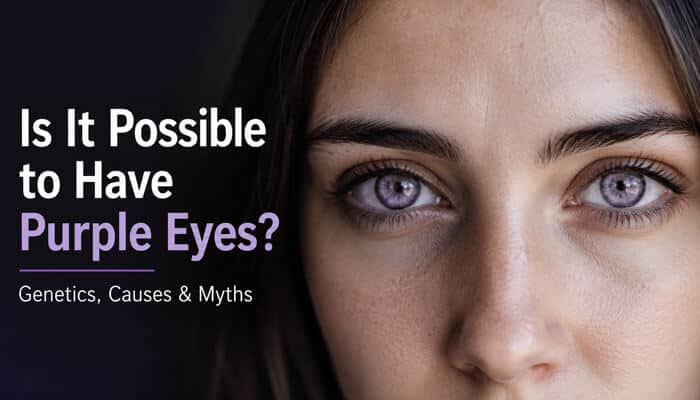

Is it possible to have purple eyes? Human eyes can naturally appear violet, lavender, or purple under certain conditions. However, purple is not generally classified as a separate biological eye color produced by a unique pigment. In most cases, violet-looking eyes are extremely pale blue or gray eyes whose appearance is influenced by low melanin, iris structure, light scattering, reflected colors, and photography.
Very low pigmentation associated with albinism can also make the eyes appear reddish, pinkish, or violet under particular lighting. Bright purple eyes seen in movies, photographs, or social-media posts may instead be produced by colored contact lenses, makeup, filters, camera processing, or digital editing.
Eye-color genetics are more complicated than the traditional idea that a single gene determines whether someone has brown or blue eyes. Multiple genes influence melanin production and distribution within the iris, creating a continuum of shades rather than a few perfectly separate categories.
This guide explains whether naturally violet eyes are real, how genetics and albinism affect their appearance, how rare purple-looking eyes may be, and when an unexpected change in eye color requires professional attention.
Quick Answer: Is It Possible to Have Purple Eyes?
Yes, human eyes can appear purple or violet, but scientists have not identified a normal purple pigment within the iris or a single recognized “purple-eye gene.”
A violet appearance is usually associated with one or more of the following:
- An extremely pale blue or gray iris
- A very low amount of melanin
- The structural scattering of light
- Reflections from clothing, makeup, or nearby colors
- Camera exposure, flash, white balance, or filters
- Reduced pigmentation associated with albinism
- Cosmetic purple contact lenses
Someone may therefore accurately describe their eyes as violet even though a medical or genetic classification would probably place them within the light-blue, gray, or lightly pigmented range.
Key Takeaways
- Naturally violet-looking eyes are possible, but they are usually a visual variation of pale blue or gray eyes.
- Medical genetics sources describe eye color through melanin levels and gene variation rather than a separate purple pigment.
- Eye color is polygenic, meaning several genes influence its appearance.
- The genes OCA2 and HERC2 play major roles in regulating iris pigmentation.
- Albinism may make lightly pigmented eyes appear reddish or violet under certain lighting conditions.
- No reliable global statistic establishes how many people have naturally violet-looking eyes.
- Elizabeth Taylor’s deep blue eyes were famously described as violet.
- Alexandria’s Genesis is an internet myth, not a recognized genetic condition.
- Colored contact lenses can create purple eyes temporarily but require proper fitting and hygiene.
- A sudden eye-color change, especially in only one eye, should be medically evaluated.
What Does “Purple Eyes” Actually Mean?
The phrase purple eyes can describe several different visual effects. Some involve the iris, while others involve the pupil, reflected light, photography, or cosmetic products.
| Appearance | Most likely explanation | Natural or artificial? |
| Pale blue eyes that look violet | Low melanin, iris structure, and reflected light | Natural appearance |
| Gray eyes with lavender undertones | Light scattering and surrounding colors | Natural appearance |
| Reddish-violet eyes associated with albinism | Very low iris pigmentation and internal reflection | Related to a genetic condition |
| Bright, evenly purple irises | Cosmetic colored contact lenses | Artificial and temporary |
| Purple eyes in edited photographs | Filters, saturation or color correction | Artificial |
| Pink or purple pupils in flash photographs | Light reflected from the retina | Photographic effect |
| A newly discolored iris | Injury, inflammation, medication or eye disease | Requires evaluation |
This distinction matters because visible color alone does not explain what is happening within the eye.
A person may have naturally pale eyes that frequently look violet without having an unusual medical condition. In contrast, an eye that suddenly becomes darker, lighter, cloudy, red, or unusually colored may require professional examination.
Is Violet an Officially Recognized Eye Color?
When people ask is it possible to have purple eyes, it is important to understand that violet is not consistently recognized as an independent eye-color category in clinical or genetic research.
Many studies and genetic prediction systems classify human eye color into three broad groups:
- Blue
- Intermediate
- Brown
Some surveys use additional categories such as green, gray, hazel, or amber. However, there is no universal classification system that assigns every visible iris shade to its own biological category.
MedlinePlus describes human eye color as a continuum extending from very light blue to dark brown. Variations across several genes influence melanin production and help create the many shades seen between these extremes.
A person may reasonably describe their eyes as violet when that is how they consistently appear. The key distinction is between:
- A visual description used in everyday conversation
- A formal biological classification used in genetics or medicine
In a clinical setting, violet-looking eyes would most likely be described as very light blue, gray, blue-gray, or lightly pigmented. Therefore, the answer to ” Is it possible to have purple eyes depends on whether “purple” refers to visual appearance or a separate biological eye color.
How Human Eye Color Develops
The iris is the colored structure surrounding the pupil. It controls how much light enters the eye by expanding or contracting around the pupil.
Visible iris color is influenced by:
- The amount of melanin in the iris
- Where that melanin is located
- How evenly the pigment is distributed
- The density and arrangement of iris tissue
- The structure of the iris stroma
- The way incoming light is absorbed and scattered
- Multiple inherited genetic variants
People with brown eyes generally have more melanin in the front layers of the iris. People with blue eyes have considerably less. Green, gray, hazel, amber, and intermediate colors develop from different combinations of pigmentation and light scattering.
How Melanin Influences Eye Color
| General melanin level | Common visible appearance | Effect on light |
| High | Dark brown or brown | More light is absorbed |
| Moderate | Hazel, amber or green | Pigment absorption and scattering combine |
| Low | Blue or gray | More light is scattered through lightly pigmented tissue |
| Very low | Pale blue, light gray or violet-looking | Lighting and reflections strongly influence the visible shade |
This table is a simplified explanation rather than a diagnostic chart. Eye color exists along a spectrum, and two people within the same broad category may have noticeably different patterns, rings, flecks, and undertones.
Why Blue or Gray Eyes Can Look Purple
Blue eyes do not contain a separate blue pigment. Their appearance results primarily from low melanin and the way light interacts with the iris.
Similar optical effects can cause a very pale blue or gray iris to appear lavender or violet.
Cool natural lighting
Soft daylight may emphasize blue, silver, and violet undertones. The same eyes may look gray indoors and more lavender near a window or outdoors.
Clothing and surrounding colors
Purple, navy, burgundy, silver, and cool-blue clothing can influence how observers perceive nearby eye color.
A deep-purple shirt, for example, may reflect subtle color toward the face and make pale blue eyes look more violet.
Makeup
Violet eye shadow, dark eyeliner, and contrasting mascara can make pale blue or gray irises appear more saturated.
Makeup does not change iris pigmentation, but it can strengthen contrast and influence visual perception.
Pupil size
The pupil expands in dim lighting and contracts in bright lighting. This changes how much of the iris is visible and may alter the perceived intensity of its color.
Camera exposure and white balance
Cameras do not always reproduce colors exactly as the human eye sees them. Exposure, white balance, flash, lenses, sensors, and automatic image processing may make an iris appear bluer, grayer, greener, or more purple.
Digital enhancement
Increasing blue, violet, or magenta saturation can make pale blue eyes look vividly purple without changing their natural color. These factors affect the perceived shade, not the underlying iris pigmentation.
Is It Possible to Have Purple Eyes Naturally?
Is it possible to have purple eyes naturally? Human eyes can consistently appear violet or lavender, particularly when the underlying iris is very light blue, gray, blue-gray, or unusually low in pigmentation.
A natural violet appearance may occur when:
- The iris contains very little melanin.
- Iris tissue scatters light in a particular way.
- Blue or gray undertones combine with warmer reflections.
- Nearby colors emphasize lavender or violet shades.
- An inherited condition reduces iris pigmentation.
When asking is it possible to have purple eyes, it is important to distinguish visual appearance from biological pigmentation. “Naturally purple eyes” can be a reasonable description of how an iris looks, but it does not mean that the eye contains a separate purple pigment.
The visible shade may also change throughout the day. Eyes that look violet in bright natural light may appear blue, gray, or silver under artificial lighting.
Is It Possible to Have Purple Eyes Because of Genetics?
Genetics can produce the pale pigmentation and iris characteristics that make eyes appear violet. However, researchers have not identified one standard gene that independently produces normal purple eyes.
Eye color is polygenic, meaning multiple genes contribute to the final appearance. Two of the most important are OCA2 and HERC2.
The OCA2 gene provides instructions for producing a protein involved in melanin production and storage. Variations within a nearby region of HERC2 can influence OCA2 activity and change the amount of melanin present in the iris.
Other genes associated with eye-color variation include:
- ASIP
- IRF4
- SLC24A4
- SLC24A5
- SLC45A2
- TPCN2
- TYR
- TYRP1
Different combinations of variants within these genes help create the wide range of human eye colors. However, inheriting pale blue or gray eyes should not be confused with inheriting a special purple-eye mutation.
Why Eye-Color Inheritance Is Difficult to Predict
Eye color is often explained using the basic rule that brown is dominant and blue is recessive. Although useful as an introduction to genetics, that model cannot accurately predict every child’s eye color.
Because several genes are involved:
- Parents with similar eye colors may have a child with a different shade.
- Variants inherited from grandparents may affect the outcome.
- Green, hazel, gray, and intermediate colors are especially difficult to predict.
- A parent’s visible eye color does not reveal every pigmentation-related variant they carry.
MedlinePlus explains that multiple genes combine with OCA2 and HERC2 to create a continuum of eye colors.
Can Violet-Looking Eyes Run in Families?
Violet-looking eyes may occur in several members of the same family because relatives can inherit similar pigmentation traits and iris structures.
Family members may share:
- Low iris melanin
- Pale blue or gray eye color
- Similar iris texture
- Similar light-scattering characteristics
- Pigmentation-related genetic variants
- An inherited condition that reduces melanin
This does not prove the existence of a purple-eye gene. It means relatives may inherit similar combinations of traits that create a violet appearance.
A family could also use different words to describe the same inherited shade. One relative may call the eyes blue-gray, while another may describe them as lavender or violet.
Can Albinism Cause Purple Eyes?
When people ask is it possible to have purple eyes, albinism is often mentioned as a possible explanation. Albinism can make the eyes appear unusually pale, reddish, pinkish, or violet under certain lighting, but not everyone with albinism has red or purple-looking eyes.
Albinism is a group of inherited conditions involving reduced or absent melanin. Depending on the type, it may affect:
- The eyes
- The skin
- The hair
- Development of the visual system
When iris pigmentation is very low, more light can pass through the iris. Reflections from structures inside the eye may then contribute to a reddish or violet appearance.
Albinism can also affect visual development. Possible effects include reduced visual acuity, involuntary eye movements, eye misalignment, depth-perception difficulties, and sensitivity to light.
Ocular albinism
Ocular albinism primarily affects pigmentation and development within the eyes. The most common form is associated with variants in the GPR143 gene.
Possible features include:
- Reduced visual acuity
- Nystagmus, or involuntary eye movement
- Strabismus, or misaligned eyes
- Reduced depth perception
- Light sensitivity
- Reduced iris and retinal pigmentation
- Developmental differences affecting the visual pathways
Ocular albinism may occur even when changes in skin or hair pigmentation are not obvious.
Oculocutaneous albinism
Oculocutaneous albinism affects pigmentation in the eyes, skin, and hair. Different forms are associated with genes involved in melanin production, including TYR, OCA2, TYRP1, and SLC45A2.
The visible appearance varies considerably. Some people have very pale skin, white hair, and light-colored eyes. Others retain more pigment and may have blond, red, light-brown, or darker hair with blue, hazel, or brown eyes.
Eye color alone cannot diagnose albinism. Diagnosis may involve:
- A complete eye examination
- Medical and family history
- Assessment of visual development
- Examination of the retina
- Genetic testing when appropriate
Purple Eyes vs. Red Eyes
Purple-looking eyes and red-looking eyes may involve related optical effects, but they are not always the same.
| Appearance | Where the visible color occurs | Possible explanation |
| Violet or lavender iris | Iris | Pale blue or gray pigmentation plus lighting |
| Reddish-violet iris | Iris and internal reflections | Very low pigmentation |
| Red pupil in a flash photograph | Pupil and retina | Common photographic red-eye effect |
| White or yellow pupil reflection | Pupil or structures behind it | Potential abnormal reflex requiring examination |
A red pupil in a photograph does not mean that the person has a red iris.
Can Camera Flash Make Eyes Look Purple?
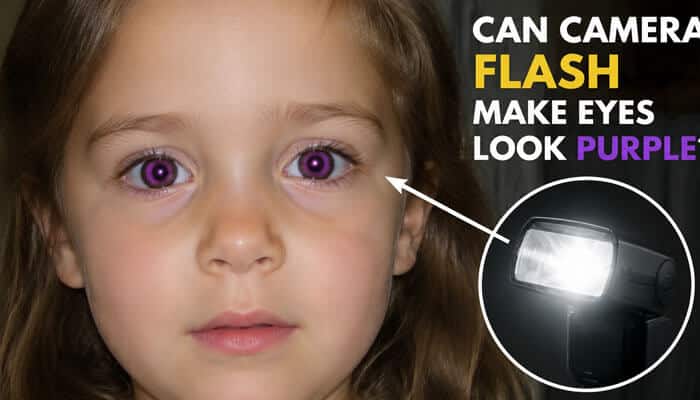
When people ask is it possible to have purple eyes, photographs can sometimes create confusion. Camera flash may make the pupil appear red, pink, magenta, or even purple because light enters the pupil and reflects from the retina at the back of the eye.
Camera exposure, white balance, flash intensity, and image processing can all affect the recorded shade. This purple-looking effect comes from reflected light through the pupil rather than a permanent change in the iris or natural eye pigmentation.
A similar red reflection in both eyes is often a normal photographic effect. However, a repeated white, yellow, unusually dark, or unequal pupil reflection—especially in a child—should be evaluated by an eye-care professional because it may indicate an underlying eye problem.
Therefore, although a camera flash can make eyes look purple in photographs, it does not mean that the person naturally has purple irises.
How Rare Are Purple or Violet-Looking Eyes?
People asking is it possible to have purple eyes often also want to know how rare they are. Unfortunately, there is no dependable worldwide percentage for naturally violet-looking eyes.
Most population studies do not record violet as a separate category. People with this appearance may instead be counted as:
- Blue-eyed
- Gray-eyed
- Light-eyed
- Intermediate
- Affected by reduced pigmentation
Because violet is not measured consistently, researchers cannot calculate a meaningful global prevalence.
Be cautious of websites claiming that an exact percentage of the population has purple eyes unless they explain:
- How purple was defined
- Whether eye color was self-reported
- Whether photographs used standardized lighting
- Whether contact lenses were excluded
- Whether people with albinism were counted separately
- Which population was studied
- How large the sample was
A consistent natural violet appearance is probably uncommon, but it cannot be confidently ranked against green, gray, amber, or other rare eye colors.
Are Purple Eyes the Rarest Eye Color?
Purple cannot reliably be called the rarest eye color because it is not consistently recognized as a separate biological category.
Uncommon recognized appearances may include:
- Gray eyes
- Green eyes
- Amber eyes
- Extremely pale irises
- Unusual forms of heterochromia
- Reddish or violet-looking eyes associated with severe hypopigmentation
The answer also depends on what someone means by purple. Pale blue eyes that appear violet under daylight are different from:
- Eyes affected by severe hypopigmentation
- Purple cosmetic contact lenses
- Digitally edited photographs
- Flash-related pupil reflections
It is therefore more accurate to describe violet-looking eyes as an uncommon visible variation than to assign them an unsupported rarity ranking.
Did Elizabeth Taylor Really Have Violet Eyes?
Elizabeth Taylor is the celebrity most closely associated with violet eyes.
Her eyes were widely described as deep blue or blue-violet, and lighting, clothing, makeup, film processing, and photography could make them appear:
- Deep blue
- Blue-violet
- Indigo
- Lavender
- Violet
Her large eyes, dark eyebrows, and prominent eyelashes also created strong contrast around the irises, making their color appear more dramatic. Calling Taylor’s eyes violet was a reasonable visual description, but it does not prove that her irises contained a unique purple pigment. Her appearance is a useful example of how lighting, contrast, personal description, and photography can influence eye-color terminology.
Are Violet Eyes the Same as Gray Eyes?
Not always, but many violet-looking eyes are probably very pale blue-gray or gray eyes.
Gray irises usually contain relatively little melanin and can change noticeably under different lighting. Depending on their structure and surroundings, they may look:
- Silver
- Slate gray
- Blue-gray
- Green-gray
- Lavender
- Violet
A person may therefore have eyes that consistently appear violet while still being classified more broadly as gray or light blue.
What Is Heterochromia?
Heterochromia is a difference in color between the two irises or within one iris.
- Complete heterochromia
Each eye is a different color.
- Sectoral heterochromia
A section of one iris is a different color from the rest.
- Central heterochromia
A ring surrounding the pupil differs from the outer part of the iris.
Heterochromia may be present from birth or develop later. Congenital heterochromia is often harmless, while acquired heterochromia may be associated with:
- Inflammation
- Eye injury
- Medication
- Surgery
- Changes in iris tissue
- Another eye condition
Contrasting blue, gray, green, or brown sections may create a violet impression, but heterochromia does not normally produce purple pigment.
Other Conditions That Can Affect Iris Color
Unusual iris color does not automatically indicate a disorder. However, certain conditions may change eye pigmentation.
Waardenburg syndrome
Waardenburg syndrome is a group of genetic conditions that can affect pigmentation and hearing.
Possible features include:
- Very pale blue eyes
- Two differently colored eyes
- Different colors within one iris
- A white section of hair
- Changes in skin pigmentation
- Congenital hearing loss
The condition does not specifically create purple pigment, but its pigmentation changes can produce unusually pale or differently colored eyes.
Horner syndrome
Horner syndrome affects nerves controlling parts of the eye and face.
Possible signs include:
- A smaller pupil in one eye
- Drooping of the upper eyelid
- Reduced sweating on one side of the face
- A lighter iris when the condition begins in early childhood
New pupil inequality or eyelid drooping should be medically assessed, particularly when accompanied by pain, weakness, headache, or other neurological symptoms.
Can Babies Be Born With Purple-Looking Eyes?
A baby may be born with pale blue or gray eyes that appear violet.
Babies often have relatively little pigment in their irises at birth. As melanin develops during infancy, initially light eyes may become:
- Darker blue
- Gray
- Green
- Hazel
- Brown
Eye color may continue changing gradually during the first months or years of life.
A pediatric eye examination may be appropriate when unusual pigmentation occurs with:
- Strong light sensitivity
- Difficulty focusing
- Involuntary eye movements
- Eye misalignment
- Unusual skin or hair pigmentation
- A white pupil reflection
- A family history of an inherited eye condition
Can Adult Eye Color Change Naturally?
Major eye-color changes are uncommon after early childhood, but an adult’s eyes may appear different because of:
- Lighting
- Pupil size
- Makeup
- Clothing
- Camera exposure
- Aging
- Medication
- Eye injury
- Inflammation
- Changes in iris tissue
A temporary difference under new lighting is not the same as a permanent change in pigmentation. A lasting change—particularly when it affects only one eye—should be examined by an optometrist or ophthalmologist.
Is It Possible to Have Purple Eyes Suddenly?
A healthy adult iris is unlikely to suddenly develop a uniform purple pigment. A new purple, dark, pale, cloudy, or otherwise unusual appearance may involve the:
- Iris
- Pupil
- Cornea
- Lens
- Blood vessels
- Tissues surrounding the eye
Possible causes of an acquired color change include:
- Eye inflammation
- Injury or bleeding
- Iris atrophy
- Previous surgery
- Certain forms of glaucoma
- Corneal clouding
- Medication-related pigmentation
- Acquired heterochromia
Seek prompt eye care when a color change occurs with:
- Eye pain
- Persistent redness
- Blurred or reduced vision
- Light sensitivity
- Discharge
- New flashes or floaters
- An irregular pupil
- Different pupil sizes
- A drooping eyelid
- Recent eye or head trauma
Sudden vision loss, severe pain, chemical exposure, or major trauma requires urgent medical attention.
Can Medication Change Eye Color?
Some prescription eye medicines can affect iris pigmentation. For example, latanoprost and related prostaglandin medicines used to lower eye pressure may gradually increase brown pigmentation within the iris. The change may be permanent and may be more noticeable when the medication is used in only one eye.
Medication-related changes are more likely to darken the iris than make it purple. Do not stop using prescribed eye medication without speaking to the clinician who prescribed it.
How Do Eye Doctors Examine Unusual Eye Color?
An optometrist or ophthalmologist does not diagnose a condition based on eye color alone. The examination focuses on determining whether the appearance is a harmless variation or a sign of disease.
An assessment may include:
- Asking when the color first appeared
- Comparing current and childhood photographs
- Examining both eyes under controlled lighting
- Testing visual acuity
- Checking pupil responses
- Looking for nystagmus or eye misalignment
- Examining the iris with a slit lamp
- Performing a dilated retinal examination
- Checking for reduced iris pigmentation
- Reviewing medical and family history
- Considering genetic testing when appropriate
Genetic testing is not usually necessary simply because someone’s pale eyes look violet in photographs. It may be considered when the appearance occurs alongside:
- Reduced vision
- Nystagmus
- Strong light sensitivity
- Hearing changes
- Unusual skin or hair pigmentation
- A relevant family history
Can Purple Contact Lenses Change Eye Color?
Colored contact lenses can create a convincing temporary purple appearance.
Available styles include:
- Transparent enhancement tints
- Lavender lenses
- Semi-opaque violet lenses
- Fully opaque purple lenses
- Costume or theatrical designs
Even contact lenses without corrective power are medical devices. In the United States, decorative lenses require a valid prescription. Poorly fitted, contaminated, counterfeit, or incorrectly worn lenses may cause corneal injuries, infections, ulcers, scarring, and vision loss.
Safer Contact-Lens Practices
- Obtain a professional eye examination and lens fitting.
- Purchase lenses from a legitimate seller.
- Follow the prescribed wearing schedule.
- Wash and dry your hands before handling lenses.
- Use approved contact-lens solution.
- Never use tap water or saliva to clean lenses.
- Never share contact lenses.
- Do not sleep in lenses unless specifically approved.
- Avoid swimming or using a hot tub while wearing lenses.
- Replace lenses and storage cases as directed.
- Remove the lenses if pain, redness, discharge, or blurred vision develops.
The FDA advises consumers not to purchase decorative contacts from sellers that do not require a prescription.
Can Surgery Permanently Change Eyes to Purple?
Several cosmetic procedures are promoted as permanent methods of changing eye color. These procedures carry substantially greater risks than removable contact lenses.
Cosmetic iris implants
An artificial colored implant is placed inside the eye.
Possible complications include:
- Inflammation
- Increased eye pressure
- Glaucoma
- Cataracts
- Corneal damage
- Reduced vision
- Blindness
Laser iris depigmentation
A laser is used to reduce brown pigment and reveal a lighter appearance. Released pigment may interfere with fluid drainage within the eye and potentially increase eye pressure.
The final color may also be unpredictable.
Keratopigmentation
Pigment is placed within the cornea to alter the visible eye color.
Possible complications include:
- Infection
- Inflammation
- Glare
- Light sensitivity
- Corneal damage
- Pigment problems
- Visual distortion
The American Academy of Ophthalmology warns that cosmetic eye-color-changing procedures can cause serious or permanent harm, including glaucoma, corneal injury, reduced vision, and blindness.
Changing eye color surgically is not comparable to changing hair color. The affected structures are essential for vision, and some complications may be irreversible.
Can Eye Drops Make Eyes Purple?
No approved cosmetic eye drop has been shown to safely and permanently turn a healthy iris purple. Products advertised as eye-lightening or melanin-removing drops may contain undisclosed or inadequately tested ingredients.
Potential risks include:
- Contamination
- Corneal damage
- Inflammation
- Increased eye pressure
- Allergic reactions
- Light sensitivity
- Permanent vision problems
The American Academy of Ophthalmology warns that unapproved products claiming to alter eye color have not been adequately tested for safety or effectiveness and may damage the eyes.
Never place the following substances into the eyes:
- Lemon juice
- Honey
- Herbal mixtures
- Bleach
- Cosmetic liquids
- Homemade eye drops
- Unapproved chemicals
Can Diet or Vitamins Turn Eyes Purple?
No reliable scientific evidence shows that foods, vitamins, detox plans, or supplements can create purple iris pigment.
A balanced diet supports general eye health, but it cannot selectively remove melanin from the iris or replace it with another pigment.
Unsupported eye-color-changing methods include:
- Eye-color diets
- Vitamin overdoses
- Herbal drops
- Melanin detoxes
- Subliminal recordings
- Hypnosis
- Manifestation techniques
Any apparent color change is more likely to result from lighting, pupil size, makeup, camera settings, or expectation.
Is Alexandria’s Genesis Real?
Alexandria’s Genesis is an internet myth, not a recognized genetic or medical condition.
Online stories claim that people with the supposed mutation develop purple eyes alongside characteristics such as:
- Perfect health
- Extremely long life
- No body hair
- Little or no aging
- An inability to gain weight
- Fertility without menstruation
- Resistance to disease
There is no credible scientific evidence supporting this collection of traits.
Real genetic conditions can affect melanin, vision, skin, hair, and hearing, but they do not produce the supernatural characteristics attributed to Alexandria’s Genesis.
Common Purple-Eye Myths
| Myth | Evidence-based explanation |
| Purple eyes are caused by one rare gene | Eye color is polygenic, and no standalone purple-eye gene has been established |
| Purple is a normal pigment within the iris | Violet-looking eyes are usually pale blue, gray, or lightly pigmented |
| Everyone with albinism has red or purple eyes | Iris color varies among people with albinism |
| Purple eyes provide superior eyesight | Eye color alone does not improve vision |
| A special diet can turn brown eyes violet | Food cannot create a new iris pigment |
| Alexandria’s Genesis is a genuine mutation | It is an internet myth |
| Elizabeth Taylor had a separate purple pigment | Her deep blue eyes often appeared violet under certain conditions |
| Colored lenses are harmless accessories | Decorative contacts require proper fitting, hygiene, and care |
| Eye-color surgery is a simple cosmetic procedure | It can cause glaucoma, corneal damage, and vision loss |
| Eye color can never change | Development, medication, injury, and disease may alter its appearance |
How to Tell Whether Eyes Are Naturally Violet-Looking
A single photograph is not enough to determine someone’s natural eye color.
For a more accurate visual assessment, observe the eyes:
- In indirect natural daylight
- Without camera flash
- Without colored contact lenses
- Without strong purple or blue makeup
- Without image filters
- Without increased color saturation
- In several photographs
- From different angles
- With neutral-colored surroundings
Even under controlled conditions, color labels remain subjective. One observer may describe an iris as gray-blue, while another calls it lavender or violet.
Should Purple-Looking Eyes Be a Medical Concern?
Eyes that have appeared violet since childhood, remain similar in both eyes, and cause no symptoms are more likely to represent a harmless pigmentation variation.
Arrange an eye examination when:
- The color changes suddenly.
- Only one eye changes.
- The eye becomes painful or red.
- Vision becomes blurred or reduced.
- Bright light causes unusual discomfort.
- A pupil changes shape or size.
- One eyelid begins to droop.
- The eyes move involuntarily.
- The change follows an injury.
- A child repeatedly shows a white pupil in photographs.
- Unusual pigmentation occurs with hearing problems.
- There is a family history of an inherited eye disorder.
Final Verdict: Is It Possible to Have Purple Eyes
So, is it possible to have purple eyes? Human eyes can naturally appear violet, lavender, or purple. In most cases, this appearance comes from an extremely pale blue or gray iris, low melanin, iris structure, light scattering, and reflected colors rather than a separate purple pigment.
Genetics can produce the low-pigmentation traits behind violet-looking eyes, but there is no established standalone purple-eye gene. Albinism can also cause lightly pigmented eyes to look reddish or violet under particular lighting, although eye color alone cannot diagnose the condition.
No reliable worldwide statistic establishes how many people have naturally violet-looking eyes. Claims that purple is definitively the world’s rarest eye color are not supported by standardized population research.
Colored contact lenses can create a stronger purple appearance, but they should be professionally fitted and properly maintained. Permanent eye-color procedures and unapproved eye-lightening drops carry much greater risks and may cause irreversible damage.
Lifelong violet-looking eyes without symptoms are usually an unusual part of natural human variation. A new color change—particularly in one eye or accompanied by pain, redness, light sensitivity, pupil changes, or reduced vision—should be evaluated by a qualified eye-care professional.
Is It Possible to Have Purple Eyes FAQs
1. Is it possible to have purple eyes naturally?
Yes. Human eyes can naturally appear violet or purple, especially when the iris is extremely pale blue or gray. However, purple is not generally recognized as a separate eye color created by its own pigment.
2. Is it possible to have purple eyes because of genetics?
Genetics can produce pale blue, gray, or lightly pigmented eyes that appear violet. Eye color is influenced by multiple genes, but scientists have not identified a single gene that specifically creates purple eyes.
3. Is it possible to have purple eyes with albinism?
Yes, eyes affected by albinism may sometimes appear reddish, pinkish, or violet because of very low pigmentation. However, people with albinism can also have blue, gray, green, hazel, or brown eyes.
4. How rare are naturally purple eyes?
There is no reliable worldwide percentage because violet is not consistently measured as a separate eye-color category. Naturally violet-looking eyes are probably uncommon, but their exact rarity is unknown.
5. Is it possible to have purple eyes suddenly as an adult?
A healthy adult iris is unlikely to suddenly develop a true purple pigment. A new color change—especially in one eye or with pain, redness, pupil changes, or blurred vision—should be examined by an eye-care professional.
