



In short: Invoicing software earns its place in three ways: it puts every legally required GST field on the bill the first time, it tells you which invoices are unpaid and how old they are, and it keeps a searchable record you can hand to a CA or a tax officer without digging through a drawer.
For Indian small businesses, invoicing software from myBillBook creates GST invoices with HSN/SAC codes and tax breakup, shares them on WhatsApp, and tracks paid, unpaid, and overdue bills from mobile or desktop, with plans from ₹291/month billed annually and a free mobile app plan to start on.
Here is a number most Indian business owners underestimate. Ask a small manufacturer or a service provider what their average collection period is, and they will usually say “30 days, maybe 45.” Then ask them to open their books and count. The real figure is almost always longer, and the reason is rarely that customers refuse to pay. It is that nobody in the business knows, on any given Tuesday, exactly which bills are overdue and by how many days.
That is the actual job of invoicing software. Creating a bill is the easy part. Knowing the status of every bill you have ever created is the part that changes your cash position.
What Invoicing Software Actually Has to Get Right
Before evaluating anything, it helps to separate the three jobs an invoice does in India.
It is a commercial document. It tells the customer what they bought and what they owe.
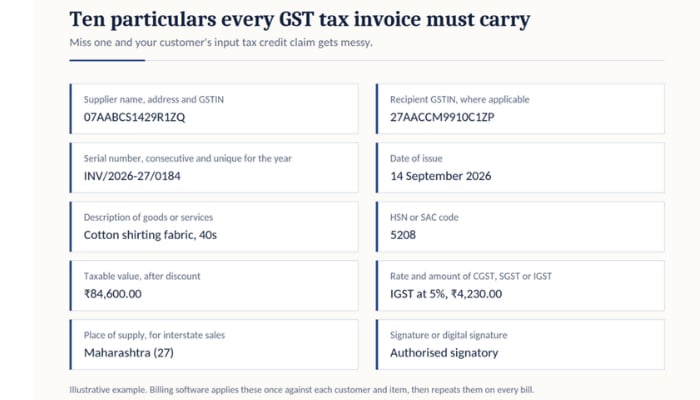
It is a tax document. Under GST, a tax invoice must carry specific particulars: your GSTIN, the customer’s GSTIN where applicable, a consecutive serial number for the financial year, date of issue, description of goods or services, HSN or SAC code, taxable value, the rate and amount of CGST, SGST, or IGST, place of supply for interstate sales, and a signature or digital signature. Miss one and your customer’s input tax credit claim becomes messy, which is the fastest way to lose a B2B account.
It is evidence. When a payment is disputed, when GSTR-1 does not reconcile, or when an assessment comes up two years later, the invoice is your record.
Manual bill books and Excel templates handle the first job fine. They are unreliable at the second and useless at the third. Invoicing software is the thing that does all three without asking anyone to remember a field.
The Serial Number Problem Nobody Warns You About
Here is a small detail that causes an outsized amount of trouble.
GST requires invoice numbers to be consecutive and unique within a financial year. Sounds trivial. But when a business runs two bill books at two counters, or issues some invoices from a phone and some from a laptop, the sequence breaks. Duplicate numbers appear. Gaps appear. And gaps in an invoice series are exactly the kind of thing that invites a question during scrutiny, because a missing number looks like a suppressed sale even when it was just a torn page.
Software that generates the number for you removes the problem entirely. It is the least exciting benefit of going digital and one of the most useful.
Payment Tracking Is the Real Return on Investment
Most guides to invoicing software stop at invoice creation. That is where the money problem actually starts.
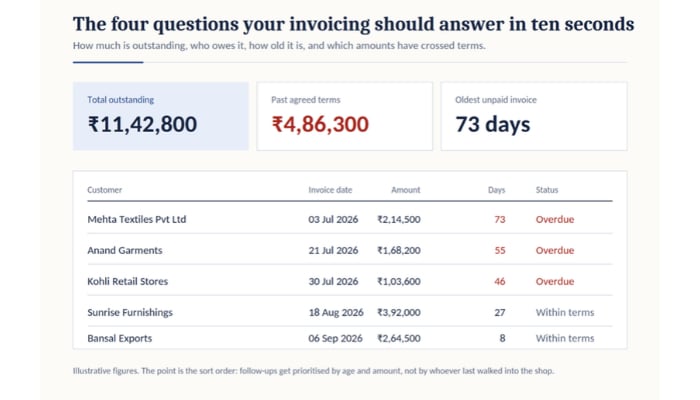
A functioning invoicing setup should answer four questions in under ten seconds:
- How much money is outstanding right now, in total?
- Which customers owe it?
- How old is each of those amounts?
- Which ones have crossed the payment terms we agreed?
If your current system cannot answer all four without a manual tally, your follow-ups are being driven by memory, and memory favours the customers who call you rather than the ones who owe you.
myBillBook tracks paid, unpaid, and overdue invoices in one view and maintains party-wise balances, so follow-ups get prioritised by age and amount instead of by whoever last walked into the shop. Invoices go out over WhatsApp, email, or PDF, which matters more than it sounds: a bill that reaches the customer’s phone the same day starts its own clock, while a bill posted or handed over at month-end starts it late.
The 45-Day MSME Clock Most Billing Guides Skip
This is the section that has changed the stakes of invoicing in India, and it is still missing from most “best invoicing software” listicles.
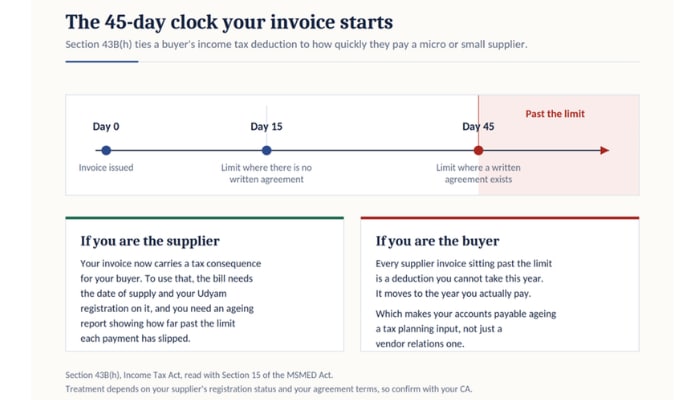
Section 43B(h) of the Income Tax Act, inserted by the Finance Act 2023 and applicable from assessment year 2024-25, ties income tax deductions to prompt payment of micro and small suppliers. If a buyer does not pay a registered micro or small enterprise within the time limit under Section 15 of the MSMED Act, which is 45 days where there is a written agreement and 15 days where there is not, the buyer can claim the expense as a deduction only in the year the payment is actually made, not the year it was incurred.
Read the operational implication in both directions.
If you are the supplier, and you are registered as a micro or small enterprise on Udyam, your invoice now carries a tax consequence for your buyer. That is leverage you did not have three years ago, but it only works if your invoice clearly shows the date of supply and your MSME registration details, and if you can produce an ageing report showing exactly how far past 45 days a payment has slipped.
If you are the buyer, every unpaid supplier invoice sitting past the limit is a deduction you cannot take this year. Which means your accounts payable ageing is now a tax planning input, not just a vendor-relations one.
Either way, the answer is the same: you need dated, retrievable, party-wise invoice records. That is a systems problem, and systems solve it better than registers. Confirm the specifics with your CA, because the treatment depends on your supplier’s registration status and your agreement terms.
When You Cross Into e-Invoicing
e-Invoicing under GST is not a feature you choose. It is a threshold you cross.
Businesses above the notified aggregate annual turnover limit must generate an Invoice Reference Number (IRN) from the Invoice Registration Portal before issuing a B2B invoice, and an invoice without a valid IRN is not treated as a valid invoice at all. The threshold has been lowered in stages since 2020, so a business that was outside it two years ago may be inside it now.
When you evaluate invoicing software, this is a question to ask directly rather than assume: does the product generate e-invoices natively, and does it also handle e-way bills? myBillBook supports e-invoicing and unlimited e-way bills on its Pro Max plan, which is worth knowing before you subscribe at a lower tier and discover the gap at the exact moment you cross the threshold.
Free Invoicing Versus Paid: Where the Line Actually Falls
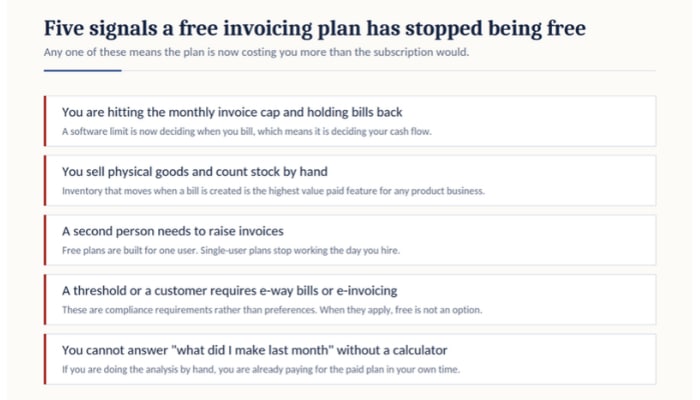
There is nothing wrong with starting free. There is something wrong with staying free past the point where it costs you.
myBillBook’s free plan covers up to 15 invoices a month on the mobile app, which is genuinely enough for a freelancer, a consultant, or a new service business finding its feet. The signals that you have outgrown it are practical rather than philosophical:
- You are hitting the monthly invoice cap and postponing bills to next month
- You are selling physical products and need stock to move when a bill is created
- You need a second person to raise invoices
- You need barcode billing at a counter
- You need e-way bills or e-invoices for compliance
Any one of those is the upgrade signal. The rest of the time, free is doing its job.
How to Evaluate Invoicing Software Before You Commit
Run this test rather than watching a demo.
Bill your five most awkward transactions. Not clean ones. The interstate sale, the partly paid one, the one with a discount after tax, the service invoice with SAC instead of HSN, and the one to a customer with no GSTIN. If all five come out correct without a workaround, the product fits your business.
Check what an invoice looks like to your customer. Open the WhatsApp share or the PDF on a phone. If it is hard to read or missing your branding, your customers will find it hard to trust.
Ask how you get your data out. Export formats matter more than anyone admits when signing up. Confirm you can export invoices, party balances, and GST reports before you have two years of history inside the system.
Test on the device your team actually uses. myBillBook runs on Android, iOS, and web across all plans, with desktop access on Pro and above. Match that to whether your billing happens on a phone at a counter or on a laptop in an office.
Confirm support reachability. The invoicing crisis always happens at month-end, not on a Tuesday morning.
Where Invoicing Is Heading
Three shifts are worth watching. Invoice data is becoming the primary input for credit decisions, with lenders increasingly underwriting small businesses on billing history rather than collateral. Compliance is moving further upstream, with more of the GST return prepopulated from invoice data rather than filed separately. And the invoice is becoming a payment surface, with UPI links and payment reminders attached to the bill itself rather than chased over phone.
All three reward businesses whose invoice data is already digital and structured. None of them reward a bill book.
Frequently Asked Questions
What is invoicing software? Invoicing software is a digital tool that creates GST-compliant invoices with customer details, item details, HSN or SAC codes, tax breakup, and payment status, then stores and shares them. It replaces manual bill books and spreadsheets with a system that numbers invoices automatically, calculates tax correctly, and keeps a searchable record of what has been billed and what has been paid.
Is there free invoicing software in India? Yes. myBillBook offers a free mobile app plan that covers up to 15 invoices a month, which suits freelancers, consultants, and new service businesses. Paid plans start at ₹291/month billed annually and add unlimited invoices, inventory management, barcode billing, e-way bills, e-invoicing, and detailed reports.
What fields must a GST invoice include? A tax invoice must carry your GSTIN, the recipient’s GSTIN where applicable, a consecutive serial number unique to the financial year, the date of issue, a description of goods or services, HSN or SAC code, taxable value, the applicable rate and amount of CGST, SGST, or IGST, place of supply for interstate transactions, and a signature or digital signature. Invoicing software applies these once and repeats them on every bill.
Can invoicing software help me collect payments faster? Indirectly but reliably. It cannot make a customer pay, but it tells you precisely who owes what and for how long, which turns collections from a memory exercise into a prioritised list. Sharing the invoice digitally on the day of supply also starts the payment clock earlier than a bill handed over at month-end.
Do I need e-invoicing? Only if your aggregate annual turnover crosses the notified threshold, which has been reduced in stages since 2020. Above it, B2B invoices need a valid IRN from the Invoice Registration Portal to be treated as valid invoices at all. Check your current turnover against the prevailing limit, and confirm your software supports e-invoicing before you need it rather than after.
The Bottom Line
Invoicing software is not judged on how pretty the bill looks. It is judged on whether every invoice was compliant the first time, whether you know your outstanding position without a manual tally, and whether you can retrieve any bill from any month in seconds.
For Indian small businesses that want GST-ready invoices, WhatsApp sharing, payment tracking, and organised billing records in one place, myBillBook covers that ground on mobile and desktop, with a free plan to start on and paid plans from ₹291/month billed annually. The best time to fix your invoicing is before the next 45-day window closes, not after.
