




Most early-stage startups need to be seen long before they can afford a dedicated growth team. That gap is where AI video tools for startups have quietly changed the math. A single person can now produce marketing videos that look like a small studio made them, which means brand visibility no longer waits for a headcount plan or a big content budget.
The reason video matters so much here is simple. People remember a face and a voice far better than they remember a static ad or a wall of text. For a startup trying to earn attention on social feeds and in cold outreach, consistent video is one of the fastest ways to feel bigger than you are. Below are five of the best AI video generator for startups for brand visibility worth knowing, starting with the one that handles the entire process from a single idea.
1. Intellemo AI
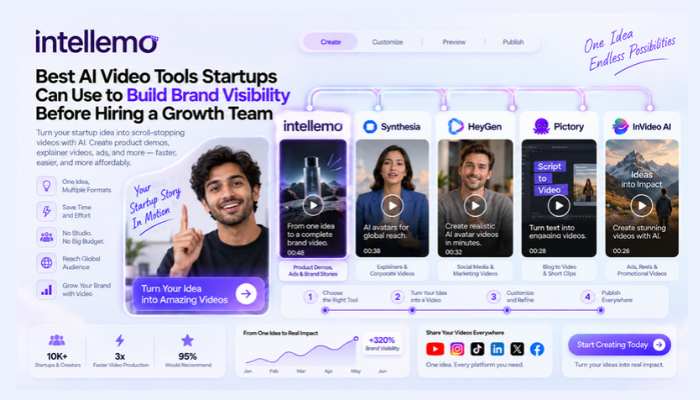
Intellemo AI is built for founders who need a complete brand video, not a random clip they still have to stitch together. You give it one prompt, and it runs a structured workflow that turns that idea into a scripted, storyboarded video with voice, lip sync and sound.
The starting point can also be a website URL. Intellemo can analyze available brand information and assets from the site, including the logo and business or product context, and use those details when developing the script and video.
What ties this most closely to brand visibility is consistency. Intellemo AI lets you save your characters, product shots, logo, and locations, then pull them into any script using simple @mentions. You reference the same saved character, so your videos start to look like they belong to one recognizable brand. That repeated visual identity helps an audience remember a young company across repeated posts and campaigns.
A few things make it practical for a lean team:
- Storyboard-first generation: You see and approve storyboard frames before final clips are made, which helps keep the output on-brand.
- Multi-step approvals: Script, speech, and storyboard checkpoints give a non-video founder control before anything is rendered. The Audioboard also lets users review narration for pronunciation, pacing, tone, emotion, and timing before moving into visual production and final rendering.
- Variant generation: You can spin new versions of the same story to test different hooks, which is the kind of creative testing a growth team would normally run.
- Targeted scene refinement: Individual storyboard scenes can be adjusted without regenerating the whole video, including changes to characters, backgrounds, camera angles, lighting, or product placement.
- Built-in AI music: Music can be generated within the same workflow alongside voice, visuals, lip sync, and scene audio.
There is also a cost angle that matters when you are watching runway closely. Intellemo AI charges based on the video clips generated, while intermediate production steps are not billed separately. For a founder producing brand content regularly, predictable pricing on the finished output is easier to plan around.
2. Synthesia
Synthesia is the tool to reach for when you want a clear talking-head video without ever turning on a camera. You paste a script, pick from its large library of AI avatars, and choose a voice, then it renders a polished presenter delivering your words. Founders lean on it for product updates and quick explainers, since the whole thing takes minutes rather than a shoot day. For a startup that needs a steady face for the brand without booking studio time, that speed is the real draw.
What ties Synthesia most closely to brand visibility is reach across markets. It supports well over a hundred languages from one script, so a startup chasing customers in more than one country can localize the same message without re-recording anything. A single explainer becomes several localized versions that all carry the same presenter and the same look, which keeps the brand recognizable as it crosses borders.
A few things make it practical for a lean team:
- Deep language coverage: Render one script in more than a hundred languages with matched voice and lip movement.
- Personal avatar: Train an avatar of the founder from a short recording, then produce videos in their likeness straight from text.
- Brand kit controls: Lock in your brand colors and logo so every avatar video stays on brand.
The honest limitation is that Synthesia leans toward internal training and corporate communication, so pure marketing storytelling can feel a little stiff next to tools built for ads. Custom avatars and the higher language tiers also sit on paid plans, so a very early startup should confirm the pricing covers its use before committing. For founder-led explainers where clarity matters more than cinematic flair, it stays a dependable pick.
3. HeyGen
HeyGen covers similar avatar territory to Synthesia but tends to suit solo founders and small teams working on tighter budgets. It creates AI avatar videos from a script, handles translation and lip sync cleanly, and moves quickly. The free tier is generous enough to test the format before you commit any money, which lowers the risk for a startup still deciding whether avatar video fits the brand.
The feature that stands out for visibility work is personalization at scale. You can record one video and have HeyGen adapt it for many recipients by swapping names and company details while keeping the lip movement natural. A startup running early outreach can send what feels like a one-to-one message to hundreds of prospects, which turns a single recording into a repeatable way to get in front of people. That is the kind of leverage a founder needs before a growth team exists to run campaigns.
A few things make it practical for a lean team:
- Personalization at scale: Record once and generate personalized versions for many prospects automatically.
- Fast translation: Localize a clip into dozens of languages with lip movement that matches the new audio.
- Low entry cost: A usable free tier and cheaper paid plans than most enterprise avatar tools.
The trade-off is that high-volume personalization and the sharper avatars sit behind the paid plans, so check where your use case lands on pricing before you scale it up. HeyGen is strongest for founders who want speed and volume rather than deep enterprise controls, which describes most startups at the visibility stage anyway.
4. Runway
Runway is where founders go when they want cinematic, visually rich footage without a film crew. Its Gen-4 model produces b-roll and stylized scenes with strong control over motion, which makes it a fit for brand and campaign videos that need to look premium. If your positioning depends on looking polished, this is the tool that helps a bootstrapped startup appear more established than its size suggests.
For a good brand visibility AI video tool, Runway is best aimed at the hero moments rather than everyday updates. A striking product reveal on your homepage or a mood-setting clip inside a paid ad can shape how people perceive the brand at first glance. That first impression carries real weight for a young company, since one polished thirty-second piece can do more for credibility than a week of ordinary posts.
A few things make it practical for a lean team:
- Cinematic generation: Gen-4 creates film-like scenes and b-roll from text prompts or reference images.
- Motion control: Direct camera movement and pacing to match a specific creative look.
- Editing suite: Extend and recombine generated clips inside the same platform.
The learning curve is steeper than template tools, and matching the exact shot in your head can take a few attempts, which uses up credits along the way. Runway asks for more creative direction than a plain text-to-video app, so set aside some time to learn it. For founders who care about visual quality and carry a clear look in mind; that effort pays off in footage that genuinely stands out.
5. InVideo AI
InVideo AI is the friendliest starting point for anyone new to video. You describe what you want in plain language, and it drafts a full video from templates, complete with scenes and captions. For a founder who has never touched an editor, the text-to-video approach removes almost all of the intimidation and gets a first draft on screen within minutes.
Its sweet spot is fast social content, which is exactly what early brand awareness runs on. When you need a steady stream of short clips for platforms like Instagram and TikTok to keep a young brand in front of people, InVideo lets you produce them without a specialist. Consistency of posting matters more than polish in the early days, and a tool that clears the production bottleneck helps a startup stay visible week after week.
A few things make it practical for a lean team:
- Plain-language prompts: Type what you want, and it assembles the scenes and captions for you.
- Large template library: Ready-made formats sized for each social platform.
- Brand kit upload: Add your colors and logo so the output looks less generic.
The output can look template-driven if you lean on the defaults, so it pays to upload your own brand kit and swap in real footage where you can. Used that way, InVideo keeps a startup posting consistently, which is half the battle in early visibility. It will not match a cinematic tool for a flagship brand film, but for sheer volume and ease of use, it is hard to beat.
How to Pick the Right One for Your Stage
These are all brand visibility tools for startups, but they do not do the same job, so the best choice depends on what your brand needs first. If you want a full, on-brand video from a single idea with consistency built in, Intellemo AI handles the whole pipeline. If your priority is a founder explainer or a multilingual message, Synthesia or HeyGen will get you there. Reach for Runway when you need a cinematic look and InVideo AI when you need volume for social. Many founders end up using two together, one to create and one to refine.
FAQs
Can a startup really build brand visibility with AI video before hiring a growth team?
Yes. A single founder using AI video tools for startups can produce consistent, on-brand videos for social, ads, and outreach. The bottleneck used to be production capacity, and that is exactly what these tools remove for small teams.
Which type of AI video works best for a new brand?
It depends on the goal. AI avatar videos suit founder explainers and updates, cinematic generators suit hero brand moments, and text-to-video tools suit high-volume social clips. Most startups benefit from mixing a couple of formats.
Do AI video tools keep a brand looking consistent across posts?
Some do this far better than others. Tools that let you save and reuse characters, logos, and locations, such as Intellemo AI with its @ mentions, keep the same look across scenes, which is what makes an audience recognize a young brand over time.
Where This Leaves You
Building visibility used to mean waiting for budget and headcount before you could produce anything that looked professional. That order has flipped. A founder with the right AI video generator can ship a recognizable, consistent stream of brand content today and worry about the growth later. Start with one tool that fits your most pressing need and let the visibility compound as you keep shipping. By the time you do bring on a growth team, you will hand them an audience that already knows who you are.
