




A silent revolution is happening in the global beauty sector. And leading this shift is the Ayurvedic beauty brand, a category that has moved from niche wellness shelves to the center of mainstream skincare conversations worldwide. At the same time, innovation in natural skincare is no longer an oxymoron. It is, in fact, where the most exciting science is happening right now.
This is not about going back. It’s about going deeper.
Why Ayurveda Is Having Its Moment And Why It’s Here to Stay
Ayurveda has existed for over 5,000 years. It has survived empires, colonization, industrialization, and the rise of laboratory-made cosmetics. The reason is simple: it works. But what’s different today is that the modern consumer is no longer asking, “is this traditional?” they’re asking, “is this effective, safe, and sustainable?” Ayurveda answers all three.
The surge in Ayurvedic beauty’s global popularity isn’t driven by nostalgia. It’s driven by a generation of informed buyers who read ingredient lists, research botanical actives, and distrust the word “fragrance” on a label.
Ayurvedic formulations are inherently ingredient-transparent. Every herb has a name, a history, and a documented purpose. Turmeric (Curcuma longa) for inflammation. Neem (Azadirachta indica) for bacterial balance. Ashwagandha (Withania somnifera) for stress at cellular level . Rose (Rosa damascena) to tone and hydrate. These are not marketing buzz phrases, these are ingredients with centuries of recorded use and a growing amount of current science supporting their processes.
Innovation Is Not Artificial
One of the biggest fallacies in beauty is that you need a laboratory of synthetic substances to innovate. The most forward-thinking Ayurvedic beauty brands are demonstrating otherwise and, in doing so, redefining what innovation in natural skincare really looks like.
The real innovation is in the precise understanding of formulation, not only what herbs to use but how to prepare them for maximum bioavailability. It means age-old processes like Taila Paka Vidhi (slow oil frying for 36 hours) or Arka (steam distillation of botanicals) that contemporary science has come to know as sophisticated extraction processes. It means understanding skin typology through the lens of doshas Vata, Pitta, Kapha and formulating products that address the underlying imbalance, not just the surface symptom.
Innovation also means delivery systems. How a herb enters the skin matters as much as which herb is chosen. Ayurvedic oils, for instance, use lipid-based carriers that naturally enhance the penetration of fat-soluble actives, a principle that modern cosmetic science calls “liposomal delivery” and charges a premium for.
The ancient world figured this out with sesame oil. Thousands of years ago.
The New Breed of Ayurvedic Beauty Brand
What separates the new generation of Ayurvedic beauty brands from their predecessors is the marriage of ancient texts with contemporary rigor. The best brands today are not simply bottling tradition; they are interrogating it, testing it, and presenting it with the credibility that the modern consumer demands.
That involves procuring herbs from their natural growing places at full potency. That is, to formulate without parabens, sulfates and synthetic preservatives not as a trend but as a principle. And it involves investment in clinical validation, dermatological testing, and clear explanation about what each ingredient does and why it’s there.
It also signifies sustainability as a practice, not a label. Ayurveda is in its nature an ecological philosophy. Those very texts prescribing herbal compositions talk of harvesting in unison with nature, of taking no more than nature can replace. In a society struggling with the environmental cost of the beauty business, one of the biggest contributors to plastic waste and chemical pollution, Ayurveda provides not just a product philosophy but a planetary one.
Blue Nectar: The Confluence of Ancient Wisdom and Modern Accountability
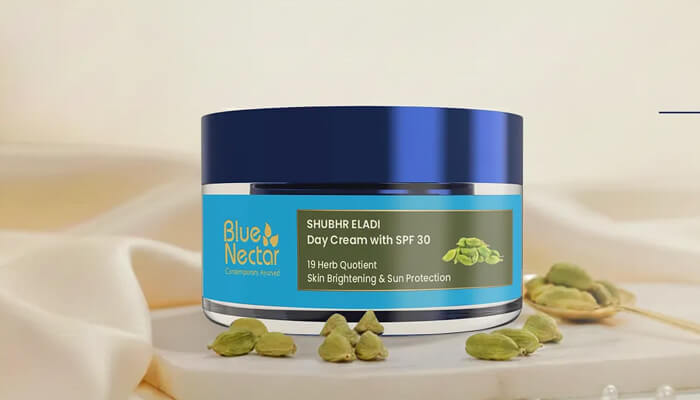
Few brands express this coalescence with as much aim as Blue Nectar. Built on the notion that Ayurveda is not a relic but a living science, Blue Nectar has innovated in natural skincare the way a researcher tackles a theory with curiosity, method and proof.
Through its Ayurveda Lab, the brand does something rare in the industry: it takes formulations rooted in classical Ayurvedic texts like Charaka Samhita and Ashtanga Hridayam and systematically cross-references them with existing scientific literature on each ingredient’s bioactive properties. No invented claims. No borrowed credibility. Just a rigorous effort to show that what the ancients prescribed, modern science increasingly confirms.
The result is a product line that feels both timeless and current: Kumkumadi oils processed for 36 hours with 26 herbs, body formulations built on dosha intelligence, and skincare rituals that treat the person, not just the pore.
Blue Nectar’s innovation isn’t in replacing Ayurveda with something newer. It’s in refusing to let Ayurveda be dismissed as something older.
Because the future of skincare isn’t synthetic. It’s ancient, validated, and just getting started.
