


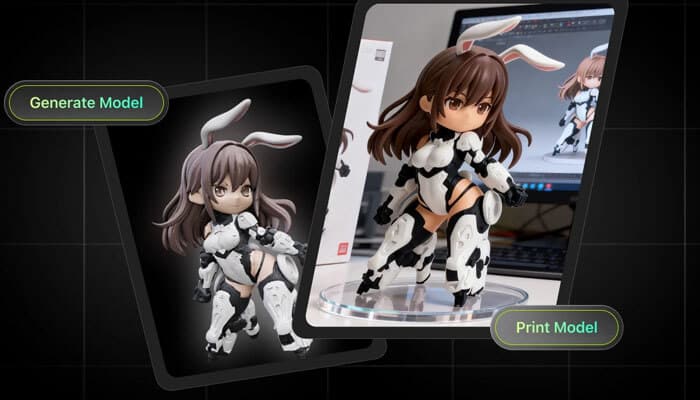

1. AI and 3D Printing Are Entering a New Creative Era
Artificial intelligence is transforming the way people create. In recent years, AI has moved from assisting simple digital tasks to helping users generate images, designs, and even complex 3D models. At the same time, 3D printing has become increasingly accessible, allowing more creators to turn digital concepts into physical objects.
However, the journey from an AI-generated idea to a successful printed product is not always simple. Creating a model is only the beginning. Before a design can become a real object, creators still need to solve practical challenges such as color reproduction, model structure, printing size limitations, and assembly preparation.
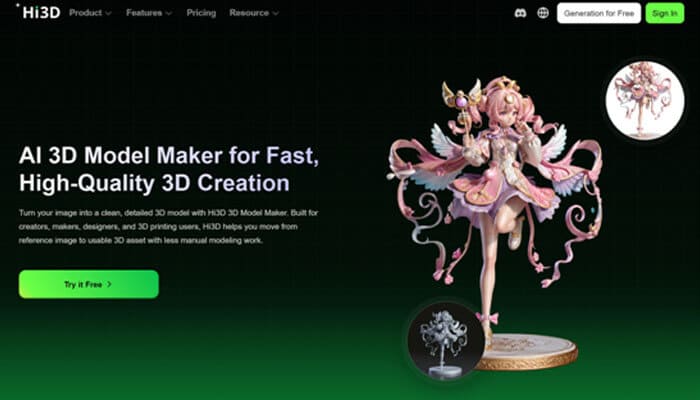
This gap between digital creation and physical production is where Hi3D comes in. Designed as an AI-powered 3D creation and printing preparation platform, Hi3D focuses on helping users move beyond model generation and create models that are better suited for real-world printing.
By combining AI creation capabilities with printing-focused features, Hi3D provides a more complete workflow for creators exploring AI 3D model maker, 3D model maker online, and 3D model maker AI solutions.
2. Why Creating a 3D Model Is Only the First Step
AI has made 3D creation faster than ever before. Users can generate creative concepts within minutes instead of spending hours building models manually. However, a digital model that looks perfect on screen may still face challenges when it enters the physical printing process.
For example, a highly detailed character model may contain too many color variations for practical printing. A large object may exceed the build volume of a desktop printer. A complex figure may require professional experience to divide into printable parts and assemble correctly.
These challenges show that the future of AI 3D creation is not only about generating models faster. The more important question is how these models can become reliable, printable objects.
Hi3D was developed to address this transition. Instead of stopping at digital creation, it helps creators prepare models for the next stage: turning ideas into physical results.
2.1 Introducing Hi3D: Connecting AI Creation With Real-World Printing
Hi3D brings together AI-based creation and practical 3D printing preparation tools in one workflow. It helps users improve the connection between imagination, digital modeling, and physical production.
For beginners, Hi3D lowers the technical barrier of entering 3D printing by reducing complicated manual preparation steps. For experienced makers and designers, it provides tools that improve efficiency when handling complex models.
Whether users are experimenting with a free 3D model maker, exploring a 3D model maker free experience, or looking for a more efficient 3D printer model maker workflow, Hi3D focuses on making the entire creative process more accessible.
3. Beyond AI Generation: Building a Complete Workflow From Concept to Print
The needs of 3D creators are becoming increasingly diverse. Some users want to create personalized collectibles, while others need prototypes, character models, or creative objects for printing projects.
For casual creators, the challenge is often the complexity of traditional 3D modeling software. For professional users, the challenge is improving efficiency after generating a model.
3.1 Making 3D Creation Easier for Different Types of Creators
Hi3D helps solve these problems by providing practical tools that support different stages of the workflow. Instead of requiring users to manually handle every technical step, Hi3D helps prepare models for printing while keeping creative control available throughout the process.
This approach allows creators to spend more time improving their ideas and less time dealing with repetitive technical preparation.
3.2 From AI Model Generation to Practical 3D Printing Solutions
A complete AI-powered 3D workflow requires more than generating a mesh. It needs tools that consider how a model will actually be produced.
Hi3D focuses on this practical connection through several key features, including Multi-Color Printing, Split-for-Printing, Smart Arrangement, and 3MF export. These functions help transform digital models into more printable and manageable designs.
For creators using AI 3D model maker technologies, Hi3D provides a bridge between creative exploration and real-world manufacturing.
4. Creating More Realistic Prints With Hi3D Multi-Color Printing
Digital models can contain unlimited colors and highly detailed textures, but real 3D printing depends on available filament materials and printer capabilities. Without optimization, digital textures may create fragmented color regions, unnecessary filament changes, and increased printing time.
4.1 Why Digital Colors Often Fail in Physical 3D Printing
Hi3D’s Multi-Color Printing feature is designed to solve this problem by converting AI-generated textured models into printable multi-color objects. It automatically creates print-friendly color regions, maps colors to available filament options, and helps users control color complexity.
4.2 How Hi3D Converts AI Textures Into Printable Color Systems
Instead of simply transferring digital colors directly into printing instructions, Hi3D considers the relationship between visual appearance and physical materials.
Users can adjust color quantity and detail levels depending on their goals. A higher detail setting can preserve sharper color transitions, while a lower setting can merge smaller regions to create a more efficient printing process.
This gives creators more control over the balance between appearance, printing time, and material usage. The feature is especially useful for projects involving character figures, collectible models, and personalized designs created through image to 3D model, image to 3D, or image to 3D model AI workflows.
4.3 Turning AI Images Into Physical Creations
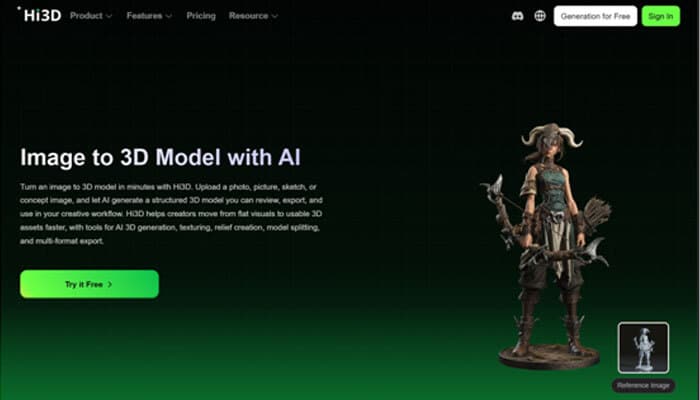
With the development of AI image generation, many creators are exploring ways to transform personal images and digital artwork into physical objects.
Through workflows such as photo to 3D model, picture to 3D model, 2D image to 3D model, and 2D to 3D image converter, users can move from a simple visual idea toward a printable three-dimensional object.
Combined with AI 3D model texturing, Hi3D helps creators maintain more visual consistency between digital concepts and printed results.
5. Simplifying Complex Models With Smart Split-for-Printing Technology
A model that looks impressive digitally may not always be practical for printing. Large designs may exceed printer size limitations, while complex figures often require careful separation before printing.
5.1 Why Large and Detailed Models Are Difficult to Print
Traditionally, creators need professional modeling software to cut models manually and design suitable connectors. This process can be time-consuming, especially for users who want to focus on creativity rather than technical preparation.
5.2 Turning One Complete Model Into Multiple Printable Parts
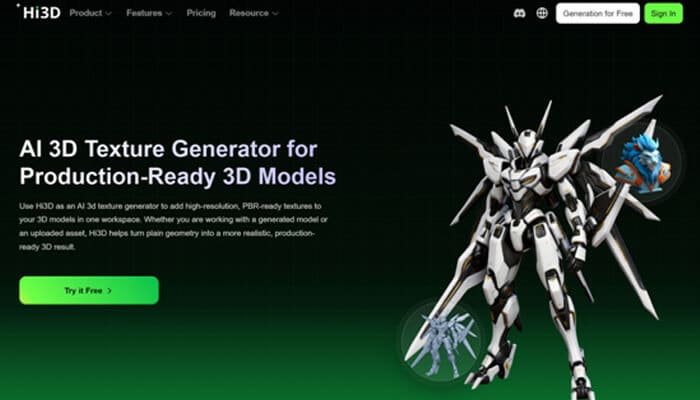
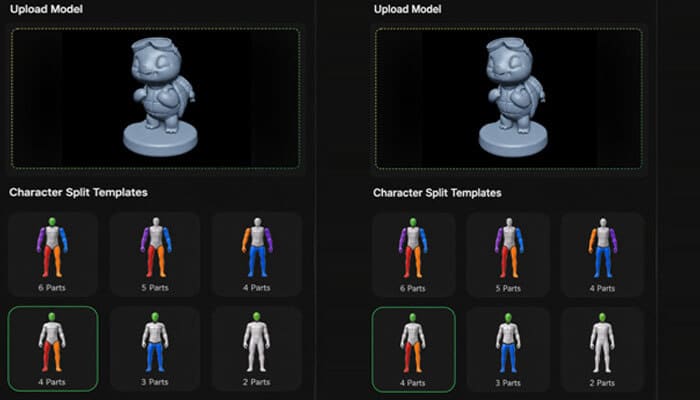
Hi3D’s Split-for-Printing feature helps transform complete models into printable components. It can separate models into different parts, repair them into printable meshes, and generate assembly connectors automatically.
For character models, Hi3D provides built-in templates that can separate areas such as the head, torso, arms, legs, weapons, and base. This allows creators to prepare complex figures without manually rebuilding the structure.
5.3 Built-In Connectors Make Assembly More Reliable
After splitting a model, assembly becomes another important challenge.
Hi3D supports automatic connector generation, including structures such as fixed connectors and ball joints. These options allow creators to prepare different types of models, from stable display figures to movable articulated designs. Users can also adjust connector size, direction, and placement according to their printing requirements.
This makes Hi3D especially valuable for creators producing collectible figures, tabletop miniatures, cosplay-related models, and large designs that need to be printed on smaller machines.
6. Preparing AI-Generated Models for a Smoother Printing Process
After generating, coloring, and splitting a model, creators still need to prepare it for printing.
6.1 Smart Arrangement Helps Reduce Manual Preparation
Hi3D helps simplify this final stage through Smart Arrangement features. It can assist with arranging parts on the build plate and suggesting better printing orientations based on different printing goals. This reduces repetitive setup work and provides creators with a more efficient starting point before entering the slicing process.
6.2 Exporting Print-Ready Files Through 3MF Workflow
Hi3D also supports 3MF export with suggested printing settings. This helps users transfer prepared models into compatible slicer workflows while keeping important model information organized. For creators handling multi-part models or detailed printing projects, this creates a smoother transition from AI-generated design to physical production.
7. How Hi3D Helps Creators Bring Different Ideas Into Reality
One of the most common applications of AI and 3D printing is creating personalized character models.
7.1 From AI Characters to Collectible Figures
A creator can start with an AI-generated concept, refine the model through Hi3D’s printing preparation tools, optimize colors, separate parts, and produce a physical collectible figure. Instead of remaining as a digital file, the design can become an object that can be displayed, shared, or collected.
7.2 From Personal Images to Customized 3D Objects
Personalized creation is another area where AI and 3D printing create new possibilities.
Users can transform personal photos, artwork, or visual concepts into 3D creations and prepare them for printing. Hi3D helps connect these creative ideas with practical production requirements.
7.3 From Digital Designs to Physical Prototypes
For designers and makers, rapid prototyping is one of the most valuable applications of 3D printing. Hi3D allows creators to move from digital concepts toward physical models more efficiently, making it easier to test ideas, evaluate designs, and improve creative workflows.
8. Solving Today’s Biggest Challenges in AI 3D Printing
The future of AI 3D printing depends not only on faster generation but also on better usability. Many creators are interested in AI-generated models but struggle when those models need to become real objects.
8.1 Reducing the Gap Between AI Models and Successful Prints
Issues such as color mapping, model preparation, and printing limitations can prevent creative ideas from reaching completion.Hi3D addresses these challenges by combining AI creation with practical printing preparation.
8.2 Helping Creators Focus More on Design Instead of Technical Preparation
By simplifying complex steps in the printing workflow, Hi3D allows creators to focus more on creativity and less on repetitive technical adjustments.
From generating ideas to preparing printable models, Hi3D helps shorten the distance between imagination and reality.
9. Celebrate Hi3D Anniversary With Special Offers for Creators
To celebrate its anniversary, Hi3D is introducing a limited-time promotion for creators who want to explore the future of AI-powered 3D printing.
During the anniversary event, users can enjoy up to 70% off selected offers and experience Hi3D’s latest workflow improvements with greater accessibility.
As AI continues to transform digital creation, Hi3D is helping creators take the next step — moving from AI-generated ideas to real, printable objects. The future of 3D printing is not only about creating models faster, but about making those creations truly possible in the physical world.
