




Technology is transforming education at an unprecedented pace. In 2026, the shift toward digital learning ecosystems, artificial intelligence, and skill-based education is redefining how individuals acquire knowledge and build careers.
The concept of Droven IO tech education trends can be understood as a modern, evolving approach to learning that focuses on simplifying complex technologies such as AI, automation, and cloud computing into practical, accessible knowledge.
Rather than representing a fully established or widely documented standalone platform, Droven IO is best interpreted as a trend-driven framework or conceptual learning model that reflects how modern tech education is evolving globally.
Droven IO tech education trends refer to a modern, skill-based learning approach that emphasizes artificial intelligence, automation, cloud computing, and real-world digital skills through simplified, continuously updated educational content aligned with current industry demands.
Quick Answer: What Are Droven IO Tech Education Trends?
Droven IO tech education trends refer to a modern, skill-based learning approach focused on artificial intelligence, cloud computing, automation, microlearning, cybersecurity, and real-world digital skills. These trends show how education in 2026 is moving toward flexible, practical, and career-focused learning instead of only traditional degree-based education.
This approach helps students, job seekers, entrepreneurs, and professionals learn in-demand technologies, build practical skills, and stay updated with changing industry needs.
What Is Droven IO in Tech Education?
Droven IO represents a conceptual model of tech education that focuses on breaking down advanced technologies into beginner-friendly, actionable insights.
This approach aligns with the broader transformation in education, where learners increasingly rely on flexible, self-paced, and skill-oriented learning systems instead of traditional degree-based models.
Key Characteristics
- Simplified explanations of complex technologies
- Focus on emerging fields like AI, machine learning, and automation
- Continuous updates aligned with industry changes
- Career-oriented and practical learning insights
Instead of functioning as a certification provider, this model acts as a knowledge hub, helping learners stay relevant in a rapidly evolving digital environment.
Important Note: Droven IO should be understood as an emerging tech education concept or trend-based learning framework. Readers should verify any course provider, certification, pricing, refund policy, and accreditation before enrolling in a paid program.
Why Droven IO Tech Education Trends Are Growing
Key Growth Drivers
- Rapid adoption of artificial intelligence across industries
- Increasing demand for skill-based hiring over traditional degrees
- Growth of online and self-paced learning platforms
- Continuous need for upskilling in a fast-changing job market
Industry Insight
-
Many employers are placing greater value on practical digital skills, portfolios, certifications, and real-world project experience alongside formal qualifications.
-
AI-related job roles are expanding at a significantly faster rate than many traditional professions
-
Cloud computing and automation technologies continue to drive global digital transformation
-
The global EdTech market continues to grow rapidly as organizations invest in digital learning and workforce upskilling
These shifts reflect a broader movement toward Education 5.0, where learning becomes more personalized, technology-driven, and aligned with real-world applications.
Research Note
Global workforce reports show that technology skills are changing quickly, especially in areas such as AI, big data, cybersecurity, and digital literacy. This supports the growing importance of continuous learning, practical training, and skill-based education.
Top Droven IO Tech Education Trends in 2026
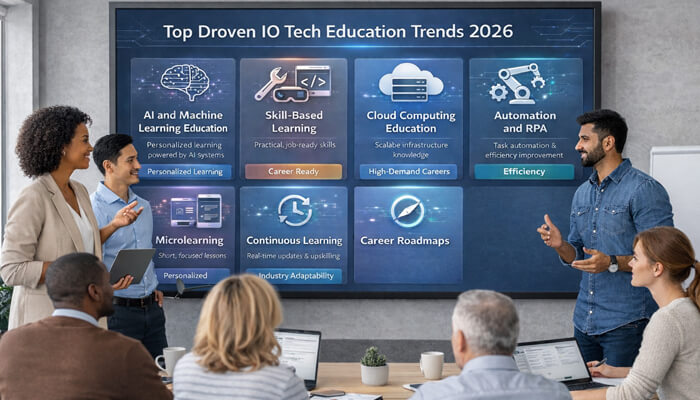
Tech Education Trends Overview
| Trend | Key Focus | Benefit |
|---|---|---|
| AI and Machine Learning | Personalized learning, automation | Better job opportunities |
| Skill-Based Learning | Practical skills | Faster employment |
| Micro-Credentials and Skill Verification | Certificates, badges, portfolios | Proof of skills |
| Cloud Computing | Scalable systems | High-demand careers |
| Cybersecurity and Data Governance | Data privacy, cloud security | Safer digital learning |
| Automation and RPA | Process automation | Increased efficiency |
| Microlearning | Short lessons | Better retention |
| Continuous Learning | Real-time updates | Staying competitive |
| Career Roadmaps | Structured paths | Clear learning direction |
1. AI and Machine Learning Education
- Personalized learning powered by AI systems
- Real-world applications across industries
- Growing importance of AI literacy
2. Skill-Based Learning
- Practical, job-ready skills
- Faster career entry
- Reduced reliance on degrees
3. Micro-Credentials and Skill Verification
- Short certificates and digital badges
- Proof of practical skills
- Resume and portfolio improvement
4. Cloud Computing Education
- Scalable infrastructure knowledge
- AI deployment capabilities
- Cloud-native development
5. Cybersecurity and Data Governance Education
- Cloud security basics
- Data privacy and protection
- Responsible AI use
6. Automation and RPA
- Task automation
- Efficiency improvement
- Enterprise demand
Example: A small business owner can use automation tools to send customer emails, update spreadsheets, manage leads, and create reports automatically.
7. Microlearning
- Short lessons
- Better retention
- Easy accessibility
8. Continuous Learning
- Real-time updates
- Ongoing upskilling
- Industry adaptability
9. Career Roadmaps
- Structured learning paths
- Clear progression
- Reduced confusion
Real-World Use Cases of These Trends
Example 1: EdTech Startup
An education technology company integrates AI-based recommendation systems to personalize learning experiences for users.
Result: Increased engagement and improved learning outcomes due to tailored content delivery.
Example 2: Software Developer
A developer adopts microlearning strategies to learn cloud computing and DevOps tools while working on real-world projects.
Result: Faster career transition and improved job opportunities.
Example 3: Small Business
A small business implements automation tools to streamline repetitive operational tasks.
Result: Increased efficiency, reduced manual workload, and better resource utilization.
Popular Tools Supporting These Trends
| Category | Tools | Purpose |
|---|---|---|
| AI & Machine Learning | ChatGPT, TensorFlow | AI learning and automation |
| Cloud Computing | AWS, Azure | Cloud deployment and infrastructure |
| Automation | Zapier, UiPath | Workflow automation |
| Learning Platforms | Coursera, Udemy | Online skill development |
| Cybersecurity | TryHackMe, Cisco Skills for All | Security learning |
| Data Analytics | Power BI, Python | Data analysis and reporting |
| Coding | GitHub, VS Code | Project building and coding practice |
These tools represent the practical ecosystem that supports modern tech education and skill development.
Step-by-Step Learning Path
| Step | Focus Area | Outcome |
| Step 1 | Basic programming and data | Strong foundation |
| Step 2 | AI and ML fundamentals | Core understanding |
| Step 3 | Cloud platforms | Practical skills |
| Step 4 | Real-world projects | Hands-on experience |
| Step 5 | Continuous updates | Industry readiness |
Project-Based Portfolio Learning
Project-based learning is an important part of modern tech education. Instead of only reading lessons or watching videos, learners should build real projects that show their skills.
Examples of portfolio projects include:
- AI chatbot project
- Cloud deployment project
- Data dashboard
- Automation workflow
- Cybersecurity checklist
- Website or app prototype
A strong portfolio helps students, job seekers, and professionals prove what they can do in real-world situations.
Industry Demand and Job Trends
Job Demand and Salary Table
| Job Role | Demand Level | Estimated Salary Range |
| AI Engineer | Very High | $100K–$150K+ |
| Cloud Engineer | High | $90K–$140K |
| Data Analyst | High | $70K–$110K |
| Automation Specialist | Growing | $80K–$120K |
| Cybersecurity Analyst | Very High | $90K–$130K |
These roles are droven by increasing adoption of AI, cloud, and automation technologies.
Note: Salary ranges are estimated and may vary by country, experience level, company, location, and job responsibilities.
Human Skills Still Matter in AI-Driven Education
AI, cloud computing, and automation are changing the way people learn. These technologies can make learning faster, easier, and more personalized.
However, human skills are still important. Employers want people who can think clearly, communicate well, solve problems, and work with others.
Important human skills include:
- Communication
- Problem-solving
- Creativity
- Teamwork
- Critical thinking
- Leadership
- Decision-making
This is why learners should build both technical skills and human skills. Droven IO tech education trends show that success in 2026 depends on using technology wisely while also developing real-world human abilities.
Comparison with Other Learning Platforms
| Feature | Droven IO Approach | Traditional Platforms |
| Focus | Trends and insights | Structured courses |
| Certification | Not primary focus | Provided |
| Learning Style | Flexible and informational | Course-based |
| Adaptability | High | Moderate |
Pros and Cons of This Learning Approach
Pros
- Simplifies complex topics
- Regularly updated with latest trends
- Accessible for beginners
- Focus on real-world applications
Cons
- Lack of formal certification pathways
- Less structured compared to traditional courses
- Requires self-discipline and consistency
Who Should Follow These Trends?
- Students entering technology fields
- Job seekers aiming to build digital skills
- Developers exploring new technologies
- Entrepreneurs adopting digital transformation
- Non-technical learners interested in AI and automation
Best Practices for Learners
To get the best results, learners should follow a clear and practical approach.
Helpful best practices include:
- Start with one skill at a time
- Build small real-world projects
- Use trusted learning platforms
- Update skills regularly
- Create a portfolio
- Learn both technical and human skills
- Verify certificates before paying for courses
This approach helps learners stay focused and avoid confusion while building career-ready digital skills.
Future of Tech Education
The future of education will continue to evolve toward:
- AI-driven personalized learning systems
- Immersive technologies such as augmented and virtual reality
- Hybrid learning environments combining online and practical experiences
- Global skill-based workforce development
Risks and Limitations of Tech Education Trends
Although Droven IO tech education trends are useful, learners should also understand the limitations of fast-changing digital education.
Common risks include:
- Outdated information
- Low-quality online courses
- Lack of recognized certification
- Too much dependence on AI tools
- Poor data privacy practices
- No hands-on project experience
Learners should always verify sources, compare learning platforms, check course reviews, and focus on practical skills before investing time or money.
Final Thoughts
Droven IO tech education trends highlight a major shift toward skill-based, technology-driven learning in today’s digital economy. As artificial intelligence, automation, and cloud computing continue to reshape industries, traditional education models are gradually being replaced by more flexible, skill-focused approaches.
Success in this new environment depends on continuous learning, adaptability, and the ability to apply knowledge in real-world scenarios.
A practical starting point is to focus on one key area, such as artificial intelligence or cloud computing, and build hands-on experience through consistent learning and project-based practice.
In conclusion, Droven IO tech education trends emphasize the importance of adapting to emerging technologies, building practical skills, and staying consistent with learning to achieve long-term career success in 2026 and beyond.
Droven IO Tech Education Trends FAQs
1. How are Droven IO tech education trends different from traditional online courses?
Droven IO tech education trends focus on real-time industry insights and practical skills, while traditional online courses follow structured, pre-defined curricula that may not update frequently.
2. Can Droven IO tech education trends help in career switching?
Yes, these trends support career transitions by focusing on in-demand skills like AI, cloud computing, and automation, which are widely required across industries.
3. What skills are most important in Droven IO tech education trends?
Key skills include artificial intelligence, data analysis, cloud computing, automation tools, and problem-solving, all of which are essential for modern tech careers.
4. Are Droven IO tech education trends suitable for non-technical learners?
Yes, this approach simplifies complex technologies, making it accessible for beginners and non-technical individuals interested in digital skills.
5. How often should you update your skills based on these trends?
It is recommended to update your skills regularly, ideally every few months, as technology evolves rapidly and continuous learning is essential to stay competitive.
