


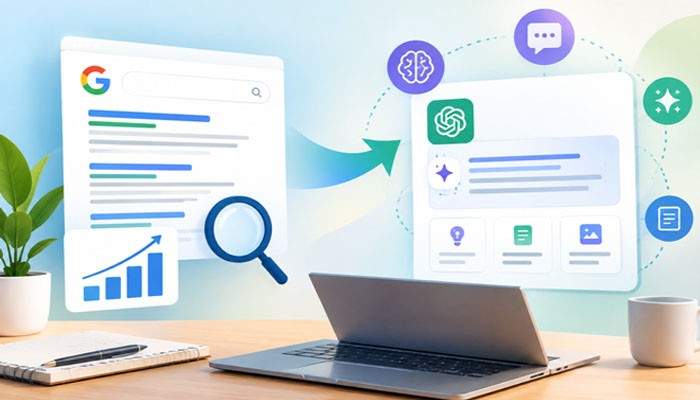

Search is no longer a list of ten blue links. When someone asks Google’s AI Overviews, ChatGPT, or Perplexity a question, they get a synthesized answer, and only a handful of sources earn a mention.
For businesses, that shift means ranking alone isn’t enough anymore; being cited matters just as much. Whether you partner with Grow Factor, which is offering the best SEO services in Pakistan, or run optimization in-house, understanding Generative Engine Optimization (GEO) is now essential. In this guide, we break down what GEO is, how it differs from traditional SEO, and the practical steps your business can take to stay visible.
What Is Generative Engine Optimization (GEO)?
Generative Engine Optimization is the practice of structuring and strengthening your content so AI-powered search platforms can understand it, trust it, and include it in their generated answers. These platforms include Google’s AI Overviews and AI Mode, ChatGPT, Perplexity, Microsoft Copilot, and Gemini.
Traditional SEO asks, “How do I rank higher on the results page?” GEO asks, “How do I become the source an AI engine quotes or recommends?” The two goals overlap heavily, but they are not identical.
GEO vs Traditional SEO: What’s Different?
| Factor | Traditional SEO | GEO |
| Primary goal | Rank on the search results page | Be cited or recommended in AI-generated answers |
| Content focus | Keywords and search intent | Clear answers, entities, and context |
| Success signal | Rankings, clicks, organic traffic | Brand mentions, citations, referral traffic, assisted conversions |
| Format | Long-form pages optimized around a keyword | Structured, scannable, question-led content |
| Authority signals | Backlinks and on-page relevance | Backlinks plus brand mentions, expertise, and consistency across the web |
The takeaway is that GEO builds on SEO rather than replacing it. A site that can’t be crawled, indexed, or trusted won’t be cited by an AI engine either.
Why Keywords Alone Are No Longer Enough

For years, SEO revolved around finding the right keyword and placing it in the right spots. That still matters, but AI engines work differently. Instead of matching a single phrase, they interpret the meaning of a whole question and often break it into related sub-questions before assembling an answer.
At Grow Factor, the focus is shifting beyond traditional keyword targeting toward creating clear, authoritative, and context-rich content that can be understood and referenced by both search engines and AI-powered platforms.
This has three practical consequences for businesses:
- Users ask longer, more conversational questions: Instead of “CRM software,” they ask, “Which CRM works best for a small team that sells online?”
- One page rarely wins alone: AI answers draw on several sources, so topical depth across your site matters more than one perfectly optimized page.
- Zero-click behavior grows: Some users get what they need from the AI answer without visiting a site, which makes a mention or citation valuable in its own right.
How AI Engines Decide What to Cite
Nobody outside these platforms knows the exact formulas, but the direction is consistent. AI engines favor sources that are accurate, well-organized, and clearly authoritative on a topic. Google’s own guidance on AI features and your website explains that the core SEO best practices, such as helpful content, good technical health, and a strong user experience, remain the foundation for appearing in AI Overviews and AI Mode.
In other words, there is no secret trick. The businesses that win are the ones that publish genuinely useful content and make it easy for machines and people to understand.
7 Practical Ways to Optimize for GEO
1. Answer questions directly and early.
Lead each section with a short, clear answer, then expand. AI engines can lift a well-formed two-sentence answer far more easily than a buried paragraph.
2. Structure content around real questions
Use headings that mirror how people actually ask things. Question-based H2s and H3s, followed by concise answers, make your page easier to parse and quote.
3. Build topical authority, not just single pages
Cover a subject from multiple angles with connected content. A cluster of well-linked articles signals depth far better than one isolated post.
4. Strengthen your E-E-A-T signals.
Show who wrote the content, why they’re qualified, and where your information comes from. Author bios, case studies, original insights, and transparent sourcing all build trust with both readers and algorithms.
5. Use structured data
Schema markup (Organization, Article, FAQ, Product, LocalBusiness) helps machines understand what your content is about. It won’t guarantee a citation, but it removes ambiguity.
6. Keep your brand information consistent everywhere.
Your business name, services, and descriptions should match across your website, Google Business Profile, social profiles, and directories. Inconsistent information makes it harder for AI engines to trust you.
7. Earn mentions beyond your own website.
AI engines learn from the wider web. Guest posts, digital PR, industry directories, and reviews on reputable platforms all reinforce your credibility as a source worth citing.
What GEO Means for Businesses in Pakistan
Pakistan’s online market is growing, and businesses across e-commerce, professional services, and technology are competing for the same digital attention. Many local searches mix English and Urdu terms, include city names, and happen on mobile. AI platforms are increasingly handling these queries too.
For Pakistani businesses, this creates an early-mover opportunity. Many competitors are still focused only on classic keyword rankings. Brands that publish clear, expert-led content and maintain consistent business information can build stronger visibility across both traditional search and AI-powered platforms.
At Grow Factor, this broader approach to SEO helps businesses adapt their content strategies for how people are discovering and evaluating brands today, including through generative search experiences.
The opportunity is not simply to rank for more keywords, but to become a reliable source that AI systems can understand, reference, and surface when potential customers are looking for relevant solutions.
How to Measure GEO Success
GEO metrics are still maturing, so a blended approach works best:
- Citation tracking: Regularly test your target questions on ChatGPT, Perplexity, Gemini, and Google’s AI features, and note whether your brand appears.
- Referral traffic: Watch analytics for visits coming from AI platforms.
- Branded search growth: More people searching your brand name often follows stronger AI and web visibility.
- Lead quality and conversions: Visitors who arrive through AI answers are often further along in their decision, so track what they do after landing.
Common GEO Mistakes to Avoid
- Abandoning SEO fundamentals in favor of “AI-only” tactics
- Publishing thin, generic AI-written content with no original insight
- Blocking crawlers unintentionally through robots.txt or meta directives
- Ignoring outdated pages that contain inaccurate information
- Expecting overnight results; GEO, like SEO, compounds over time
Final Thoughts
GEO doesn’t mean starting from scratch. It means taking the strong SEO foundation you already have and making it clearer, more structured, and more trustworthy so both people and AI engines choose your brand as the answer. Businesses that adapt early will be the ones AI platforms recommend as search keeps evolving. At Grow Factor, we help brands build that foundation by combining proven SEO practices with GEO-ready content strategies.
Frequently Asked Questions (FAQs)
1. What is Generative Engine Optimization (GEO), and how is it different from SEO?
GEO is the practice of optimizing your content so AI platforms like ChatGPT, Perplexity, and Google’s AI Overviews can understand, trust, and cite it in their answers. SEO focuses on ranking in traditional search results, while GEO focuses on being included in AI-generated responses. They work best together.
2. Does GEO replace traditional SEO?
No. GEO builds on SEO. Crawlability, quality content, site speed, and authority still determine whether AI engines can find and trust your pages. Think of GEO as an extension of SEO for a new type of search experience.
3. How can I get my business mentioned in ChatGPT or Google AI Overviews?
Publish clear, accurate, expert-led content that answers real customer questions, use structured data, keep your business information consistent across the web, and earn mentions on reputable third-party sites. There is no guaranteed method, but these steps improve your chances.
4. Is GEO worth it for small businesses?
Yes. AI platforms often surface smaller, specialized sources when they answer a niche question well. A small business with focused, helpful content can compete in AI answers without matching the budget of larger brands.
5. How long does it take to see results from GEO?
Like SEO, GEO is a gradual process. Improvements to content structure and clarity may show up in weeks, while authority-building through mentions and topical depth typically takes several months.
6. Which content formats work best for AI search visibility?
Question-led articles, concise definitions, comparison tables, step-by-step guides, and FAQ sections tend to be easiest for AI engines to interpret and quote.
7. Do I need an SEO agency to implement GEO?
Not necessarily, but an experienced agency can speed things up by auditing your technical setup, restructuring content, and building the off-site authority signals that AI engines rely on.
