


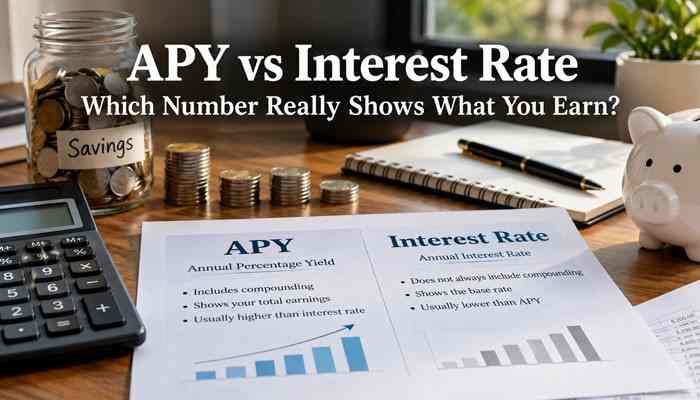

When comparing savings accounts, CDs or money market accounts, understanding APY vs interest rate can help you see which account may actually earn more money. The two percentages often look almost identical, but they measure different things.
An interest rate shows the basic annual rate a financial institution pays on your deposit. APY, or annual percentage yield, goes further by accounting for compounding. That difference makes APY vs interest rate especially important when comparing savings products from different banks.
For example, a 5.00% interest rate compounded monthly produces an APY of about 5.12%. On $10,000 kept in the account for a full year, that works out to approximately $511.62 rather than $500.
This guide explains what is APY, the APY meaning, how APY vs interest rate works, how compound interest changes your return, what a 5% APY earns and which number deserves more attention when choosing an account.
Quick Answer
The main difference between APY vs interest rate is compounding. An interest rate shows the basic annual rate paid on your deposit without including the full effect of compound interest.
APY shows the annualized yield after compounding is included. When comparing savings products, APY is usually more useful because it makes accounts with different compounding schedules easier to compare.
However, the highest APY does not automatically mean the best account. Fees, minimum balances, promotional periods and variable rates can affect what you actually earn.
Key Takeaways
- APY stands for annual percentage yield.
- APY includes the effect of compound interest.
- The stated interest rate does not include compounding.
- In an APY vs interest rate comparison, APY usually gives savers a clearer picture of annual earning potential.
- APY can be slightly higher than the stated interest rate.
- APY and interest rate can be equal when interest compounds only once annually.
- APY is expressed annually even when interest is credited monthly or daily.
- Savings APYs are often variable and can change.
- A high APY can lose its advantage when an account charges significant fees.
- APR and APY should not be confused because they are commonly used for different financial purposes.
What Is APY?
APY stands for annual percentage yield. It represents the annualized amount a deposit can earn after accounting for both the interest rate and compounding.
APY commonly appears on:
- Savings accounts
- High-yield savings accounts
- Certificates of deposit
- Money market deposit accounts
- Interest-bearing checking accounts
One reason APY vs interest rate matters is that two accounts can offer similar interest rates while producing different annual returns. Suppose one bank compounds interest monthly and another compounds daily.
Looking only at the stated interest rate may not tell you which account produces more annual interest. APY helps solve that problem by incorporating compounding into one annual percentage.
APY Meaning in Simple Terms
The easiest APY meaning to remember is:
APY tells you approximately how much your savings can grow over one year when compounding is included. Suppose you maintain $10,000 in an account paying 5.00% APY for a full year and the APY stays unchanged.
Your approximate earnings would be:
$10,000 × 5% = $500
Your approximate ending balance would be:
$10,500
Here is what the same APY could mean at different balances.
| Starting Balance | APY | Approximate Annual Interest |
|---|---|---|
| $1,000 | 5.00% | $50 |
| $5,000 | 5.00% | $250 |
| $10,000 | 5.00% | $500 |
| $25,000 | 5.00% | $1,250 |
| $50,000 | 5.00% | $2,500 |
| $100,000 | 5.00% | $5,000 |
These are simplified examples. Actual earnings can change when rates, balances, withdrawals or fees change.
What Is an Interest Rate?
An interest rate is the basic percentage paid on your deposit. Unlike APY, the stated interest rate does not incorporate the additional return created by compounding.
Suppose you deposit:
$10,000
at an annual interest rate of:
5.00%
Without the additional effect of compounding:
$10,000 × 0.05 = $500
When interest compounds during the year, previously earned interest can begin generating more interest.
That is the central concept behind APY vs interest rate.
APY vs Interest Rate at a Glance
The following table makes the APY vs interest rate difference easier to understand.
| Feature | APY | Interest Rate |
|---|---|---|
| Full name | Annual Percentage Yield | Interest Rate |
| Includes compounding | Yes | No |
| Expressed annually | Yes | Generally |
| Useful for comparing savings | Very useful | Less complete alone |
| Can be higher | Yes | Usually lower or equal |
| Used for savings accounts | Yes | Yes |
| Used for CDs | Yes | Yes |
| Reflects compounding | Yes | No |
| Guarantees exact earnings | No | No |
| Best comparison number | Usually | Supporting number |
The easiest way to remember APY vs interest rate is:
Interest rate = basic rate
APY = annualized yield after compounding
Why APY Can Be Higher Than the Interest Rate
Compound interest is the reason APY can exceed the stated interest rate.
Compound interest allows you to earn interest on:
Your original deposit + previously earned interest
Suppose you deposit $10,000 at a 5.00% nominal interest rate.
Without additional compounding:
$10,000 × 5% = $500
Now assume the account compounds monthly.
As interest is added, future interest calculations use a slightly larger balance.
A 5.00% nominal interest rate compounded monthly produces approximately:
5.12% APY
Annual interest becomes approximately:
$511.62
instead of:
$500
That small difference is why comparing APY vs interest rate matters.
How Compounding Frequency Changes APY
Using the same 5.00% nominal interest rate:
| Compounding Frequency | Approximate APY | Interest on $10,000 |
|---|---|---|
| Annually | 5.00% | $500.00 |
| Quarterly | 5.09% | $509.45 |
| Monthly | 5.12% | $511.62 |
| Daily | 5.13% | $512.67 |
The annual difference may appear small at first. However, larger account balances and longer saving periods can make the effect of compounding increasingly important. This is one reason APY is usually the stronger comparison number when evaluating APY vs interest rate offers.
Compounding Frequency vs Crediting Frequency
Compounding and crediting are related but not identical.
- Compounding frequency describes how often previously earned interest begins contributing to future interest.
- Crediting frequency describes how often a financial institution posts interest to your account.
- For example, a bank may calculate interest using daily balances but credit that accumulated interest once each month.
- For most consumers, comparing APYs is easier than comparing every institution’s individual compounding and crediting schedule.
Is APY Monthly or Yearly?
APY is an annualized percentage.
That does not mean interest must be paid only once per year.
Interest may be:
- Calculated daily
- Compounded daily
- Compounded monthly
- Credited monthly
- Credited quarterly
- Credited annually
Understanding this distinction helps prevent another common APY vs interest rate mistake. A 5% APY does not necessarily mean the bank pays exactly 5% ÷ 12 every month.
How Is APY Calculated?
For a fixed nominal rate with regular compounding, a commonly used formula is:
APY = (1 + r ÷ n)ⁿ − 1
Where:
r = annual interest rate expressed as a decimal
n = number of compounding periods each year
Suppose:
Interest rate = 5%
Compounding = monthly
Then:
APY = (1 + 0.05 ÷ 12)¹² − 1
The result is approximately:
5.116%
Rounded:
5.12% APY
This formula shows mathematically why APY vs interest rate numbers can differ even when they describe the same account.
How Much Does a 5% APY Earn?
A common question about APY is what the percentage means in actual dollars.
Assuming the APY remains 5% for a full year:
| Deposit | Approximate Annual Earnings | Approximate Ending Balance |
|---|---|---|
| $1,000 | $50 | $1,050 |
| $2,500 | $125 | $2,625 |
| $5,000 | $250 | $5,250 |
| $10,000 | $500 | $10,500 |
| $20,000 | $1,000 | $21,000 |
| $50,000 | $2,500 | $52,500 |
The larger your balance, the more important relatively small differences in APY can become.
How Much Does APY Earn Per Month?
APY is an annual number, so dividing it by 12 gives only a rough monthly estimate.
A better monthly-equivalent calculation is:
Monthly effective rate = (1 + APY)^(1/12) − 1
For 5.00% APY:
(1.05)^(1/12) − 1 ≈ 0.4074%
On $10,000:
$10,000 × 0.004074 ≈ $40.74
Actual monthly interest can still differ because:
- Months contain different numbers of days
- Your balance may change
- Savings APYs can change
- Banks may use daily calculations
- Interest-crediting dates vary
This is another reason APY vs interest rate should be evaluated over an annual period instead of using only a simple monthly estimate.
How to Convert APY to an Interest Rate
If you know the APY and the compounding frequency, you can estimate the underlying nominal interest rate.
Use:
Interest Rate = n × [(1 + APY)^(1/n) − 1]
For example:
APY: 5.00%
Compounding: monthly
The nominal interest rate is approximately:
4.89%
So one account might correctly advertise:
Interest rate: 4.89%
APY: 5.00%
This example clearly demonstrates how APY vs interest rate can describe the same product using two different percentages.
APY vs Interest Rate Example With $10,000
Consider two hypothetical accounts.
| Account | Interest Rate | APY | Starting Balance | Approximate Annual Earnings |
|---|---|---|---|---|
| Account A | 4.50% | 4.50% | $10,000 | $450 |
| Account B | 4.50% | 4.59% | $10,000 | $459 |
Account B produces about $9 more over one year.
With a $100,000 balance, the approximate difference becomes $90.
The percentages appear close, but the dollar difference becomes more noticeable as balances increase.
Which Number Really Shows What You Earn?
When choosing between APY vs interest rate, APY generally provides the clearer picture of potential annual earnings. The interest rate shows the underlying rate.
APY reflects the rate plus the impact of compounding. However, APY does not guarantee the exact amount that will appear in your account.
Your actual earnings may depend on:
- Starting balance
- Deposits
- Withdrawals
- Rate changes
- Minimum balances
- Fees
- Promotional requirements
- Balance tiers
- CD penalties
Use APY as the primary comparison number, then evaluate the account’s full terms.
APY vs Interest Rate for Savings Accounts
The APY vs interest rate difference is particularly important when comparing savings accounts.
Many savings accounts use variable rates.
That means an account advertising 5.00% APY today may not continue offering 5.00% for the entire next year.
Its APY could:
- Increase
- Decrease
- Change after a promotion
- Depend on your balance
- Require specific account activity
When comparing savings accounts, check whether the advertised APY is variable and whether you must meet requirements to receive it.
Why Do Savings APYs Change?
Financial institutions can adjust variable savings rates as market conditions change.
Factors may include:
- Broader interest-rate conditions
- Competition for customer deposits
- Funding needs
- Business strategy
- Customer acquisition
- Product pricing
This is why two banks can offer significantly different APYs at the same time. It also explains why APY vs interest rate should be treated as a current account comparison rather than assuming today’s rate will remain unchanged forever.
How Banks Determine the Balance That Earns Interest

APY tells you the annualized yield.
Your balance determines how much money is actually earning that yield.
Banks may calculate interest using methods such as:
Daily Balance Method
The periodic rate is applied to the applicable balance each day.
Average Daily Balance Method
Daily balances during the period are combined and averaged.
This matters when you regularly deposit or withdraw money.
For example, depositing $10,000 on the final day of a month will not normally generate as much interest for that month as keeping $10,000 deposited throughout the entire period.
APY vs Interest Rate for High-Yield Savings Accounts
Understanding APY vs interest rate becomes especially useful when comparing high-yield savings accounts.
These accounts generally compete by offering more attractive yields than many traditional savings accounts.
However, the headline APY is only part of the decision.
Check for:
- Minimum opening deposits
- Minimum ongoing balances
- Direct-deposit requirements
- Monthly fees
- Balance caps
- Promotional periods
- Transaction requirements
A 4.80% APY account with no fees could provide more value than a 5.00% APY account with expensive monthly charges.
APY vs Interest Rate for CDs
The APY vs interest rate comparison also matters for certificates of deposit. Traditional fixed-rate CDs commonly lock in a rate for a specified term. APY remains useful because it reflects compounding, but CD shoppers should also examine:
Term length
How long must the money remain deposited?
Early withdrawal penalties
How much could you lose if you withdraw before maturity?
Interest payout options
Can you withdraw interest while the CD remains open?
Renewal rules
Will the CD automatically renew?
Grace period
How long do you have after maturity to move your money?
A slightly higher APY may not justify locking away your cash significantly longer.
APY vs Interest Rate for Money Market Accounts
Money market deposit accounts may also display both an interest rate and APY.
In an APY vs interest rate comparison, APY remains the more useful annual earning figure.
Also check:
- Minimum balances
- Monthly fees
- Balance tiers
- Withdrawal access
- Debit-card access
- Check-writing features
- Promotional conditions
A money market deposit account should not be confused with a money market mutual fund, which is an investment product.
Promotional APY Explained
A promotional APY is a temporary rate available under specified conditions.
For example:
5.25% APY for six months
followed by the institution’s standard variable APY.
Before choosing a promotional account, check:
- How long the offer lasts
- What the APY becomes afterward
- Whether it applies only to new customers
- Whether direct deposit is required
- Whether there is a balance limit
- Whether minimum deposits apply
When comparing promotional APY vs interest rate offers, focus on the return you expect over your entire holding period rather than only the introductory percentage.
Tiered APY Explained
Some accounts pay different yields depending on your balance.
For example:
| Balance | Hypothetical APY |
|---|---|
| $0–$4,999 | 1.00% |
| $5,000–$24,999 | 3.50% |
| $25,000+ | 4.50% |
Do not assume the highest advertised APY applies automatically to every dollar in your account.
Read the account’s tier structure carefully.
Stepped-Rate Accounts Explained
A stepped-rate account changes its interest rate according to a predetermined schedule.
A hypothetical CD could pay:
Months 1–6: 3.50%
Months 7–12: 4.00%
Year 2: 4.50%
Looking only at the highest rate would give an incomplete picture.
APY helps turn the scheduled rates into a more comparable annualized figure.
APY vs Interest Rate vs APR
Another common source of confusion is APY vs interest rate versus APR.
| Term | Common Use | What It Measures |
|---|---|---|
| APY | Savings and deposit accounts | Annualized earnings including compounding |
| Interest Rate | Deposits and loans | Underlying stated rate |
| APR | Loans and credit | Annual borrowing cost |
A simple shortcut is:
APY = savings earnings
APR = borrowing costs
Although the formal definitions are more detailed, this is a useful way to remember the difference.
APY vs Interest Rate vs Compound Interest
The three concepts work together but mean different things.
Interest rate is the underlying percentage.
Compound interest is the process through which earned interest can generate additional interest.
APY is the annualized yield produced after compounding is considered.
Think of the relationship as:
Interest rate → starting percentage
Compounding → growth process
APY → annualized result
This is the foundation of the entire APY vs interest rate comparison.
Why Banks Advertise APY
APY gives consumers a standardized way to compare deposit accounts.
Without it, you might have to manually compare:
4.90% interest compounded monthly
with:
4.88% interest compounded daily
APY incorporates those compounding differences into one annualized figure.
That is why APY is normally the more practical number for deposit comparisons.
Does Daily Compounding Always Mean a Better Account?
No.
Daily compounding can create slightly more interest than monthly compounding when the nominal rates are identical.
But APY already accounts for the effect of compounding.
Suppose:
Account A: 4.90% APY with daily compounding
Account B: 5.00% APY with monthly compounding
Assuming the other terms are equal, Account B has the stronger annual yield.
When considering APY vs interest rate, do not choose an account simply because it advertises daily compounding.
Does APY Include Fees?
APY should not be treated as your final return after fees.
Suppose:
Account A: 5.00% APY with a $10 monthly fee
Account B: 4.75% APY with no monthly fee
Account A charges:
$120 annually
For someone keeping a relatively small balance, that fee could eliminate the benefit of the higher APY.
Check for:
- Monthly maintenance fees
- Minimum-balance fees
- ATM charges
- Wire fees
- Paper statement fees
- Early withdrawal penalties
The goal is to maximize net earnings, not merely choose the largest APY.
Does APY Include Bank Bonuses?
A cash bonus should generally be evaluated separately from APY.
For example:
Account A: 5.00% APY
Account B: 4.50% APY + $300 bonus
Depending on your balance, Account B could provide greater first-year value.
However, bonuses may require:
- Direct deposit
- Minimum deposits
- Minimum balance periods
- Keeping the account open
- Meeting qualifying deadlines
When evaluating APY vs interest rate offers with bonuses, calculate the bonus separately from recurring interest.
How Much Difference Does a Higher APY Make?
Consider two savings accounts:
Account A: 4.50% APY
Account B: 5.00% APY
If the yields remained unchanged for one year:
| Starting Balance | 4.50% APY | 5.00% APY | Difference |
|---|---|---|---|
| $1,000 | $45 | $50 | $5 |
| $5,000 | $225 | $250 | $25 |
| $10,000 | $450 | $500 | $50 |
| $25,000 | $1,125 | $1,250 | $125 |
| $50,000 | $2,250 | $2,500 | $250 |
| $100,000 | $4,500 | $5,000 | $500 |
The same percentage-point difference becomes increasingly valuable as your balance grows.
This is why comparing APY vs interest rate in actual dollars can be more useful than comparing percentages alone.
How to Compare APY vs Interest Rate When Choosing an Account
Start with APY, then evaluate the complete account.
| Factor | Why It Matters |
|---|---|
| APY | Reflects annual earning potential with compounding |
| Interest rate | Shows the underlying base rate |
| Fixed or variable | Tells you whether the rate may change |
| Monthly fees | Reduce your net earnings |
| Minimum balance | May determine eligibility for the best APY |
| Balance tiers | Can change the yield you receive |
| Promotional terms | May make a high APY temporary |
| Liquidity | Determines access to your money |
| CD penalties | Can reduce returns |
| Deposit protection | Helps protect eligible deposits |
The strongest account is not necessarily the one showing the highest headline percentage.
Is a Higher APY Always Better?
No.
Consider:
Account A
5.10% APY
$15 monthly fee
$10,000 minimum balance
Account B
4.85% APY
No monthly fee
No minimum balance
Someone with $2,000 could be better off with Account B even though its APY is lower.
A good account combines:
- Competitive APY
- Low fees
- Reasonable requirements
- Easy access
- Clear terms
- Appropriate deposit protection
APY and Deposit Insurance
APY measures potential returns.
It does not tell you whether the account itself is appropriately insured.
Before moving money to an unfamiliar financial institution simply because it offers an attractive APY, verify the institution and understand the applicable deposit-insurance limits.
The difference between APY vs interest rate matters for earnings, but account safety matters even more.
APY vs Inflation
APY measures nominal growth.
It does not tell you how much your purchasing power grows after inflation.
Suppose:
APY = 4%
Inflation = 3%
A simple estimate suggests roughly a 1% real gain.
A more precise formula is:
Real return = (1 + nominal return) ÷ (1 + inflation) − 1
Using the example:
1.04 ÷ 1.03 − 1 ≈ 0.97%
Your account grew 4% numerically, but your purchasing power increased only about 0.97% before tax.
Is Savings Interest Taxable?
For U.S. taxpayers, savings-account and CD interest is generally taxable unless a specific exception applies.
That means:
APY is not the same as an after-tax return. If you earn $500 in taxable interest, your final benefit depends partly on your tax circumstances. This does not change the basic APY vs interest rate comparison, but it does affect your actual net return.
Common APY vs Interest Rate Mistakes
Treating APY and Interest Rate as Identical
They are related, but APY incorporates compounding while the basic interest rate does not.
Looking Only at the Interest Rate
Ignoring APY can make it harder to compare accounts with different compounding schedules.
Dividing APY by 12 for Exact Monthly Earnings
That provides only a rough estimate.
Assuming APY Is Guaranteed for One Year
Many savings APYs are variable.
Choosing the Highest APY Without Checking Fees
Fees can erase the benefit of a slightly better rate.
Ignoring Balance Tiers
The best advertised APY may apply only to specific balances.
Ignoring Promotional Expiration Dates
A temporary APY may fall after a few months.
Ignoring CD Penalties
Early withdrawals can reduce your effective return.
Confusing APY With APR
APY is generally used for deposit earnings, while APR is generally associated with borrowing.
APY vs Interest Rate: Which Should You Compare First?
For most savings products, compare APY first.
The reason is simple: APY already includes compounding and therefore provides a more standardized annual comparison.
Then check the underlying interest rate and the account’s:
- Fees
- Minimum balances
- Variable-rate rules
- Balance tiers
- Promotional conditions
- Withdrawal access
- Deposit protection
The best answer to APY vs interest rate is not that one number makes the other irrelevant.
Instead:
Use APY for comparison and interest rate for understanding the account’s underlying rate structure.
Conclusion
Understanding APY vs interest rate makes it easier to compare savings accounts, high-yield savings accounts, CDs and money market accounts. The interest rate shows the underlying basic rate paid on your deposit. APY adds the effect of compounding and expresses the result as an annualized yield.
That is why APY vs interest rate matters when two accounts advertise similar percentages but use different compounding schedules. Understanding what is APY and the APY meaning also helps you look beyond headline rates and focus on what your money may actually earn.
However, APY should never be considered alone. Fees, balance requirements, promotional periods, variable rates, withdrawal restrictions and deposit protection all affect the practical value of an account.
For most savers, the smartest APY vs interest rate strategy is simple:
Compare APY first, understand the interest rate behind it, review the full account terms, and choose the option that delivers the strongest net return for your money.
APY vs Interest Rate FAQs
1. What is the main difference between APY vs interest rate?
The main difference between APY vs interest rate is that APY includes the effect of compounding, while the stated interest rate shows the underlying rate before compounding.
2. What is APY?
APY stands for annual percentage yield. It shows an annualized return after compound interest is taken into account.
3. What does 5% APY mean?
A 5% APY means $10,000 maintained for a full year could earn approximately $500 if the APY remains unchanged and account requirements are satisfied.
4. Is APY better than an interest rate?
For comparing savings accounts, APY is usually more useful because it includes compounding. The interest rate remains useful for understanding the base rate.
5. Why is APY higher than the interest rate?
APY can be higher because previously earned interest may begin generating additional interest through compounding.
6. Is APY calculated monthly or yearly?
APY is annualized. Interest may be calculated or credited daily, monthly, quarterly or according to another schedule.
7. Can APY change after opening an account?
Yes. Many savings accounts use variable rates, so their APYs may increase or decrease.
8. Does APY include compound interest?
Yes. The inclusion of compounding is a central difference in APY vs interest rate.
