


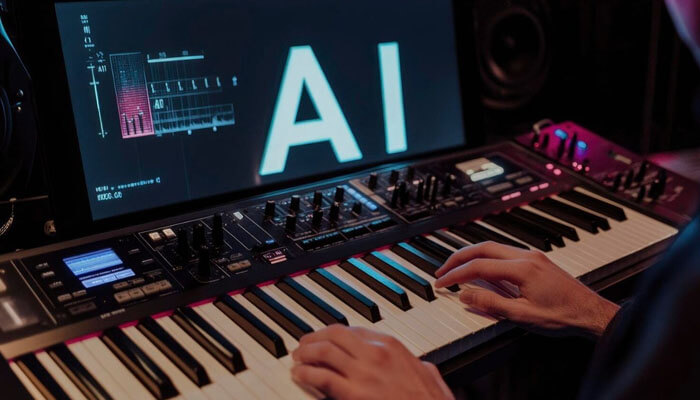

For decades, writing a song usually began with an instrument, a notebook, a microphone, or a digital audio workstation. Today, there is another possible starting point: describing what the music should sound like. AI music generators can turn ideas about mood, genre, tempo, instrumentation, and atmosphere into playable music in a very short time. For anyone curious about how that process works, click here to explore how a text-based idea can become a piece of music.
What makes this change interesting is not simply speed. AI music generators are starting to influence how people brainstorm, test ideas, build demos, explore genres, and decide which concepts are worth developing. They do not replace every part of songwriting. Instead, they introduce a new way to move from an idea in someone’s head to something that can actually be heard, judged, revised, and shared.
Quick Take
AI music generators are changing songwriting in several practical ways:
- Ideas can move from concept to sound much faster.
- Beginners can experiment without mastering every production tool first.
- Songwriters can test multiple genres, moods, and arrangements earlier.
- Rough demos can be created before investing time in full production.
- Prompts are becoming part of creative direction.
- Professional musicians can use AI for prototyping rather than full automation.
- Future songwriting workflows are likely to combine AI with traditional production.
The biggest change is not that AI can make music on its own. It is that creators now have more ways to start, test, and develop an idea.
A New Starting Point for Songwriting
Songwriting has always involved translating an idea into sound, and that translation is often where the difficulty begins.
A songwriter may hear a melody clearly but struggle to reproduce it on an instrument. A producer may understand the feeling a track needs while spending hours searching for the right sounds. Someone with no formal music training may know exactly what kind of song they want without knowing how to build the chords, rhythm, or arrangement.
AI music generators offer another way into the process.
Instead of beginning with notes, samples, or software controls, creators can start with language. They might describe:
- A soft acoustic ballad with restrained vocals;
- An energetic electronic track with a fast build;
- A dark cinematic instrumental for a dramatic scene;
- A nostalgic indie-pop song with clean guitar and warm percussion.
That result does not need to become the finished track.
Sometimes its main value is simply making the idea audible.
Once creators can hear a concept rather than only imagine it, they can make decisions more easily. Is the tempo too fast? Does the instrumentation fit the mood? Should the chorus feel bigger? Is the entire direction wrong?
AI makes the early stage of songwriting more concrete.
How AI Changes the Traditional Music Workflow

The difference becomes clearer when comparing a traditional workflow with an AI-assisted one.
| Stage | Traditional Workflow | AI-Assisted Workflow |
| Starting an idea | Begin with chords, lyrics, melody, or samples | Begin with a written musical concept or prompt |
| Testing styles | Rebuild parts of the arrangement manually | Generate and compare several directions quickly |
| Creating demos | Record, program, arrange, and mix a rough version | Create an early musical draft before full production |
| Exploring genres | Often limited by existing skills and tools | Test unfamiliar genres with less setup |
| Collaboration | Explain ideas using words or reference tracks | Share an audible concept with collaborators |
| Revising direction | Changes may require significant reworking | Alternative versions can be tested earlier |
| Final production | Built manually in a DAW or studio | Often combines AI ideas with traditional production |
This does not mean AI removes the traditional workflow. In many cases, it simply changes what happens before the serious production work begins.
A creator can test an idea first, then decide whether it deserves a full recording session, detailed arrangement, or professional mix.
Faster Experimentation and Better Demos
One of the clearest changes AI brings to music creation is the speed at which ideas can be tested.
In a traditional workflow, major creative changes often take time. Turning an acoustic track into an electronic one may require rebuilding the arrangement. Changing the tempo can affect the drums, vocals, and structure. Trying a completely different genre may mean starting much of the production again.
AI-assisted tools make it easier to explore those alternatives earlier.
For example, the same song idea could be tested as:
- Aacoustic pop
- R&B
- Electronic music
- Indie rock
- Lo-fi
- Cinematic music
This makes experimentation less expensive in terms of time.
It also encourages better creative questions.
What if the chorus were quieter instead of bigger? What if piano replaced guitar? What if a bright idea became darker? What if the same lyrics were placed in a completely different musical setting?
AI does not make those choices for the songwriter. It simply makes the options easier to hear.
Turning Ideas Into Rough Demos
This is especially useful during demo creation.
A traditional rough demo may still require:
- Choosing chords
- Programming drums
- Arranging song sections
- Recording instruments
- Adding vocals
- Applying basic mixing
That process is worthwhile for a serious project, but not every early idea needs that much work.
An AI-generated draft can help answer a simpler question first:
Is this idea worth developing?
For independent musicians, that can save time. Instead of fully producing every concept, they can explore several and invest more effort in the strongest ones.
It can also improve collaboration. Words such as “warm,” “cinematic,” “minimal,” or “energetic” mean different things to different people. An audible sketch gives collaborators something more specific to react to.
Music Creation Is Becoming More Accessible
Until recently, producing even a simple track often meant learning at least some combination of music theory, MIDI, recording, arrangement, sound selection, mixing, and DAW workflows.
Those skills remain valuable. AI has not made them irrelevant.
What has changed is that they are no longer the only possible entry point.
A creator who understands the type of music they want can begin experimenting before mastering every technical step.
This opens the process to a wider range of people.
Who Can Benefit?
AI-assisted music tools can be useful for:
- Songwriters who have ideas but limited production experience
- Video creators looking for music that matches a scene
- Podcasters testing intros, transitions, or background music
- Game developers exploring musical moods for different environments
- Independent artists creating early demos
- Beginners learning how tempo, arrangement, and instrumentation affect a song
- Producers testing ideas before building them in detail
For beginners, this can become a learning process rather than simply a shortcut.
Changing the tempo, instrumentation, mood, or genre and then hearing the result makes abstract musical concepts easier to understand.
In some cases, AI may actually encourage people to learn more about music because they can immediately hear the effect of their creative decisions.
Prompts Are Becoming Part of Creative Direction
As text-to-music tools become more common, prompts are starting to function like a form of creative direction.
A basic prompt may simply say:
“Create an indie pop song.”
That gives the system very little context.
A more useful direction might describe a warm indie-pop track with clean guitar, restrained drums, soft vocals, and a nostalgic late-night atmosphere.
The second version provides a clearer creative target.
What Makes a Useful Music Prompt?
A prompt can include several elements:
| Element | What It Controls |
| Genre | The overall musical style |
| Mood | The emotional character of the track |
| Tempo | How fast or slow the music feels |
| Instruments | Which sounds should be prominent |
| Vocals | Vocal style, energy, or character |
| Energy | Whether the track feels calm, intense, or dynamic |
| Setting | The type of scene or environment the music should fit |
The goal is not to make every prompt as long as possible.
The real skill is knowing which details matter.
That is surprisingly similar to working with a producer or musician. A creator does not need to perform every part personally, but they do need to communicate the direction clearly and recognize when the result does not fit.
AI makes creative judgment more important, not less.
The Musician’s Role Is Changing, Not Disappearing
Whenever AI becomes part of a creative field, the discussion often moves quickly toward replacement.
Music is more complicated than that.
Generating audio and creating a meaningful song are not exactly the same thing.
An AI system can produce melodies, rhythms, arrangements, and musical drafts, but creators still make decisions about:
- Emotion
- Identity
- Storytelling
- Audience
- Originality
- Arrangement
- Lyrical meaning
- Overall artistic direction
Someone still has to decide whether a result feels generic, whether the arrangement supports the lyrics, or whether the song matches the intended purpose.
Professional creators may also use AI very differently from beginners.
A producer might generate an arrangement concept and then rebuild it manually inside a DAW. A songwriter may test the same lyrics across several musical styles before choosing one. An artist might use an AI-generated result purely as a reference, with none of the original audio appearing in the finished song.
In those cases, AI works more like a sketching tool than a replacement.
It generates possibilities.
The creative value comes from what happens next.
AI Is Making Genre Exploration Easier
Musicians naturally develop habits around the tools they already know.
A guitarist may write guitar-driven songs. A producer comfortable with electronic software may stay close to electronic genres. A songwriter may return to familiar chord structures because those are the ones they can play easily.
AI can loosen some of those boundaries.
A creator who normally makes acoustic music can quickly hear how the same idea might work as synth-pop. A hip-hop concept can be reimagined with cinematic instrumentation. A simple piano idea can become orchestral, lo-fi, electronic, or something more experimental.
This creates more room for cross-genre combinations.
Creators can test ideas such as:
- Folk with electronic production;
- Hip-hop with orchestral textures;
- Indie pop with cinematic arrangements;
- Acoustic songwriting with ambient production;
- Traditional sounds mixed with modern dance rhythms.
Not every experiment will work.
That is part of the process.
The advantage is that creators can hear unusual combinations before spending hours building them manually.
Where AI Fits Best in Professional Workflows
For professional musicians and producers, AI may have the most value during the early and middle stages of creation.
It can be especially useful for:
1. Idea Generation
A producer can explore several musical directions before choosing one to develop.
2. Arrangement Testing
Different instruments, moods, or song structures can be compared before a detailed arrangement is built.
3. Demo Creation
Songwriters can create a rough musical reference before entering a studio or working with another producer.
4. Client Communication
Composers and producers can present several possible directions instead of explaining every idea only through words.
5. Creative Exploration
Artists can step outside their usual genres without needing to master an entirely new production setup first.
In most professional workflows, the final song may still involve manual arrangement, recording, editing, mixing, and mastering.
AI simply helps creators reach important decisions sooner.
The Future of Songwriting Will Likely Be Hybrid
The future of music creation is unlikely to be entirely traditional or entirely AI-generated.
A more realistic direction is hybrid.
One possible workflow might look like this:
Idea
↓
Lyrics or concept
↓
AI-generated musical draft
↓
Creative evaluation
↓
DAW arrangement
↓
Live or recorded elements
↓
Editing and production
↓
Mixing and mastering
↓
Final song
Another project may work completely differently.
A guitarist could record a rough idea first, use AI to explore several arrangement options, then return to a mostly human performance.
A producer might use AI only during brainstorming.
A beginner may use it throughout most of the process.
There is unlikely to be one standard workflow.
That flexibility may be the biggest long-term change.
AI music generators do not simply automate an existing process. They add new possible paths between the first idea and the finished song.
Conclusion
AI music generators are changing songwriting because they make ideas easier to hear, test, compare, and develop.
They allow beginners to start creating before mastering every technical skill, while giving experienced musicians a faster way to prototype arrangements, genres, demos, and creative directions.
The technology will continue to evolve, but the central creative question remains the same: which ideas are worth developing?
AI can generate possibilities. Turning those possibilities into something memorable still depends on human judgment, direction, and taste.
