



The best books of all time do something ordinary books rarely achieve. They survive changing generations, cultures, technologies, political systems, and reading habits while continuing to give new readers something valuable.
Some of the best books of all time transformed the way novels are written. Others created unforgettable fictional worlds, challenged social assumptions, reshaped philosophy and science, or told stories readers have returned to for centuries.
But there is no universally accepted No. 1 book. Critics, literary scholars, libraries, authors, and ordinary readers often rank great books differently. One list may reward literary experimentation, while another values cultural influence, global readership, emotional impact, or storytelling.
That is why our ranking of the best books of all time does not simply copy one famous list. Instead, it considers literary influence, cultural impact, critical reputation, staying power, global significance, and the experience of actually reading each book.
Whether you enjoy romance, fantasy, science fiction, historical fiction, psychological novels, literary classics, memoir, philosophy, or influential nonfiction, this guide can help you find your next great read.
Quick Answer: Best Books of All Time
The best books of all time include Don Quixote, Middlemarch, One Hundred Years of Solitude, War and Peace, Pride and Prejudice, Beloved, Ulysses, In Search of Lost Time, To the Lighthouse, and The Lord of the Rings.
Our No. 1 choice is Don Quixote because of its extraordinary influence on the modern novel, international reach, originality, humor, longevity, and continuing relevance.
For readers new to classic literature, Pride and Prejudice, 1984, The Great Gatsby, Frankenstein, Rebecca, and The Hobbit offer easier starting points.
Key Takeaways
- Don Quixote ranks first among our best books of all time because of its literary influence and longevity
- Middlemarch is ideal for readers who value realistic characters and psychological depth
- One Hundred Years of Solitude is an essential work of magical realism
- Pride and Prejudice is one of the most approachable major classics
- The Lord of the Rings is our highest-ranked fantasy book
- Beloved is one of the defining works of modern American literature
- 1984 remains one of the most influential dystopian novels
- Ulysses and In Search of Lost Time are literary landmarks but challenging choices for beginners
- The list covers different countries, centuries, genres, and literary traditions
- The right book for you depends on your interests, not simply its ranking
How We Ranked the Best Books of All Time
Calling something one of the best books of all time is inevitably subjective.
That does not mean the ranking has to be random.
We considered five broad factors when evaluating these books.
| Ranking Factor | Weight | What It Measures |
| Literary influence | 25% | Impact on writers, genres, and storytelling |
| Cultural impact | 20% | Influence beyond literature |
| Critical reputation | 20% | Long-term recognition among critics and scholars |
| Staying power | 20% | Continued relevance across generations |
| Reader experience | 15% | Storytelling, emotion, accessibility, and reread value |
These percentages are an editorial framework rather than a scientific formula.
A historically important book does not automatically rank highly simply because scholars admire it. The actual reading experience matters.
Popularity alone is not enough either.
To qualify among the best books of all time, a book should demonstrate lasting importance rather than temporary popularity.
Why Famous Best-Book Lists Disagree
Different rankings use different rules.
Some focus entirely on novels. Others consider only English-language books or titles published during a particular period.
Other rankings prioritize critic votes, reader votes, library holdings, or influence.
This explains why the same handful of books can move dramatically from one ranking to another.
There is no single definition of literary greatness.
Critics vs Readers: What Makes a Book Great?
Professional critics and ordinary readers often value different qualities.
Critics may focus on:
- Originality
- Literary technique
- Language
- Narrative structure
- Historical importance
- Influence on later writers
Readers often prioritize:
- Memorable characters
- Emotional impact
- Strong storytelling
- Entertainment
- Immersive worlds
- Rereadability
That difference matters when discussing the best books of all time.
A challenging experimental novel may receive extraordinary critical admiration, while readers may prefer a more accessible story that creates a stronger emotional connection.
Neither response is wrong.
| Perspective | Example Favorite | What It Often Rewards |
| Literary experts | Middlemarch | Craft, psychology, influence |
| General readers | The Lord of the Rings | Storytelling, emotion, immersion |
| Global library presence | Don Quixote | Longevity and international reach |
| Our ranking | Don Quixote | Overall balance |
The most useful ranking should help readers discover great books rather than tell them what they are required to admire.
Why This List Includes More Than Novels
Many lists of the greatest literature focus entirely on fiction.
This one is broader because the focus is the best books of all time, not simply the best novels.
Some books transformed science, philosophy, psychology, history, politics, or society without being fiction.
That is why works such as The Diary of a Young Girl, The Second Sex, On the Origin of Species, and Man’s Search for Meaning appear alongside novels.
Fiction still dominates the ranking, but excluding every nonfiction work would unnecessarily narrow what a great book can be.
50 Best Books of All Time at a Glance
The table below provides a quick overview of our complete best books of all time ranking.
| Rank | Book | Author | First Published | Best For |
| 1 | Don Quixote | Miguel de Cervantes | 1605/1615 | Adventure and satire |
| 2 | Middlemarch | George Eliot | 1871–1872 | Character-driven fiction |
| 3 | One Hundred Years of Solitude | Gabriel García Márquez | 1967 | Magical realism |
| 4 | War and Peace | Leo Tolstoy | 1869 | Historical epic |
| 5 | Pride and Prejudice | Jane Austen | 1813 | Romance and social comedy |
| 6 | Beloved | Toni Morrison | 1987 | Historical literary fiction |
| 7 | Ulysses | James Joyce | 1922 | Experimental fiction |
| 8 | In Search of Lost Time | Marcel Proust | 1913–1927 | Memory and psychology |
| 9 | To the Lighthouse | Virginia Woolf | 1927 | Modernist fiction |
| 10 | The Lord of the Rings | J.R.R. Tolkien | 1954–1955 | Fantasy |
| 11 | The Odyssey | Homer | c. 8th century BCE | Myth and adventure |
| 12 | Anna Karenina | Leo Tolstoy | 1878 | Love and society |
| 13 | Moby-Dick | Herman Melville | 1851 | Adventure and philosophy |
| 14 | 1984 | George Orwell | 1949 | Dystopian fiction |
| 15 | The Brothers Karamazov | Fyodor Dostoevsky | 1880 | Philosophy and family |
| 16 | Things Fall Apart | Chinua Achebe | 1958 | Culture and colonialism |
| 17 | The Great Gatsby | F. Scott Fitzgerald | 1925 | American literature |
| 18 | Crime and Punishment | Fyodor Dostoevsky | 1866 | Psychological fiction |
| 19 | Jane Eyre | Charlotte Brontë | 1847 | Gothic romance |
| 20 | The Divine Comedy | Dante Alighieri | c. 1321 | Poetry and philosophy |
| 21 | Madame Bovary | Gustave Flaubert | 1857 | Literary realism |
| 22 | Frankenstein | Mary Shelley | 1818 | Gothic and science fiction |
| 23 | Invisible Man | Ralph Ellison | 1952 | Identity and society |
| 24 | The Iliad | Homer | c. 8th century BCE | War and mythology |
| 25 | Mrs Dalloway | Virginia Woolf | 1925 | Modernist fiction |
| 26 | The Trial | Franz Kafka | 1925 | Absurdist fiction |
| 27 | The Sound and the Fury | William Faulkner | 1929 | Experimental fiction |
| 28 | The Master and Margarita | Mikhail Bulgakov | 1966–1967 | Fantasy and satire |
| 29 | The Handmaid’s Tale | Margaret Atwood | 1985 | Dystopian fiction |
| 30 | Brave New World | Aldous Huxley | 1932 | Dystopian science fiction |
| 31 | The Color Purple | Alice Walker | 1982 | Family and resilience |
| 32 | The Stranger | Albert Camus | 1942 | Existential fiction |
| 33 | The Little Prince | Antoine de Saint-Exupéry | 1943 | Philosophical fiction |
| 34 | The Grapes of Wrath | John Steinbeck | 1939 | Social fiction |
| 35 | Wuthering Heights | Emily Brontë | 1847 | Gothic fiction |
| 36 | The Count of Monte Cristo | Alexandre Dumas | 1844–1846 | Adventure and revenge |
| 37 | The Picture of Dorian Gray | Oscar Wilde | 1890 | Gothic philosophy |
| 38 | The Hobbit | J.R.R. Tolkien | 1937 | Accessible fantasy |
| 39 | Rebecca | Daphne du Maurier | 1938 | Gothic suspense |
| 40 | The Remains of the Day | Kazuo Ishiguro | 1989 | Literary fiction |
| 41 | The Left Hand of Darkness | Ursula K. Le Guin | 1969 | Science fiction |
| 42 | The Road | Cormac McCarthy | 2006 | Post-apocalyptic fiction |
| 43 | Pedro Páramo | Juan Rulfo | 1955 | Magical realism |
| 44 | The God of Small Things | Arundhati Roy | 1997 | Family and society |
| 45 | The Tale of Genji | Murasaki Shikibu | c. early 11th century | Psychological fiction |
| 46 | Season of Migration to the North | Tayeb Salih | 1966 | Postcolonial fiction |
| 47 | The Diary of a Young Girl | Anne Frank | 1947 | Memoir and history |
| 48 | The Second Sex | Simone de Beauvoir | 1949 | Philosophy and feminism |
| 49 | On the Origin of Species | Charles Darwin | 1859 | Science |
| 50 | Man’s Search for Meaning | Viktor E. Frankl | 1946 | Psychology and meaning |
1. Don Quixote by Miguel de Cervantes
Few books have influenced the development of the modern novel as profoundly as Don Quixote.
Alonso Quixano reads so many tales of chivalry that he decides to transform himself into the knight Don Quixote. Accompanied by Sancho Panza, he repeatedly interprets ordinary reality as heroic adventure.
The result is funny, sad, philosophical, and remarkably self-aware.
Cervantes explores imagination, identity, idealism, storytelling, and the gap between reality and how people choose to interpret it.
Its combination of influence, longevity, humor, and continuing global recognition makes Don Quixote our No. 1 choice among the best books of all time.
Best for: Adventure, satire, literary history, and readers fascinated by storytelling.
2. Middlemarch by George Eliot
Middlemarch proves that ordinary lives can contain extraordinary complexity.
George Eliot follows several interconnected characters, particularly Dorothea Brooke and doctor Tertius Lydgate, whose ambitions collide with marriage, careers, money, politics, and social expectations.
The novel’s greatest strength is empathy.
Characters make mistakes without becoming simple heroes or villains.
Its psychological depth and understanding of relationships make it one of the strongest candidates for anyone exploring the best books of all time.
Best for: Character development, relationships, psychology, and social realism.
3. One Hundred Years of Solitude by Gabriel García Márquez
One Hundred Years of Solitude follows generations of the Buendía family in the fictional town of Macondo.
Wars, romance, political turmoil, ghosts, inventions, tragedy, and recurring family patterns merge into one extraordinary narrative.
Gabriel García Márquez treats impossible events as though they were ordinary facts of life.
The result became one of the defining examples of magical realism.
Best for: Magical realism and multigenerational fiction.
4. War and Peace by Leo Tolstoy
The enormous length of War and Peace can intimidate new readers, but the novel is surprisingly human.
Tolstoy moves between Napoleon’s invasion of Russia, aristocratic society, friendship, romance, family, death, and philosophical questions.
Pierre Bezukhov, Natasha Rostova, and Prince Andrei change dramatically as history reshapes their lives.
Few books combine such an enormous historical canvas with such personal characters.
Best for: Historical epics and ambitious character-driven fiction.
5. Pride and Prejudice by Jane Austen
Elizabeth Bennet and Mr. Darcy form one of literature’s most famous romantic pairings.
Their changing judgments provide the central story, but Jane Austen is equally interested in marriage, money, reputation, social class, and family.
Its humor remains remarkably fresh.
Among the best books of all time, Pride and Prejudice is also one of the easiest classics for beginners to approach.
Best for: Romance and first-time classic readers.
6. Beloved by Toni Morrison
Set after the American Civil War, Beloved follows Sethe, a formerly enslaved woman whose family remains haunted by the past.
Toni Morrison combines memory, motherhood, trauma, history, and supernatural elements to show how suffering can survive long after the original event.
The novel is emotionally demanding but extraordinarily powerful.
Best for: Historical literary fiction and challenging emotional reading.
7. Ulysses by James Joyce
James Joyce transforms one ordinary day in Dublin into one of modern literature’s most ambitious experiments.
The novel follows Leopold Bloom, Stephen Dedalus, and Molly Bloom during June 16, 1904.
Different sections employ dramatically different narrative techniques.
It is playful, difficult, comic, experimental, and enormously influential.
For experienced readers exploring the best books of all time, Ulysses represents one of literature’s biggest challenges and rewards.
Best for: Experimental fiction and advanced readers.
8. In Search of Lost Time by Marcel Proust
Marcel Proust’s enormous sequence examines memory, love, jealousy, art, society, identity, and time.
Its famous madeleine episode demonstrates how a simple sensation can release memories that appear forgotten.
The novels prioritize psychological observation over fast-moving action.
Readers who enjoy introspection may find the depth extraordinary.
Best for: Memory, psychology, and reflective literary prose.
9. To the Lighthouse by Virginia Woolf
A family’s planned visit to a lighthouse becomes the foundation for an examination of relationships, time, grief, consciousness, and artistic ambition.
Virginia Woolf moves fluidly through the minds of different characters.
Rather than relying on major plot twists, the novel finds significance in thought and ordinary experience.
Best for: Modernist fiction and interior character writing.
10. The Lord of the Rings by J.R.R. Tolkien
Modern fantasy would look very different without Tolkien.
Frodo Baggins leaves the Shire carrying the One Ring while a larger struggle for Middle-earth unfolds around him.
Languages, histories, legends, cultures, landscapes, and political conflicts give Tolkien’s world extraordinary depth.
For fantasy readers searching the best books of all time, The Lord of the Rings is essential.
Best for: Fantasy, friendship, adventure, and world-building.
11. The Odyssey by Homer
Odysseus spends years attempting to return home after the Trojan War.
His journey includes monsters, gods, storms, temptations, shipwrecks, magic, and disguises.
Yet The Odyssey survived for thousands of years because it is about much more than adventure.
It explores loyalty, identity, perseverance, homecoming, hospitality, and storytelling.
Best for: Mythology and adventure.
12. Anna Karenina by Leo Tolstoy
Anna Karenina explores love, marriage, jealousy, family expectations, social judgment, and personal fulfillment.
Anna’s relationship with Vronsky drives much of the tragedy, while Levin’s parallel story examines work, marriage, faith, and meaning.
Tolstoy gives even secondary characters remarkable psychological depth.
Best for: Relationship-driven literary fiction.
13. Moby-Dick by Herman Melville
Captain Ahab’s obsessive pursuit of the white whale provides Moby-Dick with one of literature’s simplest premises.
Its execution is anything but simple.
Melville combines adventure, philosophy, symbolism, natural history, religion, humor, and detailed observations about whaling.
Best for: Symbolism, philosophy, and challenging adventure fiction.
14. 1984 by George Orwell
Few novels have contributed so many terms to modern political language.
Big Brother, thoughtcrime, and doublethink all come from Orwell’s dystopian world.
Winston Smith lives under a regime that attempts to control history, information, language, surveillance, and even private thought.
Its continuing relevance makes 1984 one of the most recognizable best books of all time for readers interested in politics and power.
Best for: Dystopian fiction, politics, propaganda, and surveillance.
15. The Brothers Karamazov by Fyodor Dostoevsky
A dysfunctional father and his very different sons form the center of Dostoevsky’s final novel.
Murder, jealousy, faith, guilt, morality, responsibility, and suffering gradually collide.
The book combines family tragedy, crime fiction, theology, and philosophical debate.
Best for: Philosophy and complex family drama.
16. Things Fall Apart by Chinua Achebe
Okonkwo is a respected man within an Igbo community whose world begins changing with British colonial expansion and Christian missionary activity.
Achebe centers African culture rather than treating it as a background for European history.
Family, religion, community, masculinity, colonialism, and cultural change shape the story.
Best for: African literature, history, identity, and postcolonial themes.
17. The Great Gatsby by F. Scott Fitzgerald
Jay Gatsby possesses wealth, status, spectacular parties, and a mansion.
Yet almost everything he does revolves around Daisy Buchanan.
Fitzgerald uses Gatsby’s dream to explore class, money, desire, reinvention, and the darker side of the American Dream.
Its short length makes it one of the easiest entries into classic American literature.
Best for: Readers wanting a short classic.
18. Crime and Punishment by Fyodor Dostoevsky
Raskolnikov convinces himself that murder can be intellectually justified.
The real drama begins after the crime.
Fear, guilt, poverty, pride, morality, and isolation begin consuming him.
The suspense comes not from discovering the murderer but from watching the crime transform his mind.
Best for: Psychological fiction and literary crime.
19. Jane Eyre by Charlotte Brontë
Jane begins life as an unwanted orphan but refuses to abandon her independence.
Her employment at Thornfield Hall introduces her to Edward Rochester and a dark secret.
Romance, class, religion, morality, mystery, and Gothic atmosphere combine with a powerful first-person voice.
Best for: Gothic romance and strong character development.
20. The Divine Comedy by Dante Alighieri
Dante travels through Hell, Purgatory, and Paradise in one of literature’s most influential imaginary journeys.
The poem combines religion, politics, history, philosophy, autobiography, and poetry.
Its vision of the afterlife influenced art and culture for centuries.
Best for: Poetry, philosophy, religion, and literary history.
21. Madame Bovary by Gustave Flaubert
Emma Bovary dreams of a passionate and dramatic life.
Marriage and provincial reality disappoint her, leading to affairs, debt, fantasy, and increasingly destructive decisions.
Flaubert’s psychological realism and precise prose influenced generations of novelists.
Best for: Realism and psychologically complex characters.
22. Frankenstein by Mary Shelley
Victor Frankenstein discovers how to create life but rejects the being he produces.
That abandonment begins the tragedy.
Shelley explores scientific responsibility, ambition, loneliness, revenge, parenthood, prejudice, and the ethics of creation.
Its historical importance to science fiction makes it an essential entry among the best books of all time.
Best for: Gothic horror and science fiction.
23. Invisible Man by Ralph Ellison
Ellison’s unnamed narrator describes living in a society that repeatedly fails to recognize him as a complete individual.
Education, work, race, ideology, politics, and activism shape his journey.
The invisibility of the title is social rather than supernatural.
Best for: Identity, race, politics, and American literature.
24. The Iliad by Homer
The Trojan War provides the backdrop, but anger and mortality drive much of The Iliad.
Achilles stands at the center of a story about honor, grief, pride, loyalty, violence, and reputation.
Rather than simply celebrating warfare, the epic repeatedly shows its human cost.
Best for: Ancient literature, mythology, and war stories.
25. Mrs Dalloway by Virginia Woolf
Clarissa Dalloway prepares for a party during a single day in London.
Memories, relationships, regrets, aging, and missed possibilities move through her thoughts.
A parallel story involving war veteran Septimus Warren Smith introduces trauma and psychological suffering.
Best for: Modernism and introspective fiction.
26. The Trial by Franz Kafka
Josef K. is arrested without being clearly told what crime he committed.
He becomes trapped inside an incomprehensible bureaucratic and legal system.
The atmosphere became so distinctive that the word Kafkaesque entered everyday language.
Best for: Philosophical and absurdist fiction.
27. The Sound and the Fury by William Faulkner
Faulkner tells the decline of the Compson family through shifting narrators and fractured chronology.
Memory, obsession, family, time, and loss overlap instead of unfolding neatly.
It is difficult, but its narrative experimentation had enormous influence on later fiction.
Best for: Advanced readers and experimental literature.
28. The Master and Margarita by Mikhail Bulgakov
The Devil arrives in Moscow, and chaos follows.
Bulgakov combines supernatural fantasy, political satire, romance, comedy, biblical storytelling, and philosophy.
Few classics manage to be this strange, serious, and entertaining at the same time.
Best for: Fantasy, satire, and unconventional fiction.
29. The Handmaid’s Tale by Margaret Atwood
Offred lives under the authoritarian Republic of Gilead, where women’s freedoms have been severely restricted.
Through her memories and daily experiences, Atwood examines political power, gender, reproduction, language, identity, and resistance.
Best for: Dystopian and feminist fiction.
30. Brave New World by Aldous Huxley
Huxley’s dystopia does not depend only on violence.
Citizens are controlled through conditioning, entertainment, consumption, technology, and pleasure.
The novel asks whether comfort itself can become a method of social control.
Best for: Technology, consumerism, and dystopian fiction.
31. The Color Purple by Alice Walker
Celie tells much of her story through letters.
Her life includes abuse and suffering, but the novel gradually develops into a story about friendship, independence, identity, love, and transformation.
Best for: Emotional character development and family stories.
32. The Stranger by Albert Camus
Meursault’s emotional detachment makes him one of modern literature’s most unusual narrators.
After an act of violence, society appears almost as disturbed by his behavior as by the crime itself.
The short novel became closely associated with philosophical discussions about absurdity.
Best for: Short philosophical fiction.
33. The Little Prince by Antoine de Saint-Exupéry
The illustrations and simple language suggest a children’s story.
Adults often find much more.
Through a series of encounters, The Little Prince explores love, friendship, responsibility, loneliness, adulthood, and what people choose to value.
Best for: Short and meaningful reading.
34. The Grapes of Wrath by John Steinbeck
The Joad family leaves Oklahoma during the Great Depression and travels toward California in search of work.
Their journey becomes a broader examination of poverty, migration, labor, exploitation, dignity, and family.
Best for: Historical fiction and social issues.
35. Wuthering Heights by Emily Brontë
The relationship between Catherine Earnshaw and Heathcliff is passionate, obsessive, destructive, and frequently cruel.
Generational conflict, revenge, class, inheritance, family, and isolation unfold against the Yorkshire moors.
Best for: Gothic fiction and complicated relationships.
36. The Count of Monte Cristo by Alexandre Dumas
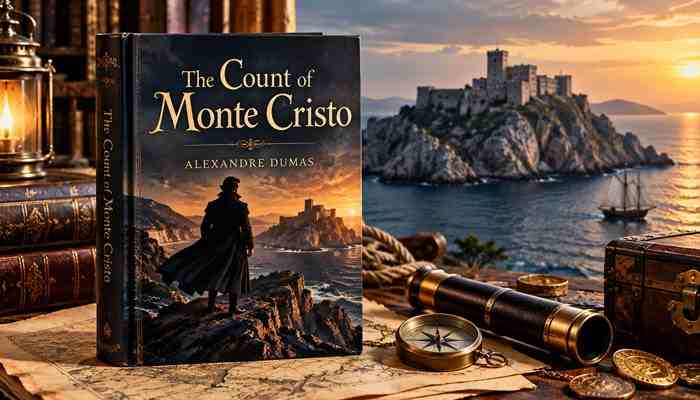
Edmond Dantès is falsely imprisoned just as his future appears secure.
After escaping and obtaining extraordinary wealth, he begins an elaborate campaign against those responsible.
Revenge, adventure, secrets, disguises, romance, escapes, and revelations give the novel remarkable momentum.
Best for: Readers who want a classic that feels like a thriller.
37. The Picture of Dorian Gray by Oscar Wilde
Dorian Gray remains young while a hidden portrait reveals the consequences of his behavior.
Wilde uses this supernatural idea to explore beauty, pleasure, morality, influence, reputation, and self-destruction.
His wit makes the dark material particularly readable.
Best for: Gothic fiction and philosophical themes.
38. The Hobbit by J.R.R. Tolkien
Bilbo Baggins leaves his comfortable home for an adventure involving dwarves, trolls, elves, goblins, treasure, and a dragon.
The novel offers an accessible introduction to Middle-earth without the scale of The Lord of the Rings.
Best for: New fantasy readers and younger readers.
39. Rebecca by Daphne du Maurier
A young unnamed narrator marries wealthy widower Maxim de Winter and moves to his estate, Manderley.
There, the memory of his first wife, Rebecca, seems to dominate everything.
What begins like a romance slowly becomes psychological suspense.
Best for: Gothic mystery and suspense.
40. The Remains of the Day by Kazuo Ishiguro
An English butler named Stevens takes a road trip and reflects on decades of service.
His restrained narration gradually exposes missed opportunities, questionable loyalty, self-deception, and regret.
Much of the novel’s power lies in what Stevens cannot admit.
Best for: Quiet and emotionally subtle fiction.
41. The Left Hand of Darkness by Ursula K. Le Guin
An envoy travels to Gethen, a planet whose inhabitants do not experience fixed gender in the way he expects.
Le Guin uses science fiction to explore gender, politics, culture, communication, loyalty, and assumptions about human nature.
Best for: Philosophical science fiction.
42. The Road by Cormac McCarthy
A father and son travel through a devastated world.
McCarthy gives little explanation for the catastrophe.
Instead, attention remains on survival, love, fear, morality, violence, and whether goodness can survive after society collapses.
Best for: Post-apocalyptic fiction with emotional depth.
43. Pedro Páramo by Juan Rulfo
Juan Preciado travels to Comala looking for his father.
He encounters voices, memories, ghosts, and fragmented stories until the boundaries between life and death begin disappearing.
The novel is short but enormously influential.
Best for: Magical realism and experimental fiction.
44. The God of Small Things by Arundhati Roy
Set largely in Kerala, India, the novel follows twins Estha and Rahel and the events that reshape their family.
Caste, childhood, politics, forbidden love, memory, social rules, and tragedy unfold through a nonlinear structure.
Best for: Indian literature and family sagas.
45. The Tale of Genji by Murasaki Shikibu
Written in Japan roughly a thousand years ago, The Tale of Genji shows remarkable attention to court life, relationships, emotion, beauty, and human behavior.
Its sustained psychological detail makes it central to discussions about the early history of long-form fiction.
Best for: Japanese literature and literary history.
46. Season of Migration to the North by Tayeb Salih
A Sudanese narrator returns home after studying in Europe and meets Mustafa Sa’eed.
The story develops into an examination of colonialism, identity, sexuality, cultural conflict, violence, and power.
Best for: Postcolonial literature and cross-cultural themes.
47. The Diary of a Young Girl by Anne Frank
Anne Frank recorded her experiences while hiding with her family during the Nazi occupation of the Netherlands.
Its historical importance is enormous.
Its emotional impact comes from Anne appearing as a developing teenager with dreams, opinions, frustrations, fears, and relationships.
Best for: Memoir and modern history.
48. The Second Sex by Simone de Beauvoir
Beauvoir investigates the historical and social construction of women’s roles through philosophy, literature, history, biology, and social analysis.
The book became enormously influential in modern feminist thought.
Best for: Philosophy, gender studies, and social history.
49. On the Origin of Species by Charles Darwin
Darwin’s argument for evolution through natural selection transformed biological science.
Its influence spread far beyond biology into philosophy, education, religion, and public debate.
Few scientific books have had comparable historical impact.
Best for: Science and intellectual history.
50. Man’s Search for Meaning by Viktor E. Frankl
Psychiatrist Viktor Frankl combines his experiences in Nazi concentration camps with reflections on suffering, meaning, responsibility, and psychological survival.
Its central question remains powerful.
How can human beings find purpose when they have little control over their circumstances?
Best for: Psychology, memoir, resilience, and meaning.
Best Books of All Time by Genre
The best books of all time cover almost every major literary genre.
Sometimes the most useful question is not which book ranks No. 1, but which great book matches your interests.
| Genre | Best Starting Point |
| Romance | Pride and Prejudice |
| Fantasy | The Lord of the Rings |
| Science fiction | The Left Hand of Darkness |
| Dystopian | 1984 |
| Gothic | Jane Eyre |
| Adventure | The Count of Monte Cristo |
| Historical fiction | War and Peace |
| Magical realism | One Hundred Years of Solitude |
| Psychological fiction | Crime and Punishment |
| Satire | Don Quixote |
| Modernist fiction | To the Lighthouse |
| Mystery and suspense | Rebecca |
| Post-apocalyptic fiction | The Road |
| Memoir | The Diary of a Young Girl |
| Philosophy and psychology | Man’s Search for Meaning |
| Science | On the Origin of Species |
Best Books of All Time by Century
Looking at the best books of all time chronologically shows how literature has changed across centuries.
| Period | Standout Book |
| Ancient world | The Odyssey |
| Early 11th century | The Tale of Genji |
| 14th century | The Divine Comedy |
| 17th century | Don Quixote |
| Early 19th century | Pride and Prejudice |
| Mid-19th century | Moby-Dick |
| Late 19th century | Middlemarch |
| Early 20th century | Ulysses |
| Mid-20th century | 1984 |
| Late 20th century | Beloved |
| 21st century | The Road |
Older books naturally have an advantage in an all-time ranking because they have already demonstrated whether they can survive changing cultures and generations.
Best Books of All Time From Around the World
A useful ranking of the best books of all time should extend beyond one country or literary tradition.
| Country or Tradition | Book | Author |
| Spain | Don Quixote | Miguel de Cervantes |
| England | Middlemarch | George Eliot |
| Colombia | One Hundred Years of Solitude | Gabriel García Márquez |
| Russia | War and Peace | Leo Tolstoy |
| Nigeria | Things Fall Apart | Chinua Achebe |
| France | In Search of Lost Time | Marcel Proust |
| Japan | The Tale of Genji | Murasaki Shikibu |
| Mexico | Pedro Páramo | Juan Rulfo |
| India | The God of Small Things | Arundhati Roy |
| Sudan | Season of Migration to the North | Tayeb Salih |
International reading introduces different histories, cultures, myths, political experiences, family structures, and storytelling traditions.
Best Classic Books for Beginners
Not every title among the best books of all time is a good first classic.
You do not need to begin with Ulysses or In Search of Lost Time.
Better beginner choices include:
- Pride and Prejudice
- 1984
- The Great Gatsby
- Frankenstein
- Rebecca
- The Hobbit
- The Picture of Dorian Gray
- Jane Eyre
- The Little Prince
- The Count of Monte Cristo
These books combine literary significance with strong characters, recognizable conflicts, or engaging stories.
Easiest and Hardest Books on the List
Difficulty does not determine whether a title deserves to rank among the best books of all time.
Some masterpieces are immediately accessible. Others demand patience.
| More Accessible | More Challenging |
| The Little Prince | Ulysses |
| The Hobbit | In Search of Lost Time |
| 1984 | The Sound and the Fury |
| The Great Gatsby | Moby-Dick |
| Rebecca | The Divine Comedy |
| Frankenstein | The Brothers Karamazov |
| Pride and Prejudice | To the Lighthouse |
| The Picture of Dorian Gray | War and Peace |
An annotated edition, reading guide, or audiobook can make difficult classics easier to follow.
Best Short Books to Read First
Several of the best books of all time are surprisingly short.
Good options include:
- The Little Prince
- The Stranger
- The Great Gatsby
- Pedro Páramo
- The Picture of Dorian Gray
- Man’s Search for Meaning
These books are useful for readers who want literary depth without committing to hundreds of pages.
Best Long Books Worth the Commitment
Some of the best books of all time require considerably more time.
War and Peace
Read it for history, relationships, warfare, philosophy, and unforgettable characters.
Middlemarch
Read it for psychology, ambition, marriage, relationships, and society.
In Search of Lost Time
Read it for memory, desire, art, psychology, and introspection.
The Brothers Karamazov
Read it for crime, morality, philosophy, faith, and family conflict.
The Lord of the Rings
Read it for fantasy, friendship, mythology, adventure, and world-building.
Don Quixote
Read it for humor, adventure, literary history, and questions about reality.
The Count of Monte Cristo
Read it for revenge, suspense, secrets, and page-turning storytelling.
Best Books About Love and Relationships
Many of the best books of all time examine love because relationships reveal character, class, morality, ambition, and personal freedom.
Consider:
- Pride and Prejudice
- Anna Karenina
- Jane Eyre
- Wuthering Heights
- The Great Gatsby
- The Remains of the Day
These books approach love very differently, from Austen’s witty misunderstandings to Tolstoy’s tragic examination of desire and Ishiguro’s exploration of emotional restraint.
Best Books About Society and Power
Several of the best books of all time remain relevant because they help readers understand institutions and power.
Strong choices include:
- 1984
- Brave New World
- The Handmaid’s Tale
- Things Fall Apart
- Invisible Man
- The Trial
- The Grapes of Wrath
- The Second Sex
Together, these books explore authoritarianism, colonialism, bureaucracy, race, gender, inequality, ideology, and social control.
Best Books for Young Adults Moving Into Classics
Young readers do not have to start with the most difficult titles among the best books of all time.
A practical progression is:
- The Hobbit
- The Little Prince
- 1984
- The Great Gatsby
- Frankenstein
- The Picture of Dorian Gray
- Pride and Prejudice
- Jane Eyre
These books provide a manageable bridge between contemporary reading and more challenging classic literature.
Which of the Best Books of All Time Should You Read First?
Do not automatically begin with No. 1.
Start with your interests.
Choose Pride and Prejudice if you enjoy romance.
Choose 1984 if you like dystopian fiction.
Choose The Hobbit if you enjoy fantasy.
Choose Rebecca if you want suspense.
Choose The Count of Monte Cristo if you enjoy adventure.
Choose Crime and Punishment if psychological stories interest you.
Choose One Hundred Years of Solitude if you want magical realism.
Choose The Great Gatsby if you want a short classic.
Choose Middlemarch if you value character development.
Choose Don Quixote if you want to explore one of the foundations of the modern novel.
The best first classic is usually the book you are genuinely excited to finish.
Why Translation Matters When Reading the Best Books of All Time
Many of the best books of all time were originally written in languages other than English.
That includes works by:
- Miguel de Cervantes
- Leo Tolstoy
- Fyodor Dostoevsky
- Gabriel García Márquez
- Marcel Proust
- Gustave Flaubert
- Albert Camus
- Franz Kafka
- Mikhail Bulgakov
- Dante Alighieri
- Homer
- Juan Rulfo
- Tayeb Salih
- Antoine de Saint-Exupéry
Two translations of the same book can feel surprisingly different.
Some prioritize literal accuracy. Others emphasize smooth contemporary English.
Before buying a long translated classic, compare sample pages whenever possible.
The best translation for you is usually the one that keeps you reading.
Should You Read Classic Books in Publication Order?
No.
Chronological reading can help people studying literary history, but most readers do not need to approach the best books of all time like an academic syllabus.
Interest matters more.
A fantasy reader may enjoy beginning with Tolkien before exploring The Odyssey.
A thriller reader may find The Count of Monte Cristo easier to enjoy than a more experimental classic.
Consistency matters more than chronology.
Do Audiobooks Count as Reading the Best Books of All Time?
Yes.
Audiobooks can make some of the best books of all time considerably easier to approach.
They are particularly useful for:
- War and Peace
- Middlemarch
- Don Quixote
- The Count of Monte Cristo
- The Brothers Karamazov
Listening can help readers follow unfamiliar names, dialogue, and older writing styles.
Some people combine audio with physical or digital editions.
The goal is to experience and understand the book rather than make reading unnecessarily difficult.
Why Are There So Few Recent Books Among the Best Books of All Time?
A ranking of the best books of all time naturally favors older works.
That does not mean modern writers are producing worse literature.
The issue is time.
A book published five years ago might receive extraordinary reviews today, but nobody can know whether readers will still consider it essential 50 or 100 years later.
Older classics have already survived:
- Changing political environments
- New literary movements
- Shifting social values
- Generations of readers
- Technological changes
- Changing publishing markets
That is why The Road, published in 2006, is one of the few 21st-century books in this ranking.
Some contemporary novels will almost certainly become future classics. They simply have not passed the same longevity test yet.
10 Great Books That Just Missed the Best Books of All Time Top 50
A list of only 50 titles inevitably leaves major books outside it.
| Book | Author | Why Read It |
| Midnight’s Children | Salman Rushdie | History, identity, and magical realism |
| Catch-22 | Joseph Heller | War, bureaucracy, and satire |
| The Name of the Rose | Umberto Eco | Medieval mystery and philosophy |
| Emma | Jane Austen | Comedy and social observation |
| Bleak House | Charles Dickens | Law, society, and interconnected lives |
| The Metamorphosis | Franz Kafka | Alienation and absurdity |
| Adventures of Huckleberry Finn | Mark Twain | American literature and social conflict |
| A House for Mr Biswas | V.S. Naipaul | Family, identity, and independence |
| All Quiet on the Western Front | Erich Maria Remarque | The human cost of war |
| Half of a Yellow Sun | Chimamanda Ngozi Adichie | War, identity, and Nigerian history |
Another reader could reasonably replace several titles in our top 50 with these books.
That disagreement is part of what makes literary rankings interesting.
How to Build Your Own Best Books of All Time Reading List
You do not need to read the best books of all time from No. 1 through No. 50.
Instead, build variety into your personal list.
Choose:
- One romance
- One fantasy novel
- One translated classic
- One short book
- One long book
- One modern novel
- One nonfiction book
- One book from an unfamiliar literary tradition
- One challenging classic
- One book selected purely for enjoyment
Then follow your interests.
One Russian novel may lead you toward Dostoevsky and Tolstoy.
One magical-realist book may lead toward Márquez, Rulfo, or Rushdie.
One Gothic novel may lead from Rebecca to Jane Eyre and Wuthering Heights.
The best reading lists grow naturally.
Are the Best Books of All Time Always the Most Enjoyable?
No.
Literary greatness and personal enjoyment are not the same thing.
Ulysses is one of literature’s most celebrated novels, yet many experienced readers find it difficult.
The Lord of the Rings may be far more immediately immersive for fantasy readers.
A book can therefore be:
- Historically important but difficult
- Critically acclaimed but personally unappealing
- Popular without being experimental
- Entertaining and artistically sophisticated
- Personally meaningful without topping critics’ rankings
The purpose of a best books of all time ranking should ultimately be discovery rather than obligation.
Conclusion: Best Books of All Time
There will never be one completely objective ranking of the best books of all time.
Literature is too broad, international, and personal for that.
Critics value innovation and craft. Literary historians study influence. Libraries reveal long-term demand. Readers remember characters, stories, ideas, and fictional worlds that remain with them.
That is why books as different as Don Quixote, Middlemarch, One Hundred Years of Solitude, War and Peace, Pride and Prejudice, Beloved, Ulysses, In Search of Lost Time, To the Lighthouse, and The Lord of the Rings can all belong near the top of a best books of all time ranking.
You do not need to read every famous book simply because somebody calls it a masterpiece.
Start with the book that suits the reader you are today.
Then allow that book to lead you toward another author, country, century, or genre.
That is ultimately why the best books of all time survive.
They are not great because they remain permanently fixed on rankings.
They remain great because generation after generation continues finding new reasons to read them.
Best Books of All Time FAQs
1. What are the Best Books of All Time?
The Best Books of All Time include Don Quixote, Pride and Prejudice, War and Peace, 1984, and One Hundred Years of Solitude, celebrated for their literary influence and lasting appeal.
2. Which book ranks No. 1 among the Best Books of All Time?
Don Quixote by Miguel de Cervantes ranks No. 1 in our list for its influence on modern fiction, memorable storytelling, and enduring cultural significance.
3. What are the best classic books for beginners?
The Great Gatsby, Pride and Prejudice, The Hobbit, 1984, and Frankenstein are excellent starting points for readers exploring classic literature.
4. Which are the best books to read in your lifetime?
Must-read books include Middlemarch, Beloved, The Lord of the Rings, Jane Eyre, and The Odyssey for their unforgettable characters, themes, and storytelling.
