


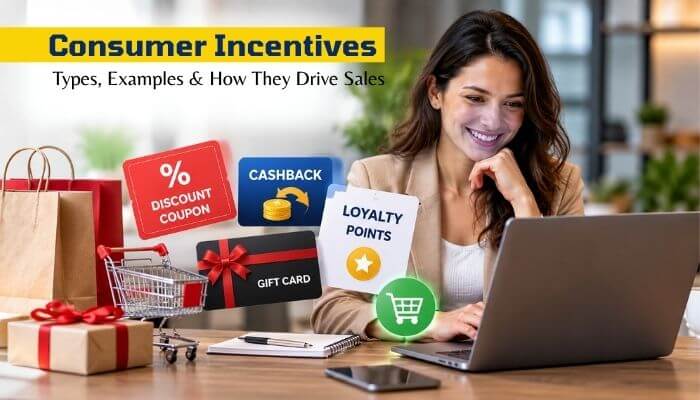

Consumer incentives give shoppers an extra reason to choose a product, complete a purchase, spend more, return to a business, or recommend a brand. They can include discounts, cashback, loyalty points, gift cards, rebates, free shipping, referral rewards, product samples, free trials, bundles, and exclusive benefits.
For businesses, the goal is not simply to make something cheaper. An effective incentive connects a valuable reward with a specific customer action, helping businesses improve conversions and build stronger relationships.
When designed carefully, consumer incentives can increase average order value, encourage product trials, generate referrals, strengthen customer loyalty, and drive profitable repeat purchases.
Quick Answer
Consumer incentives are rewards or benefits businesses offer to encourage actions such as making a purchase, spending more, trying a product, referring a friend, or returning for another order. Common examples include discounts, cashback, loyalty points, free shipping, gift cards, rebates, and referral rewards. When used strategically, these incentives can help increase sales, customer loyalty, and repeat purchases.
Key Takeaways
- Consumer incentives connect rewards with specific customer actions.
- Discounts are only one type of incentive.
- Cashback, loyalty points, rebates, gift cards, free trials, referrals, and trade-ins can serve different objectives.
- Acquisition incentives should differ from retention incentives.
- Online incentives can be personalized according to customer behavior and lifecycle stage.
- Gamification can encourage consumers to keep progressing toward rewards.
- Free shipping thresholds and bundles can increase average order value.
- Businesses should measure incremental profit rather than redemption rates alone.
- Constant discounting can train consumers to wait for promotions.
- Incentive rules, expiration dates, renewal terms, and restrictions should be easy to understand.
- Fraud controls are important for referral, coupon, cashback, and loyalty programs.
What Are Consumer Incentives?
Consumer incentives are rewards or benefits businesses offer to encourage people to take a specific action. They are commonly used to attract new customers, increase spending, encourage repeat purchases, promote new products, and strengthen customer loyalty.
The desired action may include:
- Making a first purchase
- Buying a particular product
- Spending above a certain amount
- Joining a loyalty program
- Returning for another purchase
- Referring a friend
- Trying a new service
- Starting a subscription
- Creating an account
- Trading in an older product
- Using a particular payment method
In return for completing the desired action, the consumer receives something valuable. For example, a business might offer 20% off an order for an immediate benefit or 500 loyalty points that can be used toward a future reward.
Some consumer incentives are designed to increase immediate conversions, while others encourage customers to return, spend more over time, or build a longer relationship with the brand.
How Do Consumer Incentives Work?
Consumer incentives work by connecting a business goal with a reward that encourages customers to take a specific action. The basic process is simple:
Business goal → Incentive → Consumer action → Reward → Business result
For example, an online retailer that wants to increase average order value might offer free shipping on purchases over $75. A shopper with $67 in the cart may add another product to qualify, helping the retailer generate a larger order while giving the customer a valuable benefit.
A referral program works differently. With a “Give $15, Get $15” offer, a new customer receives $15 toward a qualifying first purchase, while the existing customer earns a $15 reward after the referral meets the required conditions.
This type of program can help a business acquire new customers while encouraging existing customers to return. Effective consumer incentives work best when the reward is directly connected to the behavior the business wants to influence.
Why Do Consumer Incentives Influence Buying Behavior?
Consumer incentives can influence buying behavior by changing how shoppers perceive price, value, risk, convenience, and the timing of a purchase. A well-designed reward gives consumers an additional reason to act without relying entirely on a lower price.
1. Perceived Savings
Discounts, coupons, rebates, and cashback can reduce the effective cost of a purchase. A shopper who hesitates at $100 may view the same product differently when a promotion lowers the effective cost to $85.
2. Higher Perceived Value
An incentive does not always need to reduce the product price. Free delivery, bonus products, loyalty points, upgrades, or additional services can make the overall offer more valuable.
3. Lower Purchase Risk
Free samples and trials allow consumers to experience a product or service before making a larger commitment. This can be particularly effective for software, subscriptions, cosmetics, food products, digital services, and unfamiliar brands.
4. Reward Anticipation
Points, milestones, membership tiers, and gamified rewards can encourage repeat purchases because each transaction moves the customer closer to another benefit.
5. Convenience and Exclusivity
Free shipping, faster delivery, priority support, early product access, VIP benefits, and members-only offers can provide value without requiring a traditional discount.
6. Genuine Urgency
Limited-time promotions, seasonal offers, and launch bonuses can encourage consumers to make a decision sooner. However, businesses should avoid fake countdown timers, false scarcity, or misleading deadlines.
Ultimately, effective consumer incentives influence purchasing decisions by making an offer feel more valuable, less risky, more convenient, or more rewarding while still supporting a clear business objective.
Main Types of Consumer Incentives
Different consumer incentives serve different business goals. Some encourage an immediate purchase, while others are designed to increase spending, attract new customers, encourage product trials, or build long-term loyalty.
| Consumer Incentive | Example | Main Goal |
|---|---|---|
| Discount | 20% off | Increase conversions |
| Coupon | $10 off $50 | Encourage purchases |
| Cashback | Receive 5% back | Encourage spending |
| Loyalty points | Earn points per purchase | Improve retention |
| Rebate | Get $50 back | Support product sales |
| Referral reward | Give $15, get $15 | Acquire customers |
| Free shipping | Free over $75 | Increase order value |
| Free sample | Trial-size product | Encourage product trials |
| Free gift | Gift with $100 purchase | Increase spending |
| Gift card | $20 digital reward | Acquisition or retention |
| Bundle | Buy three and save | Increase units per order |
| Free trial | 30 days free | Encourage adoption |
| Trade-in credit | Credit toward an upgrade | Encourage replacement |
| VIP benefit | Early access | Strengthen loyalty |
| Contest | Chance to win | Increase engagement |
| Credit card reward | Points or cashback | Encourage card use |
These incentive examples show why businesses should choose a reward based on the behavior they want to influence. A free trial may help introduce a service, for example, while loyalty points are better suited to encouraging repeat purchases.
Consumer Incentives Across the Customer Journey
Businesses can choose consumer incentives based on where a customer is in the buying journey. The right reward can help move someone from first-time interest to purchase, repeat business, and eventually brand advocacy.
- Awareness and acquisition: Welcome discounts, free samples, free trials, and signup rewards can attract new customers.
- Conversion: Coupons, cashback, free shipping, and bundles can encourage interested shoppers to complete a purchase.
- Higher order value: Spending thresholds, bonus points, and gifts with purchase can encourage customers to spend more.
- Retention: Loyalty points, store credit, birthday rewards, and personalized offers can support repeat purchases.
- Advocacy: Referral credits, ambassador rewards, and exclusive benefits can encourage loyal customers to recommend the brand.
Matching incentives to the customer journey helps businesses reward the right behavior instead of relying on discounts at every stage.
Discounts and Coupons
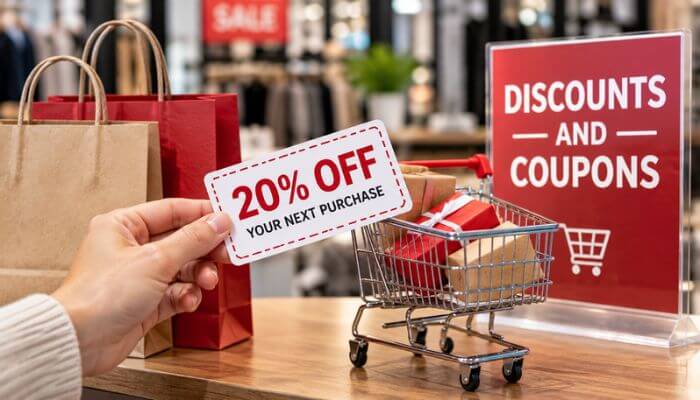
Discounts and coupons are among the most familiar consumer incentives because they provide an immediate financial benefit and can encourage shoppers to complete a purchase.
Common formats include:
- Percentage discounts
- Fixed-dollar coupons
- First-order offers
- Seasonal promotions
- Student or member discounts
- Birthday offers
- Volume discounts
Typical examples of incentives include 15% off a first order, $20 off purchases above $100, or buy one and get the second item 50% off.
These offers work particularly well when price is preventing an interested shopper from buying. However, frequent discounting can train customers to wait for the next promotion instead of paying the regular price. Businesses should therefore use discounts to generate additional demand rather than simply reduce margins on purchases that would have happened anyway.
Cashback Incentives
Cashback is one of the most flexible consumer incentives, returning part of a customer’s spending after a qualifying purchase. For example, a promotion might offer $20 cashback after spending $200.
Cashback may be provided as:
- Cash
- Statement credit
- Digital wallet funds
- Store credit
- Rewards balance
This approach can make a purchase more attractive without immediately reducing the displayed product price. Businesses should keep eligibility and redemption simple so customers clearly understand how much they will receive and when the reward will become available.
Rebates
Rebates are consumer incentives that return part of the purchase price after a customer buys an eligible product and completes the required claim process. For example, an appliance manufacturer might offer a $100 rebate on a qualifying purchase.
Rebates can encourage sales without directly changing the original shelf price. However, businesses should clearly communicate the rebate amount, eligibility requirements, redemption process, additional costs, and expected payment timing so customers understand the true value of the offer.
Loyalty Rewards
Loyalty programs are consumer incentives designed to encourage customers to continue buying from a business. Customers may earn points, cashback, discounts, free products, store credit, or VIP benefits for purchases, referrals, spending milestones, birthdays, or reaching membership tiers.
Unlike a one-time discount, loyalty rewards can influence multiple future purchases. This makes them particularly valuable for businesses focused on retention and customer lifetime value.
Referral Rewards
Referral programs encourage existing customers to introduce new consumers to a business. The company can reward the existing customer, the new customer, or both.
A common structure is “Give $20, Get $20.” The new customer receives $20 toward a qualifying first purchase, while the referrer earns $20 after the required conditions are met.
Referral rewards may include store credit, gift cards, discounts, cashback, loyalty points, or free products. These consumer incentives can help connect customer acquisition spending with successful referrals.
Free Shipping Incentives
Free shipping is one of the most common online incentives, particularly in ecommerce. Businesses may provide free delivery on every order, above a minimum spending threshold, or exclusively to members.
For example, a shopper with $64 in the cart may add another product to reach a $75 free-shipping threshold. This can increase average order value, but businesses should ensure the additional profit is enough to cover the shipping cost.
Product Samples and Free Gifts
Samples reduce the commitment required to try an unfamiliar product. Common examples include cosmetic samples, trial-size food products, product testers, free accessories, and bonus digital content.
A gift with purchase works differently. An offer such as “Spend $100 and receive a free travel bag” increases perceived value without directly reducing the product price.
These consumer incentives can be especially useful for product launches and premium brands that want to encourage trial or spending without relying heavily on discounts.
Bundle Incentives
Bundles encourage consumers to purchase related products together.
Common incentive examples include:
- Buy two and get one free
- Purchase three items and save 15%
- Buy a computer with a discounted accessory
- Purchase a product set for less than the combined individual price
Bundles can increase average order value and units per transaction while introducing customers to complementary products.
Gift Cards and Digital Rewards
Gift cards and digital rewards can support customer acquisition, referrals, retention, and promotional campaigns.
Common options include:
- Digital gift cards
- Store gift cards
- Virtual rewards
- Promotional credit
- Account credit
- Future-purchase certificates
For example, a company might offer a $25 digital gift card for a qualifying referral. Store-specific credit can encourage another purchase, while broader gift cards may appeal to customers who value greater choice.
Gamified Consumer Incentives
Gamified consumer incentives combine rewards with progress, milestones, or challenges to make participation more engaging.
Examples include:
- Purchase streaks
- Progress bars
- Spending challenges
- Bonus-point missions
- Membership tiers
- Milestone rewards
For example, a business might offer $10 after two more qualifying purchases. Gamification works best when customers can easily understand the goal, track their progress, and realistically reach the reward.
Free Trials and Subscription Incentives
Free trials are consumer incentives commonly used by software companies, streaming platforms, mobile apps, memberships, subscription boxes, and other digital services to reduce the risk of trying a product.
Common offers include:
- Seven days free
- First month free
- Introductory pricing
- Annual-plan discounts
- Free premium upgrades
- Referral subscription credits
For example, a service might provide 30 days free before regular subscription billing begins.
Businesses should clearly explain the trial length, future price, billing date, automatic renewal terms, and cancellation process. Customers should understand when a free offer becomes a paid subscription and how they can cancel.
Clear terms make free trials more effective by reducing uncertainty and helping businesses build trust instead of creating unexpected charges.
Trade-In and Upgrade Incentives
Trade-in programs are consumer incentives that encourage customers to replace older products by offering credit toward a new purchase. They are common with smartphones, computers, vehicles, appliances, and other electronics.
For example, a business might offer credit toward a new device when a customer trades in an eligible older model.
Trade-in incentives can reduce the effective upgrade cost, encourage replacement purchases, improve brand retention, and provide used products for resale or refurbishment.
Businesses should clearly explain eligibility, estimated trade-in values, product condition requirements, and any factors that could reduce the final credit.
Contests, Sweepstakes and Prize Incentives
Contests, sweepstakes, giveaways, prize drawings, and instant-win promotions can encourage participation even when every customer does not receive a reward.
These consumer incentives may help businesses increase brand awareness, attract signups, encourage engagement, or promote events and product launches.
Because rules vary by jurisdiction and promotion type, businesses should clearly communicate eligibility, entry periods, prize details, restrictions, selection methods, and official terms.
Exclusive Access and VIP Benefits
Not every incentive needs to provide a direct financial reward. Businesses can offer benefits such as early access, priority booking, members-only products, premium support, private events, faster service, or extended return periods.
VIP benefits can make customers feel recognized while giving them practical advantages. They are particularly useful for premium brands and membership programs that want to strengthen loyalty without repeatedly lowering prices.
Credit Card Rewards as Consumer Incentives
Credit card reward programs are another common form of consumer incentives. They encourage customers to use a particular card by offering benefits based on spending or qualifying activities.
Common rewards include:
- Cashback
- Travel points
- Airline miles
- Hotel points
- Statement credits
- Welcome bonuses
- Referral rewards
For example, a card may offer cashback on eligible purchases or bonus points after a customer meets a required spending amount.
However, the headline reward does not always represent the true value of the offer. The CFPB has identified consumer complaints involving unexpected promotional conditions, reward devaluation, redemption difficulties, and revoked rewards.
Consumers should therefore consider interest charges, annual fees, redemption rules, and other costs alongside the value of points or cashback. Carrying a balance, for example, can result in interest costs that exceed the rewards earned.
For businesses, there is a broader lesson: a reward is most effective when customers can easily understand how to earn it, what it is worth, and how to redeem it.
Personalized Consumer Incentives
Businesses do not have to offer every customer the same reward. Personalized consumer incentives can match an offer with a customer’s behavior, relationship with the brand, or stage in the buying journey.
Personalization may consider:
- New vs. returning customer
- Purchase history
- Product interests
- Cart value
- Loyalty status
- Previous engagement
- Customer lifecycle stage
For example, a new visitor might receive a 10% welcome discount, while an existing customer earns double loyalty points. An inactive customer might receive a $15 return credit, while a VIP member receives early access to a new product.
Target Circle provides a practical example of this approach. Target describes Target Circle Bonuses as personalized offers through which eligible members may receive additional savings, promotional items, or rewards after completing qualifying activities.
Personalization can make incentives more relevant and reduce unnecessary discounting. However, businesses should also consider customer privacy, transparency, and fairness when using customer data to determine who receives an offer.
Consumer Incentives Examples by Business Goal
The best consumer incentives depend on what a business wants customers to do. Matching the reward with a clear objective can make a promotion more targeted and easier to measure.
| Business Goal | Suitable Incentive |
|---|---|
| Attract first-time customers | Welcome discount |
| Improve conversion | Coupon or cashback |
| Increase average order value | Spending threshold |
| Encourage repeat purchases | Loyalty points |
| Generate referrals | Referral credit |
| Introduce a new product | Free sample |
| Move excess inventory | Bundle discount |
| Increase subscriptions | Free trial |
| Encourage upgrades | Trade-in credit |
| Reward valuable customers | VIP benefits |
| Increase engagement | Gamified reward |
| Encourage card usage | Credit card rewards |
These consumer incentives examples show why businesses should begin with the desired customer action rather than simply choosing the promotion that appears most attractive.
Consumer Incentives vs Customer Incentives
Consumer incentives and customer incentives are often used interchangeably, but they can describe slightly different audiences.
Consumer incentives may target anyone a business wants to influence, including prospective or first-time buyers. Customer incentives generally focus on people who already have a relationship with the business.
For example:
- Consumer incentive: Get 15% off your first order.
- Customer incentive: Existing members earn 500 bonus loyalty points.
Businesses can use the first approach to attract and convert new buyers, while the second can support retention, loyalty, and repeat purchases.
Consumer Incentives vs Sales Promotions
Consumer incentives and sales promotions are closely related, but they are not exactly the same.
A sales promotion is a marketing activity designed to stimulate customer action, often for a specific campaign or period. A consumer incentive is the particular reward or benefit offered within that promotion.
For example:
- Holiday promotion: Spend $100 and receive a $15 gift card.
- Referral promotion: Receive $20 after a qualifying referral.
In simple terms, the promotion creates the campaign, while the incentive gives customers a reason to act. Understanding this distinction can help businesses choose rewards that support a specific marketing objective instead of relying on discounts for every campaign.
Financial vs Non-Financial Consumer Incentives
Consumer incentives can also be classified by the type of value they provide. Financial incentives offer a direct monetary benefit, while non-financial incentives provide value through access, convenience, service, status, or exclusivity.
| Financial Incentives | Non-Financial Incentives |
|---|---|
| Discounts | Early access |
| Cashback | Priority service |
| Rebates | VIP status |
| Store credit | Exclusive products |
| Gift cards | Special events |
| Referral cash | Convenience benefits |
Financial incentives can encourage purchases by reducing the effective cost or providing money back. Non-financial incentives can be particularly valuable for premium brands that want to strengthen loyalty without repeatedly lowering prices.
The right approach depends on what customers value and the behavior the business wants to encourage.
Short-Term vs Long-Term Consumer Incentives
Businesses can use consumer incentives to generate immediate action or build longer-term customer relationships.
| Short-Term Incentives | Long-Term Incentives |
|---|---|
| Flash sales | Loyalty points |
| Weekend coupons | Membership tiers |
| Product launch offers | Cashback programs |
| Limited-time free shipping | Referral programs |
| Seasonal discounts | Subscription benefits |
| Limited-time bonuses | VIP programs |
Short-term incentives typically aim to increase immediate purchases, conversions, or campaign participation. Long-term incentives focus more on retention, repeat purchases, loyalty, and customer lifetime value.
A strong incentive strategy can use both, depending on whether the business needs an immediate response or sustained customer engagement.
How Consumer Incentives Drive Sales
Well-designed consumer incentives can influence purchasing decisions at several stages of the customer relationship. They can help businesses generate immediate sales while also supporting repeat purchases and customer retention.
Key ways incentives can drive sales include:
- Improve conversion: Discounts, cashback, or rewards can give interested shoppers an additional reason to complete a purchase.
- Increase average order value: Free shipping thresholds, bonus gifts, bundles, and spending-based rewards can encourage larger orders.
- Encourage product trials: Free samples, introductory offers, and free trials can reduce the perceived risk of trying something new.
- Generate repeat purchases: Loyalty points, store credits, membership tiers, and future-purchase rewards give customers a reason to return.
- Create referrals: Referral rewards can turn existing customers into a customer acquisition channel.
- Accelerate purchases: Genuine limited-time offers can encourage customers to make planned purchases sooner.
- Support upgrades: Trade-in credits and upgrade rewards can reduce the effective cost of replacing an older product.
The strongest consumer incentives do more than generate activity. They encourage profitable customer behavior that supports measurable business goals.
What Makes a Good Consumer Incentive?
Effective consumer incentives should be relevant to the customer, easy to understand, valuable enough to influence behavior, financially sustainable, and measurable.
- Relevant: The reward should match what the target customer values. Free shipping may appeal to an ecommerce shopper but provide little value for a downloadable product.
- Simple: Customers should quickly understand what they receive, what they need to do, when the reward is available, when it expires, and any important restrictions.
- Valuable: The benefit must be meaningful enough to influence behavior. Value can come from money, convenience, exclusive access, faster service, recognition, or other useful benefits.
- Profitable: The incentive should generate enough additional revenue, margin, retention, or customer value to justify its cost.
- Measurable: Every incentive should have a defined objective, such as improving conversion, increasing order value, generating referrals, or encouraging repeat purchases.
The best consumer incentives create clear value for customers while producing a measurable and sustainable benefit for the business.
How to Build a Consumer Incentive Strategy
A successful consumer incentive strategy starts with a clear business objective rather than choosing a discount first. Businesses can use these six steps to design an offer that benefits customers while supporting measurable results.
Step 1. Define the Goal
Choose one primary objective, such as acquiring customers, increasing conversions, raising average order value, generating referrals, encouraging product trials, improving retention, or growing subscriptions.
Step 2. Identify the Audience
Determine who should receive the offer. The audience might include new visitors, first-time buyers, repeat customers, inactive customers, loyalty members, subscribers, or high-value customers.
Step 3. Match the Reward to the Action
Choose an incentive that supports the desired behavior.
- First purchase: Welcome discount
- Second purchase: Future store credit
- Higher order value: Free shipping threshold
- More referrals: Double-sided referral reward
Step 4. Define the Rules
Clearly establish eligibility, minimum spending, qualifying products, expiration dates, redemption requirements, geographic restrictions, reward limits, return policies, and whether the offer can be combined with other promotions.
Step 5. Test the Offer
Do not assume a larger discount will automatically produce better results. For example, compare 15% off today with $15 toward a future purchase. The first may improve immediate conversions, while the second may encourage another transaction.
Step 6. Measure Incremental Results
Measure whether the consumer incentive created behavior that would not otherwise have occurred. Compare results with an appropriate baseline or test group and evaluate conversion, revenue, margin, repeat purchases, or other metrics connected to the original goal.
The key question is not simply “How many customers used the reward?” It is “How much additional profitable behavior did the reward create?”
How to Measure Consumer Incentives
Businesses should measure consumer incentives based on the objective they were designed to achieve. Redemption alone is not enough—a successful program should generate measurable and profitable customer behavior.
| Metric | What It Measures |
|---|---|
| Redemption rate | Percentage of issued rewards that are used |
| Conversion rate | Whether incentivized customers purchase |
| Average order value | Changes in spending per order |
| Repeat purchase rate | Whether customers return and buy again |
| Referral conversion rate | Percentage of referrals that convert |
| Customer lifetime value | Long-term value of acquired or retained customers |
| Incremental revenue | Additional sales generated by the incentive |
| Incremental profit | Additional profit after incentive and program costs |
Two useful formulas are:
Redemption Rate = Rewards Redeemed ÷ Rewards Issued × 100
AOV = Total Revenue ÷ Number of Orders
However, higher redemption or revenue does not automatically mean a successful promotion. Businesses should determine how much additional activity occurred because of the incentive.
A simplified profitability calculation is:
Incremental Profit = Additional Gross Profit − Incentive Cost − Program Cost
For example, a campaign generating $50,000 in additional sales may still have costs for discounts, cashback, shipping, referral rewards, advertising, technology, and fulfillment.
The goal of measuring consumer incentives is therefore not simply to report more sales or redemptions. The stronger measure is profitable lift—the additional profit generated because the incentive existed.
How to Calculate an Incentive Break-Even Point
Businesses should estimate how much additional purchasing behavior is needed to recover the cost of consumer incentives.
Suppose a product sells for $100 and generates $40 in gross profit before the promotion. If the business offers a $10 discount, gross profit on each incentivized order falls to about $30, assuming other costs remain unchanged.
If 100 customers who would have purchased anyway use the discount, the promotion gives up $1,000 in gross profit:
100 orders × $10 discount = $1,000 incentive cost
At approximately $30 of gross profit per additional incentivized order, the business would need roughly 34 extra orders to recover that $1,000:
$1,000 ÷ $30 ≈ 33.3 additional orders
This simplified example shows why a larger discount is not automatically a better incentive. A smaller reward that generates enough additional purchases, larger orders, referrals, or future customer value may produce a stronger financial result.
Consumer Incentive Fraud and Abuse Prevention
Businesses using consumer incentives should plan for potential fraud and promotion abuse, particularly when rewards have significant financial value.
Common problems include:
- Duplicate or fake accounts
- Self-referrals
- Coupon code sharing
- Unauthorized coupon stacking
- Multiple accounts created for welcome bonuses
- Returns made after a reward is received
- Automated promotion abuse
Businesses can reduce these risks through account verification, unique referral codes, reward limits, duplicate-account detection, transaction monitoring, clear eligibility rules, and delayed rewards when returns could affect eligibility.
Fraud controls should remain proportionate to the risk. Excessive verification or complicated redemption requirements can create friction for legitimate customers and reduce the effectiveness of the incentive itself.
The goal is to protect consumer incentives from abuse without making them unnecessarily difficult for genuine customers to use.
Consumer Incentives and Online Reviews
Businesses should be careful when using consumer incentives to encourage online reviews.
Under FTC guidance, businesses may offer incentives for reviews in some circumstances, but the reward cannot be expressly or implicitly conditioned on the reviewer providing a particular positive or negative opinion. The relationship between the incentive and the review may also need to be clearly disclosed.
For example, businesses should avoid offers such as:
“Leave us a five-star review and receive $20.”
Instead, any permitted incentive should encourage genuine feedback without requiring a favorable rating or opinion.
Businesses should also check the policies of each review platform they use, because platform rules may restrict or prohibit incentivized reviews even when a promotion might otherwise comply with applicable law.
When Consumer Incentives Become Manipulative
There is an important difference between persuasion and deception. Legitimate consumer incentives provide real value under conditions customers can reasonably understand.
Problems can arise when a business uses misleading tactics to make an offer appear more valuable, urgent, or accessible than it really is. Examples include:
- Fake countdown timers
- False scarcity claims
- Misleading sale prices
- Hidden fees
- Buried restrictions
- Fake reviews
- Misleading eligibility requirements
- Rewards that are extremely difficult to redeem
Businesses should clearly explain prices, deadlines, eligibility, redemption requirements, and other material conditions instead of using confusion or artificial urgency to drive conversions.
Effective consumer incentives should encourage action by providing genuine value. Protecting customer trust can create more long-term business value than gaining a short-term sale through misleading tactics.
How to Prevent Incentive Fatigue
More consumer incentives do not always produce better results. Customers may become less responsive when they repeatedly receive the same discounts, coupons, promotional emails, or low-value rewards.
Businesses can reduce incentive fatigue by:
- Varying reward formats
- Personalizing offers
- Limiting unnecessary promotions
- Reserving larger rewards for valuable actions
- Using non-financial benefits
- Giving customers control over marketing communications
The goal is to keep each incentive relevant and meaningful. When customers begin expecting a promotion before every purchase, the reward can lose its ability to influence behavior.
Common Consumer Incentive Mistakes
Even well-designed consumer incentives can underperform when businesses focus on the reward without considering customer behavior, profitability, and long-term impact.
Common mistakes include:
- Discounting so frequently that customers wait for sales
- Offering rewards customers do not value
- Setting unrealistic spending or redemption thresholds
- Creating confusing rules or hiding important conditions
- Giving large rewards for low-value actions
- Rewarding purchases that would have happened anyway
- Using the same incentive for every customer
- Ignoring fraud and promotion abuse
- Failing to calculate the full cost of the program
- Making rewards difficult to earn or redeem
- Changing reward values unexpectedly
- Measuring redemptions without measuring incremental profit
Another mistake is judging consumer incentives by sales volume alone. If sales increase but margins decline significantly, the promotion may generate more revenue without creating a better financial result.
When Businesses Should Avoid Consumer Incentives
Consumer incentives are not appropriate for every business situation. Offering a reward when customers already have a strong reason to buy can unnecessarily reduce margins or weaken brand positioning.
Businesses should reconsider an incentive when:
- Demand is already strong
- Inventory is extremely limited
- Profit margins cannot support the reward
- Customers are likely to purchase without an incentive
- Frequent promotions could weaken premium positioning
- The offer attracts fraudulent or low-quality signups
- The promotion creates unnecessary operational complexity
- Legal or regulatory risks outweigh the potential benefit
In some situations, improving the product, pricing, customer experience, positioning, or service may produce better long-term results than adding another promotion.
Consumer Incentives by Industry
Different industries use consumer incentives based on their buying cycles, customer relationships, products, and business models.
| Industry | Common Incentives |
|---|---|
| Retail | Coupons, loyalty points, bundles, gift cards, seasonal discounts |
| Ecommerce | First-order discounts, free shipping, personalized offers, referral rewards |
| Restaurants | Birthday rewards, free items, app promotions, loyalty points |
| Financial services | Cashback, credit card points, travel miles, welcome bonuses |
| Subscription businesses | Free trials, introductory pricing, annual-plan discounts, referral credits |
| Travel and hospitality | Loyalty points, free nights, member pricing, upgrades, priority benefits |
| Technology | Trade-in credits, product bundles, free trials, upgrade promotions |
The most effective consumer incentives depend on how customers buy within each industry. A free trial may work well for a subscription service, while free shipping may have greater value for ecommerce and loyalty rewards may be more effective for businesses that depend on frequent repeat purchases.
Consumer Incentive Checklist for Businesses
Before launching consumer incentives, businesses should answer a few important questions:
- What customer action are we trying to influence?
- Who should receive the offer?
- Does the audience value the reward?
- Is the incentive simple to understand and redeem?
- Are eligibility, expiration, and other important conditions clear?
- What is the total cost of the incentive?
- Would customers have taken the same action without it?
- How will incremental revenue and profit be measured?
- How will fraud and abuse be controlled?
- Could the offer weaken regular pricing or brand positioning?
- Does it comply with applicable laws and platform policies?
- What happens when the promotion ends?
If a business cannot answer these questions clearly, the incentive may need further testing or refinement before launch.
Are Consumer Incentives Always Discounts?
No. Discounts are only one form of consumer incentives.
Businesses can also provide value through loyalty points, free shipping, gifts, upgrades, exclusive access, priority service, faster delivery, recognition, or special experiences.
For some businesses, these non-discount rewards can strengthen loyalty and influence customer behavior without repeatedly lowering prices.
Conclusion
Consumer incentives work best when a meaningful reward is connected to a specific customer action and a clear business objective. Discounts, loyalty rewards, cashback, referrals, free trials, and other incentives can help businesses increase conversions, encourage spending, attract new customers, and strengthen retention.
The strongest incentive is not necessarily the largest reward. Businesses should consider whether an offer changes customer behavior, creates incremental sales or loyalty, and generates enough value to justify its cost.
Clear conditions are equally important. Customers should understand eligibility, expiration dates, redemption requirements, renewal terms, and other important restrictions before participating.
When designed strategically, consumer incentives can support profitable growth while giving customers a genuine reason to purchase, return, refer others, and build a longer relationship with the business.
FAQs About Consumer Incentives
1. Can consumer incentives help a small business compete with larger brands?
Yes. Consumer incentives can help small businesses compete through personalized rewards, referral offers, exclusive benefits, or loyalty programs without relying only on lower prices.
2. How often should businesses offer consumer incentives?
Businesses should offer consumer incentives when they support a specific goal rather than following a fixed schedule. Too many promotions can reduce urgency and train customers to expect rewards.
3. Can consumer incentives help recover abandoned carts?
Yes. Consumer incentives such as targeted free shipping, limited discounts, or bonus rewards may encourage qualified shoppers to return and complete abandoned purchases.
4. Do consumer incentives work better for new or existing customers?
Consumer incentives can work for both. Acquisition offers may attract first-time buyers, while loyalty rewards and personalized benefits can encourage existing customers to return.
5. Can consumer incentives increase email signups?
Yes. Businesses may use consumer incentives such as welcome offers, bonus points, or exclusive access to encourage voluntary email subscriptions when consent requirements are followed.
6. Should consumer incentives have an expiration date?
Not always. However, expiration dates can create legitimate urgency when they are clearly communicated and appropriate for the reward and promotion.
7. Can consumer incentives damage brand value?
Yes. Excessive discount-based consumer incentives can weaken premium positioning or encourage customers to wait for promotions. Exclusive access or service benefits may be better alternatives.
8. How can small businesses test consumer incentives on a limited budget?
Small businesses can test consumer incentives with a limited customer segment, track conversions and profit, and expand only when the offer produces worthwhile incremental results.
Disclaimer: This article is for general informational and business-education purposes only. Laws governing advertising, sweepstakes, subscriptions, reviews, pricing, financial products, and consumer promotions can vary by jurisdiction. Businesses should review applicable laws, platform rules, and professional guidance before launching an incentive program.
