


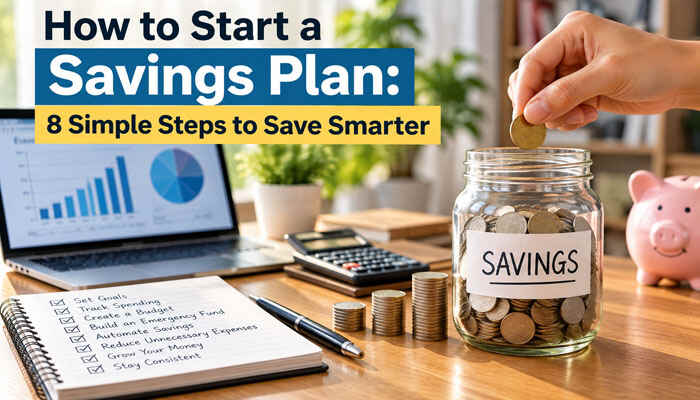

Learning how to start a savings plan can help you prepare for emergencies, afford major purchases, reduce your dependence on debt, and build stronger financial habits.
Many people want to save more money but do not know where to begin. The good news is that understanding how to start a savings plan does not require a high income, complicated spreadsheets, or advanced financial knowledge. You simply need a clear goal, a realistic contribution, the right place for your money, and a system you can maintain.
Whether you are saving for an emergency fund, vacation, car, home deposit, education expenses, business costs, or another financial goal, the same basic process applies.
This complete guide explains how to start a savings plan in eight practical steps, how much you should consider saving, where to keep your money, how to automate contributions, and how to adjust your plan when your income or expenses change.
Quick Answer: How to Start a Savings Plan
If you want a simple answer to how to start a savings plan, follow these eight steps:
- Choose a specific savings goal.
- Calculate how much money you need.
- Review your income and expenses.
- Set a realistic monthly savings amount.
- Build an emergency fund.
- Choose the right savings account.
- Automate your contributions.
- Track your progress and adjust the plan.
Use this basic formula:
Savings Goal − Current Savings = Amount Still Needed
Then:
Amount Still Needed ÷ Months Remaining = Monthly Savings Target
For example, suppose you want to save $6,000 within 12 months and already have $1,200.
$6,000 − $1,200 = $4,800
Then:
$4,800 ÷ 12 = $400 per month
You would need to save approximately $400 per month, excluding interest.
Key Takeaways
- Learning how to start a savings plan begins with setting a clear goal.
- Give each savings goal a specific amount and deadline.
- Calculate your contribution using real income and expenses.
- Start with an amount you can maintain consistently.
- Build emergency savings for unexpected essential costs.
- Use sinking funds for predictable future expenses.
- Compare APY, fees, access, and account protection.
- Automate transfers when your cash flow allows.
- Review your savings plan when your financial situation changes.
- Increase contributions gradually as your finances improve.
What Is a Savings Plan?
A savings plan is a structured system for setting aside money regularly for a future financial goal. When people first research how to start a savings plan, they often think the process simply means transferring money into a savings account. A proper savings plan goes further.
It identifies:
- What you are saving for
- How much you need
- When you need the money
- How much you will contribute
- Where you will keep the money
- How you will measure progress
A savings plan turns a general statement such as:
“I want to save more.”
into something measurable, such as:
“I want to save $5,000 within 15 months.”
Common Types of Savings Goals
Savings goals can be grouped by how soon you expect to need the money. Understanding the timeline can help you choose a more suitable savings strategy.
| Goal Type | Possible Time Frame | Examples |
|---|---|---|
| Immediate | Under 1 year | Emergency cushion, appliance |
| Short term | 1–3 years | Vacation, car, wedding |
| Medium term | 3–5 years | Home deposit, education |
| Long term | 5+ years | Retirement, long-term financial goals |
Your timeline matters because money needed soon generally requires greater accessibility and stability, while money intended for a goal many years away may allow a different approach.
Savings Plan vs Budget
A budget and savings plan are closely connected, but they serve different purposes.
A budget shows how you plan to distribute your income across:
- Essential expenses
- Flexible spending
- Debt
- Savings
- Other financial priorities
A savings plan determines exactly what your savings will accomplish.
For example, your budget may show that $400 is available after regular expenses.
Your savings plan might divide that money into:
- $250 emergency savings
- $100 car fund
- $50 vacation fund
A budget tells you what money is available.
A savings plan gives that money a specific purpose.
Understanding this distinction makes how to start a savings plan much easier because you can build your savings goal around your actual budget.
Why Is a Savings Plan Important?
Learning how to start a savings plan can improve more than your bank balance.
A good savings plan can help you:
- Prepare for financial emergencies
- Reduce dependence on loans or credit cards
- Plan large purchases
- Avoid mixing money for different purposes
- Build more consistent financial habits
- Prepare for annual expenses
- Track progress toward financial goals
- Create more financial flexibility
The Consumer Financial Protection Bureau explains that even relatively small emergency savings can provide some financial security when unexpected expenses occur.
The purpose of saving is not simply to accumulate money. The purpose is to create a financial system that helps you handle both expected and unexpected costs.
How to Start a Savings Plan in 8 Simple Steps
If you are wondering how to start a savings plan from scratch, the easiest method is to divide the process into eight manageable steps.
Step 1: Choose a Specific Savings Goal
The first step in how to start a savings plan is deciding exactly what you want to accomplish.
Avoid vague goals such as:
“I want to save money.”
Instead, use:
“I want to save $5,000 for emergencies within 15 months.”
A good savings goal should answer:
- What am I saving for?
- How much do I need?
- When do I need it?
Examples of Savings Goals
You might save for:
- Emergency expenses
- Home deposit
- Vacation
- Car
- Wedding
- Education
- Medical expenses
- Home repairs
- Technology replacement
- Business startup expenses
- Holiday spending
Prioritize Multiple Savings Goals
You may have several savings goals at the same time.
| Goal | Target |
|---|---|
| Emergency fund | $5,000 |
| Vacation | $1,500 |
| Car deposit | $8,000 |
| Home deposit | $25,000 |
Trying to fund every goal equally may slow your progress. Instead, rank each goal by urgency, importance, and the financial consequences of delaying it.
Ask yourself:
- How urgent is this goal?
- What happens if I do not have the money when I need it?
- Would delaying this goal force me to borrow?
- Which goal has the greatest financial impact?
Emergency savings and unavoidable expenses may deserve higher priority than optional goals such as vacations or nonessential purchases.
Step 2: Calculate How Much You Need to Save
The next step in how to start a savings plan is turning your goal into a specific monthly amount.
Use:
Target Amount − Current Savings = Amount Remaining
Then:
Amount Remaining ÷ Months Remaining = Monthly Savings Target
Example
Suppose your goal is:
$10,000
You already have:
$2,500
You still need:
$7,500
You want to reach the goal within 18 months.
$7,500 ÷ 18 = $416.67
Your monthly savings target is approximately:
$417
Breaking a large financial target into smaller monthly contributions can make the plan much easier to follow.
Savings Goal Examples
The table below shows how different savings targets can be broken into manageable monthly contributions.
| Goal | Already Saved | Time Remaining | Monthly Target |
|---|---|---|---|
| $1,200 | $0 | 12 months | $100 |
| $3,000 | $600 | 12 months | $200 |
| $5,000 | $500 | 18 months | $250 |
| $10,000 | $1,000 | 24 months | $375 |
| $20,000 | $2,000 | 36 months | $500 |
These examples exclude interest and assume equal monthly contributions throughout the savings period.
Step 3: Review Your Income and Expenses
An important part of understanding how to start a savings plan is knowing what you can actually afford to save.
List your regular monthly income.
Possible sources include:
- Salary
- Freelance income
- Business income
- Commission
- Rental income
- Side income
- Benefits
Then review your expenses.
Essential Expenses
Examples include:
- Rent or mortgage
- Groceries
- Utilities
- Transportation
- Insurance
- Healthcare
- Minimum debt payments
- Childcare
Flexible Expenses
Examples include:
- Restaurants
- Entertainment
- Shopping
- Streaming subscriptions
- Travel
- Hobbies
- Premium services
Review several months of transactions rather than relying entirely on memory.
Also identify irregular costs such as:
- Annual insurance
- Vehicle maintenance
- School expenses
- Medical costs
- Gifts
- Holidays
- Annual subscriptions
If these expenses are ignored, they can disrupt your savings plan later.
Step 4: Choose a Realistic Monthly Savings Amount

A major question people ask when researching how to start a savings plan is:
How much should I save every month?
There is no universal answer.
Your savings capacity depends on:
- Income
- Essential expenses
- Debt
- Housing costs
- Dependents
- Job stability
- Goal deadline
- Existing savings
- Local cost of living
Start with the amount your goal requires.
Then compare it with your budget.
If your goal requires:
$200 per month
but you can currently afford only $125, consider:
- Extending the deadline
- Reducing the target
- Cutting selected expenses
- Increasing income
- Starting with $125 and increasing it later
The best savings amount is one you can realistically maintain.
Can the 50/30/20 Rule Help?
The 50/30/20 framework is often mentioned when people research how to start a savings plan because it provides a simple way to divide take-home income.
It generally suggests:
- 50% for needs
- 30% for wants
- 20% for savings and financial goals
For example, with $4,000 in monthly take-home income:
| Category | Percentage | Amount |
|---|---|---|
| Needs | 50% | $2,000 |
| Wants | 30% | $1,200 |
| Savings and financial goals | 20% | $800 |
Treat the 50/30/20 rule as a flexible budgeting framework rather than a strict requirement. Your ideal savings percentage will depend on your income, housing costs, debt, family responsibilities, and financial goals.
If saving 20% is unrealistic, starting with 5% or 10% can still help you build a consistent savings habit.
Can You Start a Savings Plan With a Small Amount?
Yes. You do not need a large starting contribution to begin.
One of the most useful lessons in how to start a savings plan is that small, consistent contributions can still build meaningful savings over time.
| Monthly Savings | Amount After 1 Year* |
|---|---|
| $25 | $300 |
| $50 | $600 |
| $100 | $1,200 |
| $250 | $3,000 |
| $500 | $6,000 |
*Before interest.
Starting small can make the habit easier to maintain. As your income increases or your expenses decrease, you can gradually raise your monthly contribution.
The key is consistency. A manageable amount saved regularly is usually better than setting an aggressive target that you cannot sustain.
Step 5: Build an Emergency Fund
Emergency savings should be part of most plans.
An emergency fund is money reserved for unexpected essential expenses.
Examples include:
- Job loss
- Medical emergencies
- Essential vehicle repairs
- Home repairs
- Temporary income disruption
- Emergency travel
Understanding emergency savings is an important part of how to start a savings plan because unexpected expenses can otherwise force you to use credit or abandon other financial goals.
How Much Emergency Savings Do You Need?
There is no single emergency fund target that works for everyone.
A practical way to build emergency savings is to increase the fund gradually:
$500 → $1,000 → one month of essential expenses → several months of essential expenses
For example, suppose your monthly essential expenses are:
| Expense | Amount |
|---|---|
| Housing | $1,200 |
| Food | $500 |
| Utilities | $250 |
| Transportation | $300 |
| Insurance | $250 |
| Debt payments | $200 |
| Other essentials | $300 |
| Total | $3,000 |
Based on $3,000 in essential monthly expenses:
Three months of expenses = $3,000 × 3 = $9,000
Six months of expenses = $3,000 × 6 = $18,000
Your ideal emergency savings target will depend on factors such as your income stability, job security, number of dependents, insurance coverage, recurring obligations, and access to other financial resources.
When learning how to start a savings plan, it can be easier to focus on smaller milestones first rather than trying to reach a large emergency-fund target immediately.
Emergency Fund vs Sinking Fund
A complete guide on how to start a savings plan should explain the difference between an emergency fund and a sinking fund because they serve different purposes.
| Feature | Emergency Fund | Sinking Fund |
|---|---|---|
| Purpose | Unexpected essential expenses | Planned future expenses |
| Timing | Unpredictable | Usually predictable |
| Example | Job loss | Insurance premium |
| Example | Emergency repair | Vehicle maintenance |
| Example | Urgent medical bill | Holiday spending |
An emergency fund is designed for expenses you did not expect, while a sinking fund is money you save gradually for a cost you know is coming.
For example, suppose your annual insurance bill is:
$1,200
To prepare for it over 12 months:
$1,200 ÷ 12 = $100 per month
You could save $100 each month in a dedicated sinking fund so the full bill does not disrupt your regular budget.
Common sinking funds can include:
- Car maintenance
- Insurance premiums
- Travel
- Holiday expenses
- School costs
- Gifts
- Home repairs
- Appliance replacement
Using both an emergency fund and sinking funds can make your savings plan more organized. Emergency savings protect you from surprises, while sinking funds help you prepare for predictable expenses before they arrive.
Should You Save Money or Pay Off Debt First?
Another common question connected with how to start a savings plan is whether saving or debt repayment should come first.
The answer depends on your circumstances.
A practical approach may be:
- Build a small emergency cushion.
- Continue required debt payments.
- Prioritize expensive debt.
- Continue building emergency savings.
- Redirect old debt payments into savings after repayment.
For example, if you pay:
$300 per month toward a loan
once that loan is repaid, you could redirect the same $300 toward savings.
This can increase your savings without requiring a completely new budget.
Step 6: Choose the Right Place for Your Savings
When learning how to start a savings plan, choosing the right account is just as important as deciding how much to save.
| Option | Access | Risk | Typical Use |
|---|---|---|---|
| Savings account | High | Low | Emergency savings |
| High-yield savings account | High | Low | Short-term goals |
| Money market deposit account | Usually high | Low | Short-term savings |
| Certificate of deposit | Limited | Low | Money not needed soon |
| Investment account | Varies | Market risk | Longer-term goals |
High-Yield Savings Account vs Regular Savings Account
A high-yield savings account generally offers a higher interest rate than a standard savings account.
It can be suitable for:
- Emergency savings
- Vacation funds
- Home deposits
- Car savings
- Short-term goals
However, do not choose an account only because its advertised rate is high.
Compare:
- APY
- Monthly fees
- Minimum balance
- Opening deposit
- Transfer speed
- Withdrawal rules
- Deposit protection
- Rate requirements
What Does APY Mean?
APY stands for annual percentage yield.
It reflects the effect of compounding when showing how much a deposit account may earn over a year.
When comparing savings accounts, APY is useful, but it should not be your only consideration.
Also check:
- Monthly fees
- Minimum balance requirements
- Promotional-rate conditions
- Transfer times
- Withdrawal restrictions
The best account is the one that fits your overall savings needs.
Savings Account vs CD
A certificate of deposit may be suitable for money you are unlikely to need before a specific date.
| Feature | Savings Account | CD |
|---|---|---|
| Access | Easier | More restricted |
| Rate | Often variable | Often fixed |
| Emergency use | Usually more suitable | Usually less suitable |
| Early withdrawal | Easier | Penalty may apply |
| Best for | Accessible savings | Money not needed soon |
Do not automatically put all emergency savings into a CD because early-withdrawal penalties may reduce flexibility.
Money Market Account vs Money Market Fund
These names sound similar but describe different products.
- A money market deposit account can be a bank deposit.
- A money market mutual fund is an investment product.
This distinction matters when choosing where to keep money you may need soon.
Check Deposit Insurance
For U.S. readers, eligible deposits at an FDIC-insured bank generally receive federal deposit insurance under applicable ownership rules.
The standard amount is currently:
$250,000 per depositor, per insured bank, for each account ownership category.
Federally insured credit unions use separate NCUA share-insurance protection.
Readers outside the United States should check the deposit-protection rules in their own country.
Verify Online Banks Before Depositing Money
Security is another important part of how to start a savings plan.
Before depositing money with an unfamiliar online institution:
- Verify that the institution is legitimate.
- Check applicable deposit insurance.
- Confirm the official website address.
- Be cautious of unusually high rates.
- Avoid pressure to transfer money quickly.
A high savings rate is not worth the risk of sending money to an unverified institution.
Is Savings Account Interest Taxable?
For U.S. taxpayers, interest from many bank accounts and certificates of deposit is generally taxable unless an exception applies.
Tax treatment varies by country and individual circumstances.
Check the tax rules that apply where you live.
Step 7: Automate Your Savings
Automation can make how to start a savings plan much easier because you do not need to remember to transfer money manually every month.
Possible methods include:
- Automatic bank transfers
- Split direct deposit
- Weekly transfers
- Monthly transfers
- Transfers after every payday
Automation turns saving into part of your routine.
Use the Pay-Yourself-First Method
“Pay yourself first” means moving money into savings before discretionary spending.
Instead of:
Income → Spending → Save what remains
try:
Income → Savings → Spend what remains
Suppose your monthly income is:
$4,000
and your savings target is:
$400
Transfer the $400 first.
You then manage the remaining:
$3,600
This approach can make saving more intentional.
Schedule Savings Around Payday
When deciding how to start a savings plan, timing can matter.
- If you are paid monthly, schedule your transfer shortly after payday.
- If you are paid every two weeks, consider transferring money after each paycheck.
- However, make sure you leave enough money in checking for bills and essential expenses.
- Automation should make your plan easier, not create overdraft problems.
Step 8: Track and Adjust Your Savings Plan
The final step in how to start a savings plan is reviewing it regularly.
Your financial circumstances may change because of:
- Salary increases
- New jobs
- Rent increases
- New debt
- Lower expenses
- Marriage
- Children
- Emergency withdrawals
- Bonuses
- New financial goals
Questions to Ask
Review your plan and ask:
- Did I make my planned contribution?
- Am I on track?
- Has my goal changed?
- Can I increase my contribution?
- Have my expenses changed?
- Am I paying unnecessary fees?
- Is my account still suitable?
- Did I use emergency savings?
What If You Fall Behind?
Do not abandon the plan.
Recalculate it.
Suppose your target is:
$6,000 in 12 months
After six months, you have:
$2,000
Remaining amount:
$4,000
To meet the original deadline:
$4,000 ÷ 6 = approximately $667 per month
If $667 is unrealistic, extend your deadline.
Adjusting your plan is better than giving up entirely.
How to Rebuild Your Savings After an Emergency
Using emergency savings for a genuine emergency means the fund did its job.
Suppose you had:
$6,000
and used:
$1,500
Your balance becomes:
$4,500
To replace the money within six months:
$1,500 ÷ 6 = $250 per month
Create a temporary rebuilding goal until your emergency fund returns to its previous level.
How to Start a Savings Plan With a Low Income
People often assume they need a large salary before they can learn how to start a savings plan, but that is not true.
Start with an amount your budget can support.
Possible strategies include:
- Save $10, $25, or $50 each payday.
- Cancel unused subscriptions.
- Compare recurring bills.
- Save part of overtime earnings.
- Save part of bonuses.
- Sell unused items.
- Redirect paid-off debt payments.
- Save part of side income.
The first objective is consistency.
You can increase your contribution later.
How to Start a Savings Plan With Irregular Income
Understanding how to start a savings plan can be more challenging for freelancers, business owners, contractors, seasonal workers, and commission-based earners because income may change from month to month.
Instead of saving the same fixed amount every month, consider saving a percentage of each payment you receive.
For example:
Savings rule: Save 10% of every payment received.
| Income Received | 10% Savings |
|---|---|
| $2,000 | $200 |
| $3,500 | $350 |
| $5,000 | $500 |
| $7,000 | $700 |
This percentage-based approach allows your savings contribution to rise or fall with your income.
Another option is to build your regular budget around a conservative monthly income estimate. During stronger earning months, direct more money toward emergency savings, future expenses, or other financial goals.
If your income is highly unpredictable, maintaining a larger cash buffer can also help cover essential expenses during slower months.
Should You Have Multiple Savings Accounts?
You do not necessarily need one account for every goal.
However, separating goals may improve organization.
For example:
Emergency fund: $5,000
Vacation fund: $1,500
Car fund: $4,000
Annual bills: $2,000
Some banks offer digital buckets or subaccounts that allow you to divide savings without opening multiple accounts.
Short-Term Savings vs Long-Term Investing
When researching how to start a savings plan, it is important to understand the difference between saving and investing.
Saving
Saving typically focuses on:
- Stability
- Accessibility
- Lower risk
- Shorter timelines
Common goals include:
- Emergency expenses
- Travel
- Vehicles
- Home deposits
- Upcoming purchases
Investing
Investing involves accepting greater market risk for the possibility of greater long-term returns.
Investments can lose value.
Money you need in the near future should therefore not automatically be placed in volatile investments.
How Compound Interest Can Help Your Savings Grow
Compound interest means interest can potentially earn additional interest over time.
Your balance may grow through:
Initial savings + regular contributions + accumulated interest
The longer the money remains in an interest-bearing account, the more opportunity compounding has to work.
However, account rates can change over time.
Add a Buffer to Future Savings Goals
Another useful part of how to start a savings plan is preparing for rising costs.
Suppose you expect a vehicle to cost:
$15,000
A year later, a suitable vehicle may cost:
$17,000
Your original target is now too low.
Recalculate:
Updated Goal − Current Savings ÷ Months Remaining
Review future goals periodically, especially for:
- Cars
- Travel
- Weddings
- Education
- Home renovations
- Home deposits
How to Increase Your Savings Faster
Once your savings habit is established, look for ways to increase contributions.
Save Part of Every Raise
Suppose your take-home pay rises by:
$300 per month
You could put:
$150 into savings
and keep:
$150 for other priorities
Redirect Debt Payments
If you finish paying a loan that cost:
$250 per month
consider redirecting that $250 into savings.
Save Part of Windfalls
Windfalls may include:
- Bonuses
- Tax refunds
- Gifts
- Rebates
- Freelance income
- Sale of unused items
You could create a rule such as:
Save 50% of unexpected income.
Adjust the percentage to fit your financial situation.
Common Mistakes When Learning How to Start a Savings Plan
Avoid these common problems when figuring out how to start a savings plan.
Setting an Unrealistic Target
Trying to save too much can make the plan difficult to sustain.
Choose a realistic amount.
Saving Only What Is Left Over
If savings always come last, you may regularly have nothing remaining.
Make savings part of your planned budget.
Mixing Savings With Spending Money
Keeping emergency money in your everyday spending account can make it easier to use accidentally.
Ignoring Predictable Expenses
Use sinking funds for annual costs such as:
- Insurance
- Holidays
- Maintenance
- Gifts
- Subscriptions
Choosing an Account Only for the Highest APY
Compare fees, access, minimums, and deposit protection as well.
Taking Too Much Risk
Do not expose short-term money to unnecessary market volatility.
Forgetting to Rebuild Emergency Savings
If you use your emergency fund, create a plan to restore it.
Never Updating Your Plan
Your goals, income, and expenses will change.
Your savings plan should change with them.
90-Day Plan for How to Start a Savings Plan
If you understand how to start a savings plan but have not taken action yet, a simple 90-day framework can make the process easier to follow.
| Period | Action | Goal |
|---|---|---|
| Days 1–7 | Review your finances | Understand your cash flow |
| Days 8–14 | Set one savings goal | Choose an amount and deadline |
| Days 15–30 | Choose a savings account | Separate your savings |
| Month 2 | Automate contributions | Build consistency |
| Month 3 | Review your results | Improve the plan |
During the first month, focus on understanding your income, expenses, and savings capacity. In the second month, make saving more consistent through automatic transfers where practical. By the third month, review your progress and adjust the amount, deadline, or account if needed.
This 90-day approach turns how to start a savings plan into a practical routine instead of a one-time financial goal.
Days 1–7
Review several months of income and expenses.
Calculate what you can realistically save.
Days 8–14
Choose one priority goal.
For example:
Build a $1,000 starter emergency fund.
Days 15–30
Choose an appropriate account and make your first deposit.
Month 2
Set up automatic contributions if appropriate.
Month 3
Review:
- Did you make every contribution?
- Was your target realistic?
- Did unexpected expenses interfere?
- Can you save more?
- Is your account still suitable?
Then create your next 90-day plan.
Monthly Savings Plan Example
A simple example can make how to start a savings plan easier to understand.
Suppose your monthly take-home income is:
$3,500
Your regular spending looks like this:
| Category | Monthly Amount |
|---|---|
| Housing | $1,200 |
| Food | $450 |
| Utilities | $200 |
| Transportation | $300 |
| Insurance | $200 |
| Debt payments | $250 |
| Personal spending | $300 |
| Other expenses | $200 |
| Total Expenses | $3,100 |
Your remaining amount is:
$3,500 − $3,100 = $400
A possible monthly savings plan could be:
- $250 toward emergency savings
- $50 toward a vacation fund
- $100 kept as additional budget flexibility
Once your emergency fund reaches its target, you can redirect some or all of the $250 toward another goal, such as a car, home deposit, education, or other planned expense.
This approach keeps the savings habit in place even when the purpose of the money changes.
Simple Savings Plan Template
Use this template when deciding how to start a savings plan for your own goals.
Savings goal: ____________________
Target amount: ____________________
Current savings: ____________________
Amount remaining: ____________________
Target date: ____________________
Months remaining: ____________________
Monthly savings amount: ____________________
Automatic transfer date: ____________________
Savings account: ____________________
Review date: ____________________
Calculate:
Amount Remaining ÷ Months Remaining = Monthly Savings Target
Practical Savings Priority Order
There is no universal savings order, but a general framework may be:
- Pay current essential expenses.
- Establish an initial emergency cushion.
- Make required debt payments.
- Address particularly expensive debt.
- Continue building emergency savings.
- Fund short-term planned expenses.
- Save or invest appropriately for longer-term goals.
- Increase contributions as your finances improve.
How Often Should You Review Your Savings Plan?
Review your plan monthly when you are first learning how to start a savings plan.
You should also reassess it after major financial changes such as:
- Starting a new job
- Receiving a raise
- Losing income
- Moving
- Getting married
- Having a child
- Taking on new debt
- Making a major purchase
- Using emergency savings
- Reaching an existing goal
A savings plan should evolve as your life changes.
Conclusion
Learning how to start a savings plan is not about waiting until you earn more money or finding one perfect savings percentage. Start by choosing a specific goal, calculating how much you need, reviewing your actual spending, and deciding what you can realistically contribute. Build emergency savings, use sinking funds for predictable expenses, choose an appropriate account, and automate your deposits when practical.
Knowing how to start a savings plan is only the beginning. Long-term success comes from reviewing your progress, adjusting your targets, and increasing your contributions when your finances improve. Even saving $25, $50, or $100 consistently can be more useful than waiting for the perfect time to begin. A successful savings plan is one that fits your budget, adapts to your circumstances, and keeps your money moving toward the goals that matter most.
How to Start a Savings Plan FAQs
1. How to start a savings plan for the first time?
To understand how to start a savings plan, choose a specific goal, set an amount and deadline, review your budget, calculate your contribution, choose a suitable account, and automate deposits when possible.
2. How much money should I save every month?
The right amount depends on your income, expenses, debt, target, and deadline. Choose an amount that moves you toward your goal without making your monthly budget unrealistic.
3. Can I start a savings plan with $50 a month?
Yes. Saving $50 per month equals $600 after one year before interest. Starting small can help you develop a consistent savings habit.
4. How to start a savings plan with a low income?
Start with a small amount you can afford, reduce unnecessary recurring expenses, save part of extra income, and increase contributions when your financial position improves.
5. What is the difference between an emergency fund and a sinking fund?
An emergency fund is for unexpected essential expenses, while a sinking fund is for known future costs such as insurance, travel, maintenance, or holidays.
6. Is the 50/30/20 rule required when starting a savings plan?
No. It is only one budgeting framework. Choose a savings percentage that reflects your income, expenses, debt, and financial priorities.
7. Should I save weekly or monthly?
Either method can work. Choose the schedule that matches your pay cycle and makes your savings contributions easiest to maintain.
8. How to start a savings plan with irregular income?
If your income changes each month, consider saving a fixed percentage of every payment. Higher-income months can also be used to build a larger savings buffer.
