


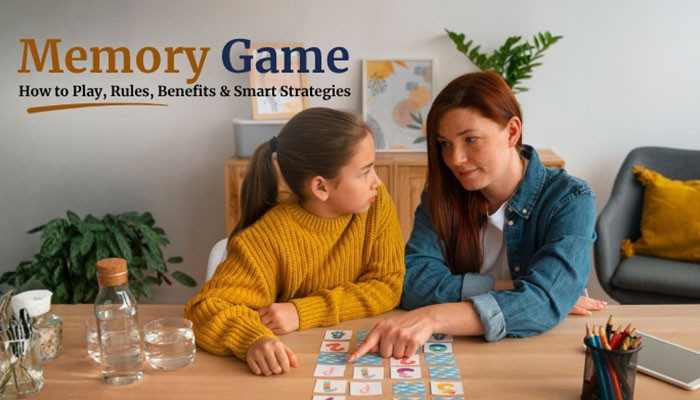

A memory game is a simple matching activity where players reveal hidden cards, remember their positions, and try to find matching pairs. Although a basic memory game is easy to understand, larger boards, similar images, timers, and advanced matching rules can make it challenging for children, adults, and experienced players.
Also known as Concentration, Matching Pairs, Pairs, or Pelmanism, the classic memory game begins with every card face down. Players normally turn over two cards during each turn. If the cards match, the pair is collected or remains visible. If they do not match, both cards return face down.
This complete guide explains how to play a memory game, the main memory game rules, winning strategies, scoring methods, card variations, benefits, educational uses, online play, difficulty levels, and ways to improve your results.
Quick Answer: Memory Game
To play a memory game, shuffle matching pairs of cards and arrange them face down.
Turn over two cards during each turn. If they match, keep the pair or leave both cards visible. If they do not match, turn them face down again without changing their positions.
Continue until all pairs have been found.
In a multiplayer memory game, the player with the most pairs usually wins. In a solo memory game, the objective may be to complete the board using fewer moves or less time.
Key Takeaways
- A memory game normally uses pairs of matching cards.
- All memory game cards begin face down.
- Players usually reveal two cards per turn.
- Matching cards are collected or left visible.
- Nonmatching cards return face down.
- Remembering both the image and position is essential.
- Watching other players can improve memory game performance.
- Smaller boards are easier for beginners.
- Larger grids make a memory game more challenging.
- A regular deck of playing cards can be used.
- A memory game can be played alone or with several players.
- Educational memory game variations can reinforce school subjects.
- Digital versions can track time, moves, mistakes, and scores.
- Cognitive benefits should be described realistically rather than exaggerated.
What Is a Memory Game?
A memory game is an activity where players must remember information that becomes hidden again.
The most common memory game uses pairs of identical pictures. Every card starts face down, which means players initially do not know where any matching pair is located.
Players gradually reveal cards and build a mental map of the board.
For example, suppose you turn over:
Row 1, Card 2 = Apple
and:
Row 3, Card 4 = Star
The cards do not match, so they return face down.
Later, another Apple appears.
If you remember where the first Apple was located, you can use that information to complete the pair.
This creates the main memory game cycle:
Reveal → Observe → Remember → Match
The better you remember earlier cards, the less you need to rely on random guessing.
Memory Game at a Glance
| Memory Game Feature | How It Works |
|---|---|
| Main objective | Find matching pairs |
| Starting setup | Shuffle the cards and place them face down |
| Cards revealed | Usually two cards per turn |
| Successful match | The matching pair is collected or remains visible |
| Failed match | The cards are turned face down again |
| Main challenge | Remember the identity and location of previously revealed cards |
| Solo goal | Complete the memory game efficiently using as few turns as possible |
| Multiplayer goal | Usually collect more matching pairs than other players |
| Common names | Memory, Concentration, Matching Pairs, Pelmanism |
| Difficulty | Adjustable by changing the number of cards or complexity of images |
| Formats | Physical cards, printable games, mobile apps, and browser games |
History of the Memory Game
The traditional memory game has appeared under several names over time.
It has commonly been called Concentration, Pelmanism, Matching Pairs, Pairs, and Memory.
Pelmanism became associated with memory-training activities in Britain, while the matching-card format later became widely recognized as Concentration or Memory.
The famous commercial memory® game produced by Ravensburger appeared in 1959 and helped popularize picture-pair matching as a family game.
Today, the memory game concept appears in:
- card sets
- classrooms
- mobile apps
- browser games
- educational software
- printable activities
- family games
The basic idea remains almost unchanged: remember previously revealed information and use it to locate matching pairs.
Other Names for a Memory Game
Different names may be used depending on country and context.
| Name | Common Meaning |
|---|---|
| Memory | General name for the matching-card game |
| Concentration | Traditional English-language name |
| Matching Pairs | Descriptive modern name emphasizing the main objective |
| Pairs | Informal shortened name |
| Pelmanism | Traditional British name associated with memory-training games |
| Shinkei-suijaku | Japanese term commonly used for the matching-card game |
| memory® | Ravensburger’s trademarked commercial matching game |
These terms often refer to a similar memory game format built around hidden cards and matching pairs.
How to Play a Memory Game
Learning how to play a memory game requires only a few basic steps.
1. Choose Matching Memory Game Cards
Start with an even number of cards.
Each card needs a matching partner.
For example:
- 4 pairs = 8 cards
- 6 pairs = 12 cards
- 8 pairs = 16 cards
- 12 pairs = 24 cards
- 18 pairs = 36 cards
For a beginner memory game, use pictures that are clearly different.
2. Shuffle the Cards
Mix every memory game card thoroughly.
Players should not know where any matching pair is located before play begins.
3. Place the Cards Face Down
Place the Cards Face Down
Arrange the cards in neat rows and columns.
An organized memory game board makes card positions easier to remember.
For example:
| Row | Card 1 | Card 2 | Card 3 | Card 4 |
|---|---|---|---|---|
| Row 1 | 🂠 | 🂠 | 🂠 | 🂠 |
| Row 2 | 🂠 | 🂠 | 🂠 | 🂠 |
| Row 3 | 🂠 | 🂠 | 🂠 | 🂠 |
Instead of remembering only:
Dog
try remembering:
Dog — Row 2, Card 3
Using both the image and its position can make matching pairs easier as the game continues.
4. Choose the First Player
For a multiplayer memory game, select the starting player randomly or use any agreed method.
A solo player can begin immediately.
5. Reveal Two Cards
The first player turns over one card and then another.
Both memory game cards should remain visible long enough for everyone to see them.
6. Check for a Match
If both cards match, the player has found a pair.
The cards may be:
- collected
- removed
- or left face up
In many traditional memory game rules, finding a successful pair allows the same player to take another turn.
7. Turn Nonmatching Cards Back Over
If the cards do not match, return them face down.
Do not move them.
Their positions are now valuable information for future memory game turns.
8. Continue Until Every Pair Is Found
The memory game ends when every matching pair has been found.
Players count the pairs they collected.
The person with the most pairs usually wins.
Basic Memory Game Rules
Classic memory game rules are simple.
| Memory Game Rule | Explanation |
|---|---|
| Cards begin hidden | All cards start face down |
| Two cards per turn | A player normally reveals two |
| Matching cards score | The pair is collected or stays visible |
| Nonmatching cards return | Both cards are hidden again |
| Cards stay in position | Locations cannot change |
| Match may earn another turn | Common memory game rule |
| Game continues | Until every pair is found |
| Winner | Usually the player with the most pairs |
Players should decide before starting what counts as a valid memory game match.
For traditional picture cards:
Apple ↔ Apple
Educational versions can use related concepts.
Examples:
France ↔ Paris
7 × 6 ↔ 42
Dog ↔ Perro
How Many Cards Should a Memory Game Have?
A memory game does not require a fixed number of cards.
The best size depends on age, experience, card similarity, and desired difficulty.
| Memory Game Level | Grid | Cards | Pairs |
|---|---|---|---|
| Very Easy | 2 × 3 | 6 | 3 |
| Easy | 2 × 4 | 8 | 4 |
| Beginner | 3 × 4 | 12 | 6 |
| Standard | 4 × 4 | 16 | 8 |
| Intermediate | 4 × 5 | 20 | 10 |
| Challenging | 4 × 6 | 24 | 12 |
| Advanced | 6 × 6 | 36 | 18 |
| Very Hard | 8 × 8 | 64 | 32 |
A larger memory game generally requires players to remember more locations.
However, card similarity also matters.
A 16-card memory game containing nearly identical flowers may be harder than a 24-card game containing completely different objects.
Memory Game Rules for Two Players
A two-player memory game follows the same basic rules.
Player 1 reveals two cards.
If they match:
- Player 1 keeps the pair.
- Player 1 commonly takes another turn.
If they do not match:
- The cards return face down.
- Player 2 takes a turn.
The memory game continues until every pair is collected.
The player with the most pairs wins.
Watching your opponent’s turn is extremely important because their unsuccessful attempt may reveal the location of a pair you can use later.
Can Three or More Players Play a Memory Game?
Yes.
A memory game can easily support several players.
Players take turns in a fixed order.
When someone finds a pair, common rules allow that player to continue. When the player misses, the turn moves to the next person.
With more players, careful observation becomes even more important because many memory game cards may be revealed before your next turn.
How to Play a Memory Game With Regular Playing Cards
You do not need dedicated memory game cards.
A standard 52-card deck works well.
One common version treats cards of the same rank as matching pairs.
Examples include:
- 6♣ ↔ 6♥
- Q♠ ↔ Q♦
- A♣ ↔ A♠
Standard Playing-Card Memory Game Setup
- Shuffle the deck.
- Place all cards face down.
- Turn over two cards per turn.
- Compare their ranks.
- Collect matching cards.
- Turn nonmatches face down again.
- Continue until the memory game is complete.
Harder Memory Game Variation
Require both cards to have the same:
- rank
- color
For example:
7♥ ↔ 7♦
This adds another rule for players to remember.
Best Memory Game Strategies
A strong memory game strategy is based on organization rather than random guessing.
Scan the Memory Game Board Systematically
Avoid choosing cards from completely random positions.
Instead, move:
- left to right
- top to bottom
- row by row
- section by section
A systematic memory game approach creates a more organized mental map.
Remember the Image and Position Together
Knowing the picture without its location is not very useful.
Instead of remembering:
Elephant
remember:
Elephant — Row 3, Card 2
The strongest memory game players connect identity and location immediately.
Watch Every Memory Game Turn
Do not pay attention only when it is your turn.
Every revealed card gives you information.
Another player’s failed memory game turn may reveal a pair you can use later.
Take Guaranteed Pairs
If you already know where both matching cards are located, take the pair.
Do not explore random cards when a known memory game match is available.
Divide a Large Memory Game Into Zones
For a large board, mentally divide the cards into:
- upper left
- upper right
- center
- lower left
- lower right
This can make a large memory game easier to organize mentally.
Create Simple Associations
Link each image with its position.
Examples:
- corner tiger
- center apple
- bottom bicycle
- left-side moon
Associations can make memory game locations easier to retrieve later.
Advanced Memory Game Strategy: Reveal an Unknown Card First
When you do not already know a complete pair, consider turning over an unknown card first.
Suppose your first card reveals a star.
If you remember seeing another star earlier, use the second flip to complete the pair.
If you do not know its partner, reveal another unknown card and collect additional information.
This memory game strategy makes an uncertain turn useful because it can either:
- produce a match
- reveal new information
The exception is straightforward.
If you already know a complete pair, take the guaranteed memory game match first.
Is a Memory Game Mostly Luck or Skill?
A memory game involves both.
At the beginning, almost every card is unknown.
If there are N pairs, the memory game contains 2N cards.
After revealing the first card, only one of the remaining 2N − 1 cards is its matching partner.
A completely random second choice therefore has a matching probability of:
1 ÷ (2N − 1)
As the memory game continues, previously revealed cards provide more information.
Luck matters more near the beginning.
Memory, observation, and decision-making become increasingly important later.
Example of Smart Memory Game Play
Imagine an eight-card memory game.
You reveal:
A2 = Apple
and:
B4 = Star
They do not match.
Later, another player reveals:
A4 = Apple
and:
B1 = Moon
Now you remember:
- A2 = Apple
- A4 = Apple
- B4 = Star
- B1 = Moon
On your next memory game turn, select A2 and A4.
That gives you a guaranteed Apple pair.
This demonstrates an important principle:
A failed memory game turn is useful when you remember what it revealed.
What Counts as a Move in a Memory Game?
For easy scoring, count one complete two-card attempt as one move.
| Memory Game Action | Moves |
|---|---|
| Reveal two nonmatching cards | 1 |
| Reveal one matching pair | 1 |
| Finish 8 pairs in 18 attempts | 18 |
| Finish 12 pairs in 24 attempts | 24 |
Using one scoring method consistently makes memory game results easier to compare.
What Is a Good Memory Game Score?
There is no universal good memory game score.
Difficulty depends on:
- number of cards
- board size
- image similarity
- experience
- viewing time
- timer settings
- matching rules
A score from an easy 4 × 4 memory game should not be directly compared with a difficult 8 × 8 game.
Instead, compare repeated attempts using the same settings.
Memory Game Moves Per Pair
One useful measure is:
Moves per pair = Total moves ÷ Number of pairs
Suppose you complete eight pairs in 16 moves.
16 ÷ 8 = 2 moves per pair
If your next comparable memory game takes 13 moves, your efficiency has improved.
What Makes a Memory Game Difficult?
Several factors affect memory game difficulty.
More Cards
More pairs mean more locations to remember.
Similar Pictures
Distinctive pictures are easier.
A memory game containing several similar flowers, faces, or symbols demands more careful observation.
Short Viewing Time
Cards that disappear quickly provide less time to remember them.
Timers
A timed memory game adds pressure.
Complex Matching Rules
Identical pictures are usually easier than:
Country ↔ Capital
Word ↔ Definition
Equation ↔ Answer
Three-Card Matching
Finding groups of three rather than pairs makes a memory game substantially harder.
Memory Game Benefits
A memory game directly involves several abilities during play.
Visual Recall
Players repeatedly see a picture, lose visual access to it, and try to recall it later.
Attention and Concentration
Every memory game card may become important later.
Players therefore have a reason to pay attention throughout the activity.
Spatial Recall
Players must remember where a card appeared as well as what it showed.
Pattern Recognition
A memory game requires repeated comparison between pictures, words, symbols, or numbers.
Decision-Making
Players decide whether to:
- explore an unknown card
- use a known match
- revisit a remembered position
Turn-Taking
A multiplayer memory game also encourages players to follow rules, observe others, and wait for their turn.
Do Memory Games Actually Improve Memory?
A memory game provides direct practice in remembering cards, images, and positions.
That does not mean every memory game produces broad cognitive improvements.
Research into structured cognitive and working-memory training generally finds stronger improvements on the trained task or closely related tasks than on completely unrelated abilities.
For practical purposes, a memory game can reasonably be described as an activity that exercises:
- visual recall
- attention
- matching
- spatial memory
- observation
It should not be promoted as a guaranteed way to:
- raise IQ
- prevent dementia
- treat memory disorders
- improve every cognitive ability
Memory Game vs Working-Memory Training
A traditional memory game and scientific working-memory training are not automatically the same.
A matching memory game mainly asks players to remember previously revealed cards and their positions.
Formal cognitive-training tasks may require people to:
- remember sequences
- manipulate information
- update changing information
- perform several mental operations
- respond to increasing difficulty
Research involving specialized training programs should therefore not automatically be used to make claims about every memory game.
Memory Game for Kids
A memory game for kids can combine entertainment with visual learning.
Young children can start with only a few pairs.
Good beginner memory game themes include:
- animals
- fruits
- colors
- numbers
- letters
- shapes
- vehicles
- foods
- household objects
As the child becomes comfortable, increase the number of memory game cards gradually.
What Age Is a Memory Game Suitable For?
There is no single required age for a memory game.
Difficulty can be adapted.
For younger children, try:
- 3 or 4 pairs
- large cards
- familiar pictures
- no timer
- plenty of viewing time
Older children can use:
- larger memory game boards
- similar pictures
- letters
- numbers
- educational concepts
Adults can increase the challenge further with large boards and complex matching rules.
Educational Memory Game Ideas
A memory game can reinforce school subjects by matching related concepts rather than identical pictures.
| Subject | Memory Game Match |
|---|---|
| Mathematics | 7 × 5 ↔ 35 |
| Geography | France ↔ Paris |
| Science | H₂O ↔ Water |
| Vocabulary | Happy ↔ Joyful |
| Languages | Dog ↔ Perro |
| History | 1969 ↔ Moon landing |
| Biology | Bee ↔ Pollinator |
| Chemistry | Na ↔ Sodium |
| Grammar | Run ↔ Verb |
Teachers can make an educational memory game more useful by requiring students to explain why the cards match.
Memory Game for Adults
A memory game for adults can be considerably harder than a children’s version.
Try matching:
- similar photographs
- names and faces
- flags and countries
- countries and capitals
- foreign-language words
- historical dates
- formulas and answers
- abstract symbols
Adult memory game variations can also use:
- timers
- move limits
- penalties
- larger grids
- shorter viewing periods
- three-card matching
Memory Game for Older Adults
A memory game can also be an enjoyable social and recreational activity for older adults.
The game encourages active participation involving:
- observation
- matching
- attention
- recall
- conversation
However, a memory game should not be used as a medical test or treatment.
Anyone experiencing significant or unexplained memory changes should seek appropriate professional medical advice rather than relying on memory game performance.
Types of Memory Games
There are many types of memory game.
Picture Memory Game
Players match identical images.
This is the classic memory game format.
Number Memory Game
Players match numbers or mathematical relationships.
Word Memory Game
Possible matches include:
- identical words
- synonyms
- antonyms
- definitions
- translations
Sound Memory Game
Players listen for matching sounds.
Sequence Memory Game
Players remember and reproduce sequences involving:
- colors
- lights
- sounds
- numbers
- symbols
Location Memory Game
Objects briefly appear in different positions and then disappear.
Players identify where they were located.
Educational Memory Game
Players match related concepts rather than identical cards.
Three-Card Memory Game
Players search for three matching or related cards instead of two.
Digital Memory Game
An online memory game may track:
- moves
- time
- mistakes
- accuracy
- levels
- pairs
- personal records
Physical Memory Game vs Online Memory Game
Both formats use similar core rules.
| Feature | Physical Memory Game | Online Memory Game |
|---|---|---|
| Setup | Manual | Automatic |
| Shuffling | Manual | Automatic |
| Move tracking | Usually manual | Often automatic |
| Timer | Optional | Common |
| Multiplayer | Excellent for in-person play | Depends on the platform |
| Customization | Easy with homemade or printable cards | Platform-dependent |
| Screen required | No | Yes |
| Automatic scoring | No | Usually |
| Difficulty adjustment | Add or remove cards | Usually instant |
| Replay | Requires reshuffling | Usually immediate |
A physical memory game works well for families and classrooms.
An online memory game offers fast setup, automatic shuffling, score tracking, and adjustable difficulty.
What to Look for in an Online Memory Game
A good online memory game should be simple to use.
Useful features include:
- clear graphics
- responsive controls
- mobile support
- selectable board sizes
- move counter
- restart option
- optional timer
- simple scoring
- readable symbols
- minimal distractions
Additional online memory game features might include:
- personal best scores
- multiple themes
- multiplayer modes
- sound settings
- daily challenges
- accessibility controls
How to Make a Memory Game Harder
If your current memory game becomes too easy, increase the challenge gradually.
Add More Memory Game Cards
More pairs mean more positions to remember.
Use Similar Images
Replace obvious pictures with similar:
- flowers
- animal breeds
- faces
- patterns
Add a Timer
Require players to finish the memory game within a time limit.
Limit Moves
Set a maximum number of memory game attempts.
Reduce Viewing Time
Make unsuccessful cards disappear faster.
Match Related Concepts
Try:
Country ↔ Capital
Word ↔ Definition
Equation ↔ Answer
Require Three Cards
Finding three related cards makes a memory game considerably harder.
How to Make a Memory Game Easier
For beginners, simplify the memory game.
Use:
- fewer pairs
- larger cards
- clearly different pictures
- familiar objects
- organized rows
- longer viewing time
- no timer
- no penalties
Increase difficulty only when the memory game becomes consistently easy.
How to Improve at a Memory Game
Improving at a memory game is mainly about using information more effectively.
Build a Mental Grid
Think of every memory game card as having an address.
Examples:
- top-left
- Row 2, Card 3
- center-right
- bottom corner
Avoid Random Flips
A systematic memory game strategy is easier to remember than random selection.
Focus on Half-Known Pairs
Once you have seen one half of a pair, remembering that position becomes especially valuable.
Avoid Repeating Forgotten Cards
If you repeatedly reveal the same card, pause and deliberately connect it with its location.
Compare Similar Memory Game Boards
Track improvement using comparable board sizes and rules.
A lower score on an easier memory game does not necessarily mean greater skill.
Common Memory Game Mistakes
Ignoring Other Players
Every memory game turn provides useful information.
Moving Cards
Cards should remain in their original locations.
Covering Cards Too Quickly
Players need enough time to identify each card.
Flipping Randomly
An organized memory game approach makes information easier to store.
Forgetting Known Pairs
Take a guaranteed memory game pair when you know both locations.
Increasing Difficulty Too Quickly
An overly difficult memory game may become frustrating rather than enjoyable.
Focusing Only on Speed
Fast card flipping is not useful if you immediately forget the card.
Solo Memory Game
A solo memory game allows one player to compete against their own previous performance.
Track:
- total moves
- mistakes
- completion time
- moves per pair
- board size
Example:
| Memory Game Round | Pairs | Moves |
|---|---|---|
| Round 1 | 8 | 24 |
| Round 2 | 8 | 20 |
| Round 3 | 8 | 17 |
Use the same memory game settings for meaningful comparisons.
Multiplayer Memory Game
A multiplayer memory game adds strategic observation.
A typical turn works like this:
- Player A reveals two cards.
- A matching pair is collected.
- Player A commonly receives another turn.
- A mismatch is turned face down.
- Player B takes the next turn.
- The memory game continues until all pairs are found.
The player who remembers information revealed by everyone has an advantage.
Competitive vs Cooperative Memory Game
A memory game does not always need one winner.
In cooperative play, everyone can work together to:
- clear the memory game board
- beat a previous time
- stay under a move limit
- reduce mistakes
- complete the game before a timer ends
A cooperative memory game can work particularly well for families, classrooms, and younger players.
Memory Game Scoring Ideas
Traditional memory game scoring is simple.
One matching pair = one point
More advanced scoring might include:
| Memory Game Action | Example Score |
|---|---|
| Find a matching pair | +10 points |
| Find consecutive pairs | +5 bonus points |
| Reveal a mismatch | 0 points |
| Finish below the time target | +50 points |
| Finish below the move target | +50 points |
| Complete a harder level | Difficulty bonus |
Keep the scoring system simple enough that it does not distract from the memory game itself.
How to Make a Memory Game More Accessible
A memory game should be easy to understand and interact with.
Do Not Depend Only on Color
Use:
- symbols
- text
- patterns
- shapes
along with color.
Use Clear Memory Game Cards
Cards should have:
- readable text
- recognizable pictures
- sufficient size
- uncluttered backgrounds
- clearly distinguishable symbols
Make Timers Optional
Not every memory game needs time pressure.
Provide Difficulty Settings
Useful adjustments include:
- fewer cards
- larger cards
- slower animations
- longer viewing periods
- no timer
Support Keyboard Controls Online
An online memory game should ideally support navigation without requiring only a mouse or touchscreen.
DIY Memory Game at Home
A homemade memory game is easy to create.
You can use:
- index cards
- cardboard
- photographs
- printed pictures
- flashcards
- paper squares
Create two copies of each picture or concept.
Make all card backs look identical.
Then:
- shuffle the memory game cards
- place them face down
- choose the first player
- reveal two cards
- collect matches
- hide nonmatches
- continue until every pair has been found
DIY memory game themes can include:
- family photos
- animals
- school lessons
- vocabulary
- travel
- sports
- foods
- hobbies
How to Choose a Good Memory Game
The best memory game depends on the player’s age, skill level, and purpose.
Look for:
- suitable board size
- clear pictures
- adjustable difficulty
- simple rules
- interesting themes
- readable text
- easy controls
- minimal distractions
A memory game for young children should generally use fewer cards and familiar pictures.
A memory game for experienced adults can use large grids, subtle visual differences, and concept matching.
Memory Game vs Matching Game
A memory game and matching game are closely related, but they are not always identical.
A classic memory game hides the cards.
Players must remember information that was previously visible.
A normal matching activity may leave every item visible.
For example, connecting two visible animals on a worksheet is a matching activity.
Finding two animals among hidden cards creates a memory game because the player must remember previous locations.
Why Is the Memory Game So Popular?
The memory game has remained popular because it combines simple rules with flexible difficulty.
A memory game is:
- easy to understand
- inexpensive
- customizable
- portable
- suitable for many ages
- playable alone
- suitable for groups
- useful in classrooms
- easy to convert into an online game
- adaptable to almost any theme
A young child can play a memory game with only three or four pairs.
An adult can play a memory game with dozens of visually similar cards.
The core objective remains the same.
Conclusion: Memory Game
A memory game turns a simple matching activity into a challenge involving observation, recall, spatial awareness, and decision-making.
The basic memory game rules are straightforward. Place matching cards face down, reveal two cards per turn, collect successful pairs, and remember unsuccessful attempts.
The strongest memory game players do more than guess. They remember both what appeared and where it appeared, watch every player’s turn, use known pairs immediately, divide large boards into smaller areas, and explore unknown cards strategically.
A memory game can be adapted for children, adults, classrooms, solo challenges, multiplayer games, standard playing cards, educational activities, and online play.
Memory-training research supports practice effects on trained and closely related tasks, but a memory game should not be presented as a guaranteed method for raising intelligence or preventing cognitive disorders.
Whether you use homemade cards, a standard deck, classroom concepts, photographs, or digital tiles, every memory game ultimately asks the same thing:
Remember what you saw, remember where you saw it, and find the matching pair.
Memory Game FAQs
1. What is a Memory Game?
A Memory Game is a matching activity where players reveal hidden cards, remember their locations, and try to find matching pairs.
2. How do you play a Memory Game?
Shuffle matching pairs, place them face down, and reveal two cards per turn. Keep matching pairs and turn nonmatching cards face down again.
3. What skills does a Memory Game use?
A Memory Game uses visual recall, attention, spatial memory, observation, pattern recognition, and decision-making.
4. How can you get better at a Memory Game?
Remember each card’s image and location, watch every turn, organize the board mentally, and take known matching pairs when available.
5. Can a Memory Game be educational?
Yes. An educational Memory Game can match concepts such as countries with capitals, equations with answers, or words with their meanings.
