


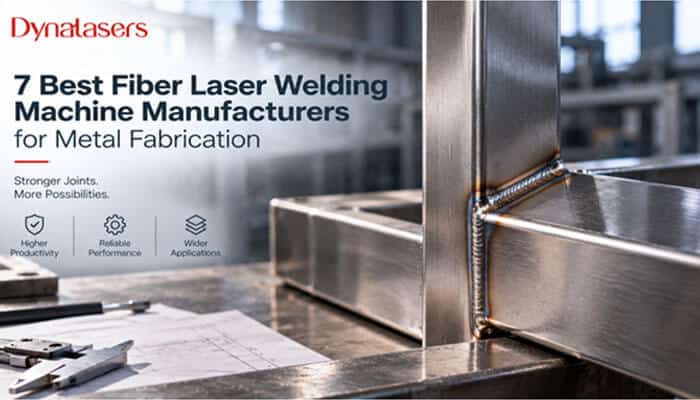

A good fiber laser welding machine manufacturer should offer more than a high-power laser source. In daily fabrication, machine size, cooling, welding-head weight, wire feeding, process control, and support all affect how useful the system actually is.
For shops welding stainless steel, carbon steel, or aluminum, the manufacturers below cover several approaches to fiber laser welding. Dynalasers stands out for compact air-cooled systems ranging from a lightweight 700W unit to 1800W workshop models.
7 Fiber Laser Welding Machine Manufacturers Compared
| Manufacturer | Representative System | Power Range | Main Strength | Typical Use |
| Dynalasers | S / M / D Series | 700–1800W | Compact air-cooled design | Flexible metal fabrication |
| IPG Photonics | LightWELD | 1000–2000W | Established fiber laser platform | Industrial fabrication |
| Miller | OptX | 1000 / 2000W | Welding-focused ecosystem | Production shops |
| JASIC | LS Series | 1500 / 2000W | Industrial welding background | Regular fabrication |
| SENFENG | Handheld Laser Welder | Multiple options | Broad laser portfolio | General metalworking |
| GWEIKE | Handheld Laser Welder | Multiple options | Wide equipment range | Workshop fabrication |
| xTool | MetalFab | 800 / 1200W | Compact multi-process system | Light fabrication |
These fiber laser welding machine suppliers target different workloads. A fixed production shop may prioritize maximum output and duty cycle, while a fabricator handling short runs, repairs, and different materials may care more about portability and fast setup.
That second type of work is where the Dynalasers product range makes more sense.
Why Air Cooling Matters in a Fabrication Shop
Cooling is easy to overlook when comparing welding specifications.
A conventional water-cooled system needs a chiller, coolant circuit, pump, and additional space around the machine. That is reasonable for a fixed production station, but less convenient when the welder regularly moves between work areas.
Dynalasers uses air cooling across its S, M, and D Series. Removing the water circuit helps keep the machines compact and reduces coolant-related maintenance.
This does not mean air cooling is automatically better for every factory. For a fixed, high-duty application, machine mobility may have little value. For mixed fabrication and maintenance work, however, footprint and weight can have a direct effect on how often the equipment is actually used.
Dynalasers M Series for General Metal Fabrication
The M Series is the most versatile starting point in the Dynalasers welding range.
It includes approximately 800W, 1200W, and 1800W models. Machine weight remains below about 37 kg, 42 kg, and 45 kg, respectively.
One Platform for Mixed Workshop Jobs
Depending on configuration, M Series systems combine welding, cleaning, and light handheld cutting.
That combination can be useful in repair and short-run production. A fabricated component may need oxide removed before welding, while another part may require a small trimming operation during fitting.
For everyday sheet-metal work, I would select the power around the thickness the shop welds regularly rather than the thickest job it might encounter occasionally.
The 800W and 1200W versions suit lighter fabrication, while the 1800W M70 provides more process margin when thicker material appears more frequently.
Dynalasers D Series for More Demanding Welding
The D Series moves further toward regular workshop production.
Current models provide 1200W and 1800W output while remaining below approximately 41 kg and 43 kg. This keeps the system relatively compact while providing more capacity for stainless steel, carbon steel, and aluminum work.
Across the wider Dynalasers range, suitable models can handle approximately 1–7 mm stainless steel and 1–5.5 mm aluminum under appropriate process conditions.
Those figures need to be treated as working ranges, not guarantees for every joint. A 5 mm flat coupon with good fit-up is very different from a 5 mm corner joint with an inconsistent gap.
The D Series also carries CE-MD certification and uses a safety architecture designed to ISO 13849 PL-e. For industrial users, this is worth checking alongside welding performance rather than treating safety documentation as something to consider after the machine arrives.
Dynalasers S Series for Portable Welding
The S30 solves a different problem.
It produces 700W but weighs less than 21 kg. For maintenance teams, small workshops, field repair, and thin-sheet jobs, that can be more useful than carrying around unused power.
I would not choose the S30 for a shop regularly welding the thickest sections in the Dynalasers range. That is not what it is designed for.
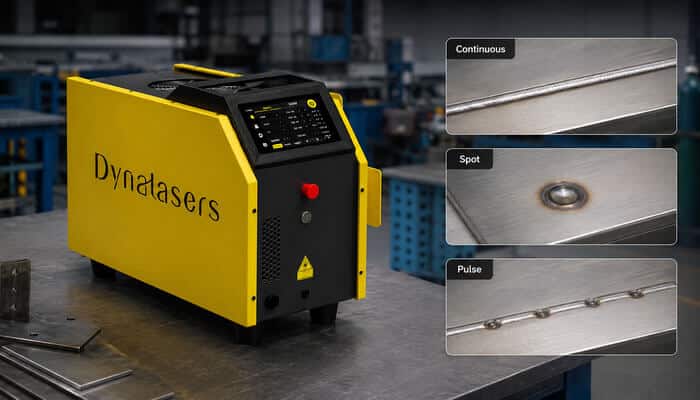
Its advantage is getting a fiber laser welding system into places where a larger cabinet becomes inconvenient. It also supports continuous, burst, and pulse modes, allowing the process to be adjusted for different welding conditions.
How Much Laser Power Do You Actually Need?
This is where specification sheets can lead buyers in the wrong direction.
More power generally provides additional penetration and process margin, but it does not automatically produce a better weld. Material, joint design, gap, focal position, beam movement, travel speed, filler wire, and shielding gas all interact.
A practical starting point is:
| Normal Workload | Dynalasers Direction |
| Thin sheet + frequent movement | S Series |
| Light-to-medium general fabrication | Lower-power M Series |
| Mixed everyday workshop work | M Series |
| Regular thicker material | Higher-power M / D |
| Higher-output stainless and aluminum work | D Series |
I would rather run an appropriately sized machine within a stable process window than buy substantially more power and spend most of the time turning it down.
A capable fiber laser welding machine supplier should therefore ask about the part before recommending wattage.
The Welding Gun Is Part of the Process
The laser source gets most of the attention, but the operator spends the shift holding the welding head.
Dynalasers uses a handheld gun weighing approximately 0.48 kg. That may seem like a minor specification until an operator starts welding around a large enclosure or frame for several hours.
Fatigue can affect travel speed, gun angle, stand-off, and filler-wire position. These variables influence weld consistency even when every setting on the machine remains unchanged.
For genuinely handheld production, I would compare gun weight and ergonomics alongside laser power.
What to Test Before Ordering
Before selecting a fiber laser welding machine manufacturer, send representative parts rather than relying only on demonstration coupons.
The supplier should know:
- Material and alloy
- Minimum and maximum thickness
- Joint type
- Normal production gap
- Required penetration
- Filler-wire requirements
- Expected operating time per shift
Ask for the settings used during the sample test as well. Power, travel speed, wobble settings, focus, shielding gas, and wire conditions make the result easier to evaluate.
For an important joint, appearance is not enough. A polished top bead can still hide poor penetration or incomplete fusion. A cross-section or suitable mechanical test gives much better information.
Source Warranty and After-Sales Support Matter
The laser source is one of the highest-value components in the machine.
Dynalasers uses a self-developed laser source and provides a two-year source warranty. Keeping the source and machine within the same product system can also simplify troubleshooting if a source-level issue occurs.
I would still check the smaller parts before purchasing. Protective lenses, nozzles, wire-feeder components, and other consumables should be easy to obtain.
For an overseas buyer, a $20 component with a long delivery time can cause more production trouble than a small difference in the original machine price.
FAQs
Can fiber laser welding be used without filler wire?
Yes. Close-fitting joints can often be welded autogenously. Filler wire becomes useful when there is a gap, additional material is required, or the desired bead profile cannot be achieved without it.
Can the same machine weld stainless steel and aluminum?
Yes, if its output is suitable, but the parameters should be established separately. Aluminum behaves differently from stainless steel and may require changes to power, speed, focus, wire, and shielding conditions.
Does a higher-power fiber laser always weld faster?
No. Higher available power can increase the process window, but welding speed is still limited by penetration requirements, material, joint design, wire feeding, and acceptable weld quality.
What consumables should a workshop keep in stock?
Protective lenses and nozzles are sensible starting points. Production users should also ask about commonly replaced welding-head and wire-feeder components.
Conclusion
Choosing a fiber laser welding machine manufacturer is easier when the decision starts with the normal workload rather than maximum wattage.
Dynalasers covers three useful ranges: the S Series for portability, M Series for mixed fabrication, and D Series for higher-output workshop work. With 700W to 1800W air-cooled options, the range gives fabricators room to match machine size and power to the parts they actually weld.
