


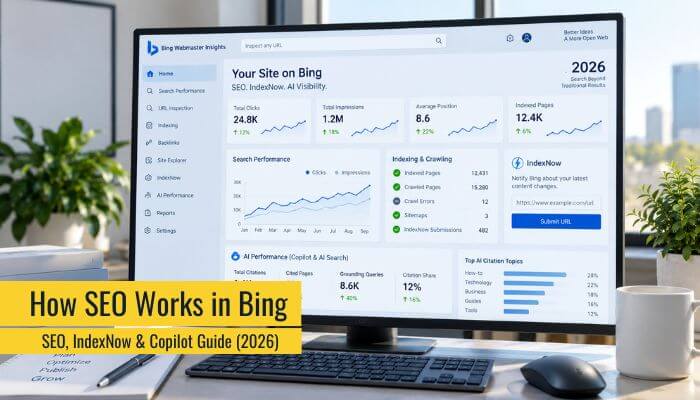

Understanding how SEO works in Bing in 2026 starts with a straightforward process. Microsoft Bing must discover your URL, crawl and render the page, understand its content, decide whether to index it, and evaluate whether it deserves visibility for a particular search.
What has changed is where that visibility can happen. Bing SEO is no longer limited to traditional search results. Well-structured webpages may also become sources in Microsoft Copilot, AI-generated Bing summaries, and other supported AI experiences.
This evolution changes the bigger picture of how SEO works in Bing. Microsoft’s search ecosystem now combines traditional SEO fundamentals with faster content discovery through IndexNow and AI visibility reporting in Bing Webmaster Tools, including citation and grounding data for supported AI-generated experiences.
Quick Answer
How SEO works in Bing can be understood through six core stages.
| Stage | What Happens |
|---|---|
| Discovery | Bing finds URLs through links, XML sitemaps, IndexNow, and other signals |
| Crawling | Bingbot visits accessible URLs and retrieves page resources |
| Rendering | Bing processes HTML, media, and supported JavaScript content |
| Indexing | Bing determines whether the URL belongs in its searchable index |
| Evaluation | Bing assesses relevance, usefulness, authority, freshness, structure, and technical signals |
| Visibility | The page may appear in Bing Search or supported AI-generated experiences |
A strong Bing SEO strategy therefore combines high-quality content, search intent, technical accessibility, internal linking, backlinks, canonical URLs, XML sitemaps, IndexNow, Bing Webmaster Tools, and AI-friendly content structure.
Key Takeaways
- Bing must discover, crawl, understand, and index a page before it can rank.
- Bing does not publish a fixed formula showing the exact weight of every ranking signal.
- Search intent and content usefulness matter more than repeating exact-match keywords.
- IndexNow can speed up discovery of URL changes but does not guarantee indexing or rankings.
- XML sitemaps and IndexNow should be used together rather than treated as alternatives.
- Bing Webmaster Tools is essential for monitoring queries, pages, crawling, indexing, backlinks, and AI visibility.
- Copilot citations are different from conventional rankings, clicks, and traffic.
- Clear headings, evidence, tables, concise answers, and entity clarity can make content easier for search and AI systems to understand.
- Canonicalization and duplicate-content management matter for both traditional search and AI visibility.
- SEO and Generative Engine Optimization increasingly overlap in Microsoft’s search ecosystem.
What Is Bing SEO?
Bing SEO is the process of improving a website so Microsoft Bing can efficiently discover, crawl, understand, index, and display its content for relevant searches.
It includes familiar SEO disciplines such as keyword research, search-intent analysis, technical SEO, content optimization, internal linking, link building, structured data, image optimization, canonicalization, sitemap management, and performance tracking.
The main difference in 2026 is that search visibility is broader. Microsoft now provides publishers with insight into how webpages can appear as cited sources in AI-generated experiences alongside conventional Bing Search.
How SEO Works in Bing Step by Step
Understanding the complete process makes Bing optimization much easier.
1. Bing Discovers Your URL
Before a webpage can appear in search, Bing must know that it exists.
Bing can discover pages through:
- Internal links
- Links from other websites
- XML sitemaps
- IndexNow submissions
Internal linking is especially important because it helps search engines understand both your site hierarchy and relationships between related topics.
For example, an article about Bing SEO could naturally link to separate guides covering IndexNow, technical SEO, structured data, XML sitemaps, keyword research, or AI search.
Important pages should not exist as isolated URLs with no internal links pointing toward them.
2. Bingbot Crawls the Page
After discovering a URL, Bingbot may request it.
Several technical problems can interfere with crawling, including blocked resources, server errors, broken pages, redirect loops, unnecessary URL parameters, excessive duplicate URLs, and poor site architecture.
Large websites should pay particular attention to crawl efficiency. If search engines repeatedly encounter thousands of low-value filter pages, duplicate archives, or parameter variations, they may spend unnecessary crawl resources away from more important URLs.
3. Bing Renders and Understands the Content
Modern websites frequently depend on JavaScript.
Important information should therefore remain easy for search engines to access and understand.
Critical content can include:
- Main article text
- Product information
- Navigation
- Headings
- Internal links
- Prices
- Business information
- Important calls to action
Pages that depend on complicated interactions before displaying their main information may be harder to process consistently.
4. Bing Decides Whether to Index the Page
Crawling does not automatically mean indexing.
Bing may visit a URL but decide that another version is more appropriate for the index or that the page does not provide enough unique value.
Possible indexing problems include:
- Thin content
- Duplicate content
- Incorrect canonical tags
noindexdirectives- Weak internal linking
- Rendering problems
- Scraped content
- Low-value parameter pages
- Large quantities of similar automatically generated pages
If an important page is missing from Bing, URL Inspection and other diagnostic tools in Bing Webmaster Tools should be among your first places to investigate.
How Does Bing Decide What Should Rank?
There is no publicly available Bing formula that assigns fixed percentages to backlinks, keywords, engagement, freshness, or other individual signals.
That means articles claiming exact Bing ranking-factor percentages should be treated cautiously.
When understanding how SEO works in Bing, it is more useful to focus on the core areas that can support stronger search visibility.
| SEO Priority | Why It Matters |
|---|---|
| Search intent | Content should solve the user’s actual problem |
| Relevance | The page should clearly address the topic being searched |
| Originality | Unique information gives the page a reason to exist |
| Authority | Trustworthy references and relevant links reinforce credibility |
| Technical accessibility | Bingbot needs reliable access to the content |
| Internal linking | Helps Bing discover pages and understand relationships |
| Canonicalization | Consolidates signals around the preferred URL |
| Freshness | Current information matters for topics that change over time |
| Clear structure | Headings and sections make content easier to understand |
| Multimedia relevance | Relevant images and videos can reinforce the main topic |
Rather than optimizing for one supposed ranking factor, focus on creating a technically accessible, relevant, original, well-structured page that genuinely satisfies the searcher’s intent.
Search Intent Matters More Than Keyword Density
Someone trying to understand Bing SEO usually wants more than a simple definition. They may also want to know how Bing crawls websites, how pages become indexed, which optimization practices matter, whether backlinks are important, how IndexNow works, and how Microsoft Copilot affects search visibility.
That is why understanding how SEO works in Bing requires covering the broader search intent rather than repeatedly using one exact-match phrase.
A competitive page should answer the main query while naturally covering related concepts such as:
- Bing SEO
- Bing ranking factors
- Bing Webmaster Tools
- Bing indexing
- Bingbot
- IndexNow
- XML sitemaps
- Microsoft Copilot
- AI search optimization
- Technical SEO
- Structured data
- Grounding queries
- Bing search visibility
The goal is topical relevance and usefulness, not artificial keyword density.
Does Bing Still Care About Keywords?
Yes. Keywords still help search engines understand a page’s subject and relevance, but they should appear naturally.
Important locations can include the:
- SEO title
- H1
- Introduction
- Relevant H2 and H3 headings
- Main content
- URL slug
- Internal-link anchor text
- Descriptive image alt text
A well-optimized Bing SEO article should sound as though it was written to answer a reader’s question, not to satisfy a keyword counter.
Use relevant variations such as Bing search optimization, Bing indexing, Bing ranking factors, Bing Webmaster Tools, and Copilot SEO where they genuinely improve context. This creates stronger topical coverage without unnecessary repetition.
Content Quality and Original Value
Search engines already have access to millions of pages covering basic SEO topics. To compete, your content needs to offer something useful beyond information that has already been repeated across other websites.
When learning how SEO works in Bing, content quality matters because a strong page should clearly satisfy the searcher’s intent while providing accurate, useful, and distinctive information.
Original value can come from:
- Better explanations
- Current information
- First-hand experience
- Original screenshots or examples
- Expert commentary
- Useful comparisons
- Original research or data
- Step-by-step instructions
- Troubleshooting guidance
- Primary-source references
Do not add extra paragraphs simply to increase word count. Each section should help answer the searcher’s question, explain an important concept, or provide information that competing pages may have missed.
The goal is to create a resource useful enough that readers do not immediately need another article to understand the topic.
Do Backlinks Matter for Bing?
Yes. Relevant backlinks can help search engines discover webpages and provide signals about their authority and credibility.
However, backlink quality and relevance matter more than simply accumulating large numbers of links.
Valuable backlinks may come naturally from:
- Industry publications
- Professional organizations
- Reputable news websites
- Research publications
- Relevant blogs
- Business partners
- Educational resources
- High-quality resource pages
The best approach is to publish content that other websites have a genuine reason to reference.
Avoid buying large quantities of low-quality links, participating in artificial link schemes, or creating networks designed primarily to manipulate search rankings.
Internal Linking for Bing SEO
Internal linking helps both visitors and Bingbot navigate your website while showing how individual pages and topics relate to one another.
A clear internal-linking structure can help Bing understand:
- Which pages are important
- How topics are connected
- Your website hierarchy
- Which pages form a topical cluster
- How Bingbot can discover deeper pages
- Which page provides more detailed information about a related subject
Use descriptive anchor text that tells readers what they can expect after following the link.
Weak anchor text:
Click here
Better anchor text:
Bing Webmaster Tools guide
Better anchor text:
Technical SEO checklist
For example, an article about Bing SEO could naturally link to separate guides covering IndexNow, XML sitemaps, technical SEO, structured data, keyword research, and Bing Webmaster Tools.
Internal links should primarily help readers navigate to useful related information. When they are relevant and descriptive, they also create a clearer website structure for search engines.
What Is IndexNow?
IndexNow is an open protocol that allows websites to notify participating search engines when a URL has been created, updated, or deleted.
Instead of relying only on search-engine crawlers to eventually discover a change, a website can proactively send a notification that a URL has changed and may need to be crawled again.
This is an important part of understanding how SEO works in Bing, especially for websites that publish or update content frequently.
However, an IndexNow submission is only a notification. It does not guarantee that the submitted URL will be crawled immediately, indexed, or ranked higher.
The IndexNow protocol supports submitting a single URL or multiple URLs, with up to 10,000 URLs in one POST request.
How Does IndexNow Work?
The basic IndexNow process is straightforward:
- Your website publishes, updates, or removes a URL.
- The changed URL is submitted through IndexNow.
- Participating search engines receive the notification.
- Each search engine decides whether and when to crawl the URL.
- The search engine processes the page using its normal crawling, indexing, and search-quality systems.
In simple terms:
Publish or update URL → Submit through IndexNow → Search engine receives notification → URL may be crawled → Normal indexing and ranking evaluation continues
IndexNow therefore improves URL-change discovery and freshness communication. It does not bypass a search engine’s normal quality or indexing systems.
Does IndexNow Improve Bing Rankings?

Not directly.
IndexNow is primarily a discovery and freshness mechanism, not a direct ranking factor or guaranteed ranking boost.
Its main advantage is helping Bing learn about important URL changes without relying entirely on traditional crawling.
This can be particularly useful for websites with frequently changing content, such as:
- News websites
- E-commerce stores
- Job boards
- Classified websites
- Event websites
- Product catalogs
- Frequently updated blogs
For example, an online store could use IndexNow after a product becomes unavailable, while a news publisher could send a notification after publishing or substantially updating an article.
However, submitting a page through IndexNow does not make weak content competitive.
The page still needs strong fundamentals such as:
- Relevant and useful content
- Clear search intent
- Technical accessibility
- Appropriate internal linking
- Accurate canonicalization
- Trustworthy authority signals
- Good overall page quality
Think of IndexNow as a way to tell Bing “this URL changed”, not “rank this URL higher.”
How to Use IndexNow on WordPress
WordPress site owners usually do not need to build an IndexNow API system manually.
Many SEO plugins, caching systems, hosting providers, and content-management integrations can handle submissions automatically.
A practical workflow is
- Enable IndexNow through a compatible plugin or service.
- Confirm that your domain is properly configured.
- Publish or substantially update your page.
- Verify that the URL is submitted.
- Keep important canonical pages in your XML sitemap.
- Monitor indexing and performance through Bing Webmaster Tools.
Avoid repeatedly submitting the same unchanged URL in the hope of forcing higher rankings.
Do You Still Need an XML Sitemap With IndexNow?
Yes. Using IndexNow does not eliminate the need for an XML sitemap because the two serve different purposes.
IndexNow notifies participating search engines when individual URLs are created, updated, or deleted.
XML sitemaps provide search engines with a structured list of important URLs that you want them to discover and process.
For most websites, the strongest approach is to use IndexNow and XML sitemaps together rather than choosing one over the other.
A well-maintained XML sitemap should:
- Include important canonical URLs
- Reflect the current structure of your website
- Remove deleted URLs
- Avoid unnecessary redirected URLs
- Exclude low-value duplicate URLs
- Use accurate
lastmodinformation when content has meaningfully changed
Do not automatically change every lastmod date each day when the underlying content has not been updated. Accurate modification dates provide a more useful freshness signal than artificial date changes.
In simple terms:
XML Sitemap = Important URL inventory
IndexNow = Fast URL-change notification
Using both creates a more complete discovery strategy.
Why Content Freshness Matters for Bing SEO
Freshness is another useful part of understanding how SEO works in Bing, particularly for topics where information changes frequently.
However, freshness does not simply mean changing the publication or “Last Updated” date on an old article.
A genuinely fresh page contains meaningful improvements or updated information.
For an SEO article, a substantial update might include:
- New Bing Webmaster Tools features
- Changes to Microsoft guidance
- New IndexNow capabilities
- Updated screenshots
- New AI search features
- Revised statistics or research
- New examples
- Corrected outdated information
- Improved instructions based on current tools
For evergreen topics, you do not need to rewrite an article constantly. Update it when new information materially improves accuracy or usefulness.
For fast-changing topics such as technology, news, products, prices, regulations, or AI search, more frequent reviews may be appropriate.
The goal is meaningful freshness, not simply making an old page look new.
What Is Bing Webmaster Tools?
Bing Webmaster Tools is Microsoft’s platform for website owners, publishers, and SEO professionals who want to understand and improve their visibility in Bing Search.
It provides tools and reports for monitoring how Bing discovers, crawls, indexes, and surfaces website content.
For anyone learning how SEO works in Bing, Bing Webmaster Tools is particularly valuable because it connects SEO strategy with real search, crawling, indexing, backlink, and AI visibility data.
Key Bing Webmaster Tools Features
| Feature | What It Helps You Do |
|---|---|
| Search Performance | Monitor search impressions, clicks, queries, pages, and other performance data |
| URL Inspection | Investigate how Bing sees a specific URL |
| Site Explorer | Explore your website structure as understood by Bing |
| Keyword Research | Discover keywords, related queries, trends, and content opportunities |
| Backlinks | Review links pointing to your website |
| Sitemaps | Submit and monitor XML sitemap files |
| IndexNow | Help Bing discover new, updated, or deleted URLs faster |
| Site Scan | Identify common technical SEO issues |
| Crawl Tools | Review and manage aspects of Bingbot crawling |
| AI Performance | Analyze how your content appears as citations in supported AI-generated experiences |
Bing Webmaster Tools should be part of an ongoing SEO workflow rather than something you open only when rankings or indexing go wrong.
A practical routine is to use it to:
- Monitor important search queries and pages
- Inspect URLs with indexing problems
- Check XML sitemap status
- Review backlinks
- Identify technical SEO issues
- Monitor Bingbot activity
- Find new keyword opportunities
- Track AI citations and grounding visibility
Combining these reports can help you identify whether a problem is related to discovery, crawling, indexing, content relevance, technical SEO, or search visibility.
Bing AI Performance in 2026
Microsoft introduced AI Performance in Bing Webmaster Tools as a public preview on February 10, 2026. It gives publishers greater insight into how their webpages appear as citations across supported AI-powered experiences, including Microsoft Copilot, AI-generated summaries in Bing, and select partner integrations.
For publishers learning how SEO works in Bing, this is important because search visibility can now be evaluated beyond traditional rankings, impressions, and clicks.
Key Bing AI Performance Metrics
| Metric | What It Shows |
|---|---|
| Total Citations | How often content from your website was visibly cited in supported AI-generated answers |
| Cited Pages | Which URLs from your website appeared as cited sources |
| Average Cited Pages | The average number of unique pages from your site cited per day during the selected period |
| Grounding Queries | Grouped phrases associated with retrieval that resulted in your content being cited |
| Page-Level Citation Activity | Citation activity associated with individual pages |
Total Citations
Total Citations shows how often content from your website was visibly referenced as a source in supported AI-generated answers.
This can help you track changes in AI visibility over time. However, a citation does not automatically mean that a user visited or clicked your website.
Cited Pages
Cited Pages helps identify which URLs from your website are appearing as sources.
Reviewing these pages can reveal which topics, content formats, or sections of your website are gaining greater visibility in AI-powered experiences.
Average Cited Pages
Average Cited Pages measures the average number of unique pages from your website cited per day during the selected period.
This metric can help you understand whether AI citation visibility is concentrated on a small number of URLs or distributed across more of your content.
It should not be interpreted as a traditional ranking or authority score.
Grounding Queries
Grounding Queries are grouped phrases associated with information retrieval that resulted in your content being cited.
They are not necessarily the exact prompts or questions entered by individual users.
Publishers can use grounding-query data to better understand the topics and concepts for which their content is being retrieved and referenced.
Page-Level Citation Activity
Page-Level Citation Activity helps identify citation activity associated with individual URLs.
This can be useful for discovering which pages frequently contribute information to supported AI-generated answers and which pages may have opportunities for further improvement.
What These Metrics Do Not Tell You
AI Performance data should not be confused with conventional search-performance data.
A high number of citations does not automatically mean:
- Higher Bing rankings
- More organic clicks
- Greater website authority
- More conversions
- A number-one search position
Instead, these metrics provide another layer of visibility data that publishers can use alongside traditional SEO measurements such as impressions, clicks, queries, average position, and conversions.
Intents, Topics, Citation Share, and Compare
Bing has expanded AI Performance with additional preview capabilities that help publishers understand AI visibility beyond basic citation counts. These insights are useful when analyzing how SEO works in Bing across AI-powered search experiences.
| Feature | What It Shows |
|---|---|
| Intents | Groups grounding queries by purpose, such as informational, commercial, research, comparison, planning, or local |
| Topics | Organizes related grounding queries into broader themes |
| Citation Share | Shows your site’s percentage of citations for a particular grounding query |
| Compare | Compares current AI Performance data with a previous period |
Citation Share is different from Total Citations. Total Citations measures how often your content is cited, while Citation Share shows your relative share of citations for a particular grounding query.
These metrics can help identify topics, search intent, citation trends, and changes in AI visibility. However, they should not be treated as direct ranking, traffic, or website-quality scores.
Understanding these differences provides a more complete picture of how SEO works in Bing as traditional search and AI-powered discovery increasingly overlap.
How to Optimize Content for Bing Copilot
There is no guaranteed method for making Copilot cite a webpage. A stronger approach is to make your information clear, accessible, current, easy to understand, and supported by reliable evidence.
This is increasingly relevant when understanding how SEO works in Bing across both traditional search and AI-powered experiences.
To make content easier for users and AI systems to understand:
- Answer the main question early: Give readers a direct answer before adding detailed background.
- Use descriptive headings: A heading such as Does IndexNow Improve Bing Rankings? is clearer than More Information.
- Make important facts self-contained: Write key statements so they still make sense when viewed outside the surrounding paragraph.
- Use tables for comparisons: Tables work well for tools, features, technical requirements, and Bing vs Google comparisons.
- Use lists for steps: Bullets and numbered lists can make processes and requirements easier to scan.
- Support important claims: Reference official documentation, original research, reliable statistics, expert sources, or clear examples where appropriate.
- Keep information current: Review changing facts, screenshots, statistics, product features, and technical guidance regularly.
- Maintain consistency: Important facts should remain clear and consistent across your text, images, tables, and other relevant content.
A useful content structure is:
Question → Direct Answer → Explanation → Evidence → Example
The goal is not to write specifically for an AI system. It is to publish useful, trustworthy, well-structured content that readers can understand and that search and AI systems can accurately interpret.
SEO vs GEO in Bing
Generative Engine Optimization (GEO) focuses on improving how content can participate in AI-powered experiences, including retrieval, grounding, and citations.
SEO and GEO overlap significantly. Understanding both provides a more complete picture of how SEO works in Bing as traditional search and AI-powered discovery continue to develop.
| Traditional SEO | GEO / AI Visibility |
|---|---|
| Targets conventional search visibility | Targets visibility in AI-powered experiences |
| Measures rankings, impressions, and clicks | Adds citation and grounding metrics |
| Requires crawlability and indexability | Also depends on accessible content |
| Benefits from authority and trust | Benefits from clear, verifiable information |
| Focuses on search intent | Adds conversational and semantic context |
| Uses clear page structure | Benefits from easily retrievable sections |
| Requires useful content | Also depends on useful, accurate content |
The practical takeaway is simple: do not create low-quality pages solely for AI systems.
Instead, create useful webpages for people that are technically accessible, well-structured, trustworthy, and clear enough for both traditional search engines and AI-powered systems to understand.
Entity Clarity and Bing SEO
Search and AI systems need to understand the people, companies, products, tools, and organizations mentioned on a page.
Avoid relying too heavily on vague references such as the company, the tool, or the platform. When appropriate, use clear entity names such as Microsoft Bing, Bing Webmaster Tools, Microsoft Copilot, and IndexNow.
Consistent terminology, author information, organization details, internal links, and structured data can further reduce ambiguity.
The goal is clarity, not repetition.
Does Structured Data Help Bing SEO?
Structured data provides machine-readable information that can help search engines better understand a page.
Depending on the content, relevant schema types can include:
- Article
- Organization
- Person
- Product
- LocalBusiness
- BreadcrumbList
- Event
- VideoObject
Structured data should accurately represent visible page content. It can improve understanding, but it is not a guaranteed ranking boost.
Bing Image and Video SEO
Understanding multimedia optimization is another useful part of how SEO works in Bing.
For images, use:
- Descriptive filenames
- Accurate alt text
- Relevant captions
- Useful surrounding text
For videos, consider:
- Descriptive titles
- Captions and transcripts
- Relevant descriptions
- Useful thumbnails
- Appropriate structured data
Avoid forcing your focus keyword into every image alt attribute. Alt text should primarily describe the image accurately.
Important information should also be available in text rather than existing only inside an image or video.
Why Canonical URLs Matter
Canonicalization helps search engines identify the preferred version when similar or duplicate URLs exist.
For example:
example.com/bing-seo
example.com/bing-seo?utm=email
example.com/bing-seo?ref=home
Use canonical tags, clean URLs, appropriate redirects, consistent internal links, and accurate XML sitemaps to reinforce the preferred URL.
This is particularly important for large websites, e-commerce stores, and sites that automatically generate URL parameters.
Why Bing May Crawl but Not Index a Page
If Bingbot visits your URL but it still does not appear in search, investigate the underlying cause.
Check whether:
- The URL returns HTTP 200.
- A
noindexdirective is present. - Another URL is selected as canonical.
- The page contains enough original value.
- Important content renders correctly.
- Internal links point toward the page.
- The canonical URL appears in your sitemap.
- Duplicate versions are competing.
- Low-value URLs are consuming crawl resources.
- Bing Webmaster Tools reports a problem.
Repeatedly submitting the same unchanged URL through IndexNow is not a solution to quality or technical problems.
Robots.txt vs Noindex in Bing SEO
Understanding the difference between robots.txt and noindex is an important technical part of how SEO works in Bing because they serve different purposes.
| Directive | Main Purpose |
|---|---|
robots.txt |
Controls whether crawlers can access specific areas or URLs |
noindex |
Instructs search engines not to include a page in the searchable index |
A robots.txt block should not be treated as a substitute for noindex. If you want a page excluded from search results, use the appropriate indexing directive while allowing the crawler to access it so the directive can be discovered.
When an important page unexpectedly disappears from Bing, check its robots.txt rules, meta robots directives, HTTP headers, canonical tags, and URL Inspection data before assuming the problem is related to content quality.
Crawl Efficiency and Crawl Waste
Crawl efficiency becomes more important as a website grows.
Common sources of unnecessary crawl activity include:
- Internal search pages
- Sorting parameters
- Filter combinations
- Session URLs
- Duplicate archives
- Calendar pages
- Endless faceted-navigation combinations
Reduce crawl waste by keeping internal linking clean, using canonical tags consistently, maintaining focused XML sitemaps, removing unnecessary URLs, and preventing endless low-value URL variations.
Bing SEO vs Google SEO
You generally do not need completely different SEO strategies for Bing and Google. Many core principles overlap, although each search engine has its own tools, systems, and features.
Understanding these similarities and differences provides useful context for how SEO works in Bing compared with Google.
| SEO Practice | Bing | |
|---|---|---|
| Helpful, original content | Important | Important |
| Search intent | Important | Important |
| Crawlable internal links | Important | Important |
| Clear titles and headings | Important | Important |
| Technical accessibility | Important | Important |
| Canonicalization | Important | Important |
| Structured data | Useful | Useful |
| Quality backlinks | Valuable | Valuable |
| XML sitemaps | Supported | Supported |
| IndexNow | Supported | Not Google’s primary URL-update method |
| Webmaster platform | Bing Webmaster Tools | Google Search Console |
| AI search visibility | Bing/Copilot experiences | Google AI search experiences |
The best approach is to create one high-quality page around genuine user intent rather than producing nearly identical Bing-specific and Google-specific versions solely for search engines.
Optimize the fundamentals well, then use platform-specific tools such as Bing Webmaster Tools, IndexNow, and Google Search Console where appropriate.
Common Bing SEO Mistakes
Even after understanding how SEO works in Bing, avoid common mistakes that can weaken search visibility or create technical problems.
- Keyword stuffing: Do not force exact-match keywords into every paragraph. Write naturally and use relevant variations.
- Publishing thin AI content: AI can assist with research and drafting, but generic content without accuracy checks, original value, or editorial oversight adds little value.
- Copying competitors: Do not simply rewrite what already ranks. Add better explanations, examples, evidence, research, or practical insights.
- Buying low-quality links: Focus on earning relevant, trustworthy backlinks rather than accumulating artificial links.
- Assuming IndexNow guarantees rankings: IndexNow helps notify search engines about URL changes. It does not guarantee indexing or higher rankings.
- Ignoring canonicalization: Duplicate and parameterized URLs can make it harder to identify the preferred version of a page.
- Changing dates without meaningful updates: Real freshness comes from updating the actual information, not simply changing the publication date.
- Treating AI citations like rankings: A citation means your content was referenced in a supported AI experience. It does not automatically indicate a top ranking, click, or conversion.
The best way to avoid these mistakes is to focus on useful content, technical accessibility, natural optimization, accurate information, and a strong user experience.
How to Measure Bing SEO Performance
Understanding how SEO works in Bing also means measuring whether your optimization efforts are improving traditional search visibility, AI visibility, and business results.
| Area | Metrics to Monitor |
|---|---|
| Traditional Search | Impressions, clicks, CTR, queries, average position |
| Indexing & Technical SEO | Indexed URLs, crawling issues, sitemap status |
| Authority | Backlinks and referring sources |
| AI Visibility | Total citations, cited pages, grounding queries, Citation Share, intents, topics |
| Business Results | Leads, sales, sign-ups, and organic conversions |
Use Bing Webmaster Tools to monitor search and AI visibility, then combine that information with your website analytics and conversion data.
Do not evaluate success from one metric alone. Higher rankings or more AI citations are useful only when they contribute to meaningful visibility, engagement, or business results.
Practical Bing SEO Workflow for 2026
Once you understand how SEO works in Bing, use this practical workflow when publishing a new page or improving existing content:
- Identify search intent and choose one clear primary topic.
- Research relevant keywords, questions, and competing results.
- Find content gaps that competing pages have not answered well.
- Answer the primary question early before adding deeper explanations.
- Add original value through examples, research, experience, or useful insights.
- Optimize the SEO title, H1, and headings naturally.
- Add relevant internal links using descriptive anchor text.
- Support important claims with reliable sources and evidence.
- Optimize useful images and videos with descriptive supporting information.
- Add appropriate structured data when it accurately represents the page.
- Check technical SEO, including crawlability, indexability, canonicalization, and redirects.
- Include the canonical URL in your XML sitemap.
- Use IndexNow after publishing or making meaningful updates.
- Inspect and monitor the page in Bing Webmaster Tools.
- Track search and AI visibility, then update the page when facts, features, or search intent meaningfully change.
SEO is an ongoing process. Publishing the page is only the beginning. Continue monitoring performance, correcting technical issues, and improving the content when new information adds genuine value.
Conclusion
Understanding how SEO works in Bing in 2026 means looking beyond traditional rankings. Bing still relies on the fundamentals of discovering, crawling, rendering, indexing, and evaluating webpages, but those foundations now also support Microsoft Copilot and other AI-powered search experiences.
The best strategy is not to chase a secret Bing ranking formula. Instead, publish genuinely useful content, satisfy search intent, maintain strong technical SEO, build relevant internal links, earn trustworthy backlinks, use canonical URLs correctly, keep XML sitemaps accurate, and use IndexNow after meaningful changes.
Bing Webmaster Tools can then help you monitor both traditional search performance and emerging AI visibility.
Ultimately, learning how SEO works in Bing comes down to combining useful content, technical accessibility, authority, efficient discovery, and clear structure. Websites that consistently follow these principles are better prepared to earn visibility across both conventional Bing Search and Microsoft’s evolving AI-powered experiences.
FAQs About How SEO Works in Bing
1. How long does Bing SEO take to work?
There is no fixed timeframe. When understanding how SEO works in Bing, remember that crawling, indexing, competition, content quality, authority, and technical health can all affect how quickly visibility changes.
2. Can a new website rank on Bing?
Yes. New websites can rank on Bing when their pages are crawlable, useful, relevant, properly indexed, and supported by a strong site structure. How SEO works in Bing is not based solely on domain age.
3. Does website speed affect Bing SEO?
Website performance contributes to a better user experience and technical foundation. As part of how SEO works in Bing, publishers should maintain fast, accessible, mobile-friendly pages rather than focusing only on keywords.
4. Does Bing SEO work for small websites?
Yes. Understanding how SEO works in Bing can benefit small websites because focused, original pages can target specific search intent without requiring thousands of published URLs.
5. Can Bing SEO help local businesses?
Yes. Local businesses can improve Bing visibility by maintaining accurate business information, creating useful location-relevant content, and following strong local SEO practices. This is another practical application of how SEO works in Bing.
6. Should I submit every new page manually to Bing?
Usually, manual submission should not be your only discovery method. A strong setup combines crawlable internal links, XML sitemaps, and supported URL-notification methods. Understanding these discovery methods is part of how SEO works in Bing.
7. Can old content rank well on Bing?
Yes. Older content can remain useful when it continues to satisfy search intent and remains accurate. How SEO works in Bing involves relevance and usefulness rather than simply favoring the newest publication date.
8. Does Bing SEO require a specific word count?
No fixed word count guarantees rankings. When applying how SEO works in Bing, write enough to answer the query thoroughly without adding unnecessary paragraphs simply to make an article longer.
