




Finding an online tool is easy. Finding one that is actually worth adding to your workflow is much harder. That is the problem behind searches for Zardgadjets Best Online Tool Guide by FeedBuzzard: people do not need another enormous list of apps. They need to know which tools solve real problems, which free versions are useful, where paying makes sense, and which platforms may simply duplicate something they already have.
That distinction matters even more in 2026. Productivity platforms are becoming AI workspaces, design apps are developing agentic features, research tools can search and synthesize information, and automation platforms increasingly connect AI with business applications.
The result is more capability—but also more overlap, more subscriptions, and more decisions.
This Zardgadjets Best Online Tool Guide by FeedBuzzard takes a practical approach. Instead of treating every popular platform as a must-have, it examines which types of online tools genuinely deserve a place in a modern digital toolkit and how to decide whether a free or paid service is worth using.
Quick Answer
If you searched for Zardgadjets Best Online Tool Guide by FeedBuzzard because you want useful online tools in 2026, you probably do not need dozens of applications.
A practical general-purpose toolkit can be built around the following options:
| Tool | Best For | Why It Stands Out |
|---|---|---|
| ChatGPT | AI assistance | Writing, analysis, research, coding, and workflows |
| Perplexity | Web research | Source-oriented research and deeper searches |
| Notion | Knowledge management | Documents, databases, projects, search, and AI |
| Canva | Visual content | Fast design and AI-assisted creative workflows |
| Google Workspace | Everyday work | Email, documents, spreadsheets, files, and collaboration |
| Zapier | Automation | Connects applications and automates repetitive workflows |
| Grammarly | Writing improvement | Editing, rewriting, tone, and clarity |
| Bitwarden | Password security | Password management across devices |
| Google Search Console + Ahrefs Free | SEO | Website performance, technical SEO, and search analysis |
| Descript | Video and podcast editing | Transcript-based audio and video editing |
| Adobe Acrobat Online | PDF utilities | Editing, converting, compressing, merging, and signing PDFs |
The important lesson is not to install every tool on this list. The most useful takeaway from the Zardgadjets Best Online Tool Guide by FeedBuzzard is to choose software based on the problems you repeatedly need to solve, rather than collecting tools simply because they are popular.
Key Takeaways
- Zardgadjets Best Online Tool Guide by FeedBuzzard is best treated as a search topic surrounding digital-tool discovery rather than automatically assuming it refers to one standalone software platform.
- ZardGadjet describes itself as a blog covering gadgets, online tools, tutorials, and technology information.
- FeedBuzzard operates separately as a technology-focused publication covering areas such as software, technology, web tools, productivity, and related resources.
- The best online tools increasingly combine several functions instead of performing only one narrow task.
- AI is becoming integrated into productivity, design, research, writing, and automation platforms.
- More software does not automatically create more productivity.
- Free plans can be sufficient for occasional users.
- Paid plans make more sense when software saves measurable time, improves collaboration, or replaces several subscriptions.
- Privacy, exportability, integrations, and account security should be considered alongside features.
- A digital toolkit should be reviewed regularly because features, prices, and free-plan limits can change.
What Is Zardgadjets Best Online Tool Guide by FeedBuzzard?
The phrase Zardgadjets Best Online Tool Guide by FeedBuzzard appears in search results associated with digital-tool guides covering areas such as productivity, creative software, artificial intelligence, research, communication, file utilities, and everyday technology.
ZardGadjet.org currently describes itself as a blog dedicated to gadgets and online tools. Its technology archive also contains an article titled “ZardGadjets Best Online Tool Guide by FeedBuzzard: A Complete,” published on March 6, 2026.
However, that does not necessarily establish the phrase as the name of one standalone FeedBuzzard software platform.
FeedBuzzard’s own About page describes the publication as covering technology, software breakthroughs, how-to content, world technology, and wearable technology. A separate 2026 FeedBuzzard page also describes its coverage as including web tools, productivity, privacy, and small-business resources.
For readers, the more useful question is therefore:
Which online tools are genuinely useful in 2026, and which ones are worth your time or money?
That is the question this guide focuses on.
ZardGadjets vs FeedBuzzard: Are They the Same Platform?
One confusing part of researching Zardgadjets Best Online Tool Guide by FeedBuzzard is understanding how the two names relate.
ZardGadjet.org presents itself as an informational technology blog focused on gadgets and online tools. FeedBuzzard operates a separate website and describes itself as a technology-oriented publication.
Therefore, readers should not automatically assume that every website or article using the terms “Zardgadjets” and “FeedBuzzard” belongs to the same software company, application, or online-tool directory.
Before registering, paying, downloading software, or uploading files through a site you discover in these searches:
- Check the exact domain name.
- Read its About page.
- Review its Privacy Policy.
- Verify whether recommendations link to official providers.
- Avoid assuming similarly named domains have the same ownership.
- Download software from the official developer whenever possible.
- Check current features and pricing directly with the provider.
For practical purposes, this article uses Zardgadjets Best Online Tool Guide by FeedBuzzard as a starting point for evaluating useful online tools in 2026 rather than treating the phrase as the name of one universal software suite.
What Makes an Online Tool Worth Using in 2026?
A useful online tool should earn its place in your workflow. For the Zardgadjets Best Online Tool Guide by FeedBuzzard, popularity alone is not enough—we looked for tools that solve a recurring problem without creating unnecessary cost or complexity.
Five questions matter most:
- Does it solve something you do regularly? A specialized tool used twice a year may not deserve another subscription.
- Does it genuinely save time? Setup, maintenance, prompts, exports, and troubleshooting all count against the time a tool claims to save.
- Does it fit your existing workflow? A slightly less powerful tool with strong integrations can be more useful than a feature-rich platform that operates in isolation.
- Is paying for it justified? A subscription makes sense when it removes repetitive work, replaces another service, or provides capabilities you regularly need.
- Would you trust it with your data? Before connecting accounts or uploading files, check permissions, retention policies, export options, and security controls.
The real test is simple: if removing the tool tomorrow would barely affect your work, you probably do not need to pay for it.
How We Decided Which Online Tools Are Actually Worth Using
For the Zardgadjets Best Online Tool Guide by FeedBuzzard, we looked beyond popularity and compared tools using practical factors that affect everyday use.
| Evaluation Factor | What Matters |
|---|---|
| Real usefulness | Does it solve a recurring problem? |
| Time saved | Does it reduce meaningful manual work? |
| Free-plan value | Can you test it before paying? |
| Integrations | Does it work with tools you already use? |
| Security and trust | Are privacy and account controls clearly explained? |
| Replacement value | Can it replace other subscriptions? |
| Ease of use | Can you get value without excessive setup? |
| Long-term value | Is it useful beyond a temporary trend? |
This is a research-based comparison, not a claim that every product was personally tested for months. Current product documentation and official provider information were prioritized when checking 2026 features.
Because features, pricing, and usage limits can change, always confirm important details with the provider before subscribing.
Best Online Tools Actually Worth Using in 2026
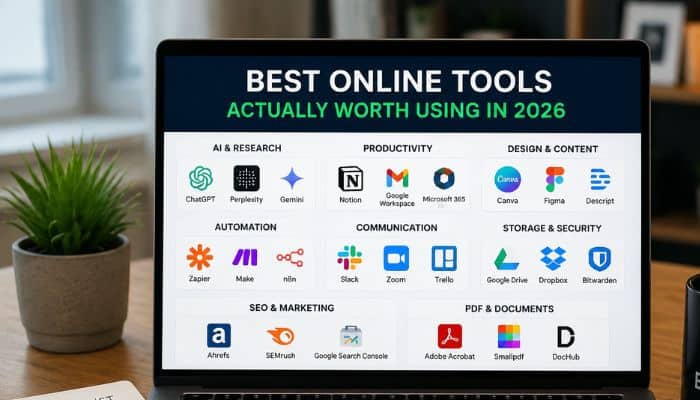
The Zardgadjets Best Online Tool Guide by FeedBuzzard covers tools for different needs, from AI and research to design, security, SEO, and file management. The best choice depends on the problem you need to solve rather than which platform has the longest feature list.
1. ChatGPT—Best General-Purpose AI Workspace

ChatGPT is one of the most flexible tools on this list because it can handle research, writing, coding, analysis, planning, and document work in one place.
- Best for: writers, marketers, developers, researchers
- Strong point: broad range of tasks in one workspace
- Useful for: drafting, summarizing, analysis, brainstorming
- Watch out for: factual errors and overconfident answers
Verdict: A strong all-round AI tool if you regularly work with information or content.
2. Perplexity — Best for Web Research

Perplexity is more research-focused than many general AI assistants and works well when you want current information supported by sources.
- Best for: research, comparisons, statistics, source discovery
- Strong point: source-oriented answers
- Useful for: competitor research and topic exploration
- Watch out for: citations still need manual checking
Verdict: Best suited to users who frequently begin tasks with web research.
3. Notion — Best for Knowledge and Project Management

Notion combines documents, databases, projects, notes, and AI features inside one workspace.
- Best for: teams, publishers, freelancers
- Strong point: flexible organization
- Useful for: content calendars, SOPs, research libraries
- Watch out for: overcomplicated dashboards
Verdict: Excellent for structured workflows, but unnecessary for simple task lists.
4. Canva — Best for Fast Visual Creation

Canva makes it easy to create professional-looking graphics without learning advanced design software.
- Best for: bloggers, marketers, small businesses
- Strong point: fast visual creation
- Useful for: featured images, social posts, presentations
- Watch out for: less control than advanced professional design tools
Verdict: One of the easiest tools for producing everyday visual content quickly.
5. Google Workspace — Best for Everyday Productivity

Google Workspace combines email, documents, spreadsheets, storage, calendars, and meetings in one familiar ecosystem.
- Best for: businesses and collaborative teams
- Strong point: close integration between everyday work tools
- Useful for: email, files, documents, meetings
- Watch out for: paid plans may be unnecessary for solo users
Verdict: A practical foundation for teams already relying on Google services.
6. Zapier — Best for Automation

Automation deserves a place in the Zardgadjets Best Online Tool Guide by FeedBuzzard because repetitive work between apps can consume hours without adding much value. Zapier connects different applications and automates many of those routine actions.
- Best for: businesses and power users
- Strong point: reducing manual cross-app work
- Useful for: lead management, notifications, data updates
- Watch out for: automating a poor workflow can make it worse
Verdict: Highly useful when you repeatedly move information between applications.
7. Grammarly — Best for Writing Improvement

Grammarly helps improve clarity, tone, grammar, and sentence structure while you write.
- Best for: writers, professionals, marketers
- Strong point: works inside everyday writing environments
- Useful for: emails, reports, blogs, client communication
- Watch out for: free features may already cover basic needs
Verdict: Useful when writing quality directly affects your work.
8. Bitwarden — Best for Password Security

Bitwarden helps manage unique passwords and credentials across devices.
- Best for: anyone managing multiple online accounts
- Strong point: capable free password-management option
- Useful for: passwords, logins, credential organization
- Watch out for: account security still depends on good setup
Verdict: Less flashy than productivity software, but potentially more important.
9. Google Search Console + Ahrefs Free — Best for SEO

Google Search Console helps website owners understand Google Search performance, while Ahrefs Free adds technical and SEO analysis for verified sites.
- Best for: bloggers, publishers, SEO professionals
- Strong point: useful website data without immediately paying for advanced software
- Useful for: clicks, impressions, indexing, technical audits
- Watch out for: deeper competitor research may require paid tools
Verdict: One of the strongest free starting combinations for website owners.
10. Descript — Best for Video and Podcast Editing

Descript makes spoken audio and video easier to edit by allowing creators to work through a transcript.
- Best for: podcasters, educators, content creators
- Strong point: transcript-based editing
- Useful for: interviews, tutorials, talking-head videos
- Watch out for: not designed for advanced cinematic editing
Verdict: A practical choice when spoken-content editing takes too much time.
11. Adobe Acrobat Online — Best for PDF Tasks

Adobe Acrobat Online handles many everyday PDF jobs directly in the browser.
- Best for: occasional PDF users
- Strong point: familiar browser-based tools
- Useful for: editing, compressing, merging, signing
- Watch out for: sensitive documents require careful attention to privacy
Verdict: Useful for routine PDF tasks that do not justify dedicated desktop software.
Zardgadjets Best Online Tool Guide by FeedBuzzard: Which Tools Should You Actually Choose?
There is no universal “best” software stack. The right combination depends on your work, budget, and the problems you need to solve. A student, blogger, developer, and small business will naturally need different tools.
| User Type | Suggested Core Stack |
|---|---|
| Student | ChatGPT + Google Workspace + research tool + password manager |
| Blogger | ChatGPT + Canva + Google Workspace + Grammarly + Search Console |
| Freelancer | ChatGPT + Notion + Google Workspace + Bitwarden |
| Small business | Google Workspace + ChatGPT + Zapier + Bitwarden |
| Researcher | Perplexity + ChatGPT + Notion or Google Docs |
| Content creator | Canva + ChatGPT + Descript + cloud storage |
| Marketing team | Canva + Google Workspace + Zapier + AI assistant |
| Website owner | Search Console + Ahrefs Free + ChatGPT + Google Workspace |
| Developer | AI assistant + Git workflow + password manager |
The practical lesson from the Zardgadjets Best Online Tool Guide by FeedBuzzard is to build a small stack around your actual workflow instead of subscribing to every popular platform. Start with the essentials, then add another tool only when it solves a clear gap.
The goal: cover your important tasks without paying for unnecessary overlap.
Free vs Paid Online Tools: When Should You Upgrade?
One of the easiest ways to waste money on software is subscribing too early. When comparing options in the Zardgadjets Best Online Tool Guide by FeedBuzzard, start with the free plan and upgrade only when its limits begin affecting real work.
Best Free Online Tools to Start With
| Need | Free Starting Point | Consider Upgrading When… |
|---|---|---|
| AI assistance | ChatGPT Free | Higher limits or advanced features become necessary |
| Research | Perplexity Free | Research limits interrupt regular use |
| Design | Canva Free | Premium assets or team features become important |
| Organization | Notion Free | Advanced collaboration or AI features are required |
| SEO performance | Google Search Console | You need deeper keyword or competitor research |
| Website audit | Ahrefs Free | Larger datasets or deeper analysis become valuable |
| Passwords | Bitwarden Free | Advanced business or security features are needed |
| PDF tasks | Acrobat Online | Advanced PDF workflows become frequent |
| Video editing | Descript Free | Usage limits interrupt regular production |
Stick with the free plan if you use a tool occasionally, rarely hit its limits, or already have another service that performs the same job.
Consider upgrading when:
- usage limits regularly interrupt your work
- premium features eliminate repetitive tasks
- team collaboration requires paid features
- the tool directly supports revenue
- one subscription can replace several others
Calculate the Value Before Paying
A simple ROI check can help. If a $20-per-month tool genuinely saves two hours of valuable work each month, paying may make sense. If it saves 30 minutes but creates an hour of setup and administration, it probably does not.
That is a useful principle behind the Zardgadjets Best Online Tool Guide by FeedBuzzard: pay for measurable value, not simply for a longer feature list.
The Biggest Change in Online Tools in 2026: Convergence
One of the biggest shifts in 2026 is convergence: tools that once handled a single job are expanding into broader workspaces. This trend matters when evaluating recommendations in the Zardgadjets Best Online Tool Guide by FeedBuzzard, because paying for several overlapping platforms can quickly become unnecessary.
For example:
- Canva is moving beyond design into AI-assisted creative workflows.
- Notion combines documents, databases, projects, search, and AI.
- Google Workspace increasingly combines everyday productivity tools with Gemini.
- Zapier connects traditional business apps with automated and AI-powered workflows.
The practical question is no longer just “Which new tool should I add?” It is also “Which existing tool can I remove?”
Reducing overlap can lower subscription costs, simplify workflows, and make the tools you keep more useful.
How to Compare Two Online Tools Properly
Feature lists rarely tell you which tool will work better in practice. When evaluating options from the Zardgadjets Best Online Tool Guide by FeedBuzzard, test competing tools with the same real task instead.
Compare them on five things:
- Setup: How quickly can you start useful work?
- Workflow: How many steps does a common task require?
- Integrations: Does it work smoothly with tools you already use?
- Export: Can you easily move your files or data elsewhere?
- Time saved: Which option completes the same task with less effort?
The winner is not necessarily the tool with the most features. It is the one that makes your actual work easier.
Seven Questions to Ask Before Paying for Any Online Tool
Before paying for a recommendation from the Zardgadjets Best Online Tool Guide by FeedBuzzard, run through these seven questions:
1. Does it solve a real problem? Buy software for an existing need, not because its features look impressive.
2. How often will I use it? A daily tool is easier to justify than something you open a few times a year.
3. Do I already have this feature? Check your existing AI, productivity, design, and business software for overlap.
4. Can I export my data? Make sure important files, contacts, or project data are not unnecessarily locked in.
5. What happens if I cancel? Check what happens to stored data, integrations, premium features, and access.
6. What data am I sharing? Review privacy, retention, permissions, and AI data-use policies before uploading sensitive information.
7. Does it save enough time or money? If you cannot identify a clear benefit, the paid plan may not be worth it.
Simple rule: Pay for a tool because it improves your workflow—not because the premium feature list looks impressive.
Online Tool Safety Checklist Before You Sign Up
Security matters just as much as features and pricing. Before trying a platform mentioned in the Zardgadjets Best Online Tool Guide by FeedBuzzard, check how it handles your account, permissions, and data.
- Verify the domain: Use the provider’s official website rather than lookalike domains or unknown download sites.
- Review permissions: Avoid giving access to email, cloud storage, calendars, or business systems unless necessary.
- Check data handling: Review how uploaded files are stored, retained, used, and deleted.
- Protect your account: Use a unique password and enable multi-factor authentication or passkeys where available.
- Limit sensitive uploads: Avoid sharing confidential documents unless you understand the provider’s privacy and security practices.
- Check export options: Make sure important files or data can be retrieved if you leave the service.
- Remove unused access: Disconnect integrations and browser extensions you no longer use.
A useful online tool should simplify your work without creating unnecessary security or privacy risks.
Common Mistakes to Avoid When Choosing Online Tools
Even a good recommendation from the Zardgadjets Best Online Tool Guide by FeedBuzzard can be a poor choice if it does not fit your workflow. These are the mistakes most worth avoiding:
- Collecting tools instead of solving problems: Start with the workflow, then choose software that improves it.
- Buying because a deal looks cheap: A lifetime plan is still wasted money if you rarely use the product.
- Paying for duplicate AI features: Check whether software you already use includes the same capability.
- Ignoring security and privacy: Review permissions, authentication, data handling, and account controls.
- Trusting AI output without verification: AI can speed up research, but important claims still need checking.
- Automating too early: Simplify a process before automating it, or you may automate inefficiency.
- Keeping unused subscriptions: Review recurring software costs regularly and cancel tools that no longer earn their place.
The simplest rule is to keep software only when it saves time, reduces friction, or delivers clear value.
The 15-Minute Online Tool Audit
A simple quarterly audit can reveal subscriptions you no longer need. Use this checklist to review tools discovered through the Zardgadjets Best Online Tool Guide by FeedBuzzard or any other software recommendations.
| Question | Answer |
|---|---|
| What problem does this tool solve? | |
| How often did I use it last month? | |
| What does it cost each month? | |
| Do I already have an alternative? | |
| Does it save measurable time? | |
| Does another subscription duplicate it? | |
| Keep, downgrade, or cancel? |
If a tool is rarely used, duplicates another service, or no longer saves meaningful time, consider downgrading or cancelling it. Cutting unused software is often more valuable than finding another discount.
Is the Zardgadjets Best Online Tool Guide by FeedBuzzard Reliable?
Treat the Zardgadjets Best Online Tool Guide by FeedBuzzard as a starting point for discovering tools, not as a substitute for checking the software provider directly. ZardGadjet presents itself as an informational blog about gadgets and online tools, while FeedBuzzard operates separately as a technology publication.
Before choosing any recommended tool:
- Verify features: Check the official product website for current capabilities.
- Confirm pricing: Free plans, limits, and subscription prices can change.
- Review privacy and security: Check how the service handles accounts, permissions, and uploaded data.
- Test before paying: Use a free plan or trial when available.
- Compare alternatives: Make sure another tool you already use cannot do the same job.
This is especially important with AI tools, where models, features, integrations, usage limits, and pricing can change quickly.
What Should a Good Online Tool Stack Look Like?
A good tool stack should cover your essential work without creating unnecessary overlap. Following the approach in the Zardgadjets Best Online Tool Guide by FeedBuzzard, most users can build an effective setup around just a few categories:
- One productivity suite: For email, documents, files, calendars, and collaboration.
- One AI assistant: Choose around your main need, such as research, writing, coding, or analysis.
- One organization system: A calendar, task manager, or project workspace is often enough.
- One or two specialist tools: Add software such as Canva for design, Descript for video, Search Console for SEO, or Zapier for automation only when your work requires it.
- One security layer: Use unique passwords, a password manager, multi-factor authentication, and sensible app permissions.
The goal is not to build the largest toolkit. Every additional subscription should solve a recurring problem that your existing stack cannot handle well.
What Online Tools Are Probably Not Worth Paying For?
Not every useful tool deserves a monthly subscription. One principle behind the Zardgadjets Best Online Tool Guide by FeedBuzzard is to pay for software only when the value goes beyond what a simple free alternative can provide.
Be cautious about recurring fees for:
- Basic utilities: Character counters, QR-code generators, and simple file converters are often available free.
- Tools you rarely use: Occasional convenience may not justify a monthly subscription.
- Duplicate AI tools: Avoid paying for another AI service that largely repeats features you already have.
- Low-value rewriting tools: Generic paraphrasing alone may offer little beyond existing writing or AI software.
- Questionable services: Be wary of unclear privacy policies, difficult cancellation, exaggerated productivity claims, or guaranteed SEO rankings.
Small utilities can still be useful. The question is whether they deserve a recurring place in your budget.
Can Online Tools Really Improve Productivity?
Yes—but only when they remove more work than they create. As emphasized in the Zardgadjets Best Online Tool Guide by FeedBuzzard, adding another app does not automatically make a workflow more productive.
A useful tool should reduce:
- Time: fewer manual steps
- Errors: less repetitive data entry
- Busywork: more automation of routine tasks
- Switching: fewer jumps between disconnected apps
By contrast, a tool that adds notifications, maintenance, duplicate information, or constant setup can become another source of work.
The real measure of productivity is not how many tools you use, but how much useful work you complete with less effort.
When an Online Tool Is Not the Best Choice
Online tools are convenient, but they are not always the best option. Even when evaluating recommendations from the Zardgadjets Best Online Tool Guide by FeedBuzzard, consider whether desktop or local software better fits the job.
Local software may be preferable when:
- Internet access is unreliable: You need to work consistently offline.
- Data is highly sensitive: Local storage may provide greater control over where files are kept.
- Files are very large: Repeated browser uploads can slow down the workflow.
- Advanced features matter: Professional editing or technical work may require specialized desktop software.
- Long-term cost is lower: A one-time software purchase may cost less than years of subscriptions.
- Local performance matters: Some demanding tasks work better without depending on cloud processing.
The best setup does not have to be entirely online. A combination of cloud convenience and local control may be the better choice.
Final Thoughts: What’s Actually Worth Using in 2026?
The biggest lesson from the Zardgadjets Best Online Tool Guide by FeedBuzzard is simple: you do not need more software—you need the right software. The best tools are those that solve a recurring problem, fit naturally into your workflow, and save enough time or effort to justify keeping them.
In 2026, the lines between tool categories are increasingly blurred. AI assistants can support research and analysis, design platforms are adding intelligent creative features, productivity suites combine communication and collaboration, and automation tools connect work that once required several manual steps.
Instead of collecting more apps, start with the problem you need to solve. Test the simplest suitable option, check whether an existing tool can already handle the task, review privacy and security, and upgrade only when the additional value is clear.
Ultimately, the Zardgadjets Best Online Tool Guide by FeedBuzzard should help you build a smaller, smarter toolkit—not a longer subscription list. A few well-chosen tools that you actually use will usually deliver more value than dozens of “must-have” apps competing for your time and money.
Zardgadjets Best Online Tool Guide by FeedBuzzard About FAQs
1. Who should use Zardgadjets Best Online Tool Guide by FeedBuzzard?
Zardgadjets Best Online Tool Guide by FeedBuzzard is useful for students, freelancers, bloggers, creators, marketers, website owners, and small businesses comparing digital tools.
2. Does Zardgadjets Best Online Tool Guide by FeedBuzzard cover AI tools?
Yes. The guide includes AI-focused options alongside productivity, research, design, automation, SEO, security, video, and document tools.
3. What are the best online tools for remote work in 2026?
Remote workers generally benefit from a collaboration suite, AI assistant, task-management system, secure password manager, and job-specific tools.
4. Are all-in-one online tools better than separate apps?
Not always. All-in-one platforms can reduce switching and subscriptions, while specialist apps may offer deeper features for demanding tasks.
5. Should startups use free online tools?
Yes. Free tools can help startups control costs while testing workflows. Paid plans become more useful when limits affect productivity, collaboration, or growth.
6. What online tools can help small businesses save time?
AI assistants, automation platforms, collaborative workspaces, scheduling tools, and password managers can reduce repetitive or administrative work.
7. How can I avoid paying for overlapping software?
List the main features of your existing subscriptions before adding another tool. Cancel or downgrade products that perform substantially the same job.
8. Will AI replace traditional online productivity tools?
Probably not entirely. AI is increasingly becoming a feature inside productivity, design, research, and automation platforms rather than replacing every category of software.
