


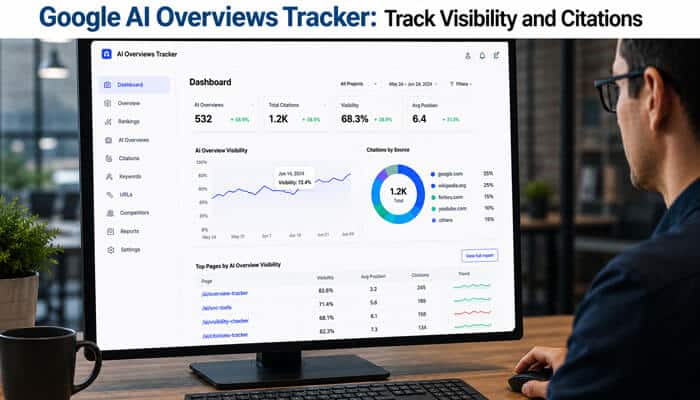

A Google AI Overviews tracker helps website owners measure whether their pages and brands appear in Google’s AI-generated search answers. Unlike a traditional rank tracker, it can show which queries trigger an AI Overview, whether your domain is cited, which URL Google selects, where the citation appears, and how that visibility changes over time.
This information matters because an organic ranking no longer provides a complete picture of search performance. A page may rank near the top of Google but receive no citation in the AI-generated answer displayed above it. Another page may earn a citation even when it does not hold the highest conventional position for the original search.
Google now offers first-party generative-AI impression reporting in Search Console for eligible properties. Specialist platforms add keyword-level monitoring, complete response snapshots, competitor comparisons, citation positions, brand mentions and location-specific data.
The strongest measurement strategy combines Google Search Console, a dedicated Google AI Overviews tracker and website analytics. Together, these tools can show whether your content appears, how it is represented and whether that exposure contributes to traffic, qualified leads or revenue.
Quick Answer: What Does a Google AI Overviews Tracker Do?
A Google AI Overviews tracker monitors selected Google searches and records information such as:
- Whether an AI Overview appears
- Whether your website is cited
- Which page receives the citation
- Where the citation appears in the generated answer
- Whether your brand is mentioned without a link
- Which competitors receive citations
- How results differ by location or device
- How often citations appear or disappear
- Whether cited pages experience changes in traffic or conversions
Google Search Console is useful for first-party impression data. Third-party platforms are more suitable when you need exact query tracking, complete responses, cited URLs, citation positions and competitor comparisons.
Key Takeaways
- AI Overview visibility is different from traditional organic ranking.
- Brand mentions, citations, and recommendations should be tracked separately.
- Search Console reports impressions from AI Overviews and AI Mode for eligible properties.
- Search Console does not provide a complete keyword-level citation history.
- AI Overviews and AI Mode may show different answers and supporting links.
- Results can vary by query wording, location, language, device and time.
- Citation quality and persistence matter more than citation quantity alone.
- Google does not require special AI schema, artificial content chunking or a
llms.txtfile for Search visibility. - Original information, technical SEO and people-first content remain the foundation of visibility.
- A Google AI Overviews tracker should ultimately connect AI visibility to engagement, qualified leads and other business outcomes.
What Are Google AI Overviews?
Google AI Overviews are AI-generated summaries displayed within conventional Google search results when Google determines that a synthesized response would provide useful information.
An AI Overview may contain:
- A concise explanation
- A summarized answer
- A comparison
- A step-by-step process
- Product or service recommendations
- Supporting source links
- Images, products or local information
Google explains that its generative-AI search experiences use techniques including retrieval-augmented generation and query fan-out. Retrieval-augmented generation allows Google to retrieve current webpages from its Search index and use information from those pages to ground an AI-generated response.
Query fan-out allows the system to generate several related searches across subtopics. For example, a broad question about choosing business software might generate related searches about features, pricing, integrations, disadvantages, and alternatives before the response is created.
Because of query fan-out, the pages cited in an AI Overview may differ from the pages ranking highest for the exact original keyword. For publishers, this expands the meaning of search visibility.
A business may need to know whether its content is:
- Used to support an AI-generated statement
- Mentioned by brand name
- Linked as a source
- Cited for the correct information
- Represented accurately
- Visible across related questions
- Selected instead of a competitor’s content
A standard rank tracker cannot answer all these questions. This is why a dedicated Google AI Overviews tracker is becoming an important addition to modern SEO reporting.
What Is a Google AI Overviews Tracker?
A Google AI Overviews tracker is software that repeatedly checks selected searches and records information about the AI-generated results.
Depending on the platform, it may collect:
- The complete AI Overview response
- Cited domains
- Individual cited URLs
- Citation order
- Brand mentions
- Product recommendations
- Competitor appearances
- Organic ranking positions
- AI and organic-result overlap
- Location and device information
- Screenshots or SERP snapshots
- Historical visibility changes
A manual search provides only a momentary observation. A tracker creates a consistent historical record.
That history can help determine whether:
- A citation appeared after a page update
- A competitor replaced your website as a source
- Google began citing a different landing page
- AI Overview coverage increased across a topic
- A citation gain was temporary or persistent
- Visibility changed in a particular location
AI Overviews load dynamically and may vary between searches. Some platforms therefore use dedicated collection methods instead of treating an AI Overview like a fixed organic result.
Advanced Web Ranking, for example, uses a dedicated Google Search and AIO engine designed to retrieve AI Overview results and their source URLs more consistently.
AI Overviews vs. AI Mode
AI Overviews and AI Mode are related Google search experiences, but they should not automatically be treated as the same reporting category.
AI Overviews
AI Overviews appear within conventional Google search-result pages. They summarize a subject and provide links that allow users to explore supporting sources.
AI Mode
AI Mode provides a more conversational search experience. It can support:
- Longer questions
- Complex comparisons
- Follow-up prompts
- Multi-step research
- More extensive generated answers
Google states that AI Overviews and AI Mode may use different models and techniques. The generated responses and links can therefore vary even when the subject is similar.
A website may have:
- Strong citation visibility in AI Overviews
- Limited visibility in AI Mode
- Different landing pages cited in each experience
- Different competitors appearing in each
- Different visibility across markets and devices
Search Console currently combines impressions from AI Overviews and AI Mode within the dedicated Search generative-AI report. A specialist Google AI Overviews tracker may provide more detailed separation, depending on the platform. Avoid combining every form of AI search visibility into one unexplained score.
Why a Google AI Overviews Tracker Matters
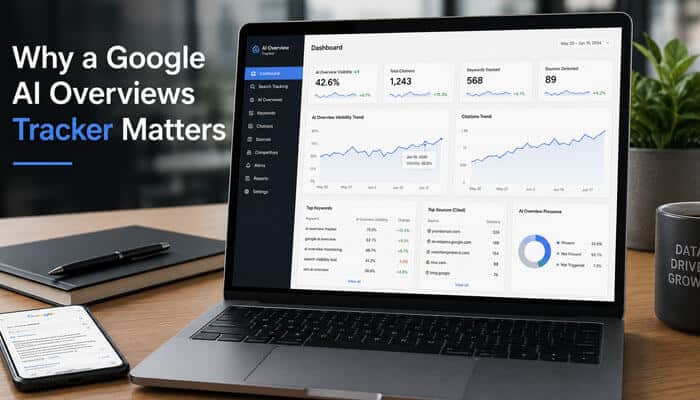
Traditional Rankings Do Not Show the Complete SERP
A page may maintain the same organic position while losing visual prominence because an AI Overview, advertisement, featured snippet or another feature appears above it. A conventional tracker could report no ranking loss even when clicks decline. Monitoring the complete search-result environment provides more context than recording only a numerical position.
Citations Can Increase Brand Exposure
An AI Overview citation may introduce a website or brand before the searcher visits any result.
Repeated appearances can help a business become associated with a subject. However, the value depends on:
- Whether the company is named
- Whether the citation is immediately visible
- Whether the cited page is relevant
- Whether the generated information is accurate
- Whether the searcher clicks
- Whether the landing page satisfies the next question
A citation is a visibility signal, not a guaranteed traffic source.
Competitors Can Be Cited Without Outranking You
Query fan-out allows Google to retrieve information for related subquestions. A competing page may consequently receive a citation even when it does not outrank your page for the original keyword.
Citation monitoring can reveal:
- Which competitors Google repeatedly selects
- Which competing pages earn citations
- Which subtopics those pages answer
- Which data, definitions, or examples are being used
- Where your content lacks evidence or clarity
A Google AI Overviews tracker makes this competitive information easier to collect consistently.
AI Visibility Can Be Volatile
AI-generated answers are not permanent listings. A citation may appear during one check and disappear during another.
Results can change because of:
- Different query wording
- Search location
- Language
- Device type
- Newly indexed content
- Updated sources
- Search-system changes
- Whether an AI Overview is triggered
Historical tracking prevents decisions based on one manual search.
Organic Ranking and AI Citation Are Different Outcomes
A strong organic ranking may increase the opportunity to be retrieved, but it does not guarantee a citation.
Similarly, receiving a citation does not prove that the page’s conventional organic ranking will improve.
Track these outcomes separately:
- Organic position
- AI Overview appearance
- Citation status
- Citation position
- Brand mention status
- Search Console impressions
- Landing-page engagement
- Conversion performance
Mentions, Citations and Recommendations
These terms should not be used interchangeably.
| Visibility Type | Meaning | Example |
|---|---|---|
| Brand mention | The generated answer names the company | “ExampleCo provides inventory software.” |
| Citation | The answer links to a page on the domain | A supporting link points to example.com |
| Cited mention | The company is both named and linked | “According to ExampleCo” with a source link |
| Uncited mention | The company is named without a link | ExampleCo appears, but another source is cited |
| Source citation | A webpage is linked without prominently naming the company | A source card links to an article |
| Recommendation | The response actively suggests the brand or product | “Consider ExampleCo for small teams.” |
| Competitor citation | A competing website is used as a source | Google links to a rival’s guide |
A company may receive valuable brand exposure without a citation. Conversely, Google may cite a page without prominently displaying the brand name. A complete Google AI Overviews tracker program should measure mentions, citations and recommendations separately.
Most Important Google AI Overviews Tracker Metrics
A useful Google AI Overviews tracker should measure more than the total number of citations.
| Metric | What It Measures | Why It Matters |
|---|---|---|
| AI Overview trigger rate | Percentage of tracked queries producing an AI Overview | Shows how much of the keyword portfolio is affected |
| Citation coverage | Percentage of AI Overview queries citing your domain | Measures presence when an overview exists |
| Cited-page count | Number of unique URLs receiving citations | Identifies pages Google repeatedly retrieves |
| Citation frequency | Total citations across tracked searches | Shows the breadth of source visibility |
| Brand mention rate | Percentage of responses naming the brand | Measures exposure beyond links |
| Cited mention rate | Responses that both name and link the brand | Indicates stronger attribution |
| Recommendation rate | Percentage of answers actively suggesting the brand | Measures decision-stage visibility |
| Citation share of voice | Your citations compared with selected competitors | Measures relative visibility |
| Citation rank | Order in which the source appears | Helps evaluate citation prominence |
| AI-organic overlap | Queries where a page appears organically and in the AI answer | Shows overlap between SEO and AI visibility |
| Citation persistence | Percentage of repeated checks containing the citation | Separates stable citations from temporary appearances |
| Citation volatility | Frequency of citation gains and losses | Shows how unstable a query is |
| Conversion contribution | Leads or sales associated with cited landing pages | Connects visibility to business value |
Useful Tracking Formulas
- AI Overview trigger rate
Queries producing an AI Overview ÷ Total tracked queries × 100
- Citation coverage
AI Overview queries citing your domain ÷ Total queries producing an AI Overview × 100
- Citation persistence
Checks containing your citation ÷ Total checks for that query × 100
- Citation share of voice
Your citations ÷ Total citations among tracked competitors × 100
Apply these formulas to a consistent keyword set, location, device, and reporting period. Changing the underlying sample can create a misleading trend.
Measure Citation Quality, Not Just Quantity
A website can accumulate many citations without receiving meaningful business value.
Use the following checklist when reviewing important citations:
| Quality Factor | Question to Ask |
|---|---|
| Citation relevance | Is the page cited for a subject it genuinely covers? |
| Claim alignment | Does the generated answer accurately reflect the source? |
| Citation prominence | Is the source immediately visible or hidden after expansion? |
| Landing-page suitability | Does the page help the visitor continue researching? |
| Brand context | Is the company represented positively, neutrally or inaccurately? |
| Commercial relevance | Is the query connected to a valuable customer journey? |
| Evidence usage | Is Google using original research, a case study, data or expert analysis? |
| Citation persistence | Does the citation remain present across repeated checks? |
A citation to an outdated or poorly matched page can provide little value. It may also reveal a content problem that should be corrected.
Review a representative sample of complete AI responses every month instead of relying entirely on an aggregate visibility score from a Google AI Overviews tracker.
Google Search Console as a Google AI Overviews Tracker
Google launched dedicated Search Generative AI performance reports in Search Console on June 3, 2026. The reports provide separate views for website impressions from supported generative-AI features on Search and Discover.
The Search report currently includes impressions from:
- AI Overviews
- AI Mode
It can help website owners:
- Monitor generative-AI impressions over time
- Identify pages receiving the deepest or lowest impressions
- Compare visibility by country
- Compare visibility by device
- Identify when a major change began
Google defines an impression in this report as an instance in which a link to the website is shown to a user in a supported generative-AI Search feature.
Google is rolling the report out to a subset of properties. A website may not see it because:
- The property has not yet received access
- The website has insufficient eligible impressions
- The site has been excluded from Search generative-AI features
Search Labs experimental data is not included.
Search Console should be part of any AI visibility program because it provides first-party data for a verified website. However, it should not be treated as a complete replacement for a dedicated Google AI Overviews tracker.
Limitations of Search Console’s Generative-AI Report
Search Console is valuable, but it is not a complete citation tracker.
The dedicated report focuses on impressions. Its available dimensions include:
- Pages
- Countries
- Dates
- Devices
It does not provide a complete query-level citation history. It also does not display the full generated response, citation order or complete competitor-source list.
Search Console Can Help Answer:
- Which pages receive generative-AI impressions?
- Is exposure increasing or decreasing?
- Which countries generate the impressions?
- Which devices account for the visibility?
- When did a meaningful change begin?
It Does Not Fully Answer:
- Which exact query generated every citation?
- What did the complete AI response say?
- Which passage was supported by your page?
- Where did the citation appear?
- Which competing pages were cited?
- Did an impression come from AI Overview or AI Mode?
- How many clicks came from a particular citation?
Google also notes that the newest figures may be preliminary and that chart and table totals can differ because of aggregation methods. Standard Search Console reporting limitations, including the 1,000-row table limit, also apply.
Use Search Console for first-party impression trends. Use a specialist Google AI Overviews tracker to save exact searches, responses, source URLs, and competitor citations.
Managing Inclusion in Generative-AI Search
Google is rolling out a Search generative-AI control within Search Console.
For properties with access, the control allows website owners to include or exclude their links and content from:
- AI Overviews
- AI Mode
- Supported generative-AI features in Google Discover
Inclusion is the default setting. When a website is included, its content may appear as a link and help ground supported AI responses.
Excluding a property prevents its links and content from appearing in these supported generative-AI experiences. The website will not receive impressions or traffic from them.
Google states that this setting is separate from Google-Extended, which controls some model-training and grounding uses outside ordinary Search inclusion.
Before changing the setting, consider:
- Current generative-AI impressions
- Organic traffic trends
- Brand-discovery goals
- Publishing or licensing priorities
- Legal considerations
- The potential loss of AI-related visibility
Google AI Overviews Tracker Tools Compared
The right platform depends on whether your priority is first-party reporting, keyword monitoring, location tracking, competitive research or broader AI visibility.
| Tool | Notable Capabilities | Best Use |
|---|---|---|
| Google Search Console | First-party impressions by page, country, date and device | Measuring a verified website |
| Advanced Web Ranking | Citations, brand mentions, citation rank, source URLs, snapshots and custom locations | Detailed Google SERP monitoring |
| Semrush | Keyword tracking, AI Overview detection, citations, mentions and competitor research | Combined SEO and AI workflows |
| Ahrefs Brand Radar | Mentions, citations, impressions, cited pages and AI share of voice | Large-scale brand discovery |
| ZipTie | Full responses, citations, mentions, source attribution and competitor monitoring | Dedicated AI-search analysis |
Google Search Console
Search Console is best for first-party impression reporting.
It is free and directly connected to a verified property, but it does not replace a keyword-level Google AI Overviews tracker.
Advanced Web Ranking
Advanced Web Ranking can report:
- AI Overview appearances
- Brand mentions
- Domain citations
- Citation rank
- Cited source URLs
- AI-versus-organic overlap
- SERP snapshots
- Competitor sources
Its custom-location tracking can monitor results at country, region, state, city or ZIP-code level.
Semrush
Semrush can track selected Google searches and identify AI Overview appearances. Its broader AI visibility features report mentions, citations, cited pages, sentiment, competitor comparisons and prompt-level visibility across supported AI experiences.
Semrush is particularly useful for teams that want conventional SEO reporting and AI visibility data in one platform.
Ahrefs Brand Radar
Ahrefs Brand Radar measures visibility using metrics such as:
- Mentions
- Citations
- Impressions
- Cited pages
- AI share of voice
It also supports competitor benchmarking and custom prompt monitoring across supported AI platforms.
ZipTie
ZipTie monitors visibility across Google AI Overviews, ChatGPT, and Perplexity.
Its reporting includes:
- Brand mentions
- Citations
- AI Overview coverage
- Full response text
- Source attribution
- Sentiment
- Competitor comparisons
ZipTie also warns that tracked results may differ from an individual user’s results because AI search experiences can vary or be personalized.
Free vs. Paid Google AI Overviews Tracker Options
A free workflow may be sufficient for a small website with a limited keyword set.
| Tracking Method | Advantages | Limitations |
|---|---|---|
| Search Console | Free, first-party impression data | Limited keyword and citation detail |
| Manual Google checks | No subscription required | Difficult to scale consistently |
| Spreadsheet tracking | Flexible and customizable | Requires manual collection and maintenance |
| General SEO platform | Combines organic and AI performance | May impose keyword or project limits |
| Dedicated AI tracker | Detailed responses, sources and competitors | Adds another subscription and workflow |
A paid Google AI Overviews tracker becomes more valuable when you need:
- Hundreds or thousands of tracked queries
- Multiple countries or cities
- Desktop and mobile comparisons
- Competitor citation monitoring
- Historical response snapshots
- Citation-position analysis
- Scheduled reporting
- API or export access
- Client or executive dashboards
Do not choose a tool only because it advertises the largest database. Its tracked queries, locations, and competitors must represent your actual audience.
How to Choose the Right Google AI Overviews Tracker
Use the following criteria when comparing platforms:
| Feature | Why It Matters |
|---|---|
| Citation-level reporting | Identifies the exact URLs Google uses |
| Brand-mention tracking | Detects exposure without a link |
| Complete response snapshots | Shows how generated answers change |
| Citation position | Measures source prominence |
| Historical retention | Supports before-and-after comparisons |
| Competitor tracking | Reveals citation gaps |
| Mobile tracking | Identifies device differences |
| Local tracking | Measures geographic variation |
| AI Mode separation | Prevents different experiences from being mixed |
| Export capability | Supports dashboards and client reporting |
| API access | Enables large-scale analysis |
| Query limits | Determines the practical subscription cost |
| Update frequency | Affects how quickly changes are detected |
| Alerts | Surfaces important gains and losses |
| Transparent methodology | Helps users interpret proprietary scores |
Before purchasing a platform, test a small set of searches using the same:
- Queries
- Location
- Language
- Device
- Competitors
- Collection schedule
Compare results over several days. One manual search is not enough to establish consistent accuracy. The best Google AI Overviews tracker is the one that reflects your actual search market, customer locations and reporting needs.
Can You Use a Google AI Overviews Tracker Manually?
Yes, but manual tracking works best for a small group of high-priority queries.
Create a spreadsheet with the following columns:
| Field | Example |
|---|---|
| Date | July 28, 2026 |
| Query | Best payroll software for startups |
| Location | United States |
| Device | Mobile |
| AI Overview present | Yes |
| Brand mentioned | No |
| Domain cited | Yes |
| Cited URL | Product comparison page |
| Citation position | Third source |
| Competitors cited | Competitor A and Competitor B |
| Organic position | 4 |
| Notes | Citation appeared after expanding the response |
Repeat the checks on a consistent schedule.
Manual tracking becomes difficult when:
- Too many keywords are involved
- Several locations must be monitored
- Daily collection is required
- Competitor reporting is needed
- Historical screenshots must be saved
- Several team members collect data
At that point, an automated Google AI Overviews tracker can create a more standardized and efficient process.
How to Set Up a Google AI Overviews Tracker
1. Define the Business Goal
Begin with the decision the data should support.
Possible goals include:
- Protecting organic traffic
- Increasing citations
- Monitoring brand representation
- Finding competitor content gaps
- Improving local visibility
- Measuring product discovery
- Prioritizing page updates
- Reporting AI visibility to clients
Tracking data without a clear decision-making purpose often produces a complicated dashboard but little business value.
2. Build a Balanced Keyword Set
Do not track only high-volume head terms.
Include:
- Informational questions
- Definitions
- How-to searches
- Product comparisons
- Service comparisons
- “Best” searches
- Problem-and-solution queries
- Branded terms
- Competitor comparisons
- Local searches
- Long-tail customer questions
- High-value commercial queries
Organize searches by topic and intent.
| Keyword Group | Example |
|---|---|
| Informational | How does inventory forecasting work? |
| Commercial | Best inventory software for small businesses |
| Comparison | Platform A vs. Platform B |
| Branded | Is ExampleCo reliable? |
| Local | Business accountant in Chicago |
| Problem based | How to reduce stockouts |
| Decision stage | Which accounting software is best for startups? |
3. Establish a Baseline
Before updating content, record:
- AI Overview trigger rate
- Existing citations
- Brand mentions
- Cited pages
- Cited competitors
- Citation positions
- Organic positions
- Search Console impressions
- Landing-page traffic
- Engagement
- Leads and conversions
Without a baseline, it is difficult to determine whether an update produced meaningful improvement.
4. Configure Locations and Devices
AI-generated results may differ by market.
Track the locations representing real customers, such as:
- Countries
- States
- Regions
- Cities
- ZIP codes
Separate desktop and mobile results when possible.
5. Choose a Tracking Frequency
Use a schedule based on query importance and volatility.
- Daily: Product launches, active tests, and highly competitive searches
- Weekly: Most ongoing SEO campaigns
- Monthly: Stable topics and executive reporting
Daily tracking can create noise, while monthly tracking may miss short-term changes. Weekly monitoring is a practical starting point for many websites.
6. Save Complete Responses
Recording only “cited” or “not cited” is not enough.
Save:
- Response text
- Cited domains
- Cited URLs
- Citation order
- Brand mentions
- Recommendations
- Source cards
- Screenshot or SERP snapshot
- Date and time
- Location
- Device
- Organic ranking
This context makes future comparisons more useful.
7. Connect Visibility With Analytics
Compare citation changes with:
- Organic landing-page traffic
- Engagement
- Newsletter registrations
- Product views
- Demo requests
- Qualified leads
- Sales
- Assisted conversions
Do not assume every traffic change was caused by an AI citation. Use Search Console trends, Google AI Overviews tracker history and landing-page analytics together.
8. Create an Annotation Log
Record every meaningful change made to a tracked page.
Include:
- Update date
- Sections revised
- Sources added
- Statistics refreshed
- Internal links changed
- Technical fixes
- Author or reviewer updates
- Structured-data changes
An annotation log makes later performance analysis more credible.
How to Perform a Citation-Gap Analysis
Citation-gap analysis identifies searches where competing websites receive AI Overview visibility but your website does not.
Step 1: Export Queries That Trigger AI Overviews
Use your Google AI Overviews tracker to identify searches that consistently generate an AI Overview.
Step 2: Classify Search Intent
Separate the queries into:
- Informational
- Commercial
- Comparison
- Branded
- Local
- Transactional
Step 3: Add Organic Ranking Data
Record where your page currently ranks for each search.
Step 4: Find High-Opportunity Gaps
Prioritize searches where:
- An AI Overview appears consistently
- Your page already ranks well
- Competitors are cited
- Your website is not cited
- The query has commercial or strategic value
Step 5: Examine Cited Competitor Pages
Review:
- Answer clarity
- Topical coverage
- Original research
- First-hand experience
- Expert commentary
- Supporting evidence
- Publication and update dates
- Images or videos
- Internal links
- Author information
Step 6: Identify the Actual Gap
The missing element might be:
- A direct definition
- A clearer answer
- A comparison table
- A real example
- Original research
- A calculation
- A step-by-step process
- A current statistic
- First-hand experience
- Better source support
- A more suitable landing page
Step 7: Improve the Existing Page
Make changes only when they genuinely improve the content for readers.
Do not copy a competitor’s wording or add sections solely because another page contains them.
Step 8: Record the Update
Document what changed and when.
Step 9: Recheck Several Tracking Cycles
One citation appearance does not prove lasting success. Look for persistent improvement across several Google AI Overviews tracker checks using consistent location and device settings.
Google warns against producing large numbers of pages primarily to capture every possible search variation or query fan-out. This can violate its scaled-content-abuse policies.
Hypothetical Google AI Overviews Tracker Example
The following example demonstrates how an SEO team could measure progress. The figures are hypothetical and should not be treated as performance benchmarks.
| Metric | Before Optimization | Eight Weeks Later |
|---|---|---|
| Tracked queries | 100 | 100 |
| Queries triggering AI Overviews | 62 | 65 |
| Queries citing the website | 8 | 17 |
| Citation coverage | 12.9% | 26.2% |
| Unique cited pages | 4 | 9 |
| Persistent citations | 3 | 11 |
| Competitor-only citation gaps | 31 | 20 |
The team should not immediately conclude that page updates caused every improvement. Search volatility, competitor changes and Google system updates may also affect the results.
A stronger conclusion would require:
- Repeated observations
- Consistent query and device settings
- An annotation log
- Comparison with organic performance
- Review of competing sources
A Google AI Overviews tracker helps organize this evidence, but it cannot prove direct causation.
How to Improve AI Overview Citations
Google states that there are no separate technical requirements for appearing as a supporting link in AI Overviews or AI Mode.
A page must be indexed, eligible to appear in Google Search with a snippet, and compliant with Google’s Search requirements. Meeting those conditions does not guarantee selection.
Publish Original, Non-Commodity Content
Create information that offers more than a summary of what is already available elsewhere.
Examples include:
- Original research
- Expert interviews
- Internal data
- Case studies
- First-hand observations
- Custom calculations
- Tested processes
- Original images
- Clear conclusions supported by evidence
Google’s current guidance emphasizes useful, expert-led, and non-commodity information rather than generic pages that repeat common knowledge.
Answer the Main Question Clearly
Give readers a direct answer near the beginning of the relevant section.
A concise answer can be followed by:
- Context
- Evidence
- Exceptions
- Examples
- Recommended actions
Clarity benefits visitors and makes the page easier to understand.
Cover Natural Supporting Questions
Query fan-out means Google may retrieve sources for related subtopics.
Cover the questions readers genuinely need to understand the subject, but do not create thin pages for every possible keyword variation.
Strengthen Evidence
Support factual claims with:
- Official documentation
- Government information
- Primary research
- Reputable studies
- Transparent methodologies
- Dates and context
Review sources regularly so that outdated evidence does not weaken the page.
Add First-Hand Experience
First-hand information can make content more distinctive.
Depending on the topic, this may include:
- Screenshots
- Test results
- Expert commentary
- Original examples
- Process documentation
- Lessons learned
- Before-and-after comparisons
Use Descriptive Headings
Use headings that tell readers what they will learn.
Avoid vague labels such as:
- More Information
- Other Details
- Useful Tips
- Additional Points
Improve Author and Editorial Transparency
Include:
- Author name
- Relevant experience
- Reviewer information
- Publication date
- Update date
- Editorial standards
- Correction policy
- Source methodology
These elements help readers evaluate reliability.
Keep Essential Information Crawlable
Important content should be available as crawlable text rather than existing only in:
- Images
- Videos
- Canvas elements
- Interactive tools
- Client-side elements Google cannot access
Add Relevant Images and Video
Google recommends supporting textual content with useful images and videos when appropriate. Its generative-AI search experiences can surface visual content as well as webpage links.
Maintain Accurate Product and Local Information
Businesses should keep relevant information current in:
- Google Business Profile
- Merchant Center
- Product pages
- Service pages
- Location pages
- Contact details
Google specifically recommends maintaining accurate local-business and ecommerce information.
Strengthen Technical SEO
Check:
- Crawl access
- Indexability
- Canonical tags
- Internal links
- Mobile usability
- Page speed
- Structured-data validity
- HTTP status codes
- Duplicate content
- JavaScript rendering
Update Outdated Pages
Refresh:
- Statistics
- Dates
- Product details
- Screenshots
- Pricing information
- Regulations
- Tool capabilities
- Source links
Do not change the publication date unless meaningful improvements have been made.
AI Search Optimization Myths to Avoid
Google’s current guidance addresses several widely promoted shortcuts.
You Do Not Need LLMS.txt for Google Search
Google states that it does not use llms.txt or similar special AI files for Search visibility. Creating one for another service will neither improve nor harm rankings in Google Search.
You Do Not Need Special AI Schema
There is no special schema.org markup required for AI Overviews or AI Mode. Continue using established structured data when it accurately represents visible content and supports eligible rich results.
You Do Not Need Artificial Content Chunking
Google does not require every answer to be divided into tiny content blocks. Use headings, paragraphs, bullets, and tables because they improve readability, not as a mechanical AI-ranking trick.
You Do Not Need Every Keyword Variation
Google’s systems can understand synonyms and related meanings. Avoid awkward repetition of the focus keyword or creating thin pages for minor wording variations.
Artificial Mentions Are Not a Sustainable Strategy
Manufacturing low-quality brand references across unrelated websites or forums is not a substitute for genuine authority. Google recommends focusing on useful content and authentic visibility rather than inauthentic mentions. A Google AI Overviews tracker should be used to measure genuine visibility, not to justify manipulative publishing tactics.
Controlling Snippets and AI Use in Search
Website owners can use established Google preview controls.
nosnippet
Prevents a text snippet or video preview from appearing for the page. It can also prevent content from being used as direct input for AI Overviews and AI Mode.
data-nosnippet
Excludes selected sections of a page from snippets.
max-snippet
Limits the number of characters Google may use as a text snippet. It can also limit how much page content is used as direct input for AI Overviews and AI Mode.
noindex
Prevents the page from appearing in Google Search.
These controls can reduce visibility in conventional and AI-powered search features. Use them carefully.
Googlebot must be permitted to crawl the page before it can discover and follow page-level preview controls.
After making a change, verify the rendered HTML through Search Console’s URL Inspection tool and allow time for Google to recrawl the page.
How Accurate Is a Google AI Overviews Tracker?
No Google AI Overviews tracker can reproduce every result shown to every Google user.
Results may vary according to:
- Query wording
- Country
- City
- Language
- Device
- Collection time
- Search-system changes
- User context
- Whether Google triggers an AI Overview
A citation seen once should not be treated like a permanent organic ranking.
Recommended Measurement Protocol
- Use the same keyword set for each comparison.
- Keep location settings consistent.
- Separate mobile and desktop.
- Save response text and cited URLs.
- Record the collection date and time.
- Compare several tracking runs.
- Separate persistent citations from one-time appearances.
- Avoid treating small movements as conclusive.
- Use a consistent competitor set.
- Review important responses manually.
Third-party tools do not have access to Google’s private ranking or AI systems. Use a Google AI Overviews tracker for observation and workflow support, but evaluate its recommendations against official guidance and actual website performance.
Google AI Overviews Tracker Reporting Dashboard
A useful Google AI Overviews tracker dashboard should connect visibility signals with actions.
| Signal | Possible Interpretation | Recommended Action |
|---|---|---|
| Trigger rate increases | More tracked searches produce AI answers | Review citation coverage and traffic |
| Trigger rate rises while coverage falls | Competitors are gaining AI visibility | Perform a citation-gap analysis |
| Citations rise but traffic stays flat | Citations may have limited click potential | Review prominence, intent and landing pages |
| Mentions rise without citations | Brand exposure is growing without linked visibility | Strengthen relevant first-party resources |
| Rankings remain stable while clicks decline | SERP features may be reducing click opportunities | Compare AI Overviews with other SERP features |
| One page earns citations across many searches | Google associates the page with several subtopics | Maintain accuracy and strengthen internal links |
| Citations change frequently | The query or source set is volatile | Increase sampling before making changes |
| A citation appears after an update | The revision may have improved relevance | Confirm the pattern across multiple checks |
| The wrong page is repeatedly cited | Google may associate the query with an unsuitable URL | Improve page differentiation and internal links |
| Competitor share increases | Competing content may offer stronger evidence | Review cited competitor pages |
Tracking reveals correlation, not direct access to Google’s decision-making systems.
Do not claim that a specific edit caused a citation gain unless the improvement persists and other explanations have been considered.
Common Google AI Overviews Tracker Mistakes
Tracking Too Few Queries
A small keyword set can provide a misleading picture. Monitor a representative portfolio across topics and search intents.
Checking Only One Location
National results may not reflect local audiences. Track the markets where customers actually search.
Ignoring Mobile Results
Desktop and mobile presentations may differ. Monitor both when mobile visibility is important.
Combining Mentions and Citations
A brand mention without a link is not the same as a citation. Report them separately.
Treating One Citation as Permanent
AI-generated results can change. Measure persistence across repeated checks.
Reporting Impressions Without Outcomes
Visibility does not automatically create business value. Connect tracking with engagement, leads and revenue.
Comparing Unrelated Competitors
Choose competitors that serve the same audience or consistently appear for the same topics.
Optimizing After One Lost Citation
A temporary loss may reflect volatility rather than a content problem. Wait for a repeated pattern before rewriting a successful page.
Assuming Organic Ranking Guarantees a Citation
Strong organic performance may help, but it does not guarantee inclusion. Track AI citations as a separate result type.
Trusting an Unexplained Vendor Score
Platforms may calculate visibility and share of voice differently. Document the formula, sample, and data source before using a proprietary score in executive reporting.
A Practical 30-Day Google AI Overviews Tracker Plan
Week 1: Establish the Baseline
- Choose 50 to 200 priority queries.
- Group them by topic and intent.
- Configure location and device settings.
- Add relevant competitors.
- Record organic rankings.
- Export current citations and mentions.
- Save important responses.
- Create an annotation log.
Week 2: Find Citation Gaps
- Identify searches where competitors are cited.
- Compare cited pages with your content.
- Prioritize high-value opportunities.
- Check whether the correct landing pages rank.
- Review internal linking and indexability.
Week 3: Improve Priority Pages
- Strengthen direct answers.
- Add missing subtopics.
- Improve evidence and sourcing.
- Include original examples or first-hand experience.
- Update outdated details.
- Add relevant internal links.
- Improve author and editorial information.
Week 4: Measure and Report
- Recheck the same query set.
- Compare citation coverage.
- Review citation persistence.
- Measure impression changes.
- Examine landing-page performance.
- Document what changed.
- Set an ongoing reporting schedule.
Thirty days may not be enough to prove a stable effect, but it can establish a repeatable Google AI Overviews tracker and optimization process.
Final Thoughts
A Google AI Overviews tracker provides a clearer picture of how a website appears in Google’s AI-generated search results. It can reveal which searches produce AI Overviews, whether a domain is cited, which pages receive visibility, how competitors perform and how citations change over time.
Start with Google Search Console for first-party generative-AI impression data. Add a specialist Google AI Overviews tracker when you need exact query monitoring, saved responses, citation rank, competitor comparisons, custom locations or separate AI Mode tracking. Most importantly, connect citation data with real business results. The objective is not to collect the largest possible number of citations.
It is to become a useful and reliable source for relevant subjects, attract the right audience and support measurable outcomes. Strong technical SEO, original information, accurate sourcing, clear answers and consistent measurement remain more valuable than unproven AI-search shortcuts.
Google AI Overviews Tracker FAQs
1. What is a Google AI Overviews tracker?
A Google AI Overviews tracker is a tool that monitors whether Google displays an AI-generated answer for selected search queries. It can track cited URLs, brand mentions, citation positions, competitors and changes in AI visibility over time.
2. Why is a Google AI Overviews tracker important for SEO?
A Google AI Overviews tracker helps businesses measure visibility that traditional rank trackers may miss. A webpage can rank well organically but receive no AI Overview citation, while a lower-ranking competitor may be selected as a supporting source.
3. What metrics should a Google AI Overviews tracker measure?
The most useful metrics include AI Overview trigger rate, citation coverage, brand mention rate, cited-page count, citation position, citation persistence, competitor citations, and AI share of voice.
4. Can Google Search Console replace a Google AI Overviews tracker?
Google Search Console can provide valuable first-party impression data for supported AI search features. However, it does not provide complete keyword-level citation history, full AI responses, citation order, or detailed competitor data. A dedicated tracker offers deeper monitoring.
5. How can a website improve its chances of earning AI Overview citations?
Websites can improve their chances by publishing original and accurate content, answering questions clearly, adding expert insights, supporting claims with reliable sources, updating outdated information, and maintaining strong technical SEO
