


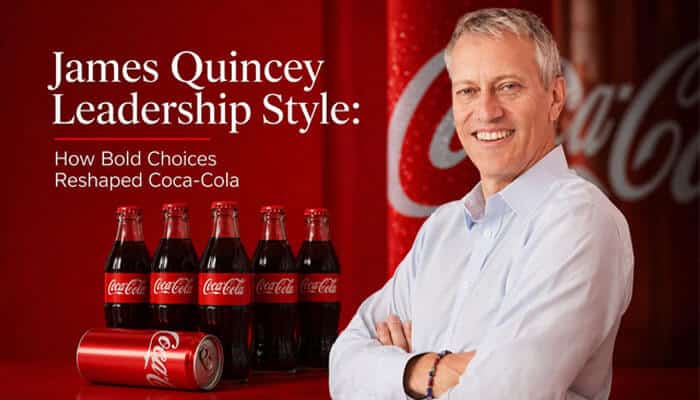

Coca-Cola had spent more than a century building one of the world’s most recognizable brands, but by 2017 the company faced a different challenge. Consumers were shifting toward healthier beverages, competition was expanding beyond traditional soft drinks, and long-term growth depended on adapting to a rapidly changing market. When James Quincey became CEO, he chose not to protect the status quo. Instead, he reshaped Coca-Cola’s strategy by simplifying its brand portfolio, expanding into new beverage categories and modernizing how the company operated. The James Quincey Leadership Style is defined by bold transformation, disciplined execution and a willingness to make difficult decisions that positioned the company for future growth.
Those decisions produced both significant achievements and valuable leadership lessons. Under Quincey, Coca-Cola reduced its portfolio from approximately 400 to 200 master brands, strengthened its asset-light bottling model and expanded into coffee, dairy and sports hydration through acquisitions such as Costa Coffee, fairlife and BODYARMOR. Not every strategic move delivered the expected results, proving that effective leadership involves reassessing decisions as markets evolve. The James Quincey Leadership Style demonstrates how balancing innovation with accountability can transform an iconic global company while preserving the competitive advantages that made it successful.
Quick Answer
James Quincey’s leadership style is primarily transformational and adaptive, combining consumer-focused innovation with disciplined execution. As Coca-Cola’s CEO, he simplified the company’s brand portfolio, expanded into categories such as coffee, dairy and sports hydration, empowered regional teams and strengthened the asset-light bottling model. His leadership demonstrates how bold strategic change, balanced with accountability and long-term thinking, can transform an iconic global company.
Key Takeaways
- The James Quincey Leadership Style combines transformational leadership with consumer-focused innovation, disciplined execution and long-term strategic thinking.
- Quincey transformed Coca-Cola into a total beverage company by expanding beyond traditional soft drinks into coffee, dairy and sports hydration.
- Portfolio simplification became a competitive advantage, as Coca-Cola reduced approximately 400 master brands to about 200 to focus on stronger growth opportunities.
- The James Quincey Leadership Style emphasized empowering regional teams while aligning them with a unified global strategy and performance goals.
- Coca-Cola’s asset-light bottling model allowed the company to scale through strong partnerships instead of owning every stage of production and distribution.
- Revenue Growth Management (RGM) helped connect consumer insights with pricing, packaging, product mix and sales channels to drive sustainable growth.
- Acquisitions such as Costa Coffee, fairlife and BODYARMOR created new opportunities while demonstrating that bold strategic decisions also require continuous evaluation.
- Sustainability, innovation and disciplined capital allocation remained central to Quincey’s long-term vision for strengthening Coca-Cola’s competitive position.
Who Is James Quincey?
James Quincey is the executive who led Coca-Cola through one of the biggest strategic transformations in its modern history. After joining the company in 1996, he spent more than two decades leading businesses across Latin America and Europe before becoming CEO in 2017. Those international roles gave him firsthand experience with changing consumer preferences, diverse markets and Coca-Cola’s global bottling system, all of which later influenced the James Quincey Leadership Style.
Before joining Coca-Cola, Quincey worked in strategy consulting at The Kalchas Group and earned a degree in Electronic Engineering from the University of Liverpool. Rather than treating Coca-Cola as simply a soft-drink company, he viewed it as a global beverage business that had to evolve with consumer demand. That perspective became a defining characteristic of the James Quincey Leadership Style, driving decisions that reshaped the company’s portfolio, operations and long-term strategy.
James Quincey Leadership Timeline: Key Decisions From 2017 to 2026
James Quincey’s impact on Coca-Cola was shaped by a series of strategic decisions rather than a single defining moment. The timeline below highlights the milestones that transformed the company from a traditional soft-drink business into a broader global beverage leader.
| Year | Major Decision or Milestone |
|---|---|
| 2017 | Quincey became CEO and accelerated Coca-Cola’s consumer-focused total beverage strategy. |
| 2017 | Coca-Cola completed the refranchising of its U.S. bottling system and continued moving toward a capital-light structure. |
| 2018 | Coca-Cola announced its World Without Waste initiative and agreed to acquire Costa Coffee. |
| 2019 | Quincey became chairman while continuing as CEO, and Coca-Cola completed the Costa Coffee acquisition. |
| 2020 | Coca-Cola reorganized its global operations and began reducing its portfolio from approximately 400 to 200 master brands. |
| 2020 | Coca-Cola acquired the remaining ownership interest in fairlife. |
| 2021 | Coca-Cola purchased the remaining 85% of BODYARMOR for $5.6 billion. |
| 2021–2024 | The company expanded digital marketing, consolidated agency relationships and strengthened data-driven commercial execution. |
| 2024 | Coca-Cola revised several environmental ambitions and extended major sustainability goals to 2035. |
| 2025 | Coca-Cola continued portfolio simplification, revenue growth management and its asset-light bottling strategy. |
| 2025 | Coca-Cola announced Henrique Braun as Quincey’s successor. |
| 2026 | Quincey became Executive Chairman on March 31 after serving approximately nine years as CEO. |
Each decision built on the previous one. Together, they reshaped Coca-Cola’s portfolio, operating model, marketing strategy and leadership structure, setting the foundation for the transformation explored throughout the rest of this article.
What Defines the James Quincey Leadership Style?
Many CEOs focus on growing sales. James Quincey focused first on changing how Coca-Cola thought about its business. Instead of asking how to sell more soft drinks, he challenged the company to respond to changing consumer habits, simplify unnecessary complexity and invest where future demand was strongest. The James Quincey Leadership Style was defined as much by the decisions he chose not to pursue as the strategies he accelerated.
Consumer Needs Came Before Products
Quincey shifted Coca-Cola’s attention from protecting legacy products to understanding how people were drinking differently. Rising demand for lower-sugar beverages, coffee, hydration and functional drinks influenced product development, packaging and investment decisions across the business.
Transformation Extended Beyond New Products
For Quincey, becoming a total beverage company required more than launching new brands. Coca-Cola reorganized its global operations, reduced its portfolio, strengthened digital marketing and invested in faster decision-making so the business could adapt more quickly to market changes.
Empowerment Required Accountability
Regional teams received greater authority because local markets often understood consumers better than headquarters. At the same time, every major decision was expected to deliver measurable commercial results rather than simply encourage experimentation.
Discipline Drove Long-Term Growth
Innovation remained a priority, but Quincey consistently reduced complexity by discontinuing weaker brands, concentrating investment on scalable opportunities and reassessing acquisitions when market conditions changed. The James Quincey Leadership Style combined ambitious transformation with the discipline needed to keep that transformation commercially sustainable.
Which Leadership Theory Best Describes James Quincey?
The James Quincey Leadership Style cannot be explained by one leadership theory alone. Over nearly a decade as CEO, Quincey combined bold transformation with practical execution, helping Coca-Cola adapt to changing consumer expectations while strengthening its long-term competitive position.
His leadership reflected several established theories:
- Transformational leadership by repositioning Coca-Cola as a total beverage company.
- Adaptive leadership by responding to changing consumer preferences, digital commerce and health trends.
- Participative leadership by empowering regional teams to make faster, market-specific decisions.
- Strategic leadership by aligning acquisitions, portfolio management and organizational restructuring with long-term business goals.
- Performance-oriented leadership by investing in scalable opportunities while discontinuing weaker brands.
Together, these leadership approaches define the James Quincey Leadership Style, demonstrating how transformation, adaptability and disciplined execution can reshape an established global business.
Consumer Obsession Instead of Product Obsession
One of the biggest changes under the James Quincey Leadership Style was shifting Coca-Cola’s attention from protecting existing products to understanding changing consumer behavior. Instead of asking how to sell more soft drinks, Quincey encouraged the company to identify where consumer demand was moving and adapt the business accordingly.
Consumer insights began shaping decisions about:
- Lower-sugar and zero-sugar beverages
- Hydration and functional drinks
- Coffee, tea and dairy categories
- Different drinking occasions
- Package sizes and affordability
- Digital purchasing behavior
This consumer-first mindset helped Coca-Cola expand beyond traditional carbonated soft drinks while preserving the strength of its flagship brands. Rather than replacing Coca-Cola, the company introduced more choices to meet evolving preferences across different markets and lifestyles.
Coca-Cola Zero Sugar became one of the strongest examples of this strategy. Worldwide unit-case volume for the brand increased 14% during 2025, showing that innovation could strengthen the company’s core business instead of competing with it.
The James Quincey Leadership Style demonstrates that lasting growth comes from adapting to changing consumer needs while continuing to build on a company’s strongest brands.
Asset-Light Leadership and Coca-Cola’s Bottling Refranchising Strategy
Most people associate James Quincey with new products and acquisitions, but one of his biggest leadership advantages came from strengthening Coca-Cola’s asset-light business model. Instead of investing billions in manufacturing and distribution, the company concentrated on the activities that created the most value while relying on independent bottling partners to produce and deliver beverages.
That approach allowed Coca-Cola to focus on:
- Brand ownership
- Product innovation
- Consumer research
- Global marketing
- Commercial strategy
- Franchise management
Although the U.S. bottling refranchising program began under former CEO Muhtar Kent, Quincey completed the transition during 2017 and continued expanding the asset-light strategy in selected international markets.
The model reduced capital-intensive operations, improved operating efficiency and enabled local bottlers to scale new products more quickly. The James Quincey Leadership Style demonstrated that effective leadership is not always about owning more assets—it is about building a system in which independent partners can grow together while pursuing shared commercial goals.
Revenue Growth Management: Turning Consumer Insight Into Commercial Action
One of the most practical aspects of the James Quincey Leadership Style was turning consumer insights into commercial decisions. Instead of measuring success only by selling more beverages, Coca-Cola focused on selling the right product, in the right package, at the right price and through the right sales channel.
Revenue Growth Management (RGM) helped the company optimize decisions around:
- Product selection
- Package size
- Pricing
- Sales channels
- Consumption occasions
This approach allowed Coca-Cola to grow without relying solely on higher sales volume. Smaller and returnable packages improved affordability in emerging markets, while premium packaging and channel-specific products increased value in developed markets. Affordable bottles in India and lower-cost juice offerings across Latin America and India attracted millions of additional consumer purchases, demonstrating how local market insights could drive commercial growth.
The James Quincey Leadership Style showed that sustainable growth comes from matching products, pricing and packaging to consumer demand rather than applying the same strategy across every market.
Simplifying Coca-Cola’s Brand Portfolio
Growing Coca-Cola’s business did not mean keeping every brand. A defining characteristic of the James Quincey Leadership Style was recognizing that complexity can slow growth just as much as a lack of innovation. By 2020, Coca-Cola managed approximately 400 master brands, stretching marketing budgets, management attention and innovation resources across too many products.
To sharpen its competitive focus, the company reduced its portfolio to approximately 200 master brands, concentrating investment on products with stronger long-term potential.
Portfolio simplification helped Coca-Cola:
- Focus marketing on stronger brands
- Improve innovation quality
- Allocate resources more efficiently
- Accelerate high-potential products
- Exit brands with limited growth prospects
Brands such as TaB and ZICO were among those discontinued or transitioned during the rationalization process.
The James Quincey Leadership Style showed that effective leadership is not measured by how many products a company launches, but by its willingness to stop investing in ideas that no longer create meaningful value. Sometimes, removing complexity creates a stronger business than adding another brand.
Building an Agile and Networked Organization
A major organizational change under the James Quincey Leadership Style was Coca-Cola’s shift to a networked operating model in 2020. The company replaced its previous structure with nine operating units, supported by global category leadership teams, Platform Services and a corporate center. The goal was simple: make decisions faster while remaining closer to local consumers.
The new model combined global consistency with regional flexibility. Responsibilities were divided between:
- Global brand strategy and innovation
- Marketing expertise and shared technology
- Local consumer insights
- Customer and bottler relationships
- Regional market execution
Instead of relying entirely on headquarters or giving every market complete independence, Coca-Cola balanced global scale with local decision-making. Successful ideas could be developed centrally and then adapted quickly for regional markets.
The James Quincey Leadership Style demonstrated that organizational structure can be a competitive advantage. By reducing duplication and empowering local teams within a common global framework, Coca-Cola became faster, more coordinated and better positioned to respond to changing consumer demand.
Empowerment, Accountability and Faster Decisions
The James Quincey Leadership Style encouraged employees to make decisions closer to consumers instead of waiting for approval from multiple management layers. Teams were expected to act quickly, but every decision had to be supported by data and measurable business results.
Employees were encouraged to:
- Challenge existing assumptions
- Understand changing consumer needs
- Test new ideas
- Make informed decisions
- Measure commercial performance
- Scale successful initiatives
Quincey viewed experimentation as a tool for learning rather than an excuse for unnecessary spending. Projects that demonstrated consumer demand and commercial potential received additional investment, while weaker initiatives were revised or discontinued. This disciplined approach helped Coca-Cola innovate faster without losing financial accountability.
The James Quincey Leadership Style shows that empowerment delivers the greatest value when it is supported by clear objectives, measurable outcomes and the willingness to make difficult decisions when evidence changes.
How Coca-Cola Measured Culture and Leadership Accountability
The James Quincey Leadership Style was supported by systems designed to measure whether leadership behaviors matched the company’s cultural expectations. Rather than treating values as slogans, Coca-Cola gathered employee feedback through engagement surveys, leadership assessments and global town halls where employees could ask senior executives direct questions.
The company encouraged leaders to demonstrate behaviors such as:
- Curiosity
- Empowerment
- Inclusion
- Agility
- Accountability
These feedback systems helped identify strengths and improvement opportunities while supporting leadership development across the organization. At the same time, Coca-Cola recognized that culture cannot be measured by survey results alone. Restructuring, changing responsibilities and workforce reductions can influence employee experiences in different ways.
The James Quincey Leadership Style showed that culture is strengthened through consistent leadership behavior and accountability, not simply by introducing new development programs or publishing corporate values.
Using Acquisitions to Enter New Categories
The James Quincey Leadership Style was defined not only by building new brands but also by acquiring businesses that could accelerate Coca-Cola’s expansion into faster-growing beverage categories. Rather than developing every product internally, Quincey used acquisitions to gain established brands, new capabilities and access to different consumer markets.
Three acquisitions best illustrate this strategy:
- Costa Coffee (2019) – Expanded Coca-Cola into global coffee retailing, ready-to-drink coffee and Costa Express vending.
- fairlife (2020) – Strengthened the company’s position in premium dairy, protein drinks and nutrition-focused beverages.
- BODYARMOR (2021) – Reinforced Coca-Cola’s presence in sports and hydration, although later trademark impairments highlighted the risks of optimistic growth assumptions.
Each acquisition addressed a different strategic objective, but they shared the same goal: accelerating growth beyond traditional soft drinks. The James Quincey Leadership Style also recognized that successful leadership requires reassessing earlier decisions. Coca-Cola’s later write-downs on BODYARMOR demonstrated that changing market conditions sometimes require companies to revise even their most ambitious investments.
Modernizing Marketing and Digital Capabilities
Marketing changed as quickly as consumer behavior during Quincey’s tenure. Instead of depending on broad mass-market campaigns, Coca-Cola invested in digital platforms, consumer data and artificial intelligence to deliver more targeted and measurable marketing. This became another defining feature of the James Quincey Leadership Style.
The transformation included:
- Greater investment in digital media
- Consumer data and analytics
- Artificial intelligence and automation
- Global content creation through Studio X
- A unified marketing partnership with WPP
- Local adaptation of global campaigns
Digital marketing became the majority of Coca-Cola’s media investment by the middle of the decade, replacing the company’s traditional advertising model with one built on measurable performance and continuous optimization.
The James Quincey Leadership Style also treated digital transformation as a business strategy rather than a technology initiative. Marketing, retail execution, customer relationships and operational efficiency were increasingly connected through data, automation and digital tools, helping Coca-Cola respond more quickly to changing consumer behavior.
Sustainability, Stakeholder Leadership and Social License
The James Quincey Leadership Style recognized that long-term business success depends on earning the trust of customers, communities, governments and investors—not just increasing sales. As environmental expectations grew, Coca-Cola expanded its sustainability efforts and treated issues such as packaging, water and climate as strategic priorities rather than public relations initiatives.
Under Quincey, Coca-Cola focused on:
- Reducing packaging waste
- Improving water stewardship
- Increasing the use of recycled materials
- Lowering carbon emissions
- Working closely with bottling and recycling partners
- Strengthening long-term stakeholder trust
The launch of World Without Waste in 2018 and the revision of several environmental goals in 2024 reflected Coca-Cola’s evolving sustainability strategy. While supporters viewed the updated targets as a practical response to implementation challenges, critics argued that extending deadlines weakened earlier commitments.
The James Quincey Leadership Style demonstrated that leadership credibility is built through transparency, measurable progress and the willingness to adapt strategies when circumstances change. For a global company like Coca-Cola, sustainability is not separate from business performance—it influences brand reputation, operational resilience and long-term growth.
Strengths of the James Quincey Leadership Style
The James Quincey Leadership Style stands out because it balanced bold transformation with disciplined execution. Rather than relying on a single leadership philosophy, Quincey combined strategic change with operational focus to keep Coca-Cola competitive in a rapidly evolving beverage market.
Key strengths included:
- Challenging long-standing business assumptions before market conditions forced change
- Simplifying the portfolio to concentrate investment on stronger global brands
- Expanding Coca-Cola beyond soft drinks through acquisitions and innovation
- Balancing global strategy with local market execution
- Making long-term decisions instead of pursuing short-term results
- Maintaining strong partnerships across Coca-Cola’s global bottling network
These strengths helped Coca-Cola modernize without abandoning the brands, distribution system and consumer trust that had driven its success for decades. The James Quincey Leadership Style demonstrates that effective leadership is often about making difficult strategic choices while preserving the company’s strongest competitive advantages.
Criticism, Risks and Leadership Limitations
No leadership approach is without trade-offs. While the James Quincey Leadership Style helped modernize Coca-Cola, several decisions have also attracted criticism and highlighted the challenges of leading a global consumer brand.
Key limitations include:
- Acquisition risk: Coca-Cola’s investment in BODYARMOR later resulted in significant impairment charges, showing that even fast-growing brands can fall short of long-term expectations.
- Portfolio simplification: Reducing the company’s portfolio from roughly 400 to 200 master brands improved focus, but some critics argue that smaller regional brands may have lost future growth opportunities.
- Sustainability expectations: Coca-Cola has expanded its environmental commitments, yet the company continues to face criticism over plastic waste, water use and the pace of progress toward its sustainability goals.
- Managing large-scale transformation: Organizational restructuring and strategic change improved efficiency but also created uncertainty for employees as roles, priorities and operating models evolved.
These challenges do not diminish Quincey’s achievements, but they illustrate that every major strategic decision involves trade-offs. The James Quincey Leadership Style demonstrates that effective leadership requires balancing growth opportunities with execution risk, stakeholder expectations and long-term business resilience.
Results of Quincey’s Coca-Cola Transformation
The James Quincey Leadership Style produced measurable changes across Coca-Cola’s business, from simplifying its brand portfolio to strengthening revenue growth and expanding billion-dollar brands. The following indicators highlight the scale of the transformation during his tenure as CEO.
| Indicator | Reported Result |
|---|---|
| CEO tenure | May 2017 – March 2026 |
| Master-brand portfolio | Reduced from approximately 400 to approximately 200 |
| Billion-dollar brands (2025) | 32 |
| Billion-dollar brands added since 2017 | 12 |
| Daily servings | Approximately 2.2 billion |
| Countries and territories | More than 200 |
| 2025 net revenue | Approximately $47.9 billion |
| 2025 organic revenue growth | 5% |
| Coca-Cola Zero Sugar growth (2025) | 14% unit-case volume |
| Current position | Executive Chairman |
These results reflect more than financial performance. Under Quincey’s leadership, Coca-Cola became a more focused and agile business by investing in growth categories, modernizing its marketing strategy, strengthening collaboration with bottling partners and preparing the next generation of leadership. The James Quincey Leadership Style demonstrates how disciplined strategic decisions can reshape a global company while preserving its strongest competitive advantages.
Leadership Lessons for Business Owners and Executives
The James Quincey Leadership Style offers practical lessons for leaders managing established businesses in fast-changing markets. His tenure at Coca-Cola shows that sustainable growth often comes from making disciplined strategic decisions rather than pursuing constant expansion.
Business owners can learn to:
- Challenge successful business models before market conditions force change.
- Stay focused on evolving customer needs instead of relying on legacy products.
- Eliminate underperforming brands and initiatives to concentrate resources on stronger opportunities.
- Balance innovation with financial discipline when entering new markets or making acquisitions.
- Build strong partnerships that align incentives across employees, suppliers and business partners.
- Plan leadership succession early to ensure long-term organizational stability.
Rather than protecting the past, Quincey demonstrated the importance of adapting while preserving the company’s strongest competitive advantages. The James Quincey Leadership Style shows that lasting leadership is built on clear strategic choices, disciplined execution and a willingness to evolve with changing consumer expectations.
Conclusion
The James Quincey Leadership Style shows that even the world’s most established companies must continue evolving to remain competitive. Instead of protecting Coca-Cola’s traditional business model, Quincey simplified the brand portfolio, expanded into faster-growing beverage categories and modernized the company’s operations while preserving its strongest competitive advantages.
Not every decision produced perfect results, and some acquisitions and sustainability initiatives attracted criticism. Even so, Quincey’s willingness to question long-standing assumptions helped reshape Coca-Cola for changing consumer preferences and a more competitive global market.
The James Quincey Leadership Style reminds business owners and executives that successful leadership is not about changing everything or preserving everything. It is about knowing what deserves to endure, what needs to evolve and having the discipline to make those decisions before the market makes them for you.
FAqs About James Quincey Leadership Style
1. How did James Quincey prepare Coca-Cola for future consumer trends?
James Quincey Leadership Style focused on anticipating changing consumer preferences by expanding into coffee, dairy, hydration, and functional beverages while strengthening digital capabilities and data-driven decision-making.
2. How is James Quincey leadership style different from previous Coca-Cola CEOs?
Unlike many previous Coca-Cola leaders who emphasized expanding the traditional soft-drink business, James Quincey leadership style centered on portfolio simplification, total beverage growth, organizational agility, and consumer-driven innovation.
3. Why is James Quincey leadership style considered transformational?
James Quincey leadership style is considered transformational because he restructured Coca-Cola’s operations, reduced portfolio complexity, modernized marketing, expanded into new beverage categories, and repositioned the company for long-term growth.
4. What leadership qualities made James Quincey successful?
James Quincey is known for strategic thinking, adaptability, consumer focus, disciplined execution, collaboration with bottling partners, and making long-term decisions that strengthened Coca-Cola’s competitive position.
5. What industries can learn from James Quincey leadership style?
Retail, FMCG, food and beverage, manufacturing, healthcare, technology, and consumer brands can apply James Quincey leadership style by simplifying operations, focusing on customer needs, embracing innovation, and adapting to market changes.
