


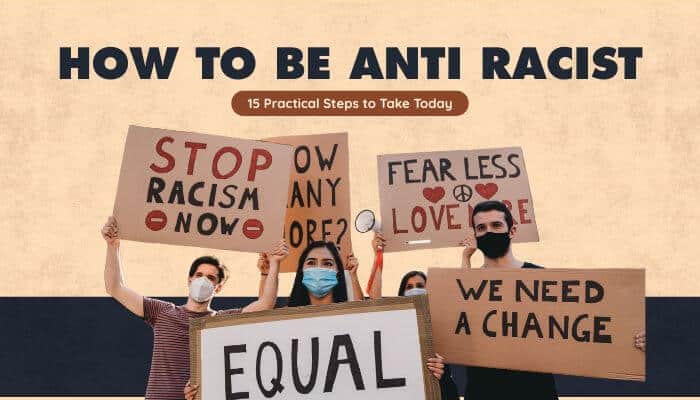

Learning how to be anti racist starts with recognizing that opposing racism involves more than avoiding offensive language or openly prejudiced behavior. It means examining your assumptions, listening to different experiences, challenging discrimination, and making fair decisions that create equal opportunities, respect, safety, and inclusion in everyday life.
Anti-racism is not a label someone earns once and keeps forever. It is an ongoing commitment to learning, reflecting, and taking meaningful action whenever unfair treatment occurs. Whether you are correcting a harmful stereotype, questioning an unfair workplace practice, supporting a person facing discrimination, or teaching children about equality, every action helps build a more inclusive society.
If you have ever wondered how to be anti racist in practical, everyday situations, this guide will walk you through evidence-based steps that you can apply at home, at work, at school, and in your community. As the Smithsonian’s National Museum of African American History and Culture explains, anti-racism is demonstrated through conscious, consistent, and equitable choices—not through a single statement or social media post.
Quick Answer
Learning how to be anti racist means combining education, self-reflection, safe intervention, fair decision-making, and sustained action.
- Learn how racism operates at personal and institutional levels.
- Examine your own assumptions and behavior honestly.
- Listen to people who experience racial discrimination.
- Challenge racist language, stereotypes, and unequal treatment.
- Review whether decisions and policies produce unfair outcomes.
- Support affected people without speaking over them.
- Use your influence at home, work, school, and in your community.
- Accept correction and continue improving.
The goal is not to appear perfect. The goal is to make your behavior, choices, and surroundings fairer over time.
Examples of Anti-Racist Actions in Daily Life
| Setting | Anti-racist action |
| Home | Correct stereotypes and discuss race openly with children |
| Workplace | Use consistent hiring, pay, promotion, and evaluation criteria |
| School | Challenge racial harassment and review biased learning materials |
| Online | Verify claims, report abuse, and avoid spreading stereotypes |
| Community | Support locally led initiatives and fair public policies |
| Media | Seek credible perspectives and question racialized headlines |
| Personal decisions | Examine assumptions and respond constructively to correction |
| Public spaces | Intervene safely or seek appropriate help when harassment occurs |
| Leadership | Review whether rules are necessary, transparent, and consistently enforced |
Key Takeaways
- Anti-racism requires action, not merely good intentions.
- Racism can be interpersonal, institutional, structural, or internalized.
- Learning history makes present-day inequalities easier to understand.
- Listening is important, but affected communities should not be expected to provide unlimited unpaid education.
- Speaking up can be direct or indirect, depending on safety and circumstances.
- Anti-racist decisions should be based on clear standards, evidence, and accountability.
- Supporting racial equity is a long-term practice rather than a one-time campaign.
- Progress should be measured through changed behavior and outcomes, not public declarations alone.
What Does It Mean to Be Anti-Racist?
Understanding how to be anti racist begins with knowing that anti-racism is more than simply avoiding racist language or behavior. It means actively identifying and challenging ideas, actions, practices, and policies that create or reinforce racial discrimination.
Racism is not limited to intentional insults or obvious acts of prejudice. According to the U.S. Centers for Disease Control and Prevention (CDC), racism is a system that assigns value and opportunity based on perceived race, appearance, or skin color. It can operate at multiple levels, affecting individuals, organizations, and society as a whole.
| Level | Meaning | Example |
|---|---|---|
| Interpersonal racism | Prejudice or discrimination occurring between people | A customer receives poorer service because of their perceived race |
| Institutional racism | Policies or practices within an organization that unfairly limit opportunities | Qualified employees from one group are repeatedly overlooked because of inconsistent promotion practices |
| Structural racism | Inequality created through interconnected institutions and historical systems | Long-term differences in access to housing, education, employment, or healthcare |
| Internalized racism | Negative racial beliefs accepted and applied to oneself or one’s own community | Believing harmful stereotypes about the worth or abilities of your own racial group |
Understanding these different forms of racism is important because unfair treatment can exist within everyday systems, routines, and expectations—even when no individual openly expresses racist intentions.
At the same time, an unequal outcome does not automatically prove discrimination. Instead, it should encourage a careful review of the available evidence and decision-making process.
When evaluating a situation, ask questions such as:
- How was the decision made?
- Were comparable people treated consistently?
- Was the requirement genuinely necessary?
- Were exceptions documented and justified?
- Was there a fair review or complaint process?
- What evidence best explains the outcome?
These questions encourage objective thinking and help distinguish isolated decisions from broader patterns that may require attention.
How Intersectionality Affects Experiences of Racism
Understanding how to be anti racist also means recognizing that race is only one part of a person’s identity. People’s experiences are often shaped by the interaction of multiple characteristics, which can create different forms of advantage or disadvantage.
Race or ethnicity may overlap with:
- Gender
- Disability
- Religion
- Age
- Social class
- Migration status
- Language
- Sexual orientation
- Nationality
- Health status
- Caste or inherited status
- Rural or urban location
For example, a woman from a racialized community who has a disability may face challenges that differ from those experienced by men from the same community or by people with disabilities from another racial group.
Intersectionality provides a framework for understanding how these identities and systems of power interact. The Office of the United Nations High Commissioner for Human Rights (OHCHR) recognizes that factors such as race, disability, migration status, religion, age, and gender can overlap and influence how discrimination is experienced.
UNESCO also recommends using an intersectional approach in anti-racism education to better understand how race interacts with gender and socioeconomic conditions.
Intersectionality does not assume everyone with the same identities has the same experience. Instead, it helps explain why barriers may affect people differently and encourages more informed, fair, and inclusive decision-making.
Race, Ethnicity, Color and Nationality: What Is the Difference?
Understanding how to be anti racist also means recognizing that terms such as race, ethnicity, color, and nationality are related but have different meanings. Their definitions may vary across countries, legal systems, and communities.
| Term | General Meaning |
|---|---|
| Race | A socially created classification often linked to perceived physical characteristics |
| Ethnicity | A shared cultural, historical, linguistic, or ancestral background |
| Color | Skin pigmentation, complexion, shade, or tone |
| Nationality | A legal or social connection to a country |
| National origin | The country, region, or ancestral origin associated with a person |
| Xenophobia | Prejudice or hostility toward people perceived as foreign or outsiders |
| Descent-based discrimination | Discrimination linked to ancestry, caste, inherited status, or a similar system |
| Racialization | The process of assigning racial meaning or assumptions to people or groups |
Although these concepts can overlap, they are not interchangeable. For example, the EEOC distinguishes race discrimination from color discrimination, which may occur because of a person’s skin pigmentation, complexion, shade, or tone—even among people of the same racial group.
UNESCO also emphasizes that race is a social construct rather than a biological hierarchy and encourages teaching its historical and social context. Because legal definitions differ by jurisdiction, these educational explanations should not replace applicable laws or official legal guidance.
Anti-Racist vs. “Not Racist”
The two ideas are related, but they do not describe exactly the same approach.
| “Not racist” approach | Anti-racist approach |
| Avoids intentional discrimination | Actively challenges discrimination |
| Focuses mainly on personal intentions | Considers intentions, decisions, effects, and evidence |
| May remain silent when unfairness occurs | Responds safely when unfairness occurs |
| Assumes identical treatment always creates fairness | Examines whether people face different relevant barriers |
| Treats racism mainly as an individual attitude | Recognizes interpersonal and institutional forms |
| Avoids uncomfortable discussions | Participates in respectful, evidence-based discussions |
| Views correction as personal condemnation | Uses correction as an opportunity to improve |
| Makes broad statements supporting equality | Connects principles to specific behavior and decisions |
A person may sincerely oppose racism while still overlooking stereotypes, applying inconsistent standards, or misunderstanding the effect of a decision.
Anti-racism adds investigation, responsibility, and corrective action to the basic commitment not to discriminate.
What Anti-Racism Does Not Mean
Understanding how to be anti racist also means knowing what anti-racism is not. Challenging racial discrimination should promote fairness, accountability, and respect—not create new forms of prejudice or unfair treatment.
Anti-racism does not mean:
- Assuming every disagreement is racist
- Insulting or stereotyping another racial group
- Harassing, threatening, or publicly exposing people
- Speaking over someone who has experienced discrimination
- Lowering legitimate academic or professional standards
- Treating members of a racial group as interchangeable
- Replacing evidence with assumptions
- Denying individual responsibility
- Expecting marginalized people to provide unlimited education
- Making decisions solely to improve public image
- Ignoring due process or a person’s opportunity to respond
- Treating guilt as a substitute for meaningful action
Effective anti-racism combines equal dignity with evidence, fair standards, accountability, safety, and respect for the law. It is possible to challenge discrimination firmly while avoiding assumptions, protecting due process, and recognizing that honest mistakes and respectful disagreements are not automatically acts of prejudice.
Why Is Anti-Racism Important?
Understanding how to be anti racist matters because racial discrimination affects far more than personal feelings or social interactions. It can influence access to education, employment, income, housing, healthcare, safety, and long-term physical and mental well-being.
The U.S. Centers for Disease Control and Prevention (CDC) identifies racism as a social condition that contributes to health inequities by limiting access to quality education, employment, housing, safe environments, and healthcare. Research has also found consistent links between experiences of racism and poorer mental health, including higher levels of stress, anxiety, and depression.
Anti-racism is therefore about more than using respectful language. It is about helping create fair opportunities so everyone can learn, work, and participate in society without racial discrimination limiting their potential.
How to Be Anti Racist: 15 Practical Steps

Learning how to be anti racist means turning awareness into consistent, responsible action. You do not need to understand every issue perfectly or always know the ideal response. What matters is examining your choices, correcting mistakes, challenging unfair treatment, and improving the spaces you influence.
These 15 practical steps can help you move from good intentions to meaningful action.
1. Treat Anti-Racism as an Ongoing Practice
The first step in understanding how to be anti racist is recognizing that anti-racism is not a permanent label. It is an ongoing process of learning, reflection, and self-correction.
People absorb messages about race from families, schools, workplaces, entertainment, news, and social media. Some of those messages may contain stereotypes or incomplete assumptions.
Ask yourself:
- What influenced my reaction?
- Did I treat comparable people consistently?
- Whose perspective did I overlook?
- What could I do differently next time?
The goal is not endless guilt. It is responsible improvement.
Action to take today: Choose one area where your decisions affect others, such as hiring, parenting, teaching, managing, publishing, or purchasing. Identify one habit you can examine more carefully.
2. Learn the History Behind Present-Day Inequality
Present-day racial inequalities are difficult to understand without historical context.
Relevant topics may include:
- Slavery and colonialism
- Indigenous dispossession
- Segregation
- Immigration restrictions
- Housing and employment discrimination
- Unequal access to citizenship and education
- Civil-rights and anti-colonial movements
History does not explain every current difference. However, it can reveal how institutions, neighborhoods, wealth, and opportunities developed over time.
Action to take today: Use a credible museum, university, archive, government, or scholarly source to study one example of racial history in your city, profession, industry, or school system.
3. Examine Your Assumptions
Learning how to be anti racist requires noticing when quick judgments are based on evidence and when they may be influenced by stereotypes.
Pay attention to assumptions about a person’s:
- Intelligence
- Trustworthiness
- Professionalism
- Nationality
- Education
- Work ethic
- Communication ability
Ask whether you would make the same judgment about a similarly situated person from another racial group.
The goal is not to question every instinct. It is to separate relevant evidence from inherited assumptions.
4. Understand Privilege Without Denying Hardship
Privilege does not mean someone has had an easy or problem-free life. It means that person may not face a particular barrier in a specific situation.
Someone may experience poverty, disability, unemployment, or family hardship without experiencing racial discrimination. Another person may have professional advantages while still facing barriers related to race, religion, gender, or disability.
The purpose is not to rank suffering or dismiss personal effort. It is to understand which barriers affect access, opportunity, treatment, and safety.
5. Use Bias Tests Carefully
Implicit-bias tests may encourage reflection, but one result should not be treated as a diagnosis or permanent measure of character.
A more useful approach is to examine real decisions and behavior over time.
You can:
- Review important decisions
- Compare how similar people were treated
- Use structured criteria
- Invite specific feedback
- Look for recurring patterns
- Correct inconsistent practices
Also consider whether a person’s name, accent, clothing, appearance, or perceived identity influenced your judgment—and whether that factor was genuinely relevant.
6. Notice Stereotypes and Unequal Standards
Racism may appear through obvious insults, but it can also emerge through jokes, coded language, stereotypes, and inconsistent expectations.
Examples include:
- Assuming someone is not fluent in the local language
- Refusing to learn how to pronounce a person’s name
- Describing similar behavior as “leadership” in one person and “aggression” in another
- Asking where someone is “really” from
- Assuming someone was hired only to meet a diversity target
- Treating one person as a spokesperson for an entire racial group
Not every awkward comment proves racist intent. However, repeated patterns can make people feel foreign, inferior, threatening, or unqualified.
Action to take today: Notice whether comparable behavior receives different labels depending on who displays it.
7. Listen Without Interrogating
An important part of learning how to be anti racist is listening carefully when someone describes discrimination.
When a person shares an experience:
- Allow them to explain what happened
- Avoid immediately searching for an innocent explanation
- Show concern before demanding evidence
- Ask what support would be helpful
- Respect their decision not to share every detail
- Avoid turning the discussion into a defense of your intentions
A helpful response is:
“Thank you for telling me. I’m sorry that happened. What support would be most useful?”
Listening does not require accepting every interpretation without thought. It means taking the experience seriously before evaluating it.
8. Learn How to Intervene Safely
You do not need a perfect speech to respond to harassment or a racist comment.
Right To Be teaches five bystander-intervention methods:
- Distract: Interrupt or redirect the situation.
- Delegate: Ask a manager, teacher, moderator, organizer, or security officer for help.
- Document: Record relevant details when it is safe and immediate assistance is already available.
- Delay: Check on the affected person afterward.
- Direct: Address the behavior clearly and briefly.
Useful direct responses include:
- “That comment relies on a racial stereotype.”
- “Please do not use that language.”
- “Why is that detail relevant?”
- “We should apply the same standard to everyone.”
Always consider safety, consent, privacy, and applicable law before recording or publishing information about an incident.
9. Respond Constructively When Corrected
An anti-racist commitment does not mean you will always choose the right words.
When someone explains that your actions were harmful:
- Listen without interrupting
- Avoid immediately defending your intentions
- Acknowledge the effect
- Apologize without excuses
- Correct the behavior
- Do not expect the person to comfort you
A stronger apology is:
“I understand why that comment was harmful. I’m sorry. I will not repeat it.”
This accepts responsibility instead of shifting blame to the person who raised the concern.
10. Diversify and Evaluate Your Media
News, films, advertisements, algorithms, and social media influence how racial groups are portrayed.
Ask:
- Who created this content?
- What evidence supports the claim?
- Which voices are included or missing?
- Does the headline generalize from one person to an entire group?
- Is the image authentic or taken out of context?
- Does the source correct errors transparently?
Diversifying your media does not mean accepting every viewpoint. It means considering a wider range of credible perspectives and questioning content that reinforces stereotypes without evidence.
11. Use Clear Decision-Making Criteria
Knowing how to be anti racist also involves improving the way important decisions are made.
Unstructured decisions create more room for favoritism, stereotypes, and inconsistent standards. This can affect hiring, promotions, admissions, awards, lending, discipline, housing, and healthcare.
Before making an important decision:
- Define relevant criteria.
- Remove unnecessary requirements.
- Apply the same standards consistently.
- Document the reason for the decision.
- Provide an appropriate review process.
For example:
| Criterion | Suggested Weight |
|---|---|
| Relevant experience | 30% |
| Demonstrated skills | 30% |
| Work sample | 20% |
| Role-related communication | 10% |
| References | 10% |
Specific standards are generally fairer than vague ideas such as “cultural fit.”
12. Examine Outcomes, Not Only Intentions
A rule may appear neutral while still creating an unnecessary disadvantage.
An unequal outcome does not automatically prove discrimination. However, it may reveal a pattern that deserves investigation.
Ask:
- Are comparable people receiving different outcomes?
- Is the requirement genuinely necessary?
- Is the rule applied consistently?
- Is there appropriate oversight?
- Is there a fair complaint or appeal process?
- Could a less restrictive method achieve the same goal?
Legal standards differ by country and situation. Organizations should obtain current professional advice before changing major employment, education, admissions, or public-benefit policies.
13. Support People Without Taking Control
Effective support should center the person affected rather than the helper’s public image.
Support may include:
- Listening privately
- Confirming what you witnessed
- Preserving relevant messages
- Accompanying someone while they report an incident
- Recommending qualified people for opportunities
- Respecting confidentiality
- Following up afterward
Ask:
“Would you like me to say something, document what happened, help you report it, or simply listen?”
This allows the person most affected to decide what type of support they want.
14. Talk to Children About Race and Fairness
Children notice differences and may absorb stereotypes even when adults avoid discussing race.
For younger children, explain that people may look different while deserving equal dignity and respect. For school-age children, discuss stereotypes in books, films, games, and news. For teenagers, explore inequality, online misinformation, current events, responsible activism, and respectful disagreement.
Children also learn by watching adults. Lessons about equality have limited value when adults tolerate racial jokes or remain silent during unfair treatment.
15. Use Your Influence and Create a Measurable Plan
The final part of understanding how to be anti racist is using your influence responsibly and tracking whether your actions lead to improvement.
Practical actions may include:
- Expanding recruitment and vendor searches
- Paying fairly for professional work
- Publishing transparent pay ranges
- Recommending qualified people for visible opportunities
- Supporting reputable community organizations
- Improving reporting and complaint processes
- Supporting accurate teaching of local history
The goal is not to lower legitimate standards or select someone solely because of race. Instead, examine whether standards are relevant, transparent, accessible, and consistently applied.
Use a simple action plan:
| Goal | Action | Deadline |
|---|---|---|
| Improve historical knowledge | Complete one credible book or course | 30 days |
| Improve intervention skills | Practice the five bystander methods | 14 days |
| Expand media sources | Add five credible writers or publications | 7 days |
| Improve workplace decisions | Introduce a structured scorecard | 30 days |
| Support community work | Help one reputable local initiative | 30 days |
Review your progress monthly. Ask what behavior changed, which decision improved, and what action should come next.
Learning how to be anti racist becomes meaningful when reflection leads to fairer decisions, responsible intervention, and consistent, measurable action.
What to Do If You Experience Racism
Understanding how to be anti racist also includes knowing how to respond if you experience racial discrimination. The right response depends on your safety, the evidence available, and the laws or procedures where the incident occurred.
Steps to Take
- Move to a safe place if there is an immediate threat.
- Record the date, time, location, people involved, and what happened.
- Save emails, messages, photos, videos, or other relevant evidence.
- Identify witnesses who may support your account.
- Report the incident through your workplace, school, landlord, or another appropriate organization.
- Seek legal or professional advice if the incident affects your employment, education, housing, healthcare, or personal safety.
- Contact emergency services immediately if violence or a credible threat is involved.
- Act promptly because reporting deadlines may apply.
Reporting Racism in the United States
- Employment: Race or color discrimination may be reported to the U.S. Equal Employment Opportunity Commission (EEOC). Most private-sector charges must be filed within 180 days, or 300 days in some states. Federal employees generally must contact an EEO counselor within 45 days.
- Housing: Complaints may be filed with the U.S. Department of Housing and Urban Development (HUD), generally within one year of the alleged discrimination.
- Education: Complaints involving federally funded education programs may be submitted to the U.S. Department of Education’s Office for Civil Rights, typically within 180 days.
- Violence or threats: Contact emergency services immediately if you or someone else is in immediate danger.
These procedures apply to the United States. Reporting systems and legal protections vary by country. Knowing how to be anti racist also means protecting your safety, preserving evidence, and using the appropriate reporting process.
How to Talk to Friends and Family About Racism
Learning how to be anti racist also means having respectful but honest conversations with the people closest to you. These discussions can be challenging because they often involve strong emotions, long-standing relationships, and deeply held beliefs.
A simple four-step approach can help keep the conversation constructive.
1. Identify the Specific Statement
Focus on the exact comment instead of labeling the person.
“You said that people from this group are naturally dishonest.”
2. Explain the Concern
Describe why the statement is harmful or inaccurate.
“That generalizes the actions of a few people to an entire community.”
3. Ask a Question
Invite reflection instead of starting an argument.
“What reliable evidence supports that claim?”
4. Set a Boundary
Clearly explain what behavior you will not accept.
“I don’t want racial jokes or slurs used around me.”
The goal is not always to change someone’s mind immediately. Sometimes success means:
- Correcting misinformation
- Challenging harmful stereotypes
- Supporting someone affected
- Encouraging reflection
- Setting a respectful boundary
- Ending an unproductive or unsafe conversation
Choose the response that best fits the relationship, the situation, and your personal safety.
Practical Phrases for Challenging Racism
Knowing how to be anti racist is easier when you have respectful, confident responses ready. You do not need a perfect speech. Simple, calm statements are often the most effective way to challenge stereotypes and support fairness.
When Someone Makes a Racial Joke
- “I don’t find that funny.”
- “That joke relies on a harmful stereotype.”
- “Let’s not make someone’s race the punchline.”
When Someone Makes a Generalization
- “What evidence supports that claim?”
- “One person’s behavior doesn’t represent an entire group.”
- “Would we make the same assumption about another group?”
During a Workplace or School Decision
- “What are the objective criteria for this decision?”
- “Are we applying the same standard to everyone?”
- “Can we explain why each person received this evaluation?”
- “Are we overlooking qualified candidates?”
When Someone Reports Discrimination
- “I’m sorry that happened.”
- “I think this should be taken seriously.”
- “How can I support you?”
- “Would you like me to document what I witnessed or help report it?”
When You Realize You Made a Mistake
- “You’re right. That assumption was unfair.”
- “Thank you for pointing that out.”
- “I’m sorry. I’ll do better next time.”
- “I need to learn more before speaking confidently about this.”
The right words will not solve every situation, but calm, respectful responses can challenge harmful assumptions, support those affected, and encourage more constructive conversations.
How to Be Anti-Racist at Work
Learning how to be anti racist in the workplace means creating fair opportunities, making objective decisions, and ensuring every employee is treated with dignity and respect. Individual actions matter, but lasting change also requires strong workplace policies.
Practical measures include:
- Publishing objective job requirements
- Standardizing interviews and hiring processes
- Using consistent performance and promotion criteria
- Regularly reviewing pay and promotion patterns
- Providing multiple confidential reporting channels
- Protecting employees from retaliation
- Investigating complaints promptly and fairly
- Training managers to document employment decisions
- Distributing professional-development opportunities equitably
- Reviewing whether informal networks limit access to leadership roles
Under U.S. federal law, racial discrimination may involve hiring, firing, pay, promotions, job assignments, training, or other terms of employment. Racial harassment may also violate the law if it is severe or pervasive enough to create a hostile work environment or results in an adverse employment action.
Anti-racism at work should be more than an annual training session. Effective workplaces combine clear policies, consistent enforcement, leadership accountability, and regular reviews to ensure fair treatment for everyone.
How to Be Anti-Racist at School or University
Learning how to be anti racist in schools and universities means creating an environment where every student has equal opportunities to learn, participate, and succeed. Fair policies, respectful behavior, and consistent decision-making all play an important role.
Students, educators, administrators, and parents can:
- Respond promptly and consistently to racial harassment.
- Apply discipline, grading, awards, placements, and admissions standards fairly.
- Avoid treating one student as the spokesperson for an entire racial group.
- Use accurate historical sources and review teaching materials for stereotypes or missing perspectives.
- Create confidential reporting procedures and protect students from retaliation.
- Avoid assumptions based on names, accents, clothing, or language.
- Ensure advanced courses, leadership roles, and extracurricular activities are accessible to all qualified students.
- Teach students the difference between respectful disagreement and harassment.
- Review classroom examples and discussions to ensure they do not reinforce stereotypes.
UNESCO notes that textbooks and educational materials can reinforce prejudice when they omit important perspectives, normalize stereotypes, or present biased narratives. Regularly reviewing educational content helps create a more balanced and inclusive learning environment.
In the United States, Title VI prohibits discrimination based on race, color, or national origin in education programs receiving federal financial assistance. Although regulations and enforcement guidance may change over time, schools, students, and families should rely on the latest official guidance when addressing discrimination complaints.
Creating an inclusive school or university requires more than written policies. It depends on fair practices, accountability, and a learning environment where every student is treated with dignity and respect.
How to Be Anti-Racist Online
Learning how to be anti racist online means using social media and digital platforms responsibly. Sharing accurate information, challenging harmful stereotypes, and protecting people’s safety are often more effective than posting slogans alone.
Before Sharing Content
- Verify the original source and publication date.
- Make sure images and videos are presented in their proper context.
- Avoid sharing graphic content simply to appear informed.
- Protect a victim’s identity unless you have permission to share it.
- Report hate speech, harassment, threats, or impersonation.
- Correct misinformation if you discover you shared something inaccurate.
- Protect your personal information when documenting online abuse.
- Prioritize credible evidence over emotionally appealing claims.
If You Witness Online Harassment
- Save relevant evidence when it is safe to do so.
- Use the platform’s reporting tools.
- Avoid amplifying abusive content unnecessarily.
- Check privately on the person who was targeted.
- Never encourage harassment or share someone’s private information.
- Report credible threats to the appropriate authorities.
Criticizing an idea, policy, organization, government, religion, or political movement is not automatically racial discrimination. The line is crossed when criticism turns into racial stereotyping, dehumanization, harassment, exclusion, or threats directed at people because of their race, color, ethnicity, ancestry, or a related protected characteristic.
Responsible online behavior helps create safer digital communities while encouraging respectful, evidence-based conversations.
Anti-Racism vs. Performative Allyship
Understanding how to be anti racist means focusing on consistent actions rather than public appearances. Speaking out can be valuable, but meaningful change happens when words are supported by responsible decisions and long-term commitment.
| Performative Allyship | Meaningful Anti-Racist Action |
|---|---|
| Posting a slogan once | Building an ongoing learning and action plan |
| Speaking for affected people | Asking what support they want |
| Publicly confronting someone for attention | Choosing the safest and most effective response |
| Making broad promises | Setting clear, measurable commitments |
| Attending one training session | Regularly reviewing decisions, policies, and outcomes |
| Focusing on personal image | Focusing on whether conditions improve |
| Announcing a donation | Supporting credible organizations consistently |
| Using fashionable language | Applying fair standards in everyday decisions |
Public statements can communicate values, educate others, and encourage discussion. However, they should not replace meaningful action. Real anti-racism is measured by consistent behavior, fair decision-making, accountability, and positive change over time.
Common Anti-Racism Mistakes
Learning how to be anti racist also means recognizing common mistakes that can limit meaningful progress. Avoiding these pitfalls can help you respond more thoughtfully and support lasting change.
1. Making the Conversation About Personal Innocence
Insisting that you are a good person can shift attention away from the real issue.
Instead, ask:
- What happened?
- Who was affected?
- What needs to change?
2. Expecting Praise for Basic Fairness
Treating people with dignity and respect is a basic responsibility, not an achievement that deserves recognition.
Focus on doing what is right rather than improving your public image.
3. Speaking Over Affected People
Use your influence to support others, not replace their voices.
Listen first, ask what support is needed, and share credit whenever possible.
4. Treating Racial Groups as Uniform
People within the same racial or ethnic group have different cultures, languages, religions, backgrounds, and life experiences.
Avoid assuming one person’s views or experiences represent an entire community.
5. Focusing Only on Language
Using respectful language matters, but words alone do not create fairness.
Also examine decisions, opportunities, treatment, and outcomes.
6. Waiting Until You Feel Perfect
Fear of making a mistake can become a reason to stay silent.
Learn, act thoughtfully, accept correction, and continue improving.
7. Ignoring Safety
Not every situation requires immediate confrontation. Before responding, consider the affected person’s wishes, the risk of retaliation or violence, and the safest way to help.
Avoiding these common mistakes encourages more respectful conversations, fairer decisions, and meaningful action over time.
A 30-Day Anti-Racism Challenge
If you’re wondering how to be anti racist in everyday life, start with small, consistent actions. This 30-day challenge helps you build habits that encourage learning, reflection, and meaningful change.
Week 1: Learn
- Study a reliable overview of your local racial history.
- Learn the difference between interpersonal and structural racism.
- Identify three stereotypes you’ve encountered in media.
- Follow several credible voices with different lived experiences.
Week 2: Reflect
- Review one recent decision for inconsistent standards.
- Notice whose opinions you trust, question, or interrupt.
- Identify one situation where you stayed silent.
- Prepare three respectful phrases for challenging stereotypes.
Week 3: Act
- Correct one inaccurate generalization.
- Support someone’s contribution during a meeting or discussion.
- Review one workplace, school, or community policy for fairness.
- Research or connect with one reputable local organization.
Week 4: Build a Routine
- Set one monthly learning goal.
- Choose one recurring community action.
- Create a simple system to review your decisions.
- Record what improved and what still needs attention.
This challenge is not designed to “complete” anti-racism in 30 days. Instead, it helps you develop lasting habits. Learning how to be anti racist is an ongoing process that grows through consistent action, reflection, and continuous improvement.
Conclusion
Understanding how to be anti racist requires moving from general support for equality to consistent, practical action.
The process begins with education and reflection, but it should not end there. It also involves listening carefully, challenging stereotypes, making decisions through transparent standards, supporting affected people, intervening safely, and examining whether practices create avoidable unfairness.
No one will handle every conversation perfectly. A more realistic goal is to respond to mistakes honestly, evaluate reliable evidence, learn from relevant experiences, and change behavior when necessary.
Anti-racism becomes credible when people continue improving even when doing so is uncomfortable.
Ultimately, learning how to be anti racist means choosing fairness repeatedly—in conversations, families, workplaces, schools, online spaces, purchasing decisions, and community institutions.
Small individual actions cannot replace institutional reform, but personal responsibility and systemic improvement can reinforce each other. Consistent action turns a general belief in equality into a meaningful practice.
How to Be Anti Racist FAQs
1. How can beginners start learning how to be anti racist?
Start by learning from credible books, research, museums, and educational organizations. Focus on understanding racial history, examining your own assumptions, listening respectfully, and applying fair standards in everyday decisions.
2. Is learning how to be anti racist a lifelong process?
Yes. Anti-racism is an ongoing commitment rather than a one-time achievement. It requires continuous learning, reflection, and improving your actions as new situations and information arise.
3. Can anyone learn how to be anti racist?
Yes. People of every race, nationality, and background can learn anti-racist principles by educating themselves, treating others fairly, and challenging discrimination when it occurs.
4. Does learning how to be anti racist require attending formal training?
No. Training can help, but many people begin through books, reputable online resources, documentaries, community discussions, and consistent self-reflection.
5. How do I know whether I’m making progress in anti-racism?
Progress is shown through consistent behavior, fairer decisions, willingness to accept feedback, and regular self-reflection—not by public statements or labels.
6. Can anti-racism improve workplace and community relationships?
Yes. Fair decision-making, respectful communication, and equal opportunities can strengthen trust, teamwork, and cooperation in workplaces, schools, and communities.
7. What books are helpful for learning how to be anti racist?
Look for books written by respected historians, legal scholars, sociologists, and researchers that explore racial history, discrimination, civil rights, and equality using evidence-based research.
8. Why is consistency important when learning how to be anti racist?
Consistent actions build trust and create lasting change. Small improvements made regularly are generally more effective than occasional public statements without meaningful follow-through.
