


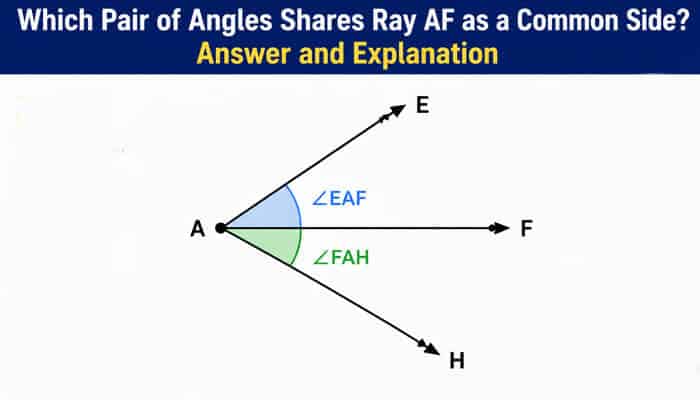

Which pair of angles shares ray AF as a common side? The correct answer is ∠BAF and ∠FAD.
Angle BAF is formed by ray AB and ray AF, while angle FAD is formed by ray AF and ray AD. Because ray AF appears as a side of both angles, it is their common side.
The easiest way to answer which pair of angles shares ray AF as a common side? is to examine the middle letter of each three-letter angle name. The middle letter identifies the vertex. In both ∠BAF and ∠FAD, A is the middle letter, so A is the vertex. Point F also appears as an outer letter in both names, confirming that each angle contains the ray beginning at A and passing through F.
Quick Answer: Which pair of angles shares ray AF as a common side?
When asked which pair of angles shares ray AF as a common side?, choose:
∠BAF and ∠FAD
Here is the complete breakdown:
- ∠BAF has sides ray AB and ray AF.
- ∠FAD has sides ray AF and ray AD.
- Ray AF appears in both angles.
- Therefore, ray AF is their common side.
Correct choice: ∠BAF and ∠FAD
Key Takeaways
- An angle is formed by two rays with a common endpoint.
- The common endpoint is called the vertex.
- The two rays forming an angle are called its sides.
- In a three-letter angle name, the middle letter identifies the vertex.
- Ray AF begins at A, passes through F, and continues in that direction.
- ∠BAF is formed by rays AB and AF.
- ∠FAD is formed by rays AF and AD.
- Ray AF is included in both angles.
- A common vertex alone is not enough; the angles must share the same complete ray.
- No angle measurements are needed to solve the problem.
- The answer to which pair of angles shares ray AF as a common side? can be determined from the angle names even without measuring the diagram.
Which Pair of Angles Shares Ray AF as a Common Side?
The correct pair is:
∠BAF and ∠FAD
To verify the answer, identify the vertex and the two sides of each angle.
| Angle | Vertex | First side | Second side |
| ∠BAF | A | Ray AB | Ray AF |
| ∠FAD | A | Ray AF | Ray AD |
The side repeated in both rows is ray AF.
Therefore:
Ray AF is the common side of ∠BAF and ∠FAD.
An angle consists of two rays that begin at the same endpoint. That endpoint is called the vertex, while the two rays are called the sides of the angle.
For ∠BAF:
- A is the vertex.
- Ray AB is one side.
- Ray AF is the other side.
For ∠FAD:
- A is the vertex.
- Ray AF is one side.
- Ray AD is the other side.
Because both angles contain ray AF, they share it as a common side.
This direct comparison provides the complete answer to which pair of angles shares ray AF as a common side?
What Is the Question Asking?
The question asks you to identify two angles that both use ray AF as one of their sides.
It does not ask:
- Which angle contains the letter F
- Which angles have A as their vertex
- Which angles share any ray
- Which angles have equal measures
- Which angles look close together
- Which angles appear to have the same size
It specifically asks for a pair in which both angles contain ray AF.
The question can be rewritten as:
Which two angles have vertex A and include the ray extending from A through F?
This rewritten form reveals two conditions:
- A must be the vertex of both angles.
- F must identify one side of both angles.
It is not enough for only one angle in an answer choice to contain AF. Both angles must contain the requested ray.
How Three-Letter Angle Names Work
A three-letter angle name follows one essential rule:
The middle letter is the vertex.
For an angle written as ∠XYZ:
- Y is the vertex.
- Ray YX is one side.
- Ray YZ is the other side.
Example: ∠BAF
In ∠BAF:
- B is a point on one side.
- A is the vertex.
- F is a point on the other side.
- The two sides are ray AB and ray AF.
Example: ∠FAD
In ∠FAD:
- F is a point on one side.
- A is the vertex.
- D is a point on the other side.
- The two sides are ray AF and ray AD.
Angle-Name Decoding Table
| Angle name | Vertex | Side 1 | Side 2 |
| ∠BAF | A | Ray AB | Ray AF |
| ∠FAD | A | Ray AF | Ray AD |
| ∠DAF | A | Ray AD | Ray AF |
| ∠DAB | A | Ray AD | Ray AB |
| ∠EAF | A | Ray AE | Ray AF |
| ∠CAE | A | Ray AC | Ray AE |
| ∠EAD | A | Ray AE | Ray AD |
| ∠AFD | F | Ray FA | Ray FD |
The middle letter must be identified before deciding which rays form an angle.
Why the Middle Letter Matters
Suppose a student sees ∠AFD and assumes it contains ray AF because the letters A and F appear together.
That conclusion is incorrect.
In ∠AFD:
- F is the middle letter.
- F is therefore the vertex.
- Its sides are ray FA and ray FD.
One side is ray FA, not ray AF.
Ray AF begins at A, while ray FA begins at F. Because their endpoints are different, they are different rays.
The middle-letter rule is therefore the fastest way to eliminate incorrect answers.
Can an Angle Be Named in Reverse Order?
Yes. The same angle can usually be named by reversing the two outer letters while keeping the vertex in the middle.
Examples include:
- ∠BAF and ∠FAB
- ∠FAD and ∠DAF
- ∠EAF and ∠FAE
Consider ∠BAF and ∠FAB:
| Name | Vertex | Sides |
| ∠BAF | A | AB and AF |
| ∠FAB | A | AF and AB |
The side order is reversed, but the same two rays form the angle.
Similarly:
| Name | Vertex | Sides |
| ∠FAD | A | AF and AD |
| ∠DAF | A | AD and AF |
Therefore, ∠FAD and ∠DAF are two names for the same angle.
This does not change the answer to which pair of angles shares ray AF as a common side? The listed correct pair remains ∠BAF and ∠FAD.
When a Single-Letter Angle Name Is Not Enough
An angle can sometimes be named using only its vertex, such as ∠A.
However, that notation is appropriate only when there is one clear angle at the vertex.
In this problem, several rays meet at A. Many different angles can therefore have A as their vertex, including:
- ∠BAF
- ∠FAD
- ∠DAB
- ∠CAE
- ∠EAD
- ∠CAF
Calling any of these simply ∠A would be unclear. Three-letter names are required to identify the exact pair of rays.
What Does Ray AF Mean?
A ray is part of a line that has one endpoint and continues indefinitely in one direction.
Ray AF:
- Begins at point A
- Passes through point F
- Continues beyond F
- Does not continue indefinitely in the opposite direction from A
The first letter identifies the endpoint. Therefore, A is the endpoint of ray AF.
Ray AF vs. Ray FA
Ray AF and ray FA are different rays.
| Ray | Endpoint | Direction |
| Ray AF | A | From A through F |
| Ray FA | F | From F through A |
Ray AF starts at A and passes through F.
Ray FA starts at F and passes through A.
The two rays contain the segment between A and F, but they have different endpoints and continue in different directions beyond that segment.
This distinction is important when reading angle names.
For example:
- ∠BAF contains ray AF.
- ∠AFD contains ray FA.
Although A and F appear in both names, the angles do not use the same ray.
Ray vs. Segment vs. Line
The letters A and F can name different geometric objects depending on the symbol used.
| Object | Number of endpoints | Extension |
| Segment AF | Two | Stops at A and F |
| Ray AF | One | Begins at A and continues through F |
| Line AF | None | Continues through A and F in both directions |
- Segment AF
Segment AF includes only the finite portion between A and F.
- Ray AF
Ray AF begins at A, passes through F and continues indefinitely.
- Line AF
Line AF extends indefinitely in both directions through A and F.
Why Angle Sides Are Rays
The sides of an angle begin at the vertex and continue in specific directions. They are therefore rays rather than finite line segments.
A printed diagram can display only part of each ray, but the ray is understood to continue beyond the visible drawing.
Step-by-Step Solution
Use the following method whenever a problem asks which angles share a particular ray.
Step 1: Identify the Ray’s Endpoint
The requested ray is AF.
Because A is the first letter, A is the endpoint.
Any angle containing ray AF must therefore have vertex A.
Step 2: Find A in the Middle
In a three-letter angle name, A must be the middle letter.
Possible angles include:
- ∠BAF
- ∠FAD
- ∠DAF
- ∠EAF
- ∠CAF
Names such as ∠AFD, ∠ABF and ∠DFA do not have A as their vertex.
Step 3: Look for F as an Outer Letter
An angle containing ray AF must also include F as either its first or third letter.
The possible patterns are:
Outer point – A – F
or:
F – A – Outer point
Examples include:
- ∠BAF
- ∠DAF
- ∠EAF
- ∠FAD
- ∠FAB
- ∠CAF
Step 4: Decode Both Angles
Do not stop after finding one angle that contains AF.
For every answer pair, write the sides of both angles.
For example:
- ∠DAF = AD and AF
- ∠DAB = AD and AB
Only the first angle contains AF, so the pair is incorrect.
Step 5: Compare the Side Lists
For the correct pair:
- ∠BAF = AB and AF
- ∠FAD = AF and AD
The repeated ray is AF.
Step 6: State the Answer
The pair of angles sharing ray AF as a common side is ∠BAF and ∠FAD.
This six-step method can be used for any similar geometry question.
Why ∠BAF and ∠FAD Are Correct
Let us examine each angle separately.
Angle BAF
Angle BAF is written as ∠BAF.
The middle letter is A, so A is the vertex.
Its sides are:
- Ray AB
- Ray AF
The angle name can be read as:
B → A → F
| Part of ∠BAF | Identification |
| First outer point | B |
| Vertex | A |
| Second outer point | F |
| First side | Ray AB |
| Second side | Ray AF |
Angle FAD
Angle FAD is written as ∠FAD.
Again, A is the middle letter, so A is the vertex.
Its sides are:
- Ray AF
- Ray AD
The angle name can be read as:
F → A → D
| Part of ∠FAD | Identification |
| First outer point | F |
| Vertex | A |
| Second outer point | D |
| First side | Ray AF |
| Second side | Ray AD |
Side-by-Side Comparison
| Feature | ∠BAF | ∠FAD |
| Vertex | A | A |
| First side | Ray AB | Ray AF |
| Second side | Ray AF | Ray AD |
| Contains ray AF? | Yes | Yes |
Both angles contain ray AF. That proves it is their common side.
Evaluating Every Answer Choice
The standard multiple-choice version of the problem may include these choices:
- ∠DAF and ∠DAB
- ∠EAF and ∠CAE
- ∠BAF and ∠EAD
- ∠BAF and ∠FAD
The safest method is to identify the sides of every angle.
| Choice | First angle’s sides | Second angle’s sides | Shared side | Correct? |
| ∠DAF and ∠DAB | AD, AF | AD, AB | AD | No |
| ∠EAF and ∠CAE | AE, AF | AC, AE | AE | No |
| ∠BAF and ∠EAD | AB, AF | AE, AD | None | No |
| ∠BAF and ∠FAD | AB, AF | AF, AD | AF | Yes |
Choice 1: ∠DAF and ∠DAB
∠DAF contains:
- Ray AD
- Ray AF
∠DAB contains:
- Ray AD
- Ray AB
These angles share ray AD, not ray AF.
Result: Incorrect
Choice 2: ∠EAF and ∠CAE
∠EAF contains:
- Ray AE
- Ray AF
∠CAE contains:
- Ray AC
- Ray AE
These angles share ray AE.
Result: Incorrect
Choice 3: ∠BAF and ∠EAD
∠BAF contains:
- Ray AB
- Ray AF
∠EAD contains:
- Ray AE
- Ray AD
They have the same vertex but do not share a side.
Result: Incorrect
Choice 4: ∠BAF and ∠FAD
∠BAF contains:
- Ray AB
- Ray AF
∠FAD contains:
- Ray AF
- Ray AD
The shared side is ray AF.
Result: Correct
Therefore, when the question asks which pair of angles shares ray AF as a common side?, the correct choice is ∠BAF and ∠FAD.
How to Read the Diagram
In the diagram used with this problem, several rays meet at point A.
The visible rays may include:
- Ray AB
- Ray AC
- Ray AD
- Ray AE
- Ray AF
Because these rays begin at A, they form several different angles around the same vertex.
The drawing may appear complicated, but you do not need to measure any angle. You only need to identify which angle names contain ray AF.
Relevant Rays
| Ray | Endpoint | Passes through |
| AB | A | B |
| AC | A | C |
| AD | A | D |
| AE | A | E |
| AF | A | F |
Do Not Assume the Diagram Is Drawn to Scale
A geometry diagram may be rotated, enlarged, compressed or drawn with imperfect proportions.
Do not select an answer only because two angles look close together.
Rely on:
- The point labels
- The middle letter of each angle name
- The endpoint of the requested ray
- The two sides forming each angle
The angle names provide more reliable information than the apparent size of the drawing.
What Is a Common Side?
A common side is one ray that belongs to two angles.
Suppose rays AB, AF and AD begin at A.
They form:
- ∠BAF using rays AB and AF
- ∠FAD using rays AF and AD
Ray AF belongs to both angles.
Therefore, AF is their common side.
Conditions for Sharing a Side
Two angles share a side when:
- They have the same vertex.
- One complete ray belongs to both angles.
- The shared ray begins at the common vertex.
- The shared ray extends in the same direction in both angle descriptions.
Common Side vs. Common Vertex
Two angles can have the same vertex without sharing a side.
For example:
- ∠BAF uses rays AB and AF.
- ∠EAD uses rays AE and AD.
Both have vertex A, but their sides are different.
Therefore:
A common vertex does not automatically mean the angles have a common side.
Common Side vs. Common Point
Two angles may meet at the same point without sharing a ray.
A common point means only that the figures touch at that location.
A common side means the same ray forms part of both angles.
In this problem, ∠BAF and ∠FAD share:
- Vertex A
- Ray AF
Are ∠BAF and ∠FAD Adjacent Angles?
They are adjacent if the diagram shows them lying next to each other without overlapping.
Adjacent angles generally:
- Have the same vertex
- Share one side
- Have interiors that do not overlap
For ∠BAF and ∠FAD:
- The common vertex is A.
- The common side is ray AF.
- The noncommon sides are ray AB and ray AD.
The angle names prove that they share ray AF. Their positions in the diagram determine whether they are also adjacent.
The most precise statement is:
∠BAF and ∠FAD share ray AF. They are adjacent when the diagram places them next to each other without overlapping.
Can More Than Two Angles Contain Ray AF?
Yes.
When several rays begin at A, ray AF can be paired with different second rays.
Examples include:
| Angle | Sides |
| ∠BAF | AB and AF |
| ∠CAF | AC and AF |
| ∠DAF | AD and AF |
| ∠EAF | AE and AF |
All these individual angles contain ray AF.
However, the question asks for a pair from the listed answer choices in which both angles contain AF.
Only:
∠BAF and ∠FAD
meets that condition among the choices.
Common Mistakes Students Make

Mistake 1: Checking Only One Angle
A student sees that ∠DAF contains AF and selects the entire answer pair.
However, the second angle must also contain AF.
Always check both angles.
Mistake 2: Looking Only for the Letter F
An angle can contain the letter F without containing ray AF.
For example, ∠AFD has vertex F. Its sides are ray FA and ray FD.
Check the middle letter first.
Mistake 3: Ignoring Ray Direction
Ray AF begins at A.
Ray FA begins at F.
The order of the letters matters.
Mistake 4: Choosing Angles With Only a Common Vertex
∠BAF and ∠EAD both have vertex A, but they do not share a ray.
Mistake 5: Identifying the Wrong Common Side
Some incorrect choices genuinely share a side:
- ∠DAF and ∠DAB share AD.
- ∠EAF and ∠CAE share AE.
The question asks specifically for AF.
Mistake 6: Treating AF as a Segment
The side of an angle is a ray beginning at the vertex, not only the finite segment from A to F.
Mistake 7: Depending Only on the Picture
The labels and angle names provide more reliable information than the apparent size or position of the angles.
Mistake 8: Expecting F in the Same Position
F appears last in ∠BAF and first in ∠FAD.
Both names still include ray AF because A remains the middle letter.
Mistake 9: Assuming the Angles Have Equal Measures
Sharing a side does not mean two angles are congruent.
Additional information would be needed to prove that their measures are equal.
Mistake 10: Assuming They Form a Linear Pair
Two angles sharing a side do not automatically form a linear pair.
Their noncommon sides would also need to be opposite rays.
Fast Test-Day Method
Use this quick method when answering a multiple-choice question.
Test 1: Find the Endpoint
Ray AF starts at A.
Therefore, A must be the middle letter in both angle names.
Test 2: Find Point F
F must appear as an outer letter in both names.
Test 3: Check Both Angles
Apply the test:
- B-A-F
- F-A-D
Both names contain:
- A in the middle
- F as an outer letter
Therefore, both contain ray AF.
This is the fastest way to answer which pair of angles shares ray AF as a common side? during a quiz or exam.
Three-Question Checklist
Ask:
- Is A the middle letter in both angles?
- Is F an outer letter in both angles?
- Does AF appear in both side lists?
For ∠BAF and ∠FAD, the answer to all three questions is yes.
Related Geometry Concepts
Identifying common sides helps students understand several later geometry concepts.
| Relationship | Common vertex? | Common side? | Additional condition |
| Angles sharing a side | Yes | Yes | None |
| Adjacent angles | Yes | Yes | Interiors do not overlap |
| Linear pair | Yes | Yes | Noncommon sides are opposite rays |
| Vertical angles | Yes | No | Formed by intersecting lines |
| Complementary angles | Not required | Not required | Measures total 90° |
| Supplementary angles | Not required | Not required | Measures total 180° |
| Angles formed by a bisector | Yes | Yes | Measures are equal |
Angle Addition
If ray AF lies inside ∠BAD, then:
m∠BAF + m∠FAD = m∠BAD
For example, if:
- m∠BAF = 32°
- m∠FAD = 43°
Then:
m∠BAD = 32° + 43° = 75°
The original question does not require measurement, but identifying the shared ray is important in angle-addition problems.
Angle Bisector
Ray AF would bisect ∠BAD only if:
m∠BAF = m∠FAD
The fact that AF is a common side does not prove that the two angles have equal measures.
Worked Example 1: Sharing Ray PQ
Question
Which pair shares ray PQ?
- ∠RPQ and ∠QPS
B. ∠PQR and ∠QRS
C. ∠RPQ and ∠SPT
D. ∠QRP and ∠PQS
Solution
Ray PQ begins at P.
For ∠RPQ:
- Vertex = P
- Sides = PR and PQ
For ∠QPS:
- Vertex = P
- Sides = PQ and PS
Both contain ray PQ.
Answer
∠RPQ and ∠QPS
Worked Example 2: Sharing Ray LM
Question
Which pair shares ray LM?
- ∠KLM and ∠MLN
B. ∠LMK and ∠NML
C. ∠KML and ∠LMN
D. ∠LKM and ∠MLN
Solution
Ray LM begins at L.
For ∠KLM:
- Vertex = L
- Sides = LK and LM
For ∠MLN:
- Vertex = L
- Sides = LM and LN
Both contain LM.
Answer
∠KLM and ∠MLN
Worked Example 3: Sharing Ray RY
Question
Do ∠XRY and ∠YRZ share a side?
Solution
For ∠XRY:
- Vertex = R
- Sides = RX and RY
For ∠YRZ:
- Vertex = R
- Sides = RY and RZ
The repeated ray is RY.
Answer
Yes. They share ray RY.
Worked Example 4: Ray BC vs. Ray CB
Question
Do ∠ABC and ∠BCA share ray BC?
Solution
For ∠ABC:
- Vertex = B
- Sides = BA and BC
For ∠BCA:
- Vertex = C
- Sides = CB and CA
The first angle contains ray BC, while the second contains ray CB.
The rays have different endpoints, so they are not the same.
Answer
No. The two angles do not share ray BC.
Worked Example 5: Common Vertex but No Common Side
Question
Do ∠LMN and ∠PMQ share a side?
Solution
For ∠LMN:
- Vertex = M
- Sides = ML and MN
For ∠PMQ:
- Vertex = M
- Sides = MP and MQ
Both angles have vertex M, but none of their sides match.
Answer
No. They share a vertex but not a side.
Practice Questions
Practice Question 1
Which pair shares ray JK?
- ∠HJK and ∠KJL
B. ∠JHK and ∠KJL
C. ∠HJK and ∠LMJ
D. ∠JKH and ∠LJK
Answer: A. ∠HJK and ∠KJL
- ∠HJK uses JH and JK.
- ∠KJL uses JK and JL.
Practice Question 2
What is the vertex of ∠BAF?
- B
B. A
C. F
D. AF
Answer: B. A
The middle letter identifies the vertex.
Practice Question 3
What are the sides of ∠FAD?
- FA and FD
B. AF and AD
C. FA and DA
D. AB and AF
Answer: B. Ray AF and ray AD
Practice Question 4
Which angle contains ray AE?
- ∠AFD
B. ∠CAE
C. ∠EFA
D. ∠DFA
Answer: B. ∠CAE
Its vertex is A, and its sides are ray AC and ray AE.
Practice Question 5
What common side do ∠DAF and ∠DAB share?
- AF
B. AB
C. AD
D. DB
Answer: C. Ray AD
Practice Question 6
Which pair of angles shares ray AF as a common side?
- ∠DAF and ∠DAB
B. ∠EAF and ∠CAE
C. ∠BAF and ∠EAD
D. ∠BAF and ∠FAD
Answer: D. ∠BAF and ∠FAD
Geometry Vocabulary
| Term | Meaning |
| Angle | A figure formed by two rays with a common endpoint |
| Ray | Part of a line with one endpoint that continues in one direction |
| Vertex | The common endpoint of an angle’s sides |
| Side of an angle | One of the rays forming an angle<% |
