


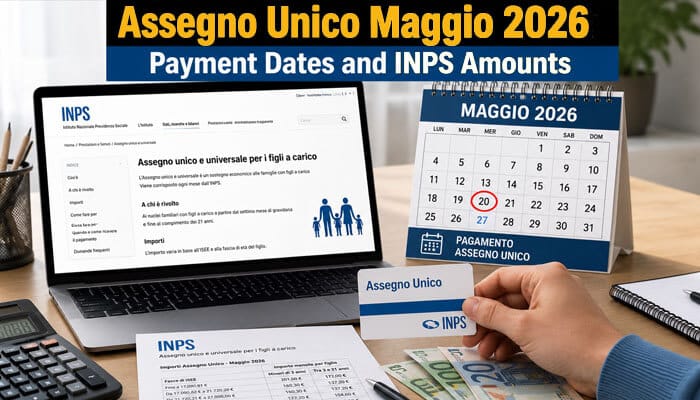

Assegno Unico Maggio 2026 payments were scheduled for May 20 and 21, 2026, for families whose benefits were already active and had not undergone changes. First payments, recalculated instalments, arrears and recoveries generally followed a later INPS processing schedule.
For families checking Assegno Unico Maggio 2026, the amount was not the same for every child. It depended mainly on the household’s applicable ISEE, the child’s age, the number of dependent children, disability status, parental employment and any available increases.
In 2026, the basic monthly amount for a minor child ranged from €58.30 to €203.80 before applicable increases. INPS also increased the benefit amounts, additions and ISEE thresholds by 1.4% for 2026.
This guide explains the official Assegno Unico Maggio 2026 payment dates, updated INPS amounts, ISEE requirements, available increases, arrears, application rules and the steps to follow when a May payment was delayed, blocked or lower than expected.
Assegno Unico Maggio 2026 Quick Answer
The ordinary Assegno Unico Maggio 2026 payment dates were:
- Wednesday, May 20, 2026
- Thursday, May 21, 2026
| Beneficiary situation | Expected payment timing |
| Existing benefit with no changes | May 20–21, 2026 |
| First payment following a new application | Normally during the final week of the month after the application |
| Payment containing a credit adjustment | Normally included in the later payment cycle |
| Payment affected by a debit adjustment or recovery | Normally included in the later payment cycle |
| Application requiring documents or verification | After the issue has been resolved |
| Domiciled postal payment above €1,000 | After an eligible IBAN is entered and the block is cleared |
The May 20–21 window applied to ongoing benefits that had not changed. First instalments were normally paid during the last week of the month following the application. Payments affected by credit or debit adjustments also followed the later processing cycle.
For an individual household, the payment date displayed in MyINPS remained more reliable than the general Assegno Unico Maggio 2026 calendar.
Key Takeaways
- Ordinary Assegno Unico Maggio 2026 payments were scheduled for May 20 and 21.
- The basic amount for a minor child ranged from €58.30 to €203.80 per month.
- The basic amount for an eligible child aged 18–20 ranged from €29.10 to €99.10.
- AUU amounts, additions and ISEE thresholds rose by 1.4% in 2026.
- The maximum basic amount applied with an ISEE of up to €17,468.51.
- The minimum amount generally applied without a valid ISEE or with an ISEE of at least €46,582.71.
- From March 2026, INPS used the new ISEE for specific family and inclusion benefits.
- A correctly certified DSU submitted by June 30, 2026, could produce eligible arrears from March.
- Existing accepted applications normally continued automatically.
- Additional Assegno Unico Maggio 2026 increases could apply for babies, large families, working parents, young mothers and children with disabilities.
What Is the Assegno Unico e Universale?
The Assegno Unico e Universale, commonly abbreviated to AUU, is an INPS benefit for families with dependent children.
It is called “universal” because families may receive a minimum amount even when they do not submit an ISEE or their ISEE exceeds the highest annual threshold. However, a valid ISEE is normally required for INPS to calculate a payment above the statutory minimum.
The benefit generally covers:
- minor dependent children;
- children beginning from the seventh month of pregnancy;
- dependent children aged 18–20 who satisfy specific conditions;
- dependent children with recognized disabilities without an age limit.
AUU is available to employees, self-employed workers, pensioners, unemployed people and economically inactive households.
The benefit is paid monthly, but the amount can change when a child reaches a relevant age, a new ISEE is processed, a family’s circumstances change or INPS applies a recalculation.
Who Was Eligible for Assegno Unico Maggio 2026?
The applicant had to satisfy the applicable citizenship, residence, immigration and Italian tax requirements.
In general, the applicant must:
- be an Italian or European Union citizen or hold another qualifying residence permit;
- be subject to Italian income taxation;
- be resident and domiciled in Italy;
- have lived in Italy for at least two years, including non-continuous periods, or hold an employment contract lasting at least six months.
Families did not need to have employment income to qualify. Unemployed and economically inactive households could also receive Assegno Unico Maggio 2026 when the other conditions were met.
Children Aged 18–20
A child aged 18–20 does not remain eligible merely because they are younger than 21.
The child must satisfy at least one of the following conditions:
- attend school;
- attend vocational training;
- be enrolled at a university;
- complete an internship;
- work while remaining within the applicable income limit;
- be registered as unemployed and seeking work;
- participate in universal civil service.
For employment or paid internships, the child’s expected total annual income must generally remain below €8,000.
When a child turns 18, the family should update the AUU application with the qualifying condition that allows the payment to continue. Failing to update the information can interrupt or delay Assegno Unico Maggio 2026 or a later monthly payment.
Children With Disabilities
A dependent child with a recognized disability may remain eligible without an age limit.
The payment depends on:
- the child’s age
- the disability classification
- the applicable ISEE
- other increases available to the household
Separate disability-related additions may apply to eligible children under 21. The recognized disability information must appear correctly in the records used by INPS.
Assegno Unico Maggio 2026 Payment Dates
INPS scheduled ordinary Assegno Unico Maggio 2026 payments for:
- Wednesday, May 20, 2026
- Thursday, May 21, 2026
These dates applied to continuing benefits that had not undergone changes.
They did not necessarily apply to:
- newly submitted applications;
- recently approved applications;
- payments affected by a new or corrected ISEE;
- payments containing arrears;
- instalments affected by a credit or debit adjustment;
- applications requiring additional verification;
- claims blocked because of an invalid IBAN;
- payments affected by family or custody changes.
For an individual family, the Assegno Unico Maggio 2026 date displayed in the personal MyINPS payment record was more reliable than the general national calendar.
Full 2026 INPS Payment Calendar
The official payment calendar for ongoing AUU benefits without changes was:
| Payment month | Official payment window |
| January 2026 | January 21–22 |
| February 2026 | February 19–20 |
| March 2026 | March 19–20 |
| April 2026 | April 20–21 |
| May 2026 | May 20–21 |
| June 2026 | June 18–19 |
| July 2026 | July 20–21 |
| August 2026 | August 18–19 |
| September 2026 | September 21–22 |
| October 2026 | October 21–22 |
| November 2026 | November 19–20 |
| December 2026 | December 16–17 |
These dates were not a universal guarantee for every beneficiary. First payments, recalculated instalments and adjusted amounts could be issued later.
The calendar was most useful for households receiving a stable monthly amount. A family whose application, ISEE or child information had changed could receive Assegno Unico Maggio 2026 on another date.
Why Did Some Assegno Unico Maggio 2026 Payments Arrive After May 21?
A later payment did not automatically mean that the benefit had been cancelled.
Common explanations included:
- a recently submitted application
- the addition of a newborn child
- a child reaching age 18
- a newly submitted or corrected ISEE
- an ISEE containing omissions or discrepancies
- recognition of a disability-related increase
- a change in custody or payment division
- a change in household composition
- arrears from an earlier month
- recovery of a previous overpayment
- verification of the beneficiary’s IBAN
- an application requiring action by the beneficiary or an INPS office
First payments were normally issued during the final week of the month following the application. Adjusted instalments could also be processed during this later period.
Therefore, a family that did not receive Assegno Unico Maggio 2026 on May 20 or 21 should first check the personal payment record before assuming that the benefit had stopped.
Assegno Unico Maggio 2026 Amounts
The amount of Assegno Unico Maggio 2026 was calculated according to the household’s applicable ISEE and the category of the child.
Basic Monthly Amounts for 2026
| Child category | Lowest ISEE band | No ISEE or highest ISEE band |
| Minor child | €203.80 | €58.30 |
| Eligible child aged 18–20 | €99.10 | €29.10 |
| Dependent child with a disability | €203.80 | €58.30 |
The maximum values applied with an ISEE of up to €17,468.51.
The amounts then declined progressively through the intermediate bands. The minimum values generally applied when the household:
- did not have a correctly certified ISEE; or
- had an applicable ISEE of at least €46,582.71.
These figures represent basic amounts before additional increases.
A family’s final Assegno Unico Maggio 2026 payment could therefore be higher than the amount shown in the basic table.
What Was the Average Assegno Unico Maggio 2026 Payment?
INPS published its May 2026 statistics on July 16, 2026.
The official data showed that:
- approximately €8.3 billion was paid during the first five months of 2026
- 6,071,269 households received AUU
- 9,574,385 children were covered
- the average May payment was approximately €175 per child, including increases
- the observed average was approximately €58 without an ISEE or above the maximum threshold
- the observed average reached approximately €227 in the lowest ISEE class.
The €175 figure is a national average, not a guaranteed amount for each child. It includes beneficiaries in different ISEE bands and families receiving different increases.
A household should not compare its Assegno Unico Maggio 2026 payment directly with the €175 average without considering the family’s ISEE, number of children and available additions.
Assegno Unico 2025 vs 2026
INPS increased the AUU amounts, indexed additions and ISEE thresholds by 1.4% for 2026.
| AUU value | 2025 | 2026 | Change |
| Maximum basic amount for a minor child | €201.00 | €203.80 | +€2.80 |
| Minimum basic amount for a minor child | €57.50 | €58.30 | +€0.80 |
| Upper limit of the lowest ISEE band | €17,227.33 | €17,468.51 | +€241.18 |
| Threshold for the minimum payment | €45,939.56 | €46,582.71 | +€643.15 |
The actual increase received by a family depended on its exact ISEE band and available additions. It was not automatically €2.80 more for every child.
The updated values applied from the February 2026 instalment. Adjustments relating to January were paid beginning with the March processing cycle.
These updated values were therefore already reflected in the ordinary Assegno Unico Maggio 2026 calculation.
Main Assegno Unico Maggio 2026 Increases
The basic amount was only the starting point. One or more increases could raise the final monthly payment.
| Increase | Maximum or fixed 2026 value |
| Child after the second | Up to €99.10 per qualifying child |
| Mother younger than 21 | €23.30 per child |
| Both parents receiving qualifying work income | Up to €34.90 per eligible child |
| Non-self-sufficient child under 21 | €122.30 |
| Child under 21 with severe disability | €110.60 |
| Child under 21 with medium disability | €99.10 |
| Four or more dependent children | €150 per household |
| Child younger than one | 50% increase in the applicable basic amount |
| Child aged one to three in an eligible large family | 50% increase in the applicable basic amount |
The increases for additional children and two income earners decrease as the ISEE rises. The disability additions and the amount for a mother younger than 21 are fixed in the official 2026 table.
Increase for a Child Under One Year
For each child younger than one year, the applicable basic AUU amount is increased by 50% until the child’s first birthday.
For a family entitled to the maximum basic amount:
| Component | Amount |
| Basic amount | €203.80 |
| 50% increase | €101.90 |
| Total before other increases | €305.70 |
The increase is calculated from the basic amount determined by the family’s ISEE. A household in a higher ISEE band therefore receives a smaller euro increase.
A baby who turned one before or during the relevant payment period could lose this 50% addition, which may explain why Assegno Unico Maggio 2026 was lower than the previous month.
Increase for Children Aged One to Three
A 50% increase can also apply to children aged one to three when:
- the household has at least three dependent children; and
- the neutralized ISEE does not exceed €46,582.71.
Both conditions must be met. A family with only one or two children does not receive this increase solely because one child is younger than three.
Increase for Four or More Children
A household with at least four dependent children can receive a fixed increase of €150 per month.
This is a household-level addition. It is not multiplied by the number of children.
This family-level amount may be paid together with the basic Assegno Unico Maggio 2026 amounts and other qualifying increases.
Increase for Children After the Second
An additional amount can apply to each qualifying child after the second.
In 2026, the amount ranged from:
- up to €99.10 in the lowest ISEE band;
- to approximately €17.40 in the minimum-payment band.
A family with four eligible children could receive this addition for the third and fourth children, together with the separate €150 large-family increase.
Increase When Both Parents Work
When both parents receive qualifying employment, self-employment or business income, the household may qualify for an additional amount.
The maximum 2026 increase was €34.90 per eligible child in the lowest ISEE band. It decreased through the intermediate bands and reached zero above the maximum ISEE threshold.
If one parent no longer met the income condition, the household’s Assegno Unico Maggio 2026 payment could be lower than an earlier instalment.
Increase for a Mother Younger Than 21
A fixed addition of €23.30 per child applies when the child’s mother is younger than 21.
The mother’s date of birth and family details must be recorded correctly in the application.
Disability-Related Increases
The 2026 additions for eligible children under 21 were:
| Disability classification | Monthly increase |
| Non-self-sufficient | €122.30 |
| Severe disability | €110.60 |
| Medium disability | €99.10 |
These amounts are added to the applicable basic payment. Other increases can also apply when the family satisfies the relevant conditions.
How the 2026 ISEE Affected Assegno Unico Maggio 2026
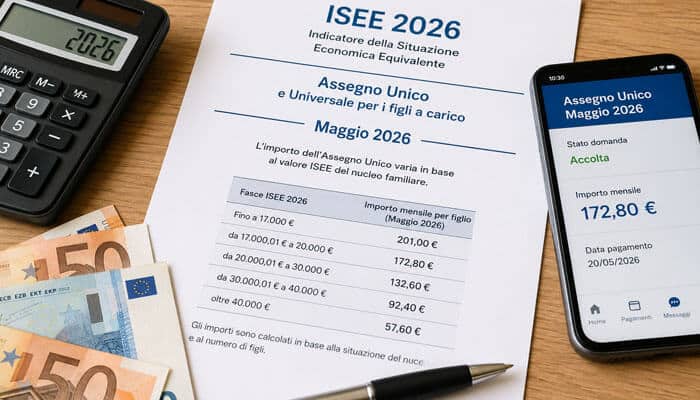
From March 2026, INPS used the new ISEE for specific family and inclusion benefits when calculating AUU. January and February 2026 were calculated using the ISEE valid on December 31, 2025. The new benefit-specific 2026 indicator applied from March.
This means that Assegno Unico Maggio 2026 was generally calculated using the new 2026 benefit-specific ISEE rather than the indicator used for the first two months of the year.
2026 ISEE Bands for a Minor Child
| Applicable ISEE | Basic monthly amount |
| Up to €17,468.51 | €203.80 |
| €17,468.52–€46,582.70 | Progressive reduction |
| €46,582.71 or more | €58.30 |
| No valid ISEE | €58.30 |
Intermediate amounts are determined using the detailed INPS table. They cannot be calculated accurately by applying one general reduction percentage.
What Changed in the New Family-Benefit ISEE?
The new benefit-specific ISEE introduced more favorable rules for selected family and inclusion benefits, including AUU.
Higher Main-Home Exemption
| Main-home location | 2026 exemption |
| Most municipalities | €91,500 |
| Municipality that is the capital of a metropolitan city | €120,000 |
| Additional amount | €2,500 for each cohabiting child after the first |
More Favorable Equivalence-Scale Additions
| Number of children | Additional scale amount |
| Two children | 0.10 |
| Three children | 0.25 |
| Four children | 0.40 |
| Five or more children | 0.55 |
These rules may produce a more favorable benefit-specific ISEE for larger families and certain homeowners. The effect depends on income, property value, financial assets, and family composition. A lower benefit-specific indicator could move a household into a more favorable band and increase its Assegno Unico Maggio 2026 amount.
Government Bonds and Postal Savings
Up to €50,000 per household may be excluded from movable assets for ISEE purposes when the assets consist of qualifying:
- Italian government bonds;
- postal savings bonds;
- postal savings books.
For a prefilled DSU, INPS applies the eligible exclusion automatically. For a self-declared DSU, the declarant is responsible for entering the information correctly.
The exclusion does not apply to every savings account or investment.
When the exclusion reduces the family’s applicable ISEE, it may indirectly increase the Assegno Unico Maggio 2026 payment or later AUU instalments.
What Is the Neutralized ISEE?
For AUU purposes, the benefit-specific ISEE is neutralized by removing the calculated effect of relevant AUU payments received by household members.
The simplified formula is:
Neutralized ISEE = benefit-specific ISEE − (relevant AUU payments ÷ household equivalence-scale parameter)
For example, when:
- the benefit-specific ISEE is €41,000;
- the household equivalence-scale parameter is 3.10;
- the relevant AUU payments total €3,100;
the amount removed is:
€3,100 ÷ 3.10 = €1,000
The neutralized indicator becomes:
€41,000 − €1,000 = €40,000
INPS performs the official calculation automatically. Manual calculation is mainly useful when estimating an amount through an online simulator.
The neutralized value can affect the band used to calculate Assegno Unico Maggio 2026, particularly when the household is close to an ISEE threshold.
The June 30, 2026 DSU Deadline
The most important ISEE deadline connected with Assegno Unico Maggio 2026 was June 30, 2026.
A family that submitted a correctly certified 2026 DSU by that date could qualify for:
- recalculation using the correct 2026 ISEE;
- higher future instalments;
- eligible differences for March, April and May;
- arrears dating back to March 2026.
Without a valid ISEE, INPS continued paying AUU but generally used the minimum statutory amount from March.
A DSU submitted after June 30 could still affect later payments, but the same automatic retroactive adjustment from March would not generally apply.
Therefore, a household that received the minimum Assegno Unico Maggio 2026 amount because its ISEE was unavailable could still recover an eligible difference by meeting the June 30 deadline.
What If the ISEE Contained Omissions or Discrepancies?
Submitting a DSU does not always produce an ISEE that can be used to calculate an amount above the minimum.
An ISEE may contain omissions or discrepancies involving:
- bank accounts;
- deposits;
- financial investments;
- movable assets;
- income information;
- inconsistencies between declared information and official records.
| ISEE situation | Possible AUU effect |
| No valid ISEE | Minimum amount |
| DSU awaiting certification | Minimum may continue while processing is pending |
| ISEE with omissions or discrepancies | Minimum amount may apply |
| Corrected DSU accepted | Recalculation using the corrected indicator |
| Supporting documents accepted | Eligible differences may be restored |
| CAF material error corrected | Retroactive correction may be possible |
The beneficiary may resolve the issue by submitting a corrected DSU, presenting supporting evidence or requesting correction of a material CAF error.
An unresolved discrepancy could explain why Assegno Unico Maggio 2026 was paid at the minimum rate even though the household expected a higher amount.
Can an ISEE Corrente Change the Amount?
A household whose current financial situation is significantly worse than the circumstances reflected in its ordinary ISEE may qualify for an ISEE Corrente.
Relevant events can include:
- loss or suspension of employment;
- a major reduction in household income;
- interruption of certain welfare or social-security payments;
- a qualifying change in household assets.
From April 1, an ISEE Corrente may also be requested in qualifying cases involving significant asset changes.
Once processed, the updated indicator may affect later AUU instalments. It does not automatically guarantee arrears for every previous month.
An ISEE Corrente approved after the ordinary Assegno Unico Maggio 2026 payment may change a later instalment rather than the payment already received.
Example Assegno Unico Maggio 2026 Calculations
The following examples are simplified. They do not replace the official INPS calculation.
Example 1: One Minor Child With a Low ISEE
Household details:
- one child aged six;
- ISEE within the lowest band;
- no additional increases.
| Component | Amount |
| Basic amount | €203.80 |
| Additional increases | €0 |
| Estimated monthly total | €203.80 |
The estimated Assegno Unico Maggio 2026 payment would be €203.80.
Example 2: One Baby Under One Year
Household details:
- one child aged eight months;
- ISEE within the lowest band;
- no other increases.
| Component | Amount |
| Basic amount | €203.80 |
| 50% baby increase | €101.90 |
| Estimated monthly total | €305.70 |
The estimated Assegno Unico Maggio 2026 payment would be €305.70 before any other additions.
Example 3: No Valid 2026 ISEE
Household details:
- one minor child;
- no correctly certified 2026 ISEE;
- no additional increases.
| Component | Amount |
| Minimum basic amount | €58.30 |
| Additional increases | €0 |
| Estimated monthly total | €58.30 |
In this example, the household would normally receive the minimum Assegno Unico Maggio 2026 amount.
Example 4: Two Working Parents
Household details:
- one minor child;
- ISEE within the lowest band;
- both parents receive qualifying work income.
| Component | Amount |
| Basic amount | €203.80 |
| Second-earner increase | €34.90 |
| Estimated monthly total | €238.70 |
The estimated Assegno Unico Maggio 2026 payment would be €238.70.
Example 5: Child With a Severe Disability
Household details:
- one eligible child under 21;
- ISEE within the lowest band;
- recognized severe disability.
| Component | Amount |
| Basic amount | €203.80 |
| Severe-disability increase | €110.60 |
| Estimated monthly total | €314.40 |
Other additions could raise these totals further. The official payment is determined from the information held in the beneficiary’s INPS application.
How to Use the INPS Simulator
INPS provides an online simulator that allows families to estimate their monthly AUU amount.
The calculation considers information such as:
- the applicable ISEE;
- the number of dependent children;
- each child’s age;
- disability status;
- both parents’ employment income;
- the mother’s age;
- large-family increases.
The result is only an estimate. It relies on the information entered by the user and does not replace INPS verification.
| Source | What it shows |
| INPS simulator | Estimated amount |
| AUU application details | Information recorded for the claim |
| Payment-status service | Processed amount and payment date |
| Bank or postal record | Amount actually credited |
| Official INPS calculation | Final entitlement after checks and adjustments |
The individual INPS payment record should be treated as the final reference for Assegno Unico Maggio 2026.
Was a New Application Required in 2026?
A family with an existing AUU application in the status “accolta,” meaning accepted, generally did not need to apply again in 2026.
The application continued automatically unless it had been:
- rejected;
- revoked;
- withdrawn;
- allowed to lapse;
- otherwise closed.
However, automatic continuation did not remove the obligation to report important changes.
The application still needed to be updated following:
- the birth of a child;
- a change in custody;
- a change in payment division;
- a child reaching adulthood;
- a change affecting an adult child’s eligibility;
- another material change in family circumstances.
Families receiving Assegno Unico Maggio 2026 through an existing accepted application therefore did not normally need to submit a duplicate claim.
When Was a New Application Necessary?
A new application could be required when:
- the family had never previously applied;
- the previous application was rejected, revoked, withdrawn or expired;
- an eligible adult child wanted to apply directly;
- a custody or guardianship arrangement required another claim;
- INPS instructed the family to submit a new application.
Applications may be submitted through:
- the INPS online service;
- an authorized patronato;
- the INPS Contact Center.
Applications filed by June 30 may qualify for arrears from March when the statutory requirements are met. Applications submitted after that date normally take effect from the month following submission.
A newly filed application would not generally follow the ordinary Assegno Unico Maggio 2026 May 20–21 payment window.
Assegno Unico for a Newborn Child
AUU entitlement for a newborn begins from the seventh month of pregnancy, not only from the month of birth.
The birth must still be added to the family’s AUU application. An existing accepted application does not remove the requirement to insert the new child’s details.
Depending on processing and eligibility, the resulting payment may include:
- the seventh month of pregnancy;
- the eighth month of pregnancy;
- the month of birth;
- later monthly instalments;
- the 50% increase until the child’s first birthday;
- other applicable family increases.
Pregnancy-month arrears may be paid separately from the family’s ordinary monthly instalment.
When a child was born around May 2026, the related arrears or increase might not have appeared in the ordinary Assegno Unico Maggio 2026 payment and could have been issued later.
AUU and Bonus Nuovi Nati Are Separate
Assegno Unico and Bonus nuovi nati are separate benefits.
Applying for or receiving one does not automatically submit an application for the other. Each benefit has separate eligibility conditions, ISEE rules and application procedures.
Can an Adult Child Receive AUU Directly?
An eligible child aged 18–20 may submit an application and receive the portion attributable to them directly. The chosen payment account must be registered or jointly registered in the adult child’s name.
A direct application by the child replaces the parents’ request for that child’s share. It does not create a duplicate payment. When the adult child applies directly, the family’s Assegno Unico Maggio 2026 payment may be divided differently from previous months.
How Is Assegno Unico Paid?
INPS can issue AUU through:
- a bank current account;
- a postal current account;
- a savings book with an IBAN;
- a payment card with an IBAN;
- a domiciled postal transfer where permitted.
The financial account must satisfy INPS verification and ownership requirements. It should generally be registered or jointly registered to the person receiving the payment.
An invalid or unverifiable account can delay Assegno Unico Maggio 2026, even when the application itself has been accepted.
Can Parents Divide the Payment?
Parents may request:
- 100% payment to one parent;
- 50% payment to each parent;
- 100% payment to the parent entitled under an exclusive-custody arrangement, subject to the applicable rules.
When a 50/50 arrangement is added after payments have started, the second parent’s share normally begins from the month following the communication to INPS. A recently changed payment division may therefore affect the amount or timing of Assegno Unico Maggio 2026.
How to Check Assegno Unico Maggio 2026
Beneficiaries can check their individual Assegno Unico Maggio 2026 payment through MyINPS.
The usual process is:
- Sign in using SPID, CIE or CNS.
- Open the AUU application or payment-status service.
- Select the payment connected with May 2026.
- Check the amount and payment date.
- Review the registered payment method.
- Look for warnings or required actions.
- Open the MyINPS Notification Centre.
- Confirm that the IBAN is correct.
The personal payment record is especially important for first instalments, arrears, recalculations and adjusted payments.
What Do Common Application Statuses Mean?
| Status | General meaning |
| Accolta | The application has been accepted |
| In istruttoria | INPS is processing or reviewing the application |
| In evidenza al cittadino | The beneficiary generally needs to provide information or make a correction |
| In evidenza alla sede | The responsible INPS office must take action |
| Sospesa | Processing or payment is temporarily paused |
| Respinta | The application was rejected |
| Decaduta | The application lost validity |
| Revocata | A previous entitlement was withdrawn |
| Rinunciata | The applicant withdrew the claim |
When an application is marked “In evidenza al cittadino,” the beneficiary should open the claim and follow the displayed instructions.
INPS may also provide a personalized video guide explaining how to correct the problem. An unresolved status can delay or block Assegno Unico Maggio 2026.
Why Was Assegno Unico Maggio 2026 Lower Than April?
A lower Assegno Unico Maggio 2026 payment did not necessarily indicate an error.
Possible explanations included:
- the 2026 ISEE placed the household in a higher band;
- the family did not have a correctly certified ISEE;
- the ISEE contained omissions or discrepancies;
- a child turned 18;
- an adult child no longer met the eligibility conditions;
- a baby turned one and lost the 50% increase;
- a child moved outside the eligible one-to-three age range;
- one parent no longer qualified as a second income earner;
- the mother no longer qualified for the under-21 increase;
- INPS recovered an earlier overpayment;
- April contained arrears or a one-time adjustment.
Families should compare the detailed monthly calculations rather than only comparing bank credits.
The payment could also appear lower because the previous month contained an exceptional credit that was not part of the ordinary entitlement.
Why Might an Assegno Unico Maggio 2026 Payment Be Blocked?
Common reasons include:
- an incorrect or unverifiable IBAN;
- a financial account that does not meet ownership requirements;
- missing information;
- an application marked “In evidenza al cittadino”;
- an unreported change involving a child;
- a domiciled postal payment above the cash limit;
- an application awaiting review by an INPS office.
Domiciled Payments Above €1,000
A domiciled postal payment can be blocked when the total due exceeds €1,000, because INPS cannot issue cash payments above that amount using this method.
This may happen when a monthly payment is combined with:
- several months of arrears;
- a large ISEE recalculation;
- payments for multiple children;
- disability-related additions;
- a previously blocked amount.
The beneficiary generally needs to add an eligible financial account with an IBAN to the AUU application.
This situation can explain why a large Assegno Unico Maggio 2026 payment containing arrears did not arrive through the selected postal method.
What to Do If Assegno Unico Maggio 2026 Did Not Arrive
A missing Assegno Unico Maggio 2026 payment should be investigated in the following order:
- check the individual payment date in MyINPS;
- confirm that the application remains accepted;
- review the Notification Centre;
- verify the IBAN;
- check whether the payment method is suitable;
- review the 2026 ISEE status;
- check for omissions or discrepancies;
- confirm whether a child’s details need updating;
- review recent custody or household changes;
- contact INPS or a patronato when the online record does not explain the delay.
The payment may simply belong to a later processing cycle because it is a first instalment, recalculation or adjustment.
A missing payment should therefore not be treated as cancelled until the beneficiary has reviewed the application and payment details.
Could Assegno Unico Maggio 2026 Include Arrears?
Yes. The ordinary Assegno Unico Maggio 2026 payment or a separate later credit could include arrears.
Common reasons included:
- a correctly certified 2026 ISEE becoming available
- approval of a new application
- addition of a newborn child
- recognition of a disability-related increase
- correction of family information
- resolution of a blocked payment
- correction of an earlier underpayment
An adjustment can work in either direction
- a credit adjustment increases the payment
- a debit adjustment reduces a later payment or recovers an earlier overpayment
INPS places adjusted instalments in the later payment process rather than guaranteeing that they will appear during the ordinary May 20–21 window.
Is Assegno Unico Taxable?
AUU does not form part of taxable total income for Italian IRPEF purposes.
It is also compatible with:
- Bonus asilo nido;
- qualifying regional and local benefits;
- the applicable Bonus mamme.
AUU replaced several older child-related measures but did not absorb the nursery-school bonus.
The Assegno Unico Maggio 2026 payment was therefore not treated as ordinary taxable income for IRPEF purposes.
Do Not Confuse AUU With ANF
Assegno Unico e Universale and Assegno per il Nucleo Familiare are different benefits. Following the introduction of AUU, ANF generally continued for qualifying households involving family members other than dependent children and orphans. ANF income tables should therefore not be used to estimate Assegno Unico Maggio 2026 for dependent children.
Common Mistakes That Delay or Reduce Assegno Unico Maggio 2026
- Not Renewing the ISEE
Without a correctly certified 2026 DSU, INPS generally applied the minimum payment from March.
- Submitting an Unnecessary New Application
An accepted application normally continued automatically. A duplicate application was generally unnecessary.
- Failing to Add a Newborn
A new child must be added to the existing AUU application.
- Not Updating a Child at Age 18
The application must show the qualifying condition that allows payment to continue.
- Ignoring ISEE Discrepancies
Submitting a DSU does not guarantee a higher payment when the resulting ISEE contains omissions or inconsistencies.
- Entering an Invalid IBAN
The financial account must be verifiable and satisfy INPS ownership requirements.
- Expecting Every Payment on May 20
The May 20–21 window applied only to unchanged continuing benefits.
- Treating the €175 Average as a Guaranteed Amount
The €175 figure was a national observed average that included applicable increases. It was not the basic amount payable to every child.
Avoiding these mistakes can reduce the risk of a delayed, blocked or unexpectedly low Assegno Unico Maggio 2026 payment.
Conclusion: Assegno Unico Maggio 2026
Assegno Unico Maggio 2026 payments were scheduled for May 20–21, 2026, for continuing benefits that had not undergone changes. First payments, recalculations, arrears and debit or credit adjustments could arrive later.
The basic Assegno Unico Maggio 2026 amount ranged from €58.30 to €203.80 per minor child, while eligible children aged 18–20 could receive between €29.10 and €99.10. The final amount could be considerably higher after increases for babies, large families, working parents, young mothers and children with disabilities.
The household’s 2026 ISEE was central to the calculation. From March, INPS applied the new benefit-specific indicator and generally paid the minimum amount when no correctly certified ISEE was available. Families that submitted their DSU by June 30 could qualify for eligible arrears from March.
Because every application can contain different ISEE values, children, increases and adjustments, the Assegno Unico Maggio 2026 payment date and amount displayed in the beneficiary’s personal INPS account remain the most reliable references for an individual case.
Assegno Unico Maggio 2026 FAQs
1. When were the Assegno Unico Maggio 2026 payments made?
The ordinary Assegno Unico Maggio 2026 payments were scheduled for May 20 and May 21, 2026, for families with active benefits that had not undergone any changes. New applications, arrears and recalculated payments generally followed a later INPS processing schedule.
2. How much was the Assegno Unico Maggio 2026 payment?
The amount of Assegno Unico Maggio 2026 depended mainly on the household’s ISEE, the child’s age, disability status and any applicable increases. In 2026, the basic monthly amount for a minor child ranged from €58.30 to €203.80 before additional bonuses were applied.
3. Why was my Assegno Unico Maggio 2026 payment delayed or lower than expected?
An Assegno Unico Maggio 2026 payment could arrive late or be lower than expected because of a newly submitted application, an updated or missing ISEE, arrears, payment recoveries, IBAN verification, changes in family circumstances or additional checks carried out by INPS.
4. Can I receive arrears with Assegno Unico Maggio 2026?
Yes. Assegno Unico Maggio 2026 could include arrears when INPS processed a corrected ISEE, approved a new application, recognized a newborn or disability increase, or recalculated a previous payment. Eligible families that submitted a valid DSU by June 30, 2026, could also receive arrears dating back to March.
5. How can I check my Assegno Unico Maggio 2026 payment status?
You can check your Assegno Unico Maggio 2026 payment by logging into MyINPS with SPID, CIE or CNS credentials. The online portal displays your scheduled payment date, payment amount, application status, registered IBAN and any notifications or actions required by INPS
