




For retail brands, the fastest route to new e-commerce revenue in 2026 is better ecommerce search and product discovery. Searchers arrive with intent, yet Baymard’s 2024 benchmark found that 41% of ecommerce sites still fail to support the eight core search query types shoppers use, and 46% of desktop, 58% of mobile, and 64% of app experiences scored “mediocre or worse” for search UX.
This comparison covers five platforms that bring together search, recommendations, and merchandising so teams can lift conversion and revenue without a full redesign. It also highlights evaluation criteria, integration notes by commerce stack, common rollout risks, and the KPIs that can show lift in 30 to 90 days.
Broader startup coverage on growing a business tracks the same shift across other parts of the modern business stack, where founders and early operators getting the strongest outcomes treat infrastructure decisions as a connected investment in deliverability, sender reputation, and cross-vendor flexibility rather than a back-office task handled only when something breaks.
Key Takeaways
The strongest platforms improve relevance, give merchandisers control, and show impact quickly.
- Pair intelligent search with recommendations and automated merchandising to get the largest lift from discovery. Personalization typically drives a 10 to 15% revenue lift on average, with outcomes ranging from 5% to 25%, depending on sector and execution.
- Prioritize hybrid search that combines keyword matching, meaning-based retrieval, and behavioral reranking. This reduces reformulations and zero-results queries while lifting revenue per visitor.
- Time to value matters. Out-of-the-box connectors for Shopify Plus, Salesforce Commerce Cloud, Adobe Commerce, BigCommerce, and commercetools can shorten deployment from months to weeks.
- Governance is a real differentiator. Look for merchandising rules, explainability, and guardrails so teams can override AI when margin, inventory, or promotions require it.
- Prove impact with a 30 to 90 day plan that tracks search revenue, RPV, add-to-cart from search, query reformulations, and zero-results rate.
How I Evaluated These Ecommerce Search Platforms
Business impact mattered more than feature count.
Each platform was assessed across six areas: business outcomes, including conversion rate, revenue per visitor, or RPV, average order value, or AOV, and zero-results reduction; AI approach, including hybrid search, reranking, and recommendation maturity; integrations and data; control and governance; time to value; and total cost of ownership.
Sources included vendor documentation, release notes, public case studies, and practitioner experience running search and merchandising programs. Salesforce reported that retailers claiming full ability to use customer data for personalization rose from 32% in 2021 to 57% in 2023, which shows how quickly this market is maturing.
What Is an Ecommerce Search and Discovery Platform?
A search and discovery platform should turn shopper intent into relevant products and higher revenue.
Core components usually include site search, autosuggest, recommendations, category merchandising, business rules, analytics, and testing across search, browse, and product detail page, or PDP, modules.
Hybrid search matters because it blends keyword matching with meaning-based retrieval and behavioral signals. Large language models, or LLMs, can help with query understanding and conversational discovery, but final ranking still depends on clean product data, guardrails, and merchandising logic.
Algolia
Algolia has been one of the most recognized names in commerce search infrastructure because of its API-first architecture and developer-friendly tooling. The platform fits teams with engineering resources who want granular control over indexing, ranking, and recommendation logic across modular commerce stacks rather than working within bundled merchandising suites.
Core Capabilities
NeuralSearch combines keyword and AI-powered semantic search in a single API to better interpret shopper intent. The platform also includes Recommend modules for PDP and cart pages, a Merchandising Studio for visual rule management, analytics dashboards, synonyms, query categorization, and robust autosuggest. In April 2026, Algolia introduced Recommendation Analytics to show revenue impact from its AI recommendations alongside search analytics.
AI Approach
Algolia blends vector embeddings with lexical precision and layers behavioral reranking on top. Recommendation models include collaborative filtering and image-based “looking similar” suggestions.
Integrations
Prebuilt cartridges and apps are available for Shopify, Salesforce Commerce Cloud, Adobe Commerce, BigCommerce, and commercetools. React and InstantSearch SDKs support custom front ends, and export options help teams feed downstream analytics and BI tools.
Ideal Customer Fit
Algolia fits commerce teams with developer resources that want granular control, enterprise scale, and a unified search plus recommendations pipeline.
Nosto
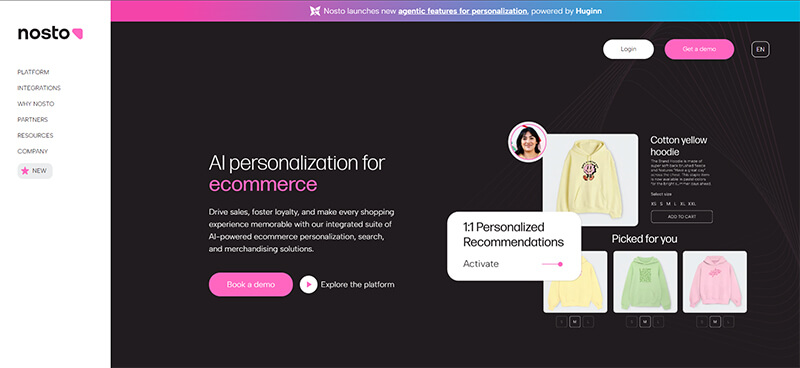
Nosto has built its position around delivering search, recommendations, merchandising, and content personalization through a single marketer-friendly interface. The platform fits mid-market retailers in fashion, beauty, and lifestyle who want measurable wins without long engineering queues, particularly when search and recommendation work needs to roll out together.
Core Capabilities
Nosto combines on-site search, autosuggest, personalized product recommendations, dynamic category merchandising, content personalization, A/B testing, audience segmentation, and user-generated content, or UGC, modules. It added native ecommerce search through its SearchNode acquisition, announced in January 2022.
AI Approach
The platform learns from shopper behavior across search, browse, and PDP placements. Context-aware autocomplete, rules, and AI guardrails give merchandisers quick override control without a long engineering queue.
Integrations
Nosto offers native integrations for Shopify, Shopify Plus, Salesforce Commerce Cloud, Adobe Commerce, BigCommerce, and Shopware, plus a GraphQL Search API for custom builds. When Nosto is already in place, search rollouts commonly land in about three to six weeks.
Ideal Customer Fit
Nosto works well for teams that want quick wins and lighter implementation work. Fashion, beauty, and lifestyle brands can benefit most when they want search, 1:1 recommendations, category merchandising, and UGC in the same workflow.
If your shortlist depends on unified on-site search, 1:1 recommendations, and category merchandising that can roll out on Shopify or Salesforce Commerce Cloud in weeks, comparing implementation scope, integration details, reporting needs, launch sequencing, data requirements, change management, and likely timelines for your current stack before approval is worthwhile, and a practical place to start that review is the platform’s current product documentation and Shopify or Salesforce app listings.
Bloomreach
Bloomreach has positioned itself for enterprise retailers who treat search as part of a broader connected commerce experience including content, customer data, and lifecycle marketing. The Discovery, Engagement, and Content modules work together to support large catalogs, multi-country assortments, and complex taxonomy work across multiple touchpoints.
Core Capabilities
Bloomreach Discovery handles semantic search, dynamic facets, and revenue-aware ranking. Bloomreach Engagement adds a customer data platform, or CDP, plus omnichannel orchestration, while Content provides a headless CMS for faster publishing. Together, they create a broad commerce experience stack.
AI Approach
Bloomreach uses self-learning search at the SKU and variant level with ranking tuned to business outcomes. Query understanding combines linguistic and semantic signals, while merchandising rules and manual overrides keep teams in control.
Integrations
Connectors and cartridges support Shopify, BigCommerce, Salesforce Commerce Cloud, and commercetools. SDKs, GraphQL tools, and a large app directory help teams connect the wider martech stack.
Ideal Customer Fit
Bloomreach fits retailers that manage large catalogs, multi-country assortments, and complex taxonomy work. It is especially useful when search, lifecycle marketing, and content publishing need to share data and orchestration.
Dynamic Yield
Dynamic Yield operates as a personalization and testing layer rather than a full search replacement, which suits retailers wanting to improve discovery without overhauling their current commerce stack. The platform fits operators with a strong experimentation culture who treat search personalization as one optimization workstream among several.
Core Capabilities
The platform includes recommendations, A/B and multivariate testing, behavioral targeting, social proof, guided selling, product finders, email personalization, and mobile SDKs. Its affinity-based approach calculates per-user preference scores from behavior to shape recommendations and targeted experiences.
AI Approach
An algorithm studio lets teams blend custom recommendation strategies. Experience Search, a multi-modal semantic AI capability added in late 2025 and early 2026, expands discovery across text, image, web, and app experiences. Conversational modules such as Shopping Muse add guided product discovery at the front end.
Integrations
Dynamic Yield uses an API-first architecture and connects well with analytics, consent, and commerce tools. For many retailers, it works best as an orchestration layer over an existing commerce stack rather than as a full replacement for search.
Ideal Customer Fit
It fits operators with a strong testing culture who want to add search personalization and guided discovery on top of their current platform.
Optimizely
Optimizely focuses on experimentation and testing rather than acting as a standalone search engine, which makes it valuable for teams that want to prove which discovery experiences actually move revenue before committing to permanent rules. The platform connects well with third-party search vendors for layered testing scenarios.
Core Capabilities
Web and Feature Experimentation support A/B tests and controlled rollouts. Optimizely Data Platform, or ODP, delivers real-time audience segments and product recommendations, while CMS and Search and Navigation cover content discovery. ODP segments can sync directly into experimentation workflows for activation.
AI Approach
Optimizely uses AI-assisted optimization, including multi-armed bandits, to shift traffic toward stronger performers faster. Opal also helps teams build audiences and test ideas with less manual setup.
Integrations
Dozens of partner integrations support common analytics, data, and commerce tools. Optimizely also connects well with third-party search vendors, which makes it useful for testing ranking logic, placement zones, and messaging before hard-wiring rules.
Ideal Customer Fit
It fits teams with a mature testing culture that want to improve any search engine by proving what to show, where to show it, and which audience should see it.
Implementation Watchouts
Most failed rollouts trace back to data quality and governance, not to weak algorithms.
- Data Quality: Normalize attributes such as size, color, and material. Map variants correctly, and keep inventory, price, and availability feeds near real time.
- Query Semantics: Build synonym sets, handle abbreviations and units, and confirm how the engine treats singulars, plurals, and close variants. Test the eight common query types identified in Baymard’s research.
- Guardrails: Define promotions, margins, and inventory policies as rules the AI must respect. Set clear manual controls and audit logs before launch.
- Analytics: Track zero-results rate, reformulation rate, click-through from search, add-to-cart from search, search RPV, and recommendation-attributed revenue.
Conclusion
The right platform is the one your team can launch, govern, and keep improving after go-live.
Start with Algolia if you need API-level control and strong support for modular commerce. Consider Nosto if your team wants a marketer-friendly suite with search, recommendations, and merchandising in one place. Bloomreach makes sense when search, customer data, and content need to work together across channels.
Dynamic Yield is a strong option for experimentation-led teams that want to layer personalization over an existing stack. Optimizely adds value when you want to test every decision before you lock it into production.
FAQs
Most rollout questions come down to proof of impact, data readiness, and scope.
Which KPIs Prove Search and Personalization Are Working?
Track search revenue per visitor, add-to-cart from search, conversion rate for searchers versus non-searchers, query reformulations, zero-results rate, and margin by test cell. These metrics tie discovery performance to commercial outcomes.
Do I Need a CDP to Personalize Search?
Not always. Most search and discovery platforms can learn from clickstream and order data on their own. A CDP becomes more valuable when you want cross-channel targeting, shared audience logic, or tighter coordination between onsite and lifecycle programs.
How Long Does a Modern Search Rollout Take?
With native connectors and a clean catalog, a focused pilot can launch in weeks. Complex catalogs, custom front ends, and weak attribute data usually add time for cleanup, QA, and ranking reviews. A realistic pilot window on a supported platform is often three to six weeks.
What Is the Fastest Way to Reduce Zero-Results?
Audit your highest-volume no-result queries first. Then add synonyms and redirects, confirm variant and SKU indexing, and apply semantic expansion where it helps. After that, test reranking and targeted recommendations on those queries so dead ends turn into productive product discovery.
BIo:
Waseem khan is a passionate multi niche writer with a focus on delivering high quality contents and reviews on the latest trends.
mwasimullah04@gmail.com
