


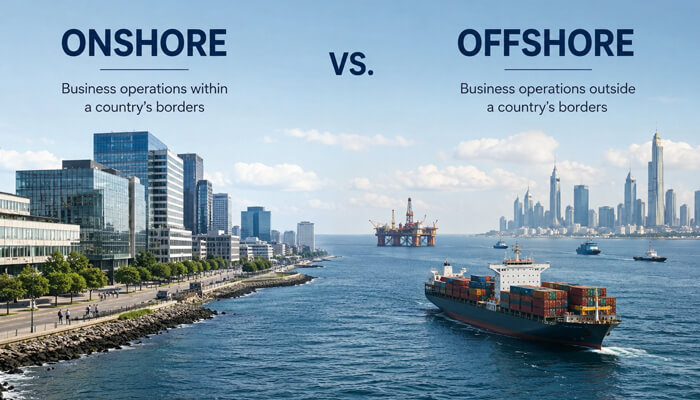

What Do Onshore and Offshore Mean?
Two companies sell the same software. One is registered in Munich and sells to German clients; the other is registered in the British Virgin Islands but run by a founder who lives in London and sells to customers across Asia. The first is onshore. The second is offshore. The labels describe one thing only: where a business is incorporated relative to where its owners live and where it actually does its work.
What is an onshore company?
An onshore company is set up in the same country where it does most of its business. It answers to that country’s laws, pays that country’s taxes, and files paperwork with that country’s regulators. Take a firm that registers in Germany, hires German staff, and serves German buyers. That is onshore in the plainest sense. The structure tends to read as transparent because the company has nowhere to hide; its accounts, its filings, and its dealings all sit under one familiar legal roof, close to the market it serves. A regulator can pull the records, a customer can check the registry, and a bank can verify the address without crossing a border.
What is an offshore company?
An offshore company is incorporated somewhere other than where its owners live or where the real activity happens. The picture gets blurry fast, though. Owners can also live in the offshore jurisdiction, and plenty of offshore companies keep genuine staff, offices, and operations on the ground. These jurisdictions tend to offer lighter administrative rules, easy international access, and room to structure things flexibly. Businesses use them to trade across borders, hold assets, manage intellectual property, and route investment between countries.
Say the word “offshore” out loud and many people picture something shady. That reaction got built over years of news coverage, much of it tied to financial scandals where leaked records exposed hidden ownership and secrecy. Reporting like that fused the word to wrongdoing in the public mind. The reality is duller. An offshore company is a company registered outside its owner’s home country, nothing more. When it follows the rules and reports what it should, the structure is entirely legal and used every day by ordinary firms. If you want a side-by-side look at how the two models actually differ, this breakdown of offshore vs onshore walks through the practical distinctions.
Key structural differences at a glance
The gap between onshore and offshore shows up across a handful of dimensions:
- Place of incorporation: the home country versus a foreign one.
- Taxation: a single domestic tax system versus regimes built around cross-border activity.
- Regulation: a full domestic rulebook versus frameworks aimed at international business.
- Market focus: local customers versus buyers spread across several countries.
- Reporting: heavier filing duties onshore, lighter ones in many offshore jurisdictions.
Onshore companies: pros and cons

Advantages of onshore companies
Onshore registration suits a business that wants to plant roots and be seen doing it. A few things tip in its favor:
- Legal predictability. The company runs inside an established legal system, so the rules rarely surprise anyone and protections are clear.
- Clients, partners, and investors read a local entity as the easier one to vet, which shortens the distance to a signed contract.
- Market reach. Talking to domestic customers, suppliers, and agencies is straightforward when everyone shares the same legal language.
- Financial access. Local banks, lenders, and government support schemes open up to a company that lives in the same system.
Operational considerations of onshore companies
That same stability carries a price. A company registered in a developed market inherits the costs of one:
- Higher running costs. Taxes, wages, and compliance bills tend to sit at the upper end.
- Demanding paperwork. Detailed reporting, audits, and legal obligations keep the books transparent, though staying compliant gets simpler when you only answer to one jurisdiction.
- Tighter operating rules. Oversight shapes how a company runs day to day, and the effect bites hardest in regulated fields.
Best use cases for onshore structures
Onshore makes sense when the work and the customers stay close to home. Picture a regional clinic chain: it needs licenses from national health regulators, patients who trust a recognizable local name, and the option to apply for state funding. None of that works from a P.O. box on a distant island. Onshore fits when:
- the company targets local or regional buyers;
- brand trust and public visibility matter;
- the industry sits under strict oversight, as finance and healthcare do;
- the business wants government incentives or funding.
Offshore companies: pros and cons
Advantages of offshore companies
Offshore structures earn their keep in international business, where reach and flexibility count:
- Global access. Cross-border deals and expansion into new markets become easier to arrange.
- Lean administration. Many jurisdictions ask for far less day-to-day paperwork.
- Asset management. They work well for holding intellectual property, investments, or assets that span several countries.
- Structuring freedom. A company can organize itself to operate across multiple markets without friction.
Disadvantages of offshore companies
The trade-offs are real, and they show up the moment a company tries to do something practical:
- Some partners want extra reassurance before they sign, which slows things down.
- Compliance load. Global reporting standards keep tightening, and meeting them across several jurisdictions at once is harder than meeting them in one.
- Banking friction. Opening and keeping international accounts can demand a thick stack of documentation. A founder who expects to wire funds on day one may instead spend weeks proving where the money comes from.
- Unfamiliar law. Working through a legal system you do not know often means paying for expert help.
Top offshore jurisdictions
A handful of jurisdictions come up again and again in international structuring, chosen for their legal track record and global recognition rather than any single perk:
- British Virgin Islands
- Cayman Islands
- Seychelles
- Belize
- Hong Kong, which sits somewhere between a pure offshore center and a full financial hub
These names surface for reasons like solid legal infrastructure, heavy international use, regulatory alignment, and lean administration. They are not interchangeable. The Cayman Islands carries institutional weight and slots neatly into the global financial system, while places such as Belize or Seychelles draw more skeptical looks from banks and partners. Picking one over another can shape how the rest of the world treats your company.
Midshore companies explained
What makes midshore different?
Midshore sits in the space between the other two. These jurisdictions pair international access with stricter rules and a cleaner reputation than the classic offshore havens. They usually run moderate tax environments, dependable courts, transparent compliance regimes, and infrastructure built for cross-border companies. The pitch is straightforward: most of the reach of offshore, with much of the credibility of onshore.
Well-known midshore jurisdictions
Midshore is a working label, not a category written into any statute. People use it for places that combine global access with strong regulation. The ones that come up most:
- Cyprus
- Malta
- Ireland
- Singapore
- Netherlands
These get picked for balanced tax rules, wide treaty networks, mature legal systems, and broad acceptance abroad. A company that wants a respectable, structured base for cross-border work tends to land here.
Onshore vs offshore vs midshore: privacy, reporting, and tax
Privacy and reporting requirements
How much a company has to disclose comes down to the rules of the place it calls home:
- Onshore companies file the most. Financial disclosures, public registers, and continuous oversight come with the territory.
- Offshore companies once filed very little, but years of international pressure have pushed disclosure and transparency obligations sharply upward.
- Midshore companies land in the middle, with rules that ask for real transparency while keeping the administrative burden workable.
Tax treatment differences
Tax usually sits at the center of the choice:
- Onshore companies pay local corporate rates, which can climb high depending on the country.
- Offshore companies fall under regimes built to encourage international activity, often with a far lighter tax footprint.
- Midshore jurisdictions offer middling rates and standards that line up with international norms.
One rule cuts across all three: a company owes tax under the laws of the country where it is incorporated and the countries where it actually earns. Treating an offshore registration as a way to skip that obligation is how founders get into trouble.
Outsourcing business operations
The same words travel beyond company formation. In outsourcing, where firms hand specific tasks to outside providers, onshore and offshore describe how far away that provider sits.
Onshore outsourcing explained
Onshore outsourcing means hiring a provider inside your own country. Communication runs smoother, the culture matches, and both sides work under the same legal system. The bill, however, runs higher.
Offshore outsourcing explained
Offshore outsourcing sends the work to providers in far-off countries. It is the standard play for IT, customer support, and manufacturing. The draw is cost, plain and simple. The cost is paid back in time zone gaps and the communication snags that come with running a team eight hours out of sync.
Nearshore: the middle ground
Nearshore outsourcing, close cousin to midshore, hands work to a neighboring or nearby country. A German firm leans on partners in Poland or the Czech Republic; a U.S. company works with teams in Mexico or Colombia. The math works because the savings stay decent while the friction drops: a one or two hour time difference instead of twelve, overlapping business culture, and pricing that still beats hiring at home.
How to choose the right jurisdiction
Key factors to consider
Sorting between onshore, offshore, and midshore comes down to a few practical questions:
- Business model: local, international, or spread across regions?
- Target markets: serving one country or chasing global reach?
- Regulatory environment: how much compliance, reporting, and oversight can the business carry?
- Cost structure: what is the budget for setup, tax, and ongoing admin?
- Reputation: what will partners, clients, investors, and regulators expect to see?
- Operational presence: does the company need real substance, like offices and staff on the ground?
Making your final decision
The right structure follows from where the business actually lives and works:
- Go onshore when the market is domestic and you need a strong local footing, legal clarity, and direct access to national infrastructure.
- Go offshore when you are building international operations, holding assets, or running cross-border activity where flexibility and reach come first.
- Go midshore when you want both global access and a credible, structured home. It fits companies that need cross-border function without giving up reputation.
Compliance in international structuring
Once a company spreads across borders, compliance stops being an afterthought and becomes part of the structure itself. That means meeting anti-money laundering rules and screening for politically exposed persons and other risk signals before they turn into problems.
Regulated and non-regulated businesses alike benefit from standardized due diligence, the kind that confirms operations stay within international transparency and reporting expectations whether the entity is onshore, offshore, or midshore. Wherever a company plants its flag next, staying compliant is what lets it operate across borders without looking over its shoulder.
