



Key Takeaways
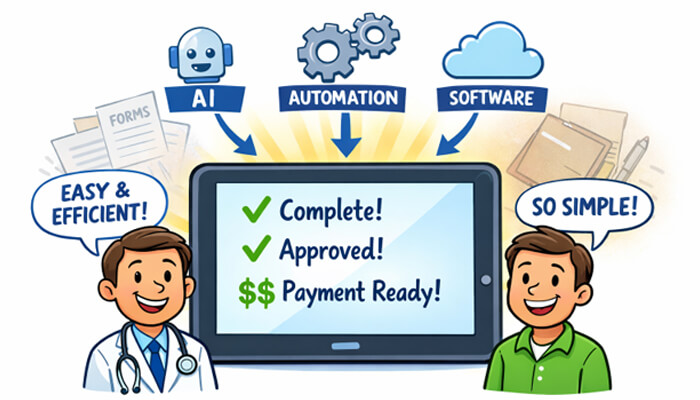
- Artificial Intelligence (AI) is streamlining billing workflows, reducing errors, and speeding up payment cycles.
- Automation is minimizing manual processes, leading to more efficient revenue cycle management and improved financial outcomes.
- Subscription-based software provides scalable, cost-effective billing solutions adaptable to healthcare organizations of all sizes.
- Despite notable advances, challenges like coding intensity and regulatory compliance continue to demand attention.
New technological tools are reshaping healthcare billing, transforming the billing landscape. As a result, providers and patients are experiencing greater efficiency, accuracy, and satisfaction with healthcare payments. Digital solutions such as those offered by ACU-Serve are leading the way, enabling organizations to improve workflows, reduce administrative burdens, and enhance revenue protection.
Healthcare billing, historically known for its complexity and risk of errors, is now benefiting from artificial intelligence (AI), automation, and modern software platforms. These advancements drive stronger financial performance while helping organizations stay compliant in an ever-tighter regulatory environment.
This article details how emerging technologies are revolutionizing healthcare billing practices and what the future holds for revenue cycle management. The integration of innovation into every step of the billing process means fewer mistakes, faster reimbursements, and a better experience for both providers and patients.
Industry experts agree that the evolution of technology is not just about improving accuracy. It is also enabling a higher standard of patient engagement, empowering healthcare teams to focus on the quality of care rather than paperwork.
The Role of AI in Modernizing Billing Processes
AI-driven systems are at the forefront of healthcare billing innovation. By automating complicated tasks, AI reduces the risk of human error and accelerates every step from coding to collections. For example, machine learning algorithms review electronic health records and generate accurate, compliant billing codes, which greatly lowers the frequency of claim denials.
Recent research shows that more than one in five healthcare organizations has already adopted commercial AI solutions, a number that continues to grow quickly. This adoption rate is especially significant compared to other sectors of the economy, indicating healthcare’s strong momentum. As more organizations implement AI, the industry is experiencing clear improvements in claim accuracy and speed, especially in claims processing and reimbursement cycles. According to Forbes, AI is directly linked to enhanced patient care and operational excellence.
Automation Enhancing Revenue Cycle Management
Automation tools are redefining how administrative work gets done in healthcare billing. Sophisticated software manages repetitive and time-consuming activities such as data entry, claim submission, payment posting, and follow-up on outstanding accounts. Organizations adopting automation report not just fewer claim denials but also faster reimbursements and more predictable cash flow.
The integration of AI and automation into hospital billing has been a significant turning point. Not only are operational costs dropping, but billing departments can now shift focus to higher-value tasks and patient engagement.
Subscription-Based Software: A New Paradigm

Modern healthcare billing platforms are moving away from traditional licensing in favor of subscription-based models. This trend is helping providers stay current with regular software updates that ensure compliance with new billing regulations and coding requirements. Monthly subscription models also benefit healthcare organizations by making expenses more predictable and scalable as needs change over time.
Providers gain the advantage of reduced upfront technology costs and can access updated features without expensive system overhauls. As reported by Digital Journal, subscription-based solutions support operational agility and allow healthcare organizations to respond more quickly to regulatory changes and marketplace shifts.
Addressing Challenges in Technological Integration
Despite the advancement, integrating technology into healthcare billing presents unique challenges. A primary concern is coding intensity, where billing for more complex care than what is provided can occur inadvertently, contributing to higher healthcare costs for patients and payers. Unnecessary coding contributed an estimated $22 million in excess spending for maternity care alone.
Additionally, organizations must continually address compliance and data security as federal and state regulations evolve. The transition to new systems often requires retraining staff and updating internal policies, which can add to the cost and complexity of technological conversion. However, when implemented thoughtfully, the long-term benefits of efficiency and compliance far outweigh the challenges.
Future Outlook: AI and Automation in Billing
The future of healthcare billing lies in deeper use of automation and AI. Emerging technologies promise even more sophisticated solutions, such as AI-driven denial prediction, proactive claims management, and automated appeals processes. Industry experts anticipate that these advances will further ease administrative workload, inspire greater transparency, and reinforce compliance with evolving billing rules.
The ongoing digital transformation in healthcare is also expected to facilitate patient engagement and self-service billing platforms, making the experience easier and more transparent for consumers. For organizations willing to invest in new technology, these advancements represent a clear path to financial growth and improved quality of care.
Conclusion
Technology is fundamentally changing how healthcare billing gets done. AI, automation, and flexible software models are removing manual barriers, enhancing accuracy, and boosting both provider and patient satisfaction. While challenges related to coding and compliance remain, the industry’s continued adoption of innovative billing technologies promises a future where healthcare revenue management is more efficient, transparent, and sustainable than ever before.
