




Key Takeaways
- Staff augmentation gives immediate access to in-demand skills, speeding up the delivery of tech projects.
- Flexible onboarding of professionals enables cost savings and quick scaling to match project needs.
- Successful integration relies on transparent communication and well-defined roles within project teams.
Table of Contents
- Access to Specialized Skills
- Cost-Effective Scalability
- Accelerated Time-to-Market
- Maintaining Focus on Core Competencies
- Best Practices for Integrating Augmented Staff
- Real-World Examples of Successful Staff Augmentation
- Conclusion
Rapid change is a constant in today’s technology sector. To keep up with demand and competitive pressures, businesses must find flexible, responsive, and efficient ways to build teams and deliver results. For many, staff augmentation is now a primary strategy, offering direct access to specialized talent while sidestepping the obstacles of traditional hiring. By expanding capabilities quickly and with precision, companies gain a crucial advantage as they scale or shift priorities.
This approach delivers more than just a temporary workforce. Staff augmentation brings deep technical expertise, unlocks faster project completion, and keeps internal teams focused on their most strategic initiatives. For both startups seeking quick expansion and enterprises needing niche skills, the model enables technology leaders to navigate shifting requirements and accelerate innovation.
Staff augmentation is increasingly vital in managing unpredictable workloads and staying ahead of technology trends. It allows businesses to handle spikes in demand or experimental projects without the permanent commitment and overhead of conventional employment, thereby increasing organizational agility. Flexible team composition means that organizations can always match the right skills to the right challenge.
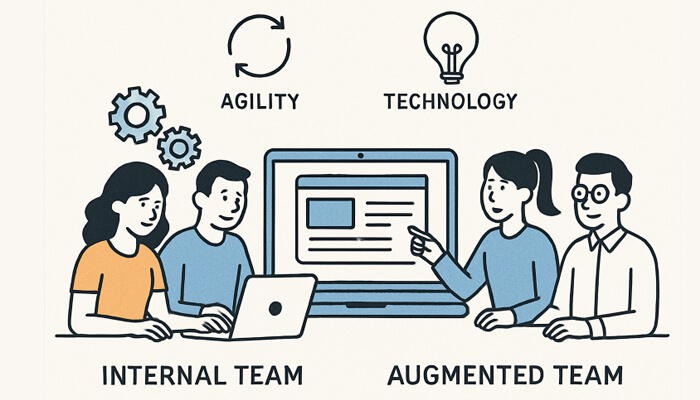
By integrating outside experts into in-house teams, companies can address complex projects with greater confidence and deliver on bold digital ambitions. This blend of internal focus and external expertise redefines how projects are executed under tight deadlines and evolving business pressures.
Access to Specialized Skills
Modern technology demands are constantly evolving, requiring new skills and domain knowledge that internal teams may not always possess. Staff augmentation connects organizations to a global marketplace of professionals with experience in AI, machine learning, cloud migration, cybersecurity, and more. This direct access positions businesses to tackle demanding initiatives without the time lost to traditional recruiting or retraining.
Many companies leverage augmented staff when launching pilot programs with emerging tech or when upskilling existing teams is not practical. This flexibility allows for rapid scaling or pivoting as requirements change. According to a recent TechRepublic report, nearly 70 percent of IT leaders have turned to staff augmentation to fill technical expertise gaps in digital transformation initiatives. This strategy ensures that gaps do not hinder progress or delay critical launches.
Cost-Effective Scalability
Controlling costs while meeting project commitments remains a fundamental objective in every tech operation. Unlike hiring permanent staff, which involves ongoing salaries and benefits, staff augmentation provides on-demand access to skills for the exact duration required. Teams expand or contract as projects move through their life cycles, resulting in predictable and optimized expenditures.
This model also limits financial risk during uncertain periods by eliminating unnecessary headcount when projects wind down or change scope. As reported by Forbes, flexible resourcing through augmentation is integral to both rapid upscaling and responsible cost management for tech-enabled businesses in fast-moving markets.
Accelerated Time-to-Market
Speed is of the essence in product development, especially in competitive sectors such as fintech and health tech. By integrating experienced technology professionals into key roles, businesses eliminate onboarding delays and bridge knowledge gaps without slowing down momentum. This immediate injection of expertise is often what makes meeting aggressive deadlines or rapid pivots possible.
A 2024 Deloitte study found that 65 percent of tech firms that employed staff augmentation reduced software delivery times by up to 25 percent. Companies no longer have to postpone important feature releases or critical updates, as they can quickly deploy the best available talent to overcome roadblocks and seize time-sensitive opportunities.
Maintaining Focus on Core Competencies
Staff augmentation is about much more than temporary support. It allows core teams to stay focused on their top strategic initiatives, such as architectural planning, product vision, or deep client engagements, without the distractions of resource bottlenecks. Augmented professionals handle specific tasks or fill critical roles, giving in-house specialists room to prioritize innovation and organizational growth.
By keeping the primary workforce dedicated to activities that drive differentiation and value, businesses can maintain momentum in their primary markets even as they escalate parallel development or experiment with new lines of business. This balanced approach is a key enabler of sustained competitiveness and innovation.
Best Practices for Integrating Augmented Staff
Maximizing the value of staff augmentation depends on an organization’s ability to integrate professionals smoothly. Clear communication channels, collaborative processes, and clearly defined project roles are essential. Establishing structured onboarding routines helps newly augmented team members understand the workflow, culture, and business priorities, which greatly reduces ramp-up time.
Successful teams often rely on regular check-ins, robust documentation, and a shared project management platform to maintain alignment. Promoting knowledge sharing and recognizing the value of external expertise, while upholding company standards, ensures continuity and essential delivery. For further reading on effective onboarding practices, see this comprehensive guide from Harvard Business Review.
Real-World Examples of Successful Staff Augmentation
Leading technology firms worldwide have turned to staff augmentation to deliver ambitious projects on tight timelines. For example, Tata Elxsi in India enhanced its AI product offerings by partnering with offshore teams, enabling it to accelerate market launches by over 40 percent. Global fintech startups frequently tap external developers for product expansions and rapid prototyping as they scale across new geographies.
Further, large enterprises like those in the automotive and telecommunications industries leverage augmented QA testers, DevOps specialists, and UX designers to address fluctuating requirements and deliver multifaceted solutions with resilience and speed. These examples demonstrate that staff augmentation can be tailored to diverse industries and project scopes, consistently enabling organizations to respond rapidly to emerging challenges.
Conclusion
For technology-driven companies intent on maintaining agility and innovation, staff augmentation offers a clear path to building flexible, responsive teams equipped to overcome new challenges. The benefits, from immediate access to specialized skills and scalable resources, significantly reduce time to market and improve focus on strategic priorities, making staff augmentation an indispensable component of successful tech project delivery. By embracing best practices for integration, businesses position themselves to meet present challenges while preparing for future opportunities in an unpredictable digital world.
