



Introduction
In 2026, browsing smarter matters more than ever. Cyber threats are increasing, phishing attacks are becoming more sophisticated, and ads now dominate search results. At the same time, user behavior is playing a major role in shaping SEO success.
So which option is actually better, safer, and smarter?
Let’s break it down clearly.
What “Search Google or Type a URL” Really Means
Modern browsers combine the search bar and address bar into one field. This is often called the omnibox.
When you type something into it, the browser decides:
- If it looks like a website address (example.com) → It loads the website directly.
- If it looks like a phrase (“best laptops 2026”) → It performs a Google search.
This unified design makes browsing easier — but it also creates confusion.
The real difference lies in what happens behind the scenes.
What Happens When You Search Google
When you enter a search query:
- Your request goes to Google’s servers.
- Google scans its indexed database.
- It ranks results using hundreds of factors.
- You see a Search Engine Results Page (SERP).
- You click a result (organic or sponsored).
This process adds an extra layer between you and your destination.
Advantages of Searching
- Helpful for discovery
- Useful for comparisons
- Good when you don’t know the exact website
- Shows reviews and alternatives
Disadvantages
- Extra step (slightly slower)
- Exposure to ads
- Risk of clicking phishing or fake sites
- Your query is logged and tracked
What Happens When You Type a URL Directly
When you type a full website address:
- Your browser performs a DNS lookup.
- It connects directly to the site’s server.
- The website loads.
There’s no search engine in the middle.
Advantages of Typing a URL
- Faster access
- Direct connection
- Fewer distractions
- Lower risk of clicking ads
Disadvantages
- Requires exact spelling
- Typos can lead to malicious sites
- Not useful if you don’t know the domain
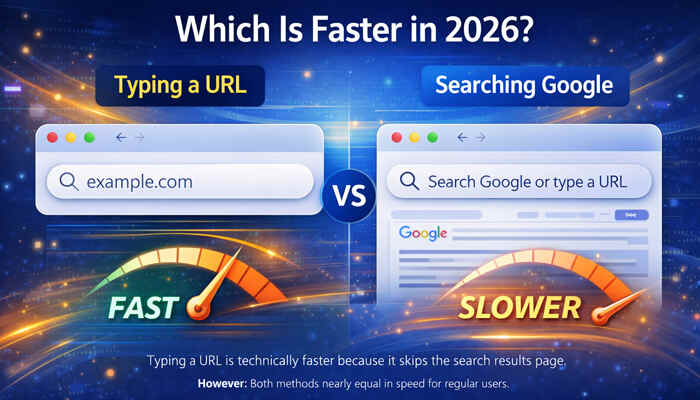
Which Is Faster in 2026?
Typing a URL is technically faster because it skips the search results page.
However:
- Browser auto-suggestions
- Cached history
- AI prediction features
Make both methods nearly equal in speed for regular users.
The difference is seconds — but seconds add up over time.
Which Is Safer?
This is where the difference becomes important.
Risk When Searching Google
- Sponsored ads may appear above official websites.
- Fake domains sometimes look identical.
- SEO spam pages rank temporarily.
- Phishing ads can trick users.
For example, searching for your bank and clicking the top ad is riskier than typing the official domain directly.
Risk When Typing a URL
- Typosquatting (gooogle.com instead of google.com)
- Misspelled domains leading to fake pages
Smartest Security Practice
- Bookmark important websites.
- Always check for HTTPS.
- Avoid clicking ads for sensitive sites (banking, government).
- Double-check spelling.
Security depends more on awareness than method.
Which Is Better for Privacy?
Searching Google:
- Logs your queries.
- Personalizes ads.
- Builds behavioral profiles.
Typing a URL:
- Avoids search tracking.
- Still allows site-level tracking.
- Reduces search-based data signals.
If privacy matters, direct navigation reduces search tracking — though it does not eliminate tracking entirely.
Which Is Smarter for Different Situations?
Use Google Search When:
- Exploring new topics
- Comparing products
- Looking for reviews
- Researching information
- Discovering alternatives
Type a URL When:
- Visiting banking websites
- Logging into email
- Accessing work systems
- Returning to trusted sites
- Prioritizing speed
The smarter internet user adapts based on intent.
Why This Matters for Businesses and SEO
This choice impacts online business performance.
If users search your brand name:
- You need strong SEO.
- You must rank for branded keywords.
- You must protect against competitor ads.
If users type your domain directly:
- You have strong brand recognition.
- You generate direct traffic.
- You reduce reliance on search engines.
In 2026, the strongest brands get typed directly.
Weaker brands depend entirely on search visibility.
This difference affects marketing strategy, SEO investment, and long-term growth.
The Psychological Difference
Searching Google means you are in “exploration mode.”
Typing a URL means you are in “destination mode.”
Exploration = discovery.
Destination = intention.
Understanding your own intent helps you browse smarter.
Final Verdict: Which Is Better in 2026?
There is no single “better” option.
Searching Google is better for discovery and research.
Typing a URL is better for speed, precision, and security.
The smartest users don’t choose one — they choose based on context.
In 2026, digital literacy is not just about using the internet.
It’s about navigating it intentionally.
So next time you see:
“Search Google or type a URL”
Pause for one second.
Ask yourself: Am I exploring — or do I already know where I’m going?
Then choose wisely.
Search Google or Type a URL Frequently Asked Questions (FAQs)
1. Is it safer to type a URL directly?
Yes, especially for banking or sensitive websites — if you know the exact address.
2. Why does my browser show “Search Google or type a URL”?
Because modern browsers combine the search and address bar into one unified field.
3. Does typing a URL improve privacy?
It reduces search tracking but does not eliminate website tracking.
4. Is searching Google slower than typing a URL?
Slightly, because it adds an extra step before reaching the site.
5. Which method is better for businesses?
Strong brands benefit when users type their URL directly. SEO helps when users search instead.
