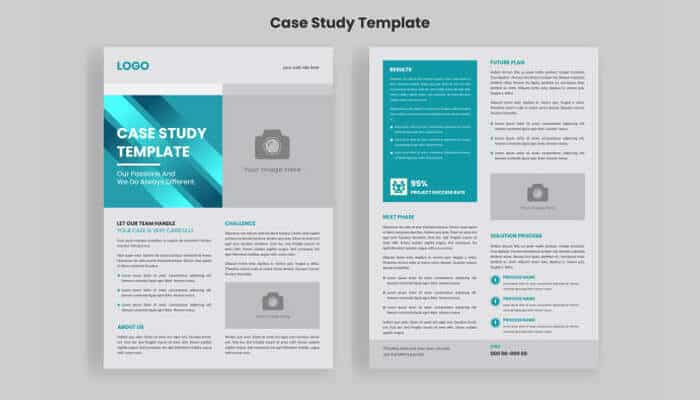
Case study templates, for starters, is an easy way to explain to prospective customers the abilities, background, and knowledge of your company.
It is also an essential component of every company’s marketing plan. Businesses can use it to create a compelling story about their achievements and prove the legitimacy of their brands using statistics. Additionally, it raises brand awareness and attracts new customers.
But creating a case study, particularly from scratch, is laborious and time-consuming. Furthermore, when you delegate the assignment to several people, it becomes more challenging to guarantee that every case study in your organization follows the same format.
Case study templates can be used to overcome these issues. For this reason, I will go over a few helpful samples of case study templates that can be useful for particular organizational needs and help you showcase your unique value proposition.
Case studies provide evidence of your products or services’ success and can help potential customers make informed decisions. Here are seven case study templates you can use to enhance your brand’s credibility and influence:
Introduction: Provide a brief overview of the customer’s challenge.
Customer Interview: Include a video interview with the customer discussing their experience and results.
Solution Highlights: Showcase how your product or service addresses the customer’s needs.
Results: Present measurable outcomes and the impact on the customer’s business.
Call-to-Action: Encourage viewers to take a specific action, such as requesting a demo or contacting your sales team.
Title and Introduction: Create an engaging title and a brief introduction to the customer and their challenge.
Problem Statement: Describe the customer’s specific issue or pain points.
Solution: Explain how your product or service solved the problem.
Implementation: Detail the process of implementing your solution.
Results: Present quantifiable outcomes and benefits.
Testimonials: Include quotes from the customer about their experience.
Conclusion: Summarize the success and highlight the key takeaways.
Visual Appeal: Use graphics, charts, and images to make the case study visually engaging.
Challenge: Summarize the customer’s challenge.
Solution: Highlight the key features of your solution.
Results: Use visuals to showcase the impact and results.
Customer Quote: Include a compelling quote from the customer.
Key Metrics: Display important data points.
Before: Present the customer’s situation before using your product or service.
After: Describe the improvements, changes, or achievements that occurred after implementation.
Images: Use images to visually illustrate the transformation.
Data: Include data or statistics to quantify the results.
Customer Testimonial: Add a testimonial from the customer about their experience.
Create a slide presentation highlighting the customer’s journey.
Include sections for the challenge, solution, results, and customer testimonial.
Use visuals, bullet points, and minimal text to maintain audience engagement.
Design an interactive webpage or PDF that allows users to click through the case study.
Use interactive elements like clickable tabs, pop-up boxes, or videos.
Provide engaging multimedia content to tell the story.
Tailor your case study templates for different industries or niches.
Highlight industry-specific challenges and solutions.
Include data and testimonials relevant to that industry.
Remember to customize each case study to the specific customer and situation, focusing on the unique challenges and outcomes. By utilizing these templates, you can effectively build your brand’s credibility and influence by showcasing real-world examples of how your product or service has made a difference for your clients.
Artificial intelligence is evolving at an unprecedented pace, and Droven.io machine learning trends highlight how businesses, developers, and industries are…
Enterprise leaders are under pressure to modernize faster, improve efficiency, protect digital assets, and prove measurable returns from technology spending.…
Unlike many businesses, outdoor service companies do not expand the same way. They are usually vulnerable to seasonal demand, volatile…
Discover how cross-platform support ensures seamless assistance for any device, anywhere, and why it's vital in today's connected world. Understanding…
The relationship between canine health and nutrition has undergone a radical transformation over the last decade. As pet owners increasingly…
Saving digital files has turned out to be very easy and convenient with the use of modern cloud storage. Over…