




The Hidden Financial Drain of “Break-Fix” Mentalities
We’ve analyzed outage logs across multiple fulfillment centers, and the pattern is consistent. A failed conveyor motor during peak season doesn’t just cost the $2,800 replacement part. It triggers a cascade: 45 minutes of stalled pick-pack lines, two missed same-day shipping cutoffs, and a service-level penalty from a major retail partner. By the time the line restarts, the total impact exceeds fifteen times the hardware cost.
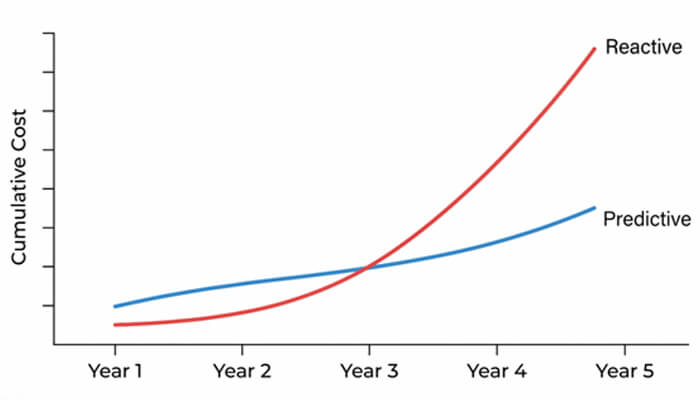
Equipment downtime steals revenue, erodes brand trust, and forces logistics teams into expensive expedited delivery promises. The shift from reactive to predictive maintenance transforms maintenance from a cost center into a revenue-protection function.
“Maintenance is not an expense to minimize—it’s a strategic investment in throughput. Every hour of predicted and planned downtime is an hour of unplanned revenue loss avoided.”
5 Strategic Benefits of Upgrading Your Maintenance Protocols
1. Preventing Catastrophic Failures with Early Detection
Most electromechanical failures don’t happen without warning. Inverter-duty motors, for instance, telegraph their declining health through subtle changes in current draw and harmonic distortion weeks before a winding fault trips the breaker. The challenge is seeing these signals early enough to act.
By deploying advanced industrial measurement and testing equipment, technicians can spot voltage anomalies and rising phase imbalance while the motor is still running within its nameplate ratings. A 5% increase in steady-state current demand on a critical exhaust fan might not trigger an alarm on a basic overload relay, but it’s a clear indicator of bearing degradation. Catching it early means replacing a $120 bearing during a planned window instead of a $6,500 motor after a burnout during third shift.
2. Extending the Lifespan of Legacy Equipment
Capital replacement budgets are often too lean to accommodate a full equipment refresh. We’ve worked on packaging lines where half the drives date back to the late 1990s—still mechanically sound but lacking onboard diagnostics. With external current transformers and vibration sensors, these machines gain a second life.
Proper monitoring allows older assets to operate safely beyond their theoretical depreciation horizon. Instead of replacing a legacy palletizer on a fixed 12-year cycle, operators can track insulation resistance trends and bearing wear rates. That data turns a calendar-based retirement decision into a condition-based one, often releasing two to four years of additional productive service.
3. Safeguarding Against Electrical Surges
Control boards and variable frequency drives have never been more compact—or more susceptible to transient overvoltages. A single nearby lightning strike or utility capacitor-switching event can instantly destroy hundreds of I/O modules, months of configuration work, and any confidence in production continuity.
Installing reliable circuit protection devices—such as coordinated Type 2 surge protective devices and high-interrupting-capacity fuses—at the panel level prevents one grid fluctuation from cascading into a plant-wide shutdown. The financial rationale is straightforward: protecting $40,000 worth of drive hardware with a properly engineered SPD costs less than the deductible on a business interruption claim.
4. Optimizing Spare Parts Inventory
We frequently walk into storerooms loaded with unopened servo drives, sealed contactor kits, and dust-covered HMI spares—capital tied up because no one could predict which part would fail next. Predictive maintenance replaces guesswork with trending data.
When you know that the mean time between failure for a particular servo amplifier under your specific load profile is approximately 18,000 hours, you can hold one spare instead of three. That shift frees up working capital, reduces shelf obsolescence, and simplifies the procurement cycle.
5. Enhancing Workplace Safety

Poorly maintained electromechanical components are a latent safety hazard. A contactor with pitted contacts may arc and weld closed, causing a motor to start unexpectedly during a manual clean-out. Insulation breakdown in a heating element can energize a machine frame well before a ground-fault relay trips.
A predictive approach to safety-critical circuits—monitoring contact resistance, leakage current, and thermal rise—pinpoints degradation while it’s still a maintenance issue, not an injury statistic. The correlation is clear: facilities that adopt condition-based monitoring for power distribution components report fewer arc-flash incidents and near-misses.
Comparing Maintenance Strategies: A Financial Perspective
| Factor | Reactive (Run-to-Failure) | Preventative (Time-Based) | Predictive (Condition-Based) |
| Initial Cost | Lowest upfront; no sensor investment | Moderate; scheduled labor and parts | Higher initial sensor and software cost, decreasing per asset over time |
| Downtime Risk | Unpredictable; high impact during production windows | Reduced but still possible between intervals | Minimal; faults identified weeks or months before functional failure |
| Equipment Lifespan | Shortened by repeated catastrophic stress | Often overserviced, causing unnecessary wear | Extended; repairs align with actual deterioration |
| Spare Parts Need | High emergency stock levels | Moderate, based on scheduled replacements | Lean; inventory matched to actual demand signals |
| Long-Term ROI | Negative; escalating overtime, expediting, and brand damage | Slightly positive; better than reactive | Strongly positive; capital avoidance and throughput gains compound annually |
How to Begin Implementing a Predictive Maintenance Strategy
You don’t need a facility-wide IIoT platform on day one. Start by identifying the single bottleneck machine on your factory floor—the asset whose failure stops 80% of downstream production. Equip it with a basic set of current transformers, a vibration sensor, and a simple data logger.
Many modern diagnostic modules are designed for retrofitting. They clamp onto existing wiring, communicate via Modbus or 4–20 mA loops, and feed into a local PLC without disturbing the existing control architecture. We’ve often sourced such components from industrial electronics distributors like Iainventory, who stock modules compatible with legacy backplanes. This standalone approach lets your team build confidence in the data and refine alarm thresholds before scaling to additional assets.
Once the proof of concept is solid—say, you successfully predicted a cooling pump bearing replacement three weeks in advance—expand to other critical assets using the same methodology. The goal is to transition from calendar-based PMs to a living maintenance calendar driven by equipment health signals.
