


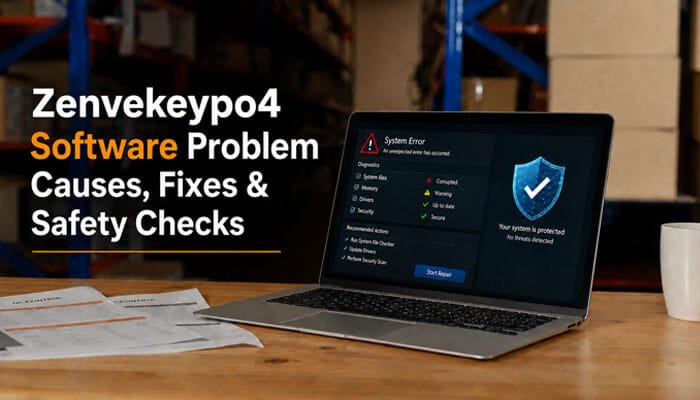

If you are dealing with a Zenvekeypo4 software problem, the first challenge may not be fixing the error. It may be determining what Zenvekeypo4 actually refers to on your computer and whether the problem comes from installed software, a browser notification, an unknown download, or something else entirely.
Public information about Zenvekeypo4 remains inconsistent. Different third-party websites describe the name in different ways, while other pages focus mainly on crashes, installation failures, browser warnings, suspicious downloads, slow performance, or security concerns. That uncertainty matters when diagnosing a Zenvekeypo4 software problem. A clearly established official vendor, authoritative documentation portal, and consistently verified technical specifications are not obvious from the public material reviewed for this guide.
That does not prove Zenvekeypo4 is malicious or nonexistent. It simply means that claims about its features, system requirements, versions, error codes, or official downloads should not be accepted without independent verification. The safest approach is to identify what is actually happening on your device before downloading a repair utility, deleting files, reinstalling software, disabling security tools, or allowing someone remote access.
This guide explains how to diagnose a Zenvekeypo4 software problem, distinguish a browser warning from an installed application, investigate crashes and startup errors, check suspicious downloads, use Windows troubleshooting tools safely, and recognize behavior that may indicate unwanted software or a scam.
Quick Answer: How Do You Fix a Zenvekeypo4 Software Problem?
If a Zenvekeypo4 software problem suddenly appears on your computer, use this order:
- Identify where the message appears: browser, Windows notification, downloaded file, startup screen, or installed application
- Check whether Zenvekeypo4 is actually installed
- Verify the publisher and download source
- Scan unfamiliar files before opening them
- Check browser notifications, extensions, and redirects if the message appears online
- Use normal Windows troubleshooting only after confirming that an installed application is involved
- Never pay, reveal passwords, install remote-access software, or disable antivirus merely because an unexpected warning tells you to. The safest troubleshooting sequence is
Identify → Verify → Scan → Diagnose → Repair or Remove → Recheck
Key Takeaways
- A Zenvekeypo4 software problem can refer to several different symptoms rather than one verified official error
- Current public descriptions of Zenvekeypo4 are inconsistent
- A webpage mentioning Zenvekeypo4 does not prove software with that name is installed
- Check Settings → Apps → Installed apps before attempting removal
- Do not download random “Zenvekeypo4 fix” utilities from unknown websites
- Verify file origin, publisher, digital signature, reputation warnings, and antivirus results
- Task Manager can help diagnose CPU, RAM, disk, startup, and network problems
- Clean boot and Safe Mode can help isolate software conflicts
- DISM and SFC should mainly be used when Windows itself appears damaged
- Browser notifications, extensions, VPNs, proxies, firewalls, and unstable networks can create symptoms that resemble application failures
- Never provide passwords, banking details, authentication codes, payment, or remote access because of an unsolicited software warning
What Is the Zenvekeypo4 Software Problem?
The phrase Zenvekeypo4 software problem is currently used online for several different situations rather than one clearly documented official error.
Someone searching for this phrase may be experiencing:
- software that will not open
- installation failures
- repeated crashes
- freezing
- slow performance
- startup problems
- update failures
- synchronization or connectivity errors
- browser warnings
- suspicious pop-ups
- unknown downloads
- security alerts
Because third-party descriptions do not consistently describe the same product, it is safer to treat Zenvekeypo4 software problem as a troubleshooting term rather than assume there is one verified Zenvekeypo4 application with a known list of proprietary errors.
Instead of immediately asking:
“How do I reinstall Zenvekeypo4?”
start with:
“Where did the Zenvekeypo4 name appear?”
The answer determines which troubleshooting path makes sense.
Zenvekeypo4 Software Problem: What Can Actually Be Verified?
Before applying any fixes, separate what you can observe on the device from what outside webpages claim.
| Question | Current Assessment |
| Does the Zenvekeypo4 name appear online? | Yes |
| Are troubleshooting pages discussing it? | Yes |
| Do those pages consistently describe the same product? | No |
| Is a clearly authoritative product identity established? | Not clearly |
| Does a browser warning prove software is installed? | No |
| Does every Zenvekeypo4 warning mean malware? | No |
| Should an unfamiliar installer automatically be trusted? | No |
| Should users verify the source first? | Yes |
This distinction is central to diagnosing a Zenvekeypo4 software problem responsibly.
Is Zenvekeypo4 Actually Installed on Your Computer?
Before troubleshooting an application, confirm that the application actually exists on the device.
On Windows 11, go to:
Start → Settings → Apps → Installed apps
Search for:
Zenvekeypo4
If nothing appears, do not immediately assume the software is hidden.
The name could instead be coming from:
- a webpage
- browser notification
- advertisement
- browser extension
- downloaded installer
- desktop shortcut
- web application
- misleading redirect
- another file using the name
What to Check on Your Device
| Location | What to Look For |
| Installed Apps | Application using the exact name |
| Start menu | Program shortcut |
| Downloads folder | EXE, MSI, ZIP, or installer |
| Desktop | Unexpected shortcut or setup file |
| Task Manager | Related running process |
| Startup Apps | Program launching automatically |
| Browser extensions | Unknown or recently added extension |
| Site notifications | Unknown websites with permission |
| Windows Security | Malware or potentially unwanted app detection |
| File Properties | Publisher and digital-signature information |
If you cannot find an installed program, that is a strong reason to investigate the browser and downloaded files before attempting to repair a supposed Zenvekeypo4 software problem.
Browser Warning vs. Installed Zenvekeypo4 Program
A browser-generated message can look surprisingly similar to a Windows warning.
A webpage can be designed to imitate:
- Windows Security
- antivirus warnings
- application updates
- system errors
- technical-support notices
- account-security alerts
An urgent-looking message inside a browser is therefore not proof that Windows itself detected a Zenvekeypo4 software problem.
Signs the Message May Be Browser-Based
Look for these clues:
- it appears only while Chrome, Edge, or another browser is open
- the browser address bar remains visible
- the warning disappears after closing the tab
- the page asks you to click Allow
- it redirects you elsewhere
- it offers an unfamiliar “repair tool”
- it displays a support number
- it demands urgent payment
- it claims many viruses were found without running a real local security scan.
If these signs appear, investigate the browser before changing Windows system settings.
Zenvekeypo4 Software Problem Troubleshooting Table
Use this table to identify the safest next step based on the symptom.
| Problem | First Check | Best Next Step |
| Zenvekeypo4 won’t open | Is it actually installed? | Verify source, restart, then repair if legitimate |
| Zenvekeypo4 keeps crashing | Task Manager and Windows health | Update, repair, clean boot, or Safe Mode |
| Zenvekeypo4 is very slow | CPU, RAM, and disk usage | Identify resource-heavy processes |
| Message appears in browser | Site permissions | Close page and revoke suspicious permissions |
| Warning appears at startup | Startup Apps | Disable entry temporarily and investigate |
| Installer suddenly downloads | File origin | Do not run; scan and verify |
| Installation fails | Publisher and source | Verify installer first |
| Login or sync fails | Internet/VPN/proxy | Test general connectivity |
| Windows Security warns | Protection History | Follow trusted security guidance |
| Warning asks for money | Possible scam | Do not pay |
| Program will not uninstall | Installed Apps | Use normal Windows removal options |
Common Causes of a Zenvekeypo4 Software Problem
Several different issues can create symptoms that users describe as a Zenvekeypo4 software problem.
1. The Message Is Coming From a Website
If Zenvekeypo4 appears only while browsing, the issue may have nothing to do with installed desktop software.
Close the suspicious page and check:
- site notification permissions
- pop-up permissions
- browser extensions
- recent downloads
- browser startup pages
Do not trust buttons inside an unexpected warning simply because they say Close, Repair, Scan, or Continue.
2. Browser Notifications Were Accidentally Enabled
Websites can request permission to send notifications. If you clicked Allow, that website may continue sending alerts after you leave it. Those notifications can make a browser issue look like a genuine Zenvekeypo4 software problem originating from Windows Review notification permissions in Chrome, Edge, or your preferred browser and remove unfamiliar sites
3. An Unknown Zenvekeypo4 Installer Was Downloaded
You may encounter filenames such as:
- zenvekeypo4.exe
- zenvekeypo4_setup.exe
- zenvekeypo4_update.exe
- zenvekeypo4_fix.exe
The filename alone proves very little because files can be renamed easily.
Instead, investigate:
| Verification Check | Why It Matters |
| Download source | Shows where the file originated |
| Publisher | Helps identify who created it |
| Digital signature | May verify the signer |
| Reputation warning | Provides another trust signal |
| Security scan | Checks for known threats |
| Vendor documentation | Helps establish legitimacy |
Do not execute an unfamiliar installer simply to discover what it does.
4. Damaged or Incomplete Application Files
If you have independently verified that Zenvekeypo4 is a legitimate application you intentionally installed, damaged files become a reasonably possible cause.
Possible issues include:
- interrupted installation
- failed update
- corrupted files
- permission problems
- software conflicts
- storage problems
For supported Windows applications, go to:
Settings → Apps → Installed apps → Advanced options
If available, try Repair first. Use Reset more cautiously because it may remove application data or settings.
5. Windows Is Out of Date
Outdated operating-system components can sometimes contribute to application problems.
Open:
Settings → Windows Update
Install legitimate Windows updates and restart when required.
Avoid downloading unofficial DLL files, Windows patches, or “system repair” packages from unrelated websites while trying to fix a Zenvekeypo4 software problem.
6. Corrupted Windows System Files
If several applications are failing—not just Zenvekeypo4—the underlying problem may involve Windows itself.
Windows includes two common repair tools:
- Deployment Image Servicing and Management (DISM)
- System File Checker (SFC)
When broader Windows corruption is suspected, open Command Prompt as Administrator and run:
DISM.exe /Online /Cleanup-Image /RestoreHealth
After DISM completes, run:
sfc /scan now
These commands are Windows repair tools. They are not proprietary Zenvekeypo4 fixes.
Use them mainly when you see:
- several programs crashing
- Windows components failing
- repeated system errors
- broader operating-system instability
Do not run system-repair commands simply because a webpage contains the phrase Zenvekeypo4 software problem.
7. Browser Cache or Site Data Is Corrupted
If Zenvekeypo4 is supposedly accessed through a verified web application, corrupted browser data could affect loading or login behavior.
Try:
- private or incognito mode
- another trusted browser
- the site with extensions disabled
- clearing data only for the affected website
This can help distinguish browser problems from Windows problems.
8. Browser Extension Conflict
A problematic extension can:
- inject advertising
- redirect pages
- modify search results
- break web applications
- generate unwanted content
- interfere with scripts.
Disable recently installed or unfamiliar extensions one at a time.
If the Zenvekeypo4 software problem disappears after disabling an extension, you have narrowed down the likely cause.
9. Startup Software Conflict
If a Zenvekeypo4 message appears every time Windows starts, inspect Startup Apps.
Open:
Task Manager → Startup apps
or:
Settings → Apps → Startup
Temporarily disabling an unfamiliar startup entry can help determine whether it triggers the message.
Do not delete files until you understand what the program is and who installed it.
10. High CPU, RAM, Disk, or Network Usage
A slow computer does not automatically mean Zenvekeypo4 is responsible.
Open Task Manager with:
ctr l + Shift + Esc
Check:
- CPU
- Memory
- Disk
- Network
If a process appears related to Zenvekeypo4, observe whether it consistently consumes unusually high resources.
Resource Diagnosis Table
| Resource | High Usage Could Suggest |
| CPU | Heavy processing or stuck task |
| Memory | RAM pressure or memory leak |
| Disk | Intensive file activity |
| Network | Online communication or synchronization |
| Startup impact | Program affecting boot speed |
If no Zenvekeypo4-related process exists, reconsider whether the Zenvekeypo4 software problem is actually coming from the browser.
11. VPN, Proxy, Firewall, or Network Problems
If a verified application requires internet access, connectivity problems can affect:
- login
- downloads
- updates
- synchronization
- web requests
Possible causes include:
- unstable Wi-Fi
- VPN configuration
- proxy settings
- firewall restrictions
- workplace network rules
- router or DNS problems
Do not disable Windows Firewall simply because unknown software asks you to.
12. Potentially Unwanted or Malicious Software
Take the situation more seriously when a Zenvekeypo4 software problem appears alongside suspicious behavior such as:
- unexpected browser redirects
- unwanted advertisements
- unknown applications installing automatically
- security protection being disabled
- unfamiliar remote-access tools
- browser settings changing without permission
- repeated Windows Security detection
Do not automatically conclude that Zenvekeypo4 itself is malware. Evaluate the actual behavior and evidence on the computer.
How to Fix a Zenvekeypo4 Software Problem Safely

The following steps provide a safer way to diagnose and fix a Zenvekeypo4 software problem without jumping directly to destructive system changes.
Step 1: Record the Exact Error
Before changing anything, note:
- complete error text
- error code if present
- where the message appeared
- when it happened
- what you were doing beforehand
- files or applications recently installed
A screenshot may help.
Do not publicly share screenshots containing passwords, authentication codes, banking details, addresses, or other sensitive information.
Step 2: Confirm the Application Exists
Open:
Settings → Apps → Installed apps
Search for Zenvekeypo4.
If the application is absent, investigate:
- browser permissions
- downloaded files
- extensions
- startup entries
- notifications.
This step prevents you from attempting to repair a program that may not actually be installed.
Step 3: Verify the Download Source
If you have an installer, ask:
- Did I intentionally download it?
- Which website provided it?
- Can I identify the publisher?
- Did a pop-up send me to it?
- Did it arrive through an unsolicited email?
- Did a webpage insist that I install it immediately?
If you cannot establish the origin, do not run it.
Step 4: Inspect File Properties and Digital Signature
Right-click the file and choose:
Properties
Look for:
Digital Signatures
If available.
A digital signature can help identify the publisher, but it should not be your only trust signal. A signed file is not automatically safe. An unsigned file is not automatically malicious.
Combine the signature with:
- file source
- publisher identity
- reputation warnings
- antivirus results
- vendor documentation
Step 5: Check SmartScreen and Reputation-Based Protection
Open:
Windows Security → App & browser control
Windows includes reputation-based protection and Microsoft Defender SmartScreen to help identify potentially unsafe files, applications, downloads, and websites.
If Windows warns about an unfamiliar Zenvekeypo4 installer, do not automatically choose Run anyway. Investigate why the warning appeared.
Step 6: Scan Suspicious Files
If a file came from an uncertain source, scan it before opening. Use Windows Security or another trusted and updated security product.
If you cannot verify the file’s origin and have no clear reason to run it, executing it adds unnecessary risk.
Step 7: Review Windows Security Protection History
Open:
Windows Security → Protection History
Check for detection around the time the Zenvekeypo4 software problem appeared.
Look for:
- detection name
- affected file
- date and time
- action taken.
A genuine Windows Security detection is very different from a webpage merely displaying a fake security-style message.
Step 8: Remove Suspicious Browser Permissions
If the message appears through Chrome, Edge, or another browser, review:
- notifications
- pop-ups
- redirects
- extensions
Remove permissions from unfamiliar websites.
Step 9: Restart the Computer
After basic verification and browser cleanup, restart Windows.
A restart can:
- stop hung processes
- clear temporary states
- complete pending updates
- reveal whether the problem returns automatically.
Step 10: Repair the Verified Application
Only repair Zenvekeypo4 if you have established that a legitimate application is installed.
Open:
Settings → Apps → Installed apps
Select the program and check Advanced options where available.
Try Repair before Reset.
If the software itself cannot be verified, do not reinstall it from a random search-result page.
Use a Clean Boot to Diagnose a Zenvekeypo4 Software Problem
If a verified program still crashes or fails to open, another startup program or background service may be interfering. Windows clean boot can help isolate these conflicts by starting the computer with nonessential third-party startup services disabled.
A typical process involves:
- opening msconfig
- hiding Microsoft services
- disabling non-Microsoft services
- disabling startup programs through Task Manager
- restarting
- testing the problem
- gradually re-enabling items
Clean boot is an advanced troubleshooting method. Avoid making unrelated System Configuration changes, especially on managed work or school computers.
Test the Zenvekeypo4 Software Problem in Safe Mode
Safe Mode starts Windows using a limited set of drivers and services. It can help identify whether normal startup programs, drivers, or background services contribute to the problem.
Safe Mode may be useful when you experience:
- repeated crashes
- startup failures
- driver conflicts
- severe application instability
- unusual background activity
If the Zenvekeypo4 software problem disappears in Safe Mode, investigate what normally loads during a standard Windows startup. Safe Mode is a diagnostic environment—not a guaranteed Zenvekeypo4 fix.
Check Whether Zenvekeypo4 Starts Automatically
If the warning appears immediately after signing into Windows, inspect:
Task Manager → Startup apps
Ask:
| Question | Why It Matters |
| Do you recognize the application? | Helps determine whether it is expected |
| Is a publisher listed? | Helps identify the origin |
| Is it also under Installed Apps? | Connects startup behavior to installed software |
| Does disabling it stop the warning? | Helps isolate the trigger |
| Does Windows Security flag it? | Adds another security signal |
Temporarily disabling a startup item is generally safer than immediately deleting its files.
Should You Reinstall Zenvekeypo4?
re installation should only be considered when:
- the application is genuinely installed
- you intentionally use it
- you can identify its publisher
- you have a trusted installer source
- security tools are not indicating a threat
Avoid generic advice telling you to “download the latest Zenvekeypo4 version” unless you can verify where an authentic version is distributed. Downloading another unknown installer while trying to solve a Zenvekeypo4 software problem could create a larger security issue.
When Should You Use DISM and SFC?
DISM and SFC make sense when the symptoms suggest Windows corruption rather than a single application failure.
Consider these tools if:
- several applications crash
- Windows functionality is broken
- system files appear damaged
- broader Windows errors continue
They are not Zenvekeypo4-specific tools.
If only one browser tab displays a Zenvekeypo4 software problem warning, DISM and SFC should not be your first troubleshooting step.
What Not to Do When Fixing a Zenvekeypo4 Software Problem
Avoid these mistakes:
- downloading random “Zenvekeypo4 Fix Tool” programs
- downloading unknown DLL files
- deleting Windows system files
- disabling Microsoft Defender because an installer asks you to
- disabling the firewall for unknown software
- entering passwords into unexpected warnings
- paying unsolicited technical-support operators
- calling numbers displayed by suspicious pop-ups
- giving unknown people remote access
- repeatedly reinstalling software before verifying what it is.
Major Security Red Flags
A normal Zenvekeypo4 software problem should not require you to reveal sensitive information or make an urgent payment.
Treat a warning as higher risk if it:
- pressures you to act immediately
- asks for cryptocurrency or gift cards
- asks for banking information
- requests Microsoft, Google, or email passwords
- requests one-time authentication codes
- tells you to install remote-access software
- asks you to disable antivirus
- blocks normal browser navigation
- downloads files without clear consent
- claims a webpage scanned your entire computer
- displays an unsolicited technical-support number
These behaviors matter far more than the Zenvekeypo4 name itself.
What If You Already Clicked the Zenvekeypo4 Warning?
If You Opened the Page but Installed Nothing
Close the page and review:
- browser notifications
- extensions
- recent downloads
- Windows Security
Avoid deleting system files or resetting Windows without evidence that anything was installed.
If You Downloaded a File but Did Not Open It
Do not execute it.
Check:
- source
- publisher
- digital signature
- reputation warning
- antivirus result
If the file cannot be verified and you do not need it, delete it rather than experimenting with it.
If You Installed Unknown Software
Review:
- Installed Apps
- Startup Apps
- Windows Security
- Protection History
- browser extensions
- Site permissions.
If you determine that the software is unwanted, use normal Windows uninstall methods instead of manually deleting random files.
If You Entered a Password
Change the password through the legitimate website or application.
Also review:
- recent login activity
- active sessions
- multi-factor authentication
- password reuse
If the password was reused on other accounts, change those too.
If You Shared Payment Information
Contact your bank, card issuer, or payment provider using independently verified contact information. Review recent transactions and follow the provider’s fraud or security procedures.
Can Microsoft Defender Fix a Zenvekeypo4 Software Problem?
Microsoft Defender can help when the underlying issue involves known malware or potentially unwanted applications, but it cannot be treated as a universal Zenvekeypo4 repair tool.
Useful Windows Security areas include:
- Virus & threat protection
- Protection History
- Firewall & network protection
- App & browser control
- SmartScreen
- reputation-based protection
If Windows Security repeatedly detects the same suspicious file after remediation, further investigation may be necessary.
When Should You Use System Restore?
If a serious Windows problem started immediately after:
- installing software
- changing a driver
- modifying system settings
- applying an update
System Restore may help return important system settings to an earlier restore point.
Use it as a later-stage recovery option rather than the first reaction to a Zenvekeypo4 software problem appearing inside a browser.
Before using major recovery tools:
- back up important files
- understand which programs may be affected
- ensure access to the BitLocker recovery key if device encryption is enabled
What If Windows Itself Is Seriously Damaged?
If Windows remains unstable and evidence points to operating-system corruption rather than Zenvekeypo4 specifically, broader Windows recovery options may be appropriate.
Depending on your Windows version, these can include:
- System Restore
- Windows repair tools
- Windows Recovery Environment
- Repair reinstall options
- Reset this PC as a later-stage choice
These are Windows recovery procedures—not proprietary fixes for a Zenvekeypo4 software problem. Do not perform major operating-system recovery because of one browser warning.
How to Verify Unknown Software Before Trusting It
Use multiple trust signals.
| Verification Question | Stronger Evidence |
| Who created the software? | Identifiable developer or company |
| Where is it downloaded? | Verified publisher-controlled source |
| Is documentation available? | Official product documentation |
| Is support verifiable? | Official support channel |
| Is the installer signed? | Valid publisher signature |
| Is update history available? | Official release notes |
| Are privacy terms available? | Product-specific privacy documentation |
| Are security practices documented? | Specific technical documentation |
| Is the product identity consistent? | Same developer and product across credible sources |
One missing signal does not automatically mean software is malicious. However, the fewer independent trust signals available, the less reason there is to execute an unknown installer.
Why Search Results Alone Cannot Verify a Zenvekeypo4 Software Problem
Search results may contain websites that repeat claims from one another without providing independent evidence. That is particularly important when researching a Zenvekeypo4 software problem, because public descriptions of Zenvekeypo4 are inconsistent.
When evaluating unfamiliar software, prioritize:
Verified publisher → Official documentation → Signed installer → Trusted platform listing → Established security guidance → Independent technical evidence → Generic blog claims
A webpage ranking highly for Zenvekeypo4 does not automatically make it an official source.
How to Prevent Another Zenvekeypo4 Software Problem
Good software and security habits can reduce future problems.
- Download programs only from sources you can verify.
- Keep Windows updated.
- Use a supported operating system.
- Keep browsers updated.
- Leave security protection enabled.
- Review browser notification permissions periodically.
- Remove extensions you no longer use.
- Avoid unsolicited download links.
- Check publishers before opening installers.
- Use unique passwords.
- Enable multi-factor authentication where available.
- Maintain backups of important files.
These practices are useful not only for a Zenvekeypo4 software problem, but for unfamiliar software issues in general.
When Should You Get Professional Technical Help?
Consider professional assistance if:
- Windows no longer starts normally
- malware detection repeatedly return
- files become encrypted or inaccessible
- unknown remote-control software is installed
- administrator settings change without permission
- accounts show unauthorized access
- business or confidential information may have been exposed
- Windows remains unstable after appropriate built-in troubleshooting
- You cannot safely identify or remove suspicious software
If the computer belongs to a company, school, or other organization, contact its IT or security team before making major changes.
Conclusion
A Zenvekeypo4 Software Problem should be approached through verification rather than immediately downloading a repair utility or making major changes to Windows. Because publicly available descriptions of Zenvekeypo4 are inconsistent, first determine whether the name belongs to an installed application, browser warning, notification, downloaded file, or startup process.
Once the source is identified, verify the publisher and file origin, run appropriate security checks, and diagnose the specific symptom. For a legitimate installed application, Windows tools such as Task Manager, application Repair, Safe Mode, clean boot, Startup Apps, and system troubleshooting can help isolate the cause. Avoid unknown “fix” utilities, disabling security protection, sharing credentials, making unexpected payments, or granting unsolicited remote access.
For any Zenvekeypo4 Software Problem, the safest troubleshooting strategy remains simple:
Identify → Verify → Scan → Diagnose → Repair or Remove → Recheck
Following this evidence-first approach can help resolve the underlying issue while reducing the risk of turning a relatively minor software or browser problem into a larger security concern.
Zenvekeypo4 Software Problem FAQs
1. What should I check first when a Zenvekeypo4 Software Problem appears?
The first step is to identify exactly where the Zenvekeypo4 Software Problem appears. Check whether the message comes from an installed application, browser tab, notification, downloaded file, or Windows startup. Then verify whether Zenvekeypo4 is actually listed under Settings → Apps → Installed apps before attempting repairs or re installations.
2. Can browser notifications cause a Zenvekeypo4 Software Problem warning?
Yes. A warning that looks like a Zenvekeypo4 Software Problem may actually originate from a website or browser notification rather than installed software. Review browser notification permissions, extensions, redirects, and recent downloads, especially when the warning appears only while your browser is open.
3. How can I tell whether a Zenvekeypo4 download is safe?
Do not judge a Zenvekeypo4 installer by its filename alone. Check the download source, publisher, digital signature, reputation warnings, security scan results, and available vendor documentation. If you cannot establish where the installer came from or who created it, avoid running it.
4. Why does a Zenvekeypo4 Software Problem return after restarting Windows?
A recurring Zenvekeypo4 Software Problem could be associated with startup software, browser permissions, extensions, unwanted applications, or another process configured to launch automatically. Check Task Manager → Startup apps, browser settings, Installed Apps, and Windows Security to identify the actual source before making major system changes.
5. When should I seek professional help for a Zenvekeypo4 Software Problem?
Professional technical assistance may be appropriate when Windows no longer starts correctly, malware detection repeatedly return, unknown remote-control software appears, files become inaccessible, accounts show unauthorized access, or the system remains unstable after appropriate troubleshooting. For work or school devices, contact the organization’s IT or security team before making major changes.
