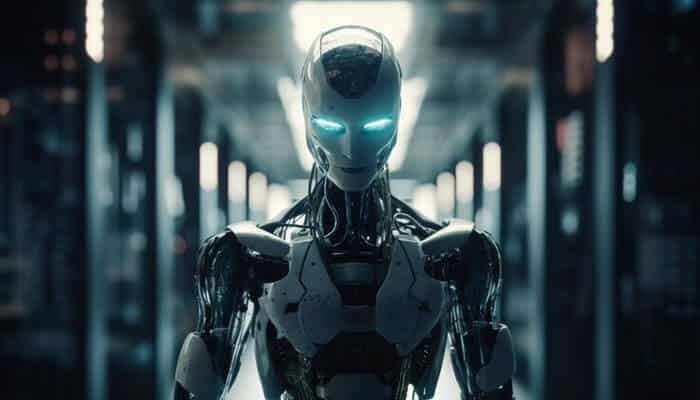
OAKLAND, Calif. — William Faulkner Sci-Fi Bots kept the words flowing with a steady drip of whiskey. Laurence Sterne conquered writer’s block by shaving his beard. Ernest Hemingway stopped writing just when the story got good, so he’d always know where to pick up the next day.
But perhaps the next generation of writers may get a boost from robots that do the hard work for them. An idea, put forth by an American author, is to use artificial intelligence to fill in parts of a story, an email or other document when a writer is searching for the best way to express him or herself. Programs that use neural networks (machines modeled after the brain) or so-called deep learning may be especially useful, Robin Sloan, the author of “Mr. Penumbra’s 24-Hour Bookstore” (Farrar, Straus and Giroux, 2012), said here at the Real Future Fair yesterday (Nov. 15).
“It turns out you can train a neural network on a big body of text,” Sloan said. “It can be Wikipedia; it can be all the works of Charles Dickens; it could be all of the Internet.”
Though these A.I. programs may not be able to craft a masterpiece like “A Tale of Two Cities” just yet, they could get a feel for how certain types of writing sound; “they can use grammar and put words together in interesting and convincing ways — and I think unexpected and beautiful ways,” Sloan said.
Sloan created a writing bot and had it read all of his old science-fiction magazines from the 1960s and 1970s. The program reads and learns the styles of those old-school stories, then, like a robotic Mad-lib, suggests ways to finish off those sentences and paragraphs.
At the fair, Sloan worked with the audience to generate the beginning of a story:
“A long, long time from now in Oakland there was a robot designed to destroy all the high families. The high families were the ones of course who owned the seasons. When they said so it was summer. When they decreed — winter fell.”
Let’s be honest. This is no Ray Bradbury — or even Spock fan-fiction. But something very similar to this writing bot could be a useful tool for gaining inspiration, Sloan said.
“I am 100 percent sure, in some number of years, that text editors will have some version of this,” Sloan said.
For instance, auto-complete programs could read an entire archive of corporate email, so that a person who is trying to get a point across will have suggestions that are in keeping with the corporate style, Sloan said. Or perhaps the next big movie hit will be written by screenplay writers who are locked in a hotel room, bouncing ideas off each other and a writing bot, Sloan said.
This isn’t the first time people have tried to leverage AI in the service of creativity. In 2008, a computer wrote a Russian novel called “True Love,” meant to have the plot line of Leo Tolstoy’s “Anna Karenina” with the writing style of Haruki Murakami, The St. Petersburg Times Reported. Earlier this year, a computer program composed and then painted a new Rembrandt in the style of the Dutch master. In May, a cadre of robot painters took their best shot at creating art in a wide array of styles. And in May, Microsoft had to kill off an A.I. named Tay that was supposed to learn its conversational style from the Internet, after it rapidly learned to be racist.
If you are searching for how HCS 411GITS software built, you have probably noticed something confusing — there is no…
The digital world is rapidly evolving toward real-time human interaction, and pink video chat has emerged as a fast-growing trend…
Stripe processes payments for millions of businesses and has become shorthand for online payment infrastructure. Yet Stripe controls only 6%…
Canadian MLS Systems will facilitate 494,512 residential property transactions in 2026, according to the Canadian Real Estate Association, a 5.1%…
In the landscape of personal training in Greater Cincinnati, long-term credibility is rare. Sustained success requires more than technical knowledge.…
Go to Settings and tap General. Then tap iPhone Storage. A bar shows how much room is left. Telegram needs…