


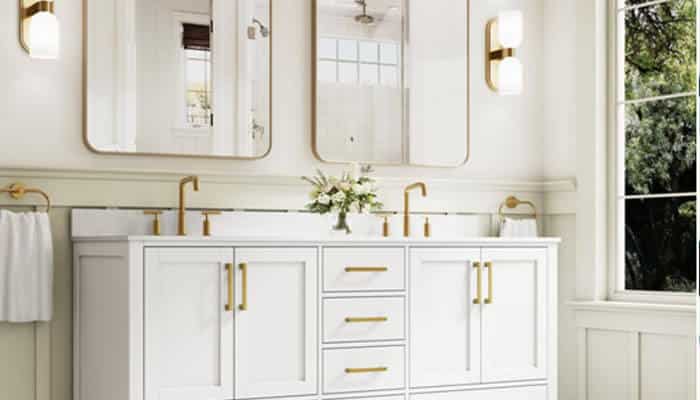

In the bathroom decoration market, color choices are becoming increasingly diverse. From oak and walnut colors to deep green and navy blue, consumers have more personalized choices. However, among the many popular colors, white bath vanities are still one of the most stable and classic choices for consumers.
According to the “2025 U.S. Houzz Bathroom Trends Study” released by Houzz, among consumers who are currently undergoing or planning bathroom renovations, wooden bathroom vanities rank first with a 28% selection rate, while white bathroom vanities rank second with a 20% selection rate, significantly higher than gray’s 9% and beige’s 10%. At the same time, 48% of the new bathroom countertops choose white, further indicating that white is still the core color in bathroom spaces.
For consumers who want to balance aesthetics, practicality, and long-term decoration value, white bathroom vanities are not a “conservative” choice, but may be a more rational choice
White Bathroom Vanities Have A Market Foundation That Can Withstand The Test Of Time
Consumers’ investment in bathroom decoration is not low. Houzz data shows that the overall median expenditure for bathroom renovation in 2024 is $13000, while the median expenditure for major bathroom renovations reaches $22000; For large bathrooms with an area exceeding 100 square feet, the median expenditure for major renovations can reach $25000.
When consumers invest tens of thousands of dollars in bathroom upgrades, bathroom vanities are usually not a product that only considers “what colors are popular this year”. Consumers prefer to choose designs that can adapt to changes in family style over the long term.
White Can Make The Bathroom Look Brighter
A bathroom is usually a relatively limited space in a household, especially for guest bathrooms, hallway bathrooms, and small master bathrooms in a large number of residences. Therefore, how to enhance the sense of space through design is an important consideration for consumers when choosing bathroom products.
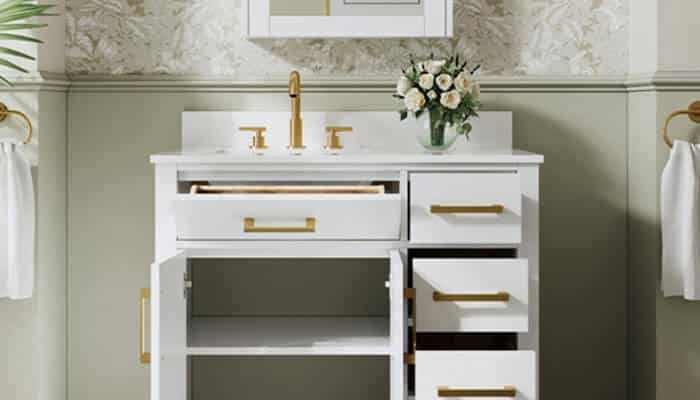
White surfaces effectively reflect ambient light. When paired with light-colored walls, mirrors, and glass shower doors, they create a better, cleaner visual effect.
This trend is also reflected in consumers’ wall choices. According to Houzz data in 2025, white is the first choice for bathroom shower area walls, accounting for 36%; in non-shower walls, white also reaches 25%.
Therefore, from the perspective of overall space design, white bathroom vanities are not isolated product choices, but can form a unity with the mainstream bathroom color system.
White Bathroom Vanities Are Particularly Suitable For Small-sized Bathrooms
There is another trend worth paying attention to in the bathroom decoration market: consumers do not necessarily improve their bathrooms by expanding their space.
According to Houzz data in 2025, 82% of bathroom renovation projects have maintained their original layout and area.
This means that improving space utilization and visual effects within a limited area has become an important direction for bathroom upgrades.
In small bathrooms, white vanities blend seamlessly with light-colored walls and mirrors to create a cohesive, unified look. Unlike darker vanities, white avoids adding heavy visual weight, making it ideal for small to medium vanity sizes, such as 24, 30, 36, and 48 inches.
Among these, the 36-inch vanity is a particularly popular choice. According to Houzz data, 47% of homeowners select vanities measuring 48 inches or smaller, highlighting strong market demand for compact designs.
This explains why 36-inch white vanities are so versatile: they offer ample storage without making a small bathroom feel cramped.
The White Bathroom Cabinet And White Countertop Form A Natural Combination
If white bathroom vanities can provide a stable visual foundation, then white countertops further enhance this advantage.
Data indicates that for 2025 bathroom renovations, 48% of new countertops are white, while another 20% are beige—meaning white and beige together represent nearly 70% of all choices.
This makes it very easy to combine white bathroom vanities with white or light textured countertops such as Carrara White and Calacatta.
White quartz countertops with gray or subtle gold veining break up the monotony of an all-white bathroom while maintaining its crisp, clean aesthetic.
This combination also offers a practical benefit: homeowners can update wall tiles, mirrors, or hardware down the road without having to replace the vanity or countertop.
From The Perspective Of Consumer Demand, Functionality Is Equally Important
Bathroom design has shifted from prioritizing pure aesthetics to focusing on functionality and long-term usability.
According to a 2025 Houzz study, 74% of consumers choose solid wood for their bathroom vanities, showing that material quality remains a top purchasing consideration. Additionally, Shaker-style doors lead the market as the most popular door style, selected by 49% of homeowners.
This means that an excellent white bathroom vanity cannot rely solely on color to attract consumers, but also needs to meet daily needs in terms of structure and function.
For example, a reasonable drawer layout can help classify and store toiletries; soft-closing hinges can enhance daily user experience; Materials with better moisture resistance are more suitable for bathroom environments.
Therefore, white+practical structure+reliable materials are becoming a more rational product concept than simply pursuing color.
Wellfor: Integrating Classic White Into Modern Bathroom Design
Against the backdrop of the continuous development towards functionality and personalization in the bathroom market, WELLFOR also continues to pay attention to consumers’ diverse needs for bathroom vanity size, color, and functionality.
Taking white bathroom vanities as an example, WELLFOR can cover usage scenarios ranging from small guest bathrooms to large main bathrooms with different sizes, while combining modern simplicity, Shaker, and other design languages to make white no longer just a traditional “base color”, but a visual foundation for the entire bathroom space.
Especially in small and medium-sized products such as 36 inch and 48 inch, white can form a unified spatial effect with mirror cabinets, LED mirrors, shower doors, and light colored tiles.
This is highly consistent with the current consumption trend in the bathroom market – consumers are improving their bathrooms through local upgrades rather than large-scale space renovations in all cases.
Conclusion: Classic Does Not Mean Outdated, But Can Withstand Changes
For consumers who are renovating their bathrooms, choosing a white bathroom vanityis not about following a short-term trend, but about finding a balance between space adaptability, design freedom, long-term durability, and product practicality.
As consumers pay more attention to functionality, storage, materials, and space design, future white bathroom vanities will continue to evolve from a single “white vanity” to high-quality materials, multiple size options, modern structures, and overall bathroom solutions.
Amid shifting bathroom design trends, white’s true power is its timeless ability to evolve alongside change.
