




That might have worked a few years ago. Now it mostly creates friction.
Buyers have been burned too many times by polished landing pages that promise everything and show very little. So instead of trusting the copy, they look for proof. They want to see how the product works, what it feels like to use, and whether it actually solves their problem before they talk to anyone.
Startups are starting to catch on. Forcing every prospect into a sales conversation slows things down and filters out people who might have converted on their own. The companies gaining traction in 2026 are shifting the approach. They let the product do the explaining. Instead of telling users what the tool can do, they let them click through it, test it, and understand the value firsthand, often before asking for anything in return.
Dismantling the Gated Value Model
The old model of software sales relied entirely on information asymmetry. The company held the “secret sauce” of the product, and you had to talk to a salesperson to see it. In a world of infinite choices, that friction is now a deal killer. When a lead hits your site, they are usually in the middle of a specific problem. If your response to that problem is a “contact us” form, you are essentially telling them to wait forty-eight hours for a solution.
Interactive product education flips this dynamic. Instead of telling a lead what your software does, you show them. This is not just about a video. It is about guided, click-through experiences that allow a user to solve a small problem within your interface in real time.
When you lower the barrier to entry, you significantly decrease your time to value. If a user can experience an “aha moment” within thirty seconds of hitting your site, the psychological cost of switching to your competitor goes up. You are no longer just selling a tool. You are teaching a new and better way to work. Transparency has become the ultimate competitive advantage because it builds a level of immediate trust that a sales deck cannot touch.
Scaling Growth Through Frictionless Walkthroughs
The most effective way to turn education into a growth channel is by embedding interactive demos directly into your marketing loops. Whether it is in a blog post, a LinkedIn ad, or a help center article, an interactive walkthrough acts as a 24/7 automated salesperson. It meets the user where they are and provides immediate proof that your software can actually do what it says on the tin.
There are now specialized platforms designed to help startups bridge this gap without needing a team of developers to hard-code a demo environment. For instance, teams use tools like Supademo to record product workflows and turn them into guided, interactive demos that users can explore at their own pace. These AI-powered interactive demos allow you to capture any product flow and turn it into a step-by-step walkthrough in seconds, rather than spending days on scripting and re-recording.
This shift moves away from the traditional model of passive, one-way monologues that are constantly out of date. By utilizing features like HTML cloning or sandbox environments, you can let buyers explore your product freely in a safe and controlled space. This approach is not just about looking polished. It delivers measurable business results.
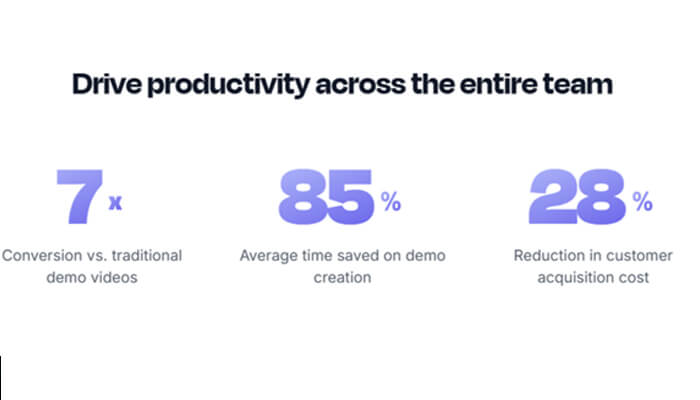
According to Supademo’s reported data, these interactive experiences can lead to a 7x higher conversion rate compared to traditional demo videos and an average 28% reduction in customer acquisition costs. When a prospect can click through your most powerful feature without signing up for a trial, the trust they feel toward your brand increases. You are not just asking for their attention. You are rewarding it with actual utility.
Repositioning Onboarding as an Acquisition Tool
Traditionally, onboarding was something that happened only after a contract was signed. Today, the most successful startups are pulling that educational content forward into the acquisition phase. They are using detailed “how-to” guides and feature deep dives to convince users to convert before a salesperson even picks up the phone. When you treat your documentation as a marketing asset, you attract high-intent users who are actively looking for solutions to specific technical problems. If your educational content is better than the actual product experience of your competitor, you have already won the deal.
Education acts as a natural filter for your sales pipeline. It qualifies leads by showing them exactly how the product fits into their specific workflow. A prospect who has already interacted with your product through a guided demo or a tutorial is far more likely to convert than one who has only read a generic list of features. By the time they sign up for a trial or a paid plan, they are already trained on your value proposition. This reduces the burden on your customer success team because the user arrives with a baseline of knowledge that usually takes weeks to build.
Personalizing Demo Paths Without Slowing the Buyer Down
The most powerful interactive demos are highly personalized. Showing a generic workflow is a good start, but showing a prospect exactly how your tool fits their role, industry, and existing tech stack is what actually moves the deal forward.
The challenge is that personalization requires context. A startup needs to understand the prospect’s role, use case, current tools, decision-making process, and biggest workflow bottleneck before serving the right demo path. If that information is collected through messy email chains or clunky documents, the experience immediately loses its shine. The buyer came for speed and clarity, not a homework assignment with a logo on it.
That is why structured intake matters. Different clients need different onboarding flows. An accounting firm may need a secure client portal for accountants to collect tax documents, track missing files, and manage deadlines. A legal client may need a portal built around case documents and approvals. A creative agency may need one focused on assets, feedback, and revision rounds. The point is simple: personalization works best when the workflow reflects the client’s profession instead of forcing everyone through the same generic form.
For startups using interactive product education as a growth channel, this same principle applies before the sale. If you know the buyer’s industry and workflow upfront, you can route them into the most relevant demo path. A CFO sees financial reporting use cases. A marketing lead sees campaign workflows. An operations manager sees automation and process visibility. The experience feels tailored without requiring a long discovery call.
This keeps personalization clean without dragging the buyer back into the exact delays the demo was supposed to remove. The prospect provides their context easily, and your team can deliver a product walkthrough that feels specific, useful, and premium from the first click.
Building a Defensible Moat Through Education
In the current startup landscape, features are incredibly easy to copy. A well-funded competitor can replicate your user interface or clone your core functionality in a matter of weeks. However, the one thing they cannot quickly replicate is a deep and educational relationship with your audience.
When you invest heavily in interactive product education, you are doing much more than acquiring a new user. You are actively training them to adopt your specific logic and workflows. This creates an incredibly powerful psychological moat around your product. Once a prospect has invested their time to learn how to solve their daily problems using your interactive guides, the idea of switching to a competitor becomes exhausting. They do not want to unlearn your system just to start from scratch somewhere else.
By making education a central pillar of your growth strategy, you shift the conversation entirely. You stop arguing about feature lists and start focusing on how your tool actually empowers the human on the other side of the screen. That human-centric approach is exactly what turns a casual visitor into a long-term brand advocate.
Conclusion
Startups do not win by making buyers wait longer to understand the product. They win by making value obvious faster.
Interactive product education turns the product itself into a growth asset. It shortens the path from curiosity to clarity, gives prospects proof before pressure, and helps teams qualify buyers without forcing every conversation through a sales call.
The startups that pull ahead this year will not rely on the loudest marketing pitches. They will teach, demonstrate, and convert in the same motion. The companies that make their products easiest to understand will have the easiest time earning trust.
