



If you have opened YouTube recently and wondered why are YouTube ads so long now, you are not alone. Whether you are watching a tutorial, podcast, gaming video, livestream, or TV-style show, commercial breaks can feel noticeably longer and more disruptive than they did in the past.
But that does not mean YouTube introduced one universal rule in 2026 that suddenly made every advertisement longer. The real explanation is more complicated.
Over several years, YouTube has expanded connected-TV advertising, grouped multiple commercials into longer breaks, increased the role of automated mid-roll placement, introduced Pause ads, and developed different advertising systems for ordinary videos, livestreams, Shorts, and television viewing.
These changes help explain why are YouTube ads so long now and why the experience can vary so much depending on the video, device, advertising format, and viewer.
The difference is particularly noticeable on televisions. Google has discussed giving long-form TV viewers fewer but longer ad breaks, while YouTube has introduced 30-second non-skippable connected-TV advertising and additional big-screen formats.
This guide explains what actually changed, how long YouTube ads can be, why some viewers receive different ads, how creators and mid-rolls affect the experience, and what viewers can realistically do about long YouTube ad breaks.
Quick Answer: Why Are YouTube Ads So Long Now?
If you are wondering why are YouTube ads so long now, the main reason is that YouTube now uses more grouped ad breaks, longer connected-TV formats, and mid-roll opportunities on long videos.
On smart TVs especially, viewers may see 30-second non-skippable ads or multiple commercials in one break. That can make YouTube feel more like traditional television even when every individual ad has not become longer.
Key Takeaways
- If you’re wondering why are YouTube ads so long now, there was no single 2026 update that suddenly made every ad longer.
- Connected-TV viewing has expanded the use of longer, more television-style advertising formats.
- Eligible YouTube Select inventory can include 30-second non-skippable connected-TV ads.
- Multiple advertisements can be grouped into one break, making the interruption feel longer.
- Monetized videos eight minutes or longer can use mid-roll ads, but an available ad slot does not guarantee an ad will appear.
- Regular YouTube, connected-TV YouTube, and YouTube TV can have different advertising formats and rules.
- Livestreams have separate advertising options, while the ads individual viewers receive can vary based on context and available inventory.
What We Could Verify About Longer YouTube Ads
To understand why are YouTube ads so long now, it helps to separate documented YouTube policies from individual viewer experiences.
Google and YouTube currently confirm that:
- Monetized videos eight minutes or longer can use mid-roll ads.
- Mid-roll slots are advertising opportunities, not guaranteed ad impressions.
- YouTube looks for suitable breakpoints such as pauses and visual transitions.
- YouTube TV supports non-skippable formats including 15-, 30-, and 60-second inventory.
- Ads can appear on some videos even when the uploader is not personally monetizing them.
- Different YouTube advertising environments can have different ad-length rules.
What YouTube does not provide is one universal ad count for every viewer.
Ad delivery can vary by device, video, campaign, available advertiser inventory, and individual viewing context.
Why Are YouTube Ads So Long Now?
If you are trying to understand why are YouTube ads so long now, the main reason is that YouTube increasingly serves advertising based on what you watch, how long you watch, the device you use, and which advertising inventory is available.
YouTube is no longer mainly a platform for short videos watched on a laptop. People now use it for hour-long podcasts, documentaries, interviews, live sports, gaming streams, educational content, TV-style creator programming, and multi-hour livestreams.
Connected TVs are especially important to this shift because viewers often watch longer content in a more traditional television-style environment. YouTube’s advertising strategy has evolved around those longer viewing habits.
1. YouTube Introduced 30-Second Non-Skippable TV Ads
YouTube announced 30-second non-skippable ads for YouTube Select on connected televisions in 2023.
Instead of receiving two consecutive 15-second ads in some situations, viewers could receive one 30-second non-skippable commercial.
For someone accustomed to clicking Skip after five seconds, a mandatory 30-second ad can feel dramatically longer.
2. YouTube Can Group Several Ads Into One Break
Another major change is the way advertisements can be grouped.
Instead of repeatedly interrupting a long video with individual commercials, YouTube can concentrate several ads into one larger break.
That creates an important trade-off:
Fewer interruptions do not necessarily mean less advertising per interruption.
You may receive a longer uninterrupted stretch of a podcast or show, but when the next commercial break arrives, multiple ads can appear together.
3. Videos Eight Minutes or Longer Can Use Mid-Roll Ads
Monetized YouTube videos that are eight minutes or longer can use mid-roll advertising.
Creators may use:
- Automatic mid-roll slots.
- Manual ad slots.
- Automatic and manual slots together.
However, an available slot is not the same as a guaranteed advertisement.
YouTube’s systems still decide whether an ad should actually appear for a particular viewer. That gives a one-hour podcast far more potential advertising opportunities than a five-minute tutorial without guaranteeing an ad at every possible breakpoint.
What Actually Changed With YouTube Ads?
YouTube’s current advertising experience developed gradually rather than through one single update.
| Period | Important Change | Viewer Impact |
|---|---|---|
| Earlier YouTube | Heavy reliance on pre-roll and skippable advertising | Many interruptions felt shorter |
| 2018 onward | Greater experimentation with grouped advertising | Multiple ads could appear within one break |
| 2023 | 30-second non-skippable YouTube Select CTV ads announced | Longer mandatory TV ads became possible |
| 2023 onward | YouTube discussed fewer but longer TV ad breaks | Breaks became more similar to streaming-TV commercials |
| May 2025 | Mid-roll placement shifted toward natural breakpoints | Automated placement became more sophisticated |
| 2025–2026 | Pause ads and expanded livestream options | More advertising formats and surfaces became available |
| 2026 | Earlier changes now overlap | Ad length and frequency vary by viewing environment |
The key to understanding why are YouTube ads so long now is that the 2026 experience reflects the accumulated effect of several advertising changes, rather than one single policy that suddenly made every YouTube commercial longer.
How YouTube Decides When Ads Appear
YouTube does not place an ad at every possible moment in a video. Instead, its system looks for suitable opportunities based on the content, the viewer, and available advertising demand.
A major change came in May 2025, when YouTube updated its approach to mid-roll ads. The platform began giving more weight to natural breaks in a video, such as pauses, scene changes, or transitions, rather than interrupting viewers in the middle of a sentence or important moment.
YouTube also expanded the use of automatic mid-roll placements alongside slots selected manually by creators. In its own testing, YouTube said channels using both approaches saw an average revenue increase of more than 5% compared with channels relying only on manual placements.
This helps explain why are YouTube ads so long now without assuming that every possible ad slot is actually used. A creator may make several points in a video available for advertising, but YouTube still decides whether an ad is shown to a particular viewer.
In other words, more available ad opportunities do not automatically mean an ad will appear at every one of them.
What Determines Whether a YouTube Ad Actually Plays?
Several factors can influence whether an available opportunity becomes an actual ad impression.
| Factor | What It Can Affect |
|---|---|
| Advertiser demand | Whether suitable advertising is available |
| Ad auction | Which advertiser may receive the opportunity |
| Ad-slot quality | Whether the placement occurs at a suitable breakpoint |
| Viewer experience | Whether another interruption may negatively affect viewing |
| Device | Which formats are eligible |
| Viewer context | Which campaigns may be relevant or available |
| Video context | Which ads may be appropriate for the content |
| Creator settings | Which monetization opportunities are enabled |
This explains why two people watching the same video may not necessarily see identical advertising.
What YouTube Does Not Guarantee
YouTube does not state that:
- Every eight-minute video must contain a mid-roll.
- Every available mid-roll position will actually serve an advertisement.
- Every viewer watching the same video will receive identical ads.
- Every smart-TV viewer will get a 30-second non-skippable ad.
- Every regular YouTube session supports the same 60-second formats documented for YouTube TV.
- Every long video automatically gets an advertisement after a fixed number of minutes.
This distinction matters because a viewer can accurately report receiving frequent ads without that experience proving the existence of a new platform-wide rule.
How Long Can YouTube Ads Be in 2026?
One reason people keep asking why are YouTube ads so long now is that there is no single ad-length limit that applies across every YouTube experience. The format can change depending on whether you are watching regular YouTube, a connected TV, YouTube TV, Shorts, or a livestream.
Common YouTube Ad Formats
| Ad Format | Typical Behavior | Skippable? |
|---|---|---|
| Bumper ad | Very short video advertisement | No |
| Skippable in-stream | Appears before, during, or after content | Usually after 5 seconds |
| Standard non-skippable | Must finish before the content resumes | No |
| Connected-TV non-skippable | Television-focused advertising | No |
| Mid-roll | Appears during eligible long-form videos | Depends on the ad |
| Livestream mid-roll | Appears during eligible livestreams | Depends on the ad |
| Shorts ad | Appears between Shorts | Usually swipeable |
| Pause ad | Appears while eligible TV content is paused | Not a normal video interruption |
YouTube’s creator-facing documentation commonly describes standard non-skippable ads as 15 or 20 seconds, while other Google advertising environments can support longer formats.
That is why viewers sometimes see different numbers reported for YouTube ad length.
Why 30-Second and 60-Second Ads Are Different
A 30-second non-skippable ad can appear in eligible connected-TV advertising.
Google also documents 60-second non-skippable inventory in certain environments such as YouTube TV, but that does not mean every regular YouTube viewer can automatically receive the same format.
The product and device matter.
What About Ads That Last Several Minutes?
A multi-minute YouTube ad is often a skippable creative, not a commercial you are required to watch from beginning to end.
For example, an ad might show several minutes remaining, but if the Skip option appears after five seconds, the remaining duration is optional.
Long ad breaks can also happen when several shorter commercials are grouped together. In that case, the break feels long even though no single advertisement is unusually lengthy.
So when someone says they received a “five-minute YouTube ad,” it is important to distinguish between:
- The full length of the ad creative.
- How long the viewer must actually watch.
- The combined length of several ads in one break.
Why YouTube Ads Feel Longer on TV
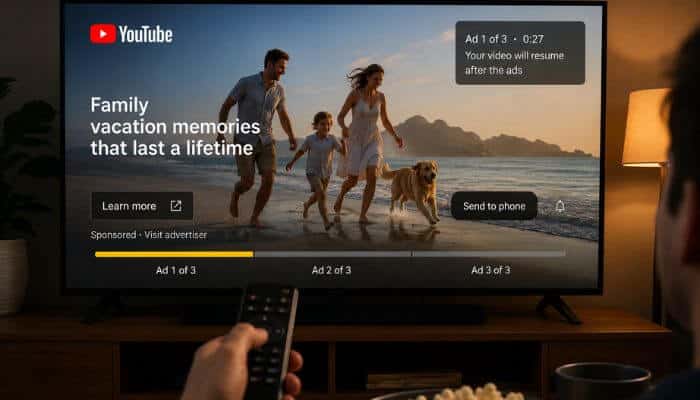
One major reason people ask why are YouTube ads so long now is the way YouTube has adapted advertising for connected TVs and longer viewing sessions.
Watching a 90-minute podcast on a smart TV is very different from watching a two-minute clip on a phone. On television screens, YouTube increasingly uses advertising formats that feel closer to traditional streaming-TV commercial breaks.
Why Are YouTube Ads Longer on Smart TVs?
YouTube has introduced television-oriented formats such as 30-second non-skippable ads and grouped commercial breaks.
Instead of:
Video → Ad → Video → Ad → Video → Ad
the experience can look more like:
Video → Longer Ad Break → Longer Content Segment → Longer Ad Break
That may reduce how often the viewer is interrupted, but each individual break can feel much longer.
This TV-focused strategy is an important part of understanding why are YouTube ads so long now, especially for people who mainly watch long-form content on smart TVs.
What Are YouTube Pause Ads?
Pause ads are another connected-TV advertising format.
A Pause ad can appear after a viewer pauses eligible content on a supported television device. Because the video is already paused, the ad does not technically extend a normal commercial break.
However, Pause ads show how YouTube is expanding advertising beyond traditional pre-roll and mid-roll placements.
Connected TV vs YouTube TV
These terms are related, but they are not the same.
Connected TV (CTV) refers broadly to YouTube or other internet video watched through devices such as:
- Smart TVs
- Streaming sticks
- Streaming boxes
- Game consoles
YouTube TV, by contrast, is Google’s separate U.S. live-TV subscription service and has its own advertising inventory.
| YouTube TV Format | Length |
|---|---|
| Bumper | 6 seconds or shorter |
| Short non-skippable | 15 seconds or shorter |
| Non-skippable | 30 seconds |
| Longer non-skippable | 60 seconds |
YouTube TV Limits Do Not Apply Everywhere
The 60-second format needs careful wording.
A 60-second non-skippable format documented for YouTube TV does not mean every person using the regular YouTube app can receive the same format under identical rules.
Regular YouTube, connected-TV YouTube, and YouTube TV are related but distinct advertising environments.
Why Your YouTube Ad Experience May Be Different
Not everyone sees the same YouTube ads. This variation helps explain why are YouTube ads so long now for some viewers but not others.
Why Do Some Ads Have No Skip Button?
YouTube uses both skippable and non-skippable ads. Skippable ads generally allow viewers to skip after five seconds, while non-skippable ads must finish before the video continues.
Why Do Ads Feel Longer?
Several ads can appear together in one break, making the interruption feel longer even when the individual commercials are relatively short.
Ad frequency and total ad-break length are not the same thing.
Why Do Different Viewers Get Different Ads?
YouTube ad delivery can vary based on factors such as location, device, account activity, personalization signals, and available advertiser campaigns. Two people watching the same video may therefore receive different ads.
Can YouTube Ads Be Several Minutes Long?
Yes, but a long ad is not necessarily mandatory from beginning to end. Some multi-minute ads are skippable, so an ad showing several minutes remaining may still let you click Skip after five seconds.
How Creators and Video Length Affect YouTube Ads
Creators influence monetization, but they do not control every ad a viewer receives. That distinction is important when explaining why are YouTube ads so long now, especially on longer monetized videos.
Does the Creator Decide How Many Ads You See?
Only partly. On eligible videos eight minutes or longer, creators can use automatic mid-rolls, manual ad slots, or both.
YouTube still decides whether an available slot actually serves an advertisement, so creators do not directly control every commercial shown to every viewer.
Can Ads Appear on Videos the Creator Did Not Monetize?
Yes. Ads can appear even when the uploader did not personally enable monetization.
This can happen when a copyright holder monetizes material in the video or when YouTube serves ads on channels outside the YouTube Partner Program.
Seeing an ad does not automatically mean the uploader chose it or receives revenue from it.
Why Do Longer Videos Often Have More Ads?
Videos eight minutes or longer can become eligible for mid-roll advertising when monetized.
| Video Length | Possible Advertising Structure |
|---|---|
| Under 8 minutes | Mainly pre-roll or post-roll opportunities |
| 8–15 minutes | Eligible for mid-roll advertising |
| Around 30 minutes | More potential natural breakpoints |
| Around 60 minutes | More mid-roll opportunities |
| Multi-hour content | Many possible ad opportunities |
These are not guaranteed ad counts. A one-hour video may have several potential slots without showing an ad at every one.
How YouTube Ads Work During Live Streams
Livestream advertising works differently from ads on ordinary uploaded videos, and this is another part of why are YouTube ads so long now for some viewers.
Eligible monetized livestreams can use pre-roll ads, automatic mid-rolls, manual ad insertion, scheduled ad opportunities, side-by-side ads, and Take a Break advertising.
Automatic vs Scheduled Livestream Ads
Creators can choose automatic ad frequency or schedule ad opportunities at set intervals.
| Scheduled Interval | Time Between Ad Opportunities |
|---|---|
| Option 1 | 6 minutes |
| Option 2 | 12 minutes |
| Option 3 | 18 minutes |
| Option 4 | 24 minutes |
| Option 5 | 30 minutes |
Even then, an available ad opportunity does not guarantee that every viewer will receive an advertisement. Two people watching the same livestream may therefore have different ad experiences.
What Are YouTube Take a Break Ads?
Livestream creators can use Take a Break when temporarily stepping away, with break options such as 1, 3, or 5 minutes.
Eligible viewers may receive ads during that break when inventory is available, while others may simply see the creator’s away screen.
Are YouTube Ads Actually Getting More Frequent?
Questions about why are YouTube ads so long now often come with another concern: are ads also appearing more often?
There is no universal rule requiring every viewer to receive an advertisement after a fixed number of minutes. On ordinary long-form videos, ad serving can depend on factors such as advertiser demand, potential slot quality, viewer experience, video context, creator monetization settings, and the device being used.
Livestreams work differently because creators may choose scheduled ad opportunities.
So claims such as “YouTube now automatically gives everyone an ad every five minutes” are too broad. There is no single five-minute advertising rule that applies across the entire platform.
Can You Reduce Long YouTube Ads?
If you are wondering why are YouTube ads so long now and whether you can reduce them, free viewers have limited control over ad duration.
The main official options are to skip ads when permitted, use YouTube Premium or Premium Lite, manage ad personalization, or report inappropriate ads.
YouTube Premium vs Premium Lite in 2026
YouTube Premium offers the more complete ad-free experience along with additional Premium features.
Premium Lite is cheaper and removes ads from most YouTube and YouTube Kids videos. In 2026, it also includes background play and downloads for most eligible videos.
However, ads may still appear on music content, Shorts, search results, and browsing experiences, so Premium Lite is not identical to full Premium.
Can Google Ad Settings Make YouTube Ads Shorter?
Not directly.
Google Ad Settings can influence the types of ads you receive, but there is no normal setting that lets viewers choose a maximum ad length.
Changing personalization may affect which ads appear, but not how long every eligible ad can be.
What About YouTube Ad Blockers?
YouTube says blocking ads violates its Terms of Service. Users with ad blockers may be asked to allow advertising or subscribe to Premium, and continued blocking can interfere with playback.
For an officially supported ad-free experience, YouTube directs viewers toward its Premium subscription options.
Myth vs Reality: Long YouTube Ads
| Claim | Reality |
|---|---|
| “Every YouTube ad became longer in 2026.” | No. There was no single universal change that did this. |
| “Every 30-second ad can be skipped.” | No. Eligible non-skippable connected-TV advertising exists. |
| “A five-minute ad means I must watch five minutes.” | Not necessarily. It may be a long skippable creative. |
| “YouTubers choose every ad I see.” | No. Creators influence opportunities, while YouTube controls serving. |
| “Every mid-roll slot becomes an ad.” | No. Slots are opportunities, not guarantees. |
| “If I see an ad, the creator must be earning money.” | Not always. Ads can appear outside YPP or because of rights-holder claims. |
| “Everyone gets the same ads on the same video.” | No. Delivery can differ by viewer and context. |
| “Long videos automatically get ads every few minutes.” | No universal interval applies to every video. |
| “YouTube TV and YouTube on a smart TV are identical.” | No. They are different advertising environments. |
| “Pause ads interrupt the video.” | Not in the usual sense. Playback is already paused. |
Is YouTube Becoming More Like Television?
On connected TVs, there are clear similarities. YouTube now uses longer non-skippable ads, grouped commercial breaks, TV-specific inventory, Pause ads, and livestream ad breaks.
At the same time, YouTube still relies on digital features that traditional television does not use in the same way, including personalized ad delivery, skippable creatives, dynamic ad auctions, Shorts advertising, and viewer-level ad selection.
The result is a hybrid:
Traditional television-style commercial breaks powered by digital advertising technology.
Why the 2026 YouTube Experience Feels Different
Several changes now overlap. Longer viewing sessions, connected-TV formats, grouped breaks, automated mid-roll placement, livestream monetization, and personalized delivery all shape the current experience.
This combination helps explain why are YouTube ads so long now even though there was no single update that simply made every advertisement longer.
What Viewers Should Expect Next
YouTube advertising is unlikely to be defined by one fixed number such as “15-second ads” or “30-second ads.”
The experience will continue to depend on factors such as:
- How many ads are grouped into a break
- How often breaks appear
- Whether the ad is skippable
- Which device is being used
- Whether the content is live or on demand
- Whether the viewer is using regular YouTube or YouTube TV
That means watching a short clip on a phone can continue to feel very different from watching a 90-minute podcast on a smart TV.
Conclusion
If you are still wondering why are YouTube ads so long now, the answer is not that YouTube suddenly made every commercial longer in 2026. The bigger change is that the platform now combines longer eligible formats, grouped ad breaks, mid-roll opportunities, connected-TV advertising, livestream monetization, and personalized delivery.
Long videos create more potential places for mid-roll ads, while connected-TV viewers can encounter more television-style commercial breaks. Several shorter ads may also be grouped together, making the interruption feel longer even when no single ad is unusually long.
That is why the answer to why are YouTube ads so long now can differ from one viewer—or even one viewing session—to another. A 30-second connected-TV commercial, a multi-ad break, and a several-minute skippable creative may all feel like “long YouTube ads,” but they are not the same thing.
The clearest takeaway is this: YouTube has not simply made every ad longer. It has built a more complex advertising system in which ad length, mandatory watch time, break structure, device, and viewer context all affect how long an interruption feels.
Why are YouTube ads so long now FAQs
1. Why are YouTube ads so long now before short videos?
Ad delivery is not based only on video length. Device type, available campaigns, viewer context, and eligible ad inventory can influence which advertisement appears.
2. Why are YouTube ads so long now even when I skip ads?
Skipping an ad does not guarantee that future ads will be shorter. YouTube can continue serving different ad formats based on available inventory, viewing context, and campaign eligibility.
3. Why are YouTube ads so long now when I am signed out?
Signing out does not remove YouTube advertising. It can change the personalization signals available to Google, but ads can still appear based on contextual and other available signals.
4. Why are YouTube ads so long now on some channels but not others?
Different videos can have different monetization opportunities, lengths, audiences, and available ad inventory. As a result, the advertising experience can vary considerably between channels and videos.
5. Why are YouTube ads so long now, and will they get even longer?
There is no universal rule requiring YouTube ads to keep increasing in length. Future ad experiences can continue to vary according to format, device, campaign, content, and viewing environment.
6. Does skipping YouTube ads affect future ad length?
There is no documented rule stating that clicking Skip causes YouTube to deliberately serve longer advertisements later.
7. Does watching YouTube for longer increase the number of ads?
Not automatically, but longer viewing sessions can create more opportunities to encounter advertising, particularly across multiple videos and eligible long-form content.
8. Does signing out of YouTube reduce the number of ads?
Not necessarily. Signing out may change how ads are personalized, but it does not guarantee fewer advertisements.
