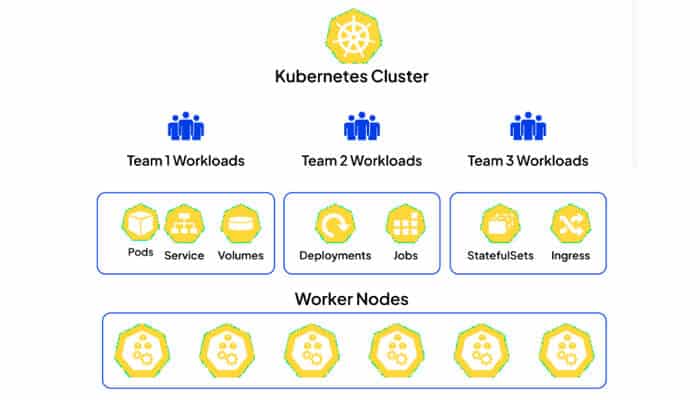
Kubernetes has risen to prominence as an indispensable tool for container orchestration, providing a powerful and flexible platform to manage and scale applications effectively. With its wide range of capabilities, Kubernetes stands out for its exceptional support for multi-tenancy, allowing multiple teams or individuals within an organization to share a Kubernetes cluster seamlessly.
This comprehensive article will develop the fundamental concepts of Kubernetes multi-tenancy, explore its intricacies, and shed light on practical implementation strategies. By gaining valuable insights into multi-tenancy nuances, you will be equipped with the knowledge and expertise to optimize your Kubernetes environment and drive greater efficiency within your organization.
Kubernetes multi-tenancy refers to how multiple tenants, like teams or individuals within an organization, share a single Kubernetes cluster. This approach offers notable cost savings and streamlined administration. Nevertheless, it’s important to note that Kubernetes lacks built-in support for end users or tenants. Implementing multi-tenancy requires meticulous planning and configuration.
There are two primary ways to implement multi-tenancy in Kubernetes: soft and hard.
Soft multi-tenancy is suited for environments with high trust between the tenants. It doesn’t have rigorous isolation between the tenants, relying more on their responsible use of shared resources.
On the other hand, hard multi-tenancy is designed for environments where strict isolation is required between tenants. This approach involves creating stronger boundaries between tenants, ensuring a tenant cannot access or impact another tenant’s resources.
Several fundamental essentials play a crucial role in Kubernetes multi-tenancy. Understanding these essentials can help create a robust and secure multi-tenant environment.
Namespaces offer a way to divide cluster resources among multiple users. Each namespace provides a scope for names of resources, ensuring that these do not overlap with others.
RBAC is a mechanism for controlling access to the Kubernetes API based on the roles assigned to individual users. RBAC ensures that only authorized users can perform specific actions.
Resource quotas provide a way to limit the amount of compute resources that a tenant can use in a namespace, preventing one tenant from consuming all available resources.
Virtual clusters are a form of isolation that allows each tenant to have their dedicated Kubernetes control plane. This approach provides additional security and isolation, ideal for hard multi-tenancy environments. Additionally, cost-tracking tools can help monitor resource usage and distribute costs appropriately among tenants.
Successfully implementing multi-tenancy in Kubernetes necessitates meticulous planning and configuration. It is crucial to follow a systematic approach to establish a multi-tenant Kubernetes cluster. This includes creating namespaces, configuring role-based access control, and setting resource quotas. Adhering to these steps can effectively set up a secure and efficient multi-tenant environment in Kubernetes.
While Kubernetes lacks native support for multi-tenancy, understanding these fundamental concepts and embracing best practices can empower you to establish a multi-tenant environment effectively. Through careful planning and the utilization of appropriate tools, Kubernetes multi-tenancy can provide significant benefits, including cost savings and streamlined administration.
Your phone holds hundreds of apps, but most disappear within weeks. Games get boring, utilities serve their purpose once, and…
Outbound calling faces an identity crisis. On one side, sales teams must handle hundreds of leads daily to meet pipeline…
The appearance and condition of a business environment play a significant role in how employees, customers, and visitors perceive an…
A residential roof is constantly exposed to environmental conditions throughout the year. Rain, wind, sunlight, leaves, dirt, and organic debris…
Homeowners often assume that pest problems appear randomly, but most infestations follow predictable seasonal patterns. Changes in temperature, rainfall, humidity,…
Experiencing a sudden accident can turn your life upside down in an instant. The physical pain, emotional trauma and sudden…