



Quick picks
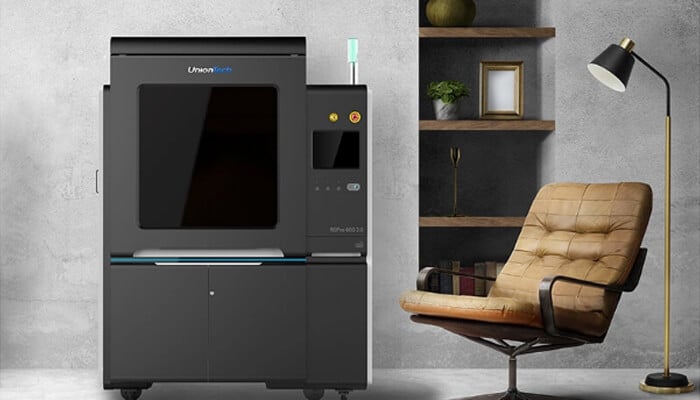
- UnionTech
- Stratasys
- 3D Systems
- EOS
- HP
- Markforged
- Formlabs
- Desktop Metal
Industrial additive manufacturing changes how modern factories operate. Aerospace, automotive, healthcare, consumer goods, and more industries rely on industrial 3D printers to cut lead times and build complex parts that traditional machining cannot replicate.
Based on real-world machine reliability, product performance, and market evaluations, this article details the top 8 industrial 3D printer manufacturers. If you are searching for a partner manufacturing 3D printer in 2026, this review offers suggestions.
Compare 8 Industrial 3D Printing Companies in 2026
| Company | Core Technology | Advantage | Value Rating |
| UnionTech | SLA, DLP, LCD | Large-format 3D printing, precision, and high-performance | 9.8/10 |
| Stratasys | FDM, PolyJet, SLA, SAF, DLP | Broad polymer portfolio, strong service network, production support | 9.7/10 |
| 3D Systems | SLA, SLS, DMP, Extrusion printing | Multiple 3D printing technologies and strength in healthcare and dental | 9.5/10 |
| EOS | DMLS, SLS, FDR | High-repeatability metal and polymer powder bed fusion | 9.2/10 |
| HP | Multi Jet Fusion (MJF) | Complex 3D parts printing | 8.8/10 |
| Markforged | CFF, BMD | Continuous carbon fiber reinforcement for metal-strength tools | 9.0/10 |
| Formlabs | SLA, SLS | Ease of use, high resolution, and modular scalability | 9.4/10 |
| Desktop Metal | Binder Jetting | Shop System, Studio System, X-Series, metal and ceramic capability | 8.5/10 |
UnionTech
Founded in 2000, UnionTech is a leading company in 3d printing equipment and additive manufacturing solutions. The company offers industrial 3D printers, printing materials, software, and 3D printing services. Its technology portfolio includes SLA, DLP, and LCD, serving industries such as prototyping, automotive, aerospace, dental, footwear molds, cultural and creative products, architecture models, etc.
Key Advantages
- Complete 3D printing workflow: Including 3D printing equipment, materials, software, and printing services.
- Diverse 3D printing technologies: Its product portfolio covers SLA, DLP, and LCD technologies.
- Large-format SLA 3D printing: Combining multi-laser stitching, automatic calibration, variable spot control, precise liquid-level management, and a granite-based platform to maintain accuracy, stability, consistency, and surface quality across large printed parts.
- Integrated hardware and software: Offers software such as Polydevs and UT ONE to support data preparation, simplify workflows, and improve printing efficiency.
Stratasys
Stratasys is leading in polymer 3D printing, serving industries such as aerospace, automotive, healthcare, dental, consumer products, education, and manufacturing. The company features five core 3D printing technologies, including FDM, PolyJet, SAF, DLP, and stereolithography solutions.
Key Advantages
- Advanced material options: Stratasys provides a wide range of engineering-grade, biocompatible, dental, flexible, high-temperature, and full-color materials.
- High-quality multi-material printing: PolyJet technology enables smooth surfaces, fine details, and multi-material parts.
- Established software ecosystem: Tools such as OpenAM and Digital Anatomy Creator help streamline file preparation, workflow management, and printer operation.
- Global industry experience: 40 locations and 130 support partners worldwide, offering global service and support capabilities.
3D Systems
3D Systems is an American company offering 3D printers, materials, parts, and application engineering services. Founded as the first 3D printing company, it supports industrial and medical applications from prototyping to production. Its portfolio serves sectors such as aerospace and defense, automotive, dental, medical devices, bioprinting, etc, with both polymer and metal additive manufacturing capabilities.
Key Advantages
- Wide technology and material coverage: 7 additive manufacturing technologies and more than 130 materials.
- Strong metal additive manufacturing capability: Its Direct Metal Printing solutions support lightweight, high-strength metal parts and complex structures.
- Healthcare and dental expertise: 3D Systems provides healthcare solutions that combine printers, materials, software, engineering expertise, and regulatory guidance, with global availability and 24/7 assistance through trusted resellers.
- Aerospace and defense expertise: 3D Systems highlights in-house experts across engineering, design, certification, and production, helping manufacturers move from application development to qualified production workflows.
EOS
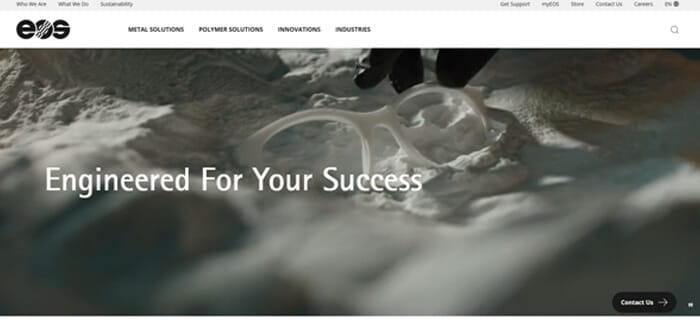
EOS is a German manufacturer that excels in DMLS, SLS, and FDR printing technology. As one of the premier industrial 3D printer manufacturers, EOS focuses on powder bed fusion technology and provides industrial systems for aerospace, automotive, medical, and engineering applications.
Key Advantages
- Powder bed fusion expertise: EOS has developed the powder bed method for more than 30 years, giving it deep technical experience.
- DMLS for metal parts: The DMLS technology is used for serial manufacturing of metal components, especially in aerospace, automotive, medical, tooling, and turbomachinery applications.
- Scalable metal 3D printer portfolio: EOS offers metal systems ranging from compact machines for delicate components to four-laser systems for high-quality serial part production.
- Partner-based manufacturing access: Its Contract Manufacturing Network connects customers with AM production partners for rapid prototyping, small series, and production support without requiring customers to manufacture in-house.
HP
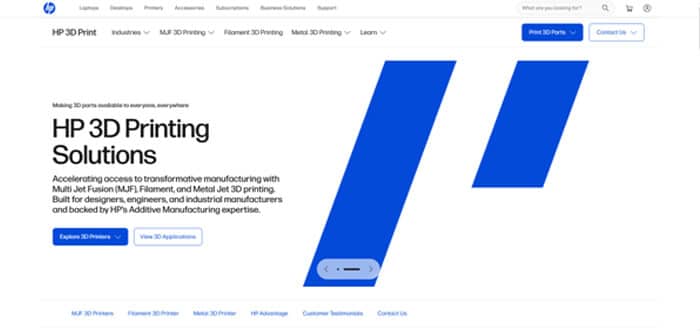
HP is a global technology company that provides industrial 3D printing solutions for polymer and metal additive manufacturing. Its Multi Jet Fusion technologies support businesses in prototyping, functional part production, customization, and scalable manufacturing.
Key Advantages
- Layer-wide printing approach: HP MJF prints full layers using PageWide technology, helping improve speed compared with point-by-point processes.
- Application case depth: Real customer cases across medical, dental, orthotics, consumer products, and industrial applications.
- Qualified material options: HP Metal Jet materials include stainless steel, low-alloy steels, and tool steels with tested parameters.
Markforged
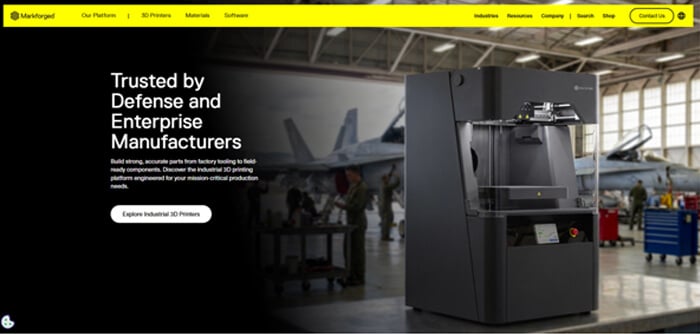
Markforged is best known for industrial composite printing, especially continuous fiber reinforcement. Its systems are often used to produce strong tools, fixtures, brackets, grippers, manufacturing aids, and functional parts directly on the factory floor.
Key Advantages
- Continuous fiber reinforcement: Markforged enables carbon fiber, fiberglass, Kevlar, and HSHT fiberglass reinforcement for stronger composite parts.
- Hybrid machine capability: The FX10 can transition from composite printing to metal printing through a modular print engine system.
- Factory-floor focus: Its industrial printers are positioned for reliable production of strong, functional parts in manufacturing environments.
- Eiger software workflow: Eiger helps move CAD designs into printed metal, continuous fiber, and composite parts.
Formlabs
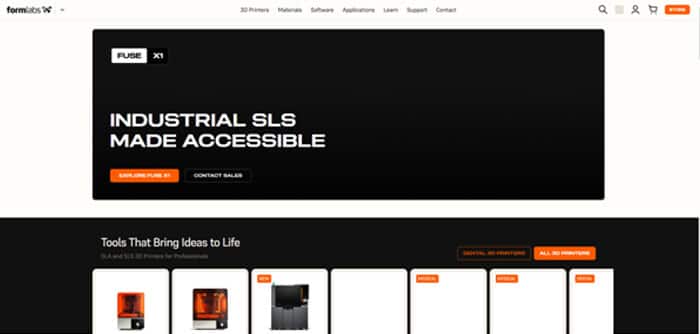
Formlabs is a strong professional 3D printing brand for SLA and SLS systems. Typical products include Form 4, Form 4L, Fuse 1+, and Fuse X1. It offers materials including general-purpose, impact-resistant, high-stiffness, temperature-resistant, elastomeric, specialty, medical, casting, and dental materials.
Key Advantages
- High-detail SLA printing: Its SLA systems emphasize fine details, high resolution, accuracy, surface quality, and easy operation.
- Support-free SLS production: SLS printing enables complex, durable nylon parts without support structures, improving design freedom and post-processing efficiency.
- Broad material ecosystem: Formlabs offers over 45 materials across many applications, supporting functional prototyping, production, medical, and dental workflows.
Desktop Metal
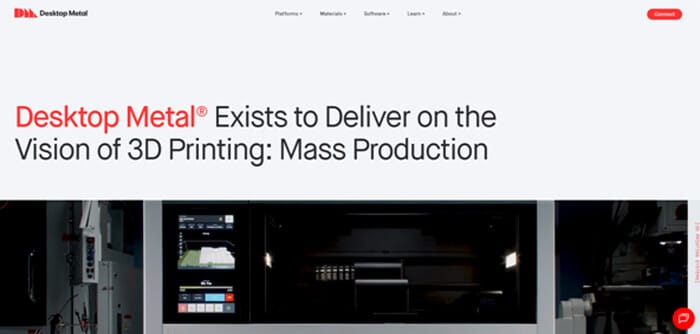
Desktop Metal is an American company focused on production-volume 3D printing. Founded in 2015, it develops systems, materials, software, and applications for metal, ceramic, polymer, and composite part production. The company positions its “Additive Manufacturing 2.0” approach around higher-volume manufacturing, aiming to make 3D printing more practical for engineers, designers, medical professionals, and manufacturers.
Key Advantages
- Binder jetting leadership: A world leader in binder jet 3D printing for mass production.
- Flexible system range: Its portfolio includes Studio System, Shop System, X-Series, and PureSinter for different production needs.
- Broad material portfolio: Materials span metals, polymers, and ceramics.
- Integrated software workflow: Live Suite connects preparation, build, sintering, scanning, and scaling for digital manufacturing workflows.
How to Choose the Industrial 3D Printing Company?
These eight top 3D printing companies are all strong in different ways. However, there is no single best 3D printer company for every factory. Use the following dimensions before choosing from the top 3D printing companies.
- Printing Needs: Different technologies meet different needs: SLA is ideal for detailed prototypes, SLS/MJF for functional polymer parts, FDM for durable prototypes and tooling, and metal printing for high-performance production parts.
- Print Volume, Speed, and Precision: Print volume affects part size. Speed affects throughput. Precision affects fit and final use. Ask for sample parts, build time estimates, post-processing time, and scrap rate. The real production cost includes the full workflow.
- Industry Experience: Look for companies with proven experience in your sector. Manufacturers serving aerospace, healthcare, and automotive markets usually have stronger knowledge of certification requirements, materials, and production workflows.
- Certification and Compliance Standards: Ensure the manufacturer supports necessary industrial standards, such as CE, FDA, ISO, etc.
- Lead Time: Evaluate hardware delivery, installation times, and how quickly the supplier can ship consumable materials to your facility.
- After-Sales Service: Industrial equipment requires ongoing support. Consider the training programs, maintenance services, spare parts availability, and local technical support.
- Total Cost of Ownership: Calculate the complete investment. This includes the initial price of the machine, auxiliary post-processing gear, software licenses, material costs, and regular maintenance fees.
FAQs
1. What is the difference between SLA and DLP 3D printers?
SLA and DLP are both vat photopolymerization technologies. Both use light to cure liquid resin into solid layers.
- SLA uses a laser to cure resin point by point. It is known for fine detail, smooth surfaces, and accurate models. It is often used for prototypes, dental models, medical models, jewelry patterns, and detailed parts.
- DLP uses a digital projector to cure an entire layer at once. Because each layer can be exposed simultaneously, DLP can offer faster printing speeds for certain applications.
2. Which 3D printing technology is best suited for industrial production?
For industrial production, SLA is a strong choice when large-format accuracy, smooth surfaces, and large output are priorities. UnionTech’s RSPro2100 supports large parts and high-volume batches with stable accuracy, making it suitable for industrial users.
