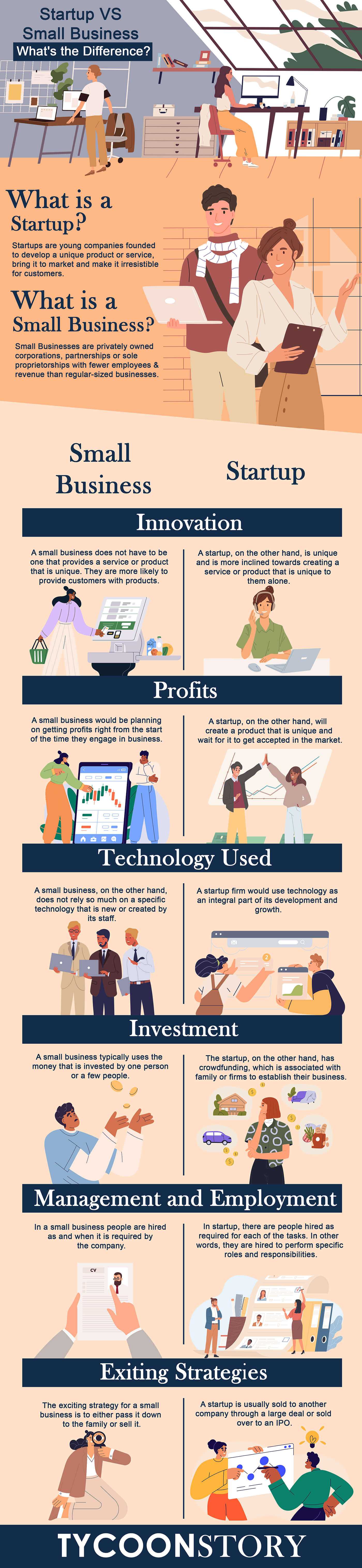

The two terms startup and small business are often confused with one another by most people. There is a world of difference that most people do not understand between these two terms startup vs. small business. We look at some of the major difference between startups and small business.
Startup and Small Business Scope
A startup has a bigger scope for improvement, and they are generally not limited to a few customers. However, the scope of a small business is not large and is limited to a few customers. In other words, there is a limit to how big the business can grow.
1. Innovation
Essentially, a small business does not have to be one that provides a service or product that is unique. They are more likely to provide customers with products or services that are common with other companies. A startup, on the other hand, is unique and is more inclined towards creating a service or product that is unique to them alone.
2. Profits
A small business would be planning on getting profits right from the start of the time they engage in business. However, a startup, on the other hand, will create a product that is unique and wait for it to get accepted in the market.
3. Technology used
A startup firm would use technology as an integral part of its development and growth. A small business, on the other hand, does not rely so much on a specific technology that is new or created by its staff.
4. Investment
A small business typically uses the money that is invested by one person or a few people. The startup, on the other hand, has crowdfunding, which is associated with family or firms to establish their business.
5. Management and Employment

In a small business people are hired as and when it is required by the company. With a startup, there are people hired as required for each of the tasks. In other words, they are hired to perform specific roles and responsibilities.
6. Exiting Strategies
The exciting strategy for a small business is to either pass it down to the family or sell it. However, a startup is usually sold to another company through a large deal or sold over to an IPO.
Apart from that, there is virtually no limit for a startup to grow, whereas small businesses are limited to a certain extent. These are the significant differences that set these businesses apart from each other.
INFOGRAPHIC