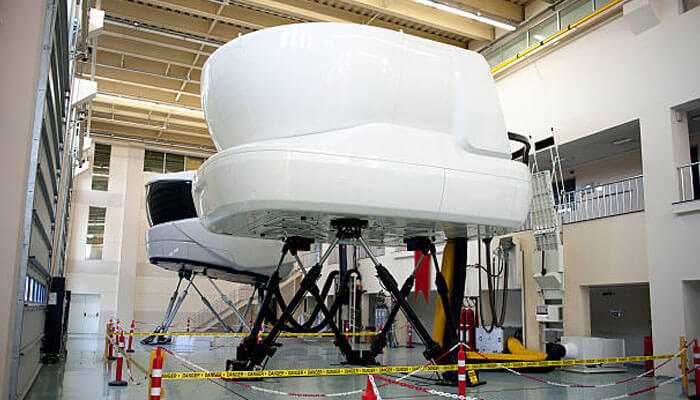
A Shenzhen-based technology company will launch a huge balloon on Sunday carrying a 2.5-meter-wide cabin carrying a live turtle to test the possibility of taking humans to “near-space” heights, or about twice the altitude flown by commercial airlines.
If all goes according to plan, Kuang-Chi Group hopes to launch its first trial flights carrying humans next year, with officially approved commercial flights by 2018 or 2019.
Today’s flight will be the first by such a craft carrying a live animal to the near-space region of Earth’s atmosphere that lies between 20 and 100km above sea level—too high for civilian aircraft but too low for satellites.
The Traveller-II balloon was due to lift at about 7 am from the launch site near Korla, southwest of Urumqi in Xinjiang province.
The craft will be able to stay aloft for between 30 and two hours, carried by wind, depending on atmospheric conditions.
During the ascent, the passenger, a 4cm-long pig-nosed turtle, will have to share its seat with various cameras and sensors recording the conditions.
The helium-filled balloon is about 40 meters wide and, including the cabin, weighs about 2 tonnes.
Compared with satellites, near-space aircraft cost significantly less to make, launch, and operate, said Kuang-Chi’s chief engineer for the project, Dr. Zhou Fei.
“Near space has remained unexplored for human beings. If Traveller II can land successfully with the turtle alive, it means China’s near-space exploration technology will be the best in the world.”
Kuang-Chi has invested more than 300 million yuan (HK$345 million) in the project since 2014, when it joined the global race to take tourists into space and near space at a relatively low cost.
In the outer regions of near space, passengers will experience some zero gravity and great views without the need to don cumbersome spacesuits, and the craft can return to Earth without going into full-orbit mode.
“In near space, the outside conditions are very harsh for living organisms, with temperatures of minus 60–70 degrees Celsius and atmospheric pressure as low as only 5,000 pascals, compared with about 101,300Pa at ground level,” Zhou said.
“But the turtle should be safe inside the cabin, which will be heated between zero and 20 degrees Celsius and have similar atmospheric pressure to ground level.”
“Compared with satellites, the vertical and forward speeds of our balloon-based aircraft will be slow, like people rising inside a fast lift, with no weightlessness.”
Founded in 2010, Kuang-Chi started as a provider of electronic materials and communications equipment. Its subsidiary, KuangChi Science Ltd., was listed in Hong Kong in 2014.
With funding from the central and local governments, the company has invested in key future strategic national industries such as aerospace, high-precision machinery, advanced biomaterials, and new energy vehicles.
The company has also invested in several overseas companies to develop futuristic technologies, including Canadian solar-powered aircraft company Solar Ship and New Zealand jetpack maker Martin Aircraft Company.
On Monday this week, the company launched a US$250 million fund to invest in start-ups and early-stage tech companies globally.
Parenting in the modern world is more complex than ever. Between technology, busy work schedules, emotional development, and social pressure,…
The gaming industry has evolved far beyond simple entertainment. Today, technology and entrepreneurship are merging to create a new innovation-driven…
Indian investors do not have to rely on the investment options available to them in their own country. The idea…
Why Digital Security Matters More for Startups Than You Think Startup founders juggle countless priorities, and digital security often slips…
So, you want your business to grow. Well, selling to customers across the US-Canada border is a great opportunity to…
The modern internet feels almost instantaneous. Websites load in seconds, videos stream without buffering, and cloud apps respond in real…