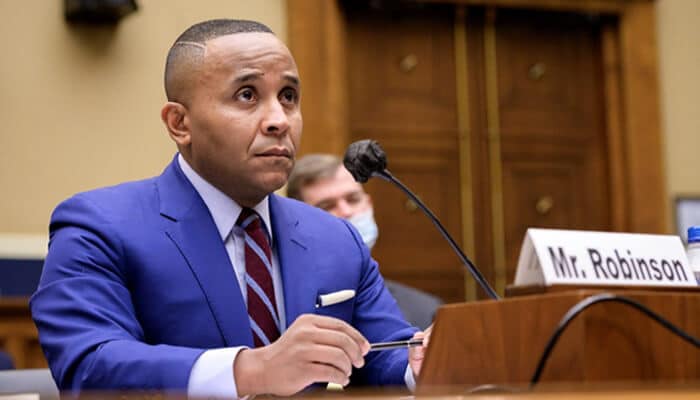
Rashad Robinson describes Freedom Table, his new monthly conversation with NewsOne, as “a show for builders, not bystanders.” The 45-minute episodes will feature organizers, journalists, business leaders, strategists, and culture-makers for real talk and real plans—tackling a question he considers urgent: how to build power when democratic architecture falters.
“We are living through a time where corruption has become policy, and cruelty a form of governance,” Robinson wrote in announcing the project. Freedom Table marks a new dimension of his public work—separate from but complementary to his advisory practice. Through Rashad Robinson Advisors, Robinson advises movement leaders, philanthropists, and businesses on navigating what he calls “a lopsided media ecosystem” where opponents to progress maintain structural advantages. His current focus extends those lessons—helping clients apply coordinated strategies across policy, culture, and economics.
A Public Classroom for Power
Each episode of Freedom Table examines how power operates by asking the same core questions: Who benefits from current arrangements? Where does leverage exist? What could make harmful practices unprofitable? How can individual actions add up to collective power?
The conversation functions as an open classroom on narrative power and systems design. Rather than aiming for passive viewership, Robinson and his guests treat every episode as a practical framework for action. Segments are short and portable—built to circulate through group chats, classrooms, and staff meetings—so the ideas can move through networks that shape public thinking.
This design reflects Robinson’s career-long effort to make strategic thinking accessible beyond policy insiders. As he puts it, visibility alone changes nothing; power emerges when people learn how to apply pressure at multiple points simultaneously.
Why NewsOne Matters

Robinson’s collaboration with NewsOne—a legacy Black-owned media platform—anchors Freedom Table within an ecosystem already trusted by the communities most affected by political and economic inequity.
“I am proud to partner with this legendary Black-owned platform, rooted in telling our stories and engaging the culture,” he wrote. The partnership transforms strategy education into part of everyday media consumption rather than a specialized discipline available only to those inside advocacy or philanthropy.
Each month features guests “doing more than just describing the moment—they’re changing it.” Practitioners discuss how they’ve turned cultural attention into institutional outcomes, demonstrating that narrative power can function as both moral language and operational leverage.
Freedom as a System, Not a Sentiment
At the heart of Freedom Table lies Robinson’s belief that freedom must be designed, not declared. “Freedom is a practice. It is not an ending point. It is not a destination. It’s an ongoing sort of process of work,” he explained in a recent interview.
The series models that philosophy by exploring how multiple forms of leverage—policy, culture, economics, and law—interact to produce or restrict freedom in daily life. Robinson distinguishes symbolic visibility from structural power: movements can trend, he warns, without transforming underlying systems.
“Freedom is our North Star,” he wrote in announcing the show. “Not the sentimental kind sold back to us in commercials, but the practical kind. Freedom requires both love and logistics, imagination and enforcement.”
For Robinson, that balance defines effective organizing. Aspirational language may inspire participation, but durable change depends on synchronized strategy—aligning cultural narratives with institutional design. Freedom Table invites practitioners to test that alignment in real time, showing how ideas travel between media, policy, and money.
Linking Analysis to Action
Robinson’s integrated approach reflects lessons learned from two decades of bridging advocacy and media. Before leading Color Of Change, he worked as associate producer of the GLAAD awards and led grassroots advocacy and racial justice work at FairVote, experiences that taught him how message control, narrative infrastructure, and economic incentives intersect.
“For the past two decades, I’ve worked both behind the scenes and out front of movements, campaigns, and media battles—helping shift power where it needs shifting,” he wrote. “I’ve spent my life connecting the dots between policy, culture, and economic pressure.”
Freedom Table extends that practice publicly. Robinson will also publish monthly op-eds on NewsOne and create occasional explainer videos that analyze how right-wing forces consolidate power and how progressive infrastructure can respond through incentive shifts and durable systems. The episodes connect to his newsletter, How We Win, which tracks how strategic frameworks evolve across sectors. Topics range from media consolidation’s impact on democracy to strategies for building narrative control within local economies.
Together, these projects build a coherent educational ecosystem: the show disseminates frameworks, the newsletter tracks their evolution, and the op-eds and videos extend the conversation beyond the monthly episodes.
Mapping the Current Crisis
Robinson frames Freedom Table as a response to what he calls “coordinated rehearsals for something bigger.” “Day after day,” he wrote, “the right is testing how far it can go in criminalizing protest, erasing history, and punishing poor and Black people for simply existing.”
He argues that the danger extends beyond policy rollback to psychological normalization—the fatigue that convinces people authoritarian drift is inevitable. “The only way out of this is claiming power,” he warns. “Not partisan power, but people power. Black power. Organizing power.”
That analysis defines the series’ tone: unsentimental, focused on strategy rather than outrage. Freedom Table assumes its audience already recognizes the stakes and is looking for concrete tools to navigate them.
Scaling Strategic Literacy
Through Rashad Robinson Advisors, Robinson and his team work with clients navigating what he describes as “a lopsided media ecosystem” where opponents to equity maintain structural advantages. The firm operates less as a consultancy and more as connective infrastructure—supporting organizers and institutions that are already leading change.
Freedom Table expands that philosophy to a broader audience. By translating complex strategy into shared vocabulary through the show, monthly op-eds, and occasional videos, Robinson hopes to democratize the kind of systems analysis typically confined to private convenings and policy rooms.
This shift from organizational leadership to broad strategy mirrors his evolution as an architect of networks rather than a manager of campaigns. The new series functions as the public counterpart to that work—a monthly forum for testing how strategic frameworks resonate outside institutional contexts.
The project will eventually connect to Robinson’s forthcoming book, From Presence to Power (One World, Penguin Random House, 2026), which expands on the same principle: visibility is only a beginning; leverage is the goal.
Whether public strategy forums like Freedom Table can scale strategic literacy as fast as democratic erosion advances remains an open question. But for Robinson, the objective is clear—to equip more people with the analytical tools and organizing discipline needed to build systems where justice becomes operational rather than aspirational.